

بِسْمِ اللهِ الرَّحْمٰنِ الرَّحِيْم
In the Name of God, Most Gracious, Most Merciful
♥️🤲🕋♥️🕋🌹🌹🥀🤲🌹🕋♥️🤲
The Prophet ﷺ and the Child: Restoring the Soul’s Identity
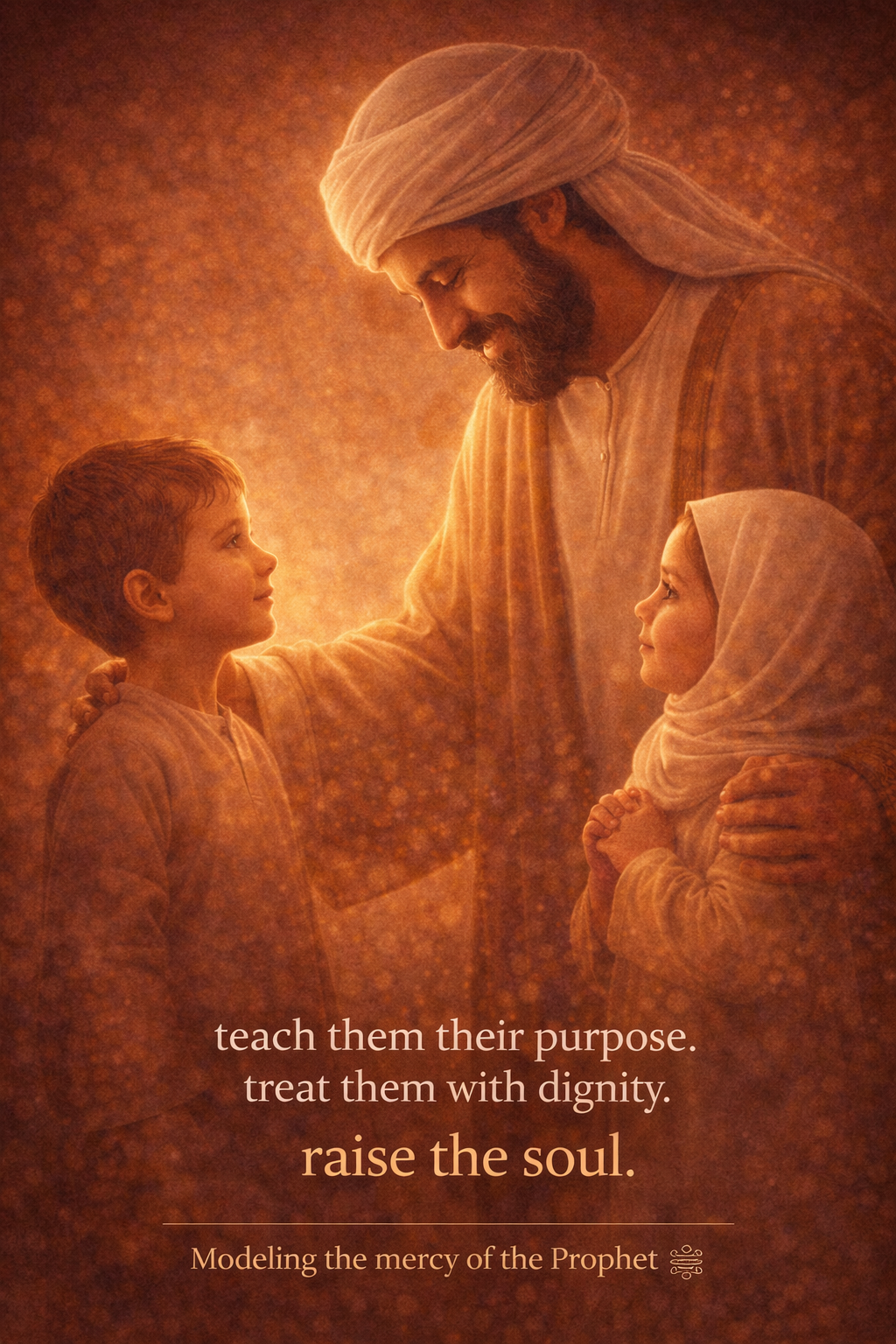
One of the quiet miracles of Islam is this:
The Prophet ﷺ did not wait for children to grow up to speak to their souls.
He spoke to them while they were still open.
While they were still innocent.
While identity had not yet been overwritten by fear, ego, or desire.
He understood something parents often forget:
If the soul is not named early, the world will name it later.
And the world is not merciful.
“O Young Man…” — Teaching Tawḥīd Before the World Teaches Dependence
The Prophet ﷺ said to a young boy, Ibn ʿAbbās:
“O young man, I will teach you words:
Be mindful of Allah, and Allah will protect you.
Be mindful of Allah, and you will find Him before you.
If you ask, ask Allah.
If you seek help, seek help from Allah.”
This is not casual advice.
This is identity formation.
He was telling a child:
You are not small in Allah’s sight.
You are not powerless.
You do not need intermediaries to reach your Lord.
You are already in relationship with Him.
This is how a soul learns confidence without arrogance.
Teaching Allah Inside Ordinary Life
A child was eating, moving his hand around the dish.
The Prophet ﷺ did not scold him.
He did not shame him.
He did not say, “You’re rude.”
He said gently:
“O boy, mention Allah’s Name,
eat with your right hand,
and eat from what is in front of you.”
This is not about food.
This is about presence.
The child learns that Allah is not only in the mosque.
Allah is in daily life.
In habits.
In manners.
In awareness.
Islam enters the child gently—without fear.
Every Child Is Born Whole
The Prophet ﷺ said:
“No child is born except upon the fitrah;
then his parents make him a Jew, a Christian, or a polytheist.”
This statement is heavy.
It means:
Your child does not begin broken.
Your child does not begin empty.
Your child does not begin corrupt.
They begin oriented toward God.
And then something happens.
Parents shape direction—consciously or unconsciously.
This is not blame.
This is responsibility.
Parents Are Not Owners — They Are Shepherds
The Prophet ﷺ said:
“Every one of you is a shepherd,
and every one of you will be questioned about his flock.”
A shepherd does not own the sheep.
He guards them.
He guides them.
He protects them from cliffs and wolves.
And then—he answers for them.
This is how Islam frames parenting:
You were trusted with a soul.
Not a possession.
Not an extension of your ego.
Not a social project.
A soul.
Why This Matters So Much
When parents fail to restore this identity early, something predictable happens:
The child grows up.
And the world takes over.
The world says:
You are your desire.
You are your body.
You are your performance.
You are your success.
You are your failure.
And the soul becomes buried.
The person feels empty.
Disconnected.
Depressed.
Lost.
Not because they are weak—
but because they were never taught who they are.
What the Prophet ﷺ Was Really Doing
The Prophet ﷺ was not just teaching children rules.
He was anchoring them.
He was saying:
You are a soul.
You have a Lord.
You have a purpose.
You have a destination.
You have accountability.
And you are not alone.
That is not pressure.
That is dignity.
A Message to Parents
You were given a rare opportunity.
A soul arrived at your door—
open, trusting, and unclaimed by the world.
Your task is not to control it.
Your task is to introduce it:
Introduce it to Allah.
Introduce it to the Messenger ﷺ.
Introduce it to meaning.
Introduce it to responsibility.
Introduce it to hope.
Because one day, your child will walk alone.
And when that day comes,
what you gave them early
will be what they carry forever.
A Final Word — How the Prophet ﷺ Treated Children
The Prophet ﷺ understood something essential:
A child is not fragile because they are weak.
A child is fragile because they are forming.
And formation happens through character, not control.
He Spoke to Children About Death — With Gentleness
A young boy named Abū ʿUmayr lost his small bird.
Instead of dismissing the child’s grief,
instead of saying, “It’s just a bird,”
the Prophet ﷺ sat with him and said gently:
“O Abū ʿUmayr, what happened to the little bird?”
He acknowledged the child’s pain.
He named the loss.
He entered the child’s world.
This is how the Prophet ﷺ introduced death to a child:
Not with fear.
Not with silence.
Not with harshness.
But with presence.
He Was Never Violent With Children — Ever
Anas ibn Mālik served the Prophet ﷺ for ten years as a child.
Ten years.
And Anas said:
“He never once said to me ‘uff,’
never asked why I did something,
and never asked why I didn’t do something.”
The Prophet ﷺ never struck a child.
He never raised his hand to a servant.
He never cursed anyone.
Not once.
There is no prophetic excuse for violence with children.
None.
His Standard of Goodness Began at Home
The Prophet ﷺ said:
“The best of you are the best to their families,
and I am the best of you to my family.”
He did not separate religion from character.
He did not separate worship from mercy.
He showed that the proof of faith begins with how you treat those who depend on you.
Especially children.
Anger Was Not an Identity — It Was a Test
The Qur’an describes the best people not as those who never feel anger,
but as those who master it:
“Those who restrain anger and forgive people—
and Allah loves the doers of good.”
Children will test your patience.
That is not a flaw in them.
That is the arena of your growth.
Forgiveness, restraint, and gentleness are not weakness.
They are acts of worship.
Remember Who the Child Is
A child is not noise.
A child is not inconvenience.
A child is not a project.
A child is a soul.
A soul that existed before the womb.
A soul that took an oath.
A soul that will stand alone before Allah.
And your role is not to become the center of their universe.
Your role is to point them toward the One who is.
What the Prophet ﷺ Actually Modeled
He did not dominate children.
He guided them.
He did not silence children.
He listened to them.
He did not frighten children.
He anchored them.
He did not replace God in their hearts.
He introduced them to Him.
The Closing Reminder
You are not raising property.
You are not raising extensions of yourself.
You are raising a soul that must one day pray without you,
stand without you,
answer without you.
So speak to them with dignity.
Treat them with mercy.
Correct them without humiliation.
Guide them without fear.
Love them without possession.
And never forget to tell them the truth:
You are a soul.
You have a Lord.
You are loved.
And you are here for a reason.
That is how the Prophet ﷺ raised children.
That is the standard.
And that is where this chapter ends.