بِسْمِ اللهِ الرَّحْمٰنِ الرَّحِيْم
In the Name of God, Most Gracious, Most Merciful
♥️🤲🕋♥️🕋🌹🌹🥀🤲🌹🕋♥️🤲
The President — Explained for New Citizens
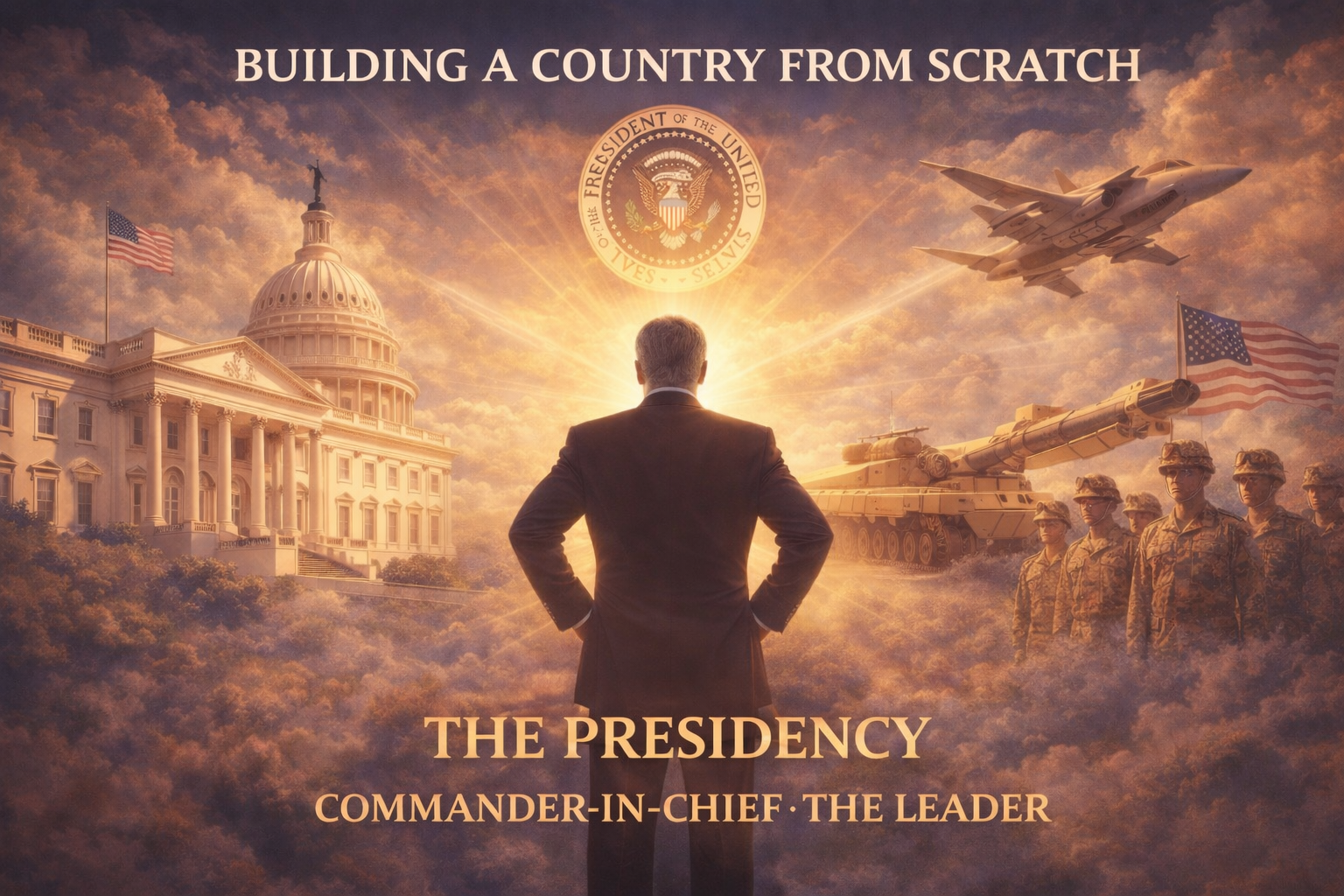
Watch "The presidency the betrayed experiment" on YouTube
What Does “President” Mean?
The word President comes from Latin praesidere, meaning to preside — to sit in front, to manage, to oversee.
It does not mean:
ruler
king
supreme leader
lawmaker
From the beginning, the President was designed to be a manager of decisions made by others, not the source of those decisions.
Why Was the Presidency Created?
The framers knew two things were true at the same time:
Government needs speed in emergencies
Power becomes dangerous when it belongs to one person
So they created an executive who could:
respond quickly,
organize defense,
carry out laws,
but only within limits set by Congress and the Constitution.
The Presidency was created to execute, not to dominate.
What Powers the President Has
Under the Constitution, the President can:
enforce laws passed by Congress,
serve as Commander in Chief after Congress authorizes military action,
conduct diplomacy with Senate approval,
respond immediately to direct attacks or emergencies (self-defense),
appoint officials with Senate consent.
These powers exist so the country is not paralyzed in moments of danger.
What Powers the President Does Not Have
The President cannot:
declare war,
create laws,
fund wars or programs,
permanently expand emergency powers,
act independently of Congress by design.
The system was not created for the President to go on offense alone.
That power belongs to Congress.
Self-Defense vs. Offense — This Is the Key Distinction
The Constitution allows the President to act defensively:
repel sudden attacks,
protect the country in immediate danger.
It does not authorize:
preemptive wars,
long-term military campaigns without Congress,
regime change decided by one person.
When you see presidents launching offensive actions without Congress, that is interpretation, not design.
Why Venezuela Is a Warning
In places like Venezuela, executives:
claimed emergency powers,
treated temporary authority as permanent,
bypassed legislatures,
ruled by decree.
That is not what the U.S. Constitution permits.
Venezuela is not a failure of having a president —
it is a failure of unchecked executive power.
The American system was built specifically to prevent that.
So What Went Wrong in the United States?
Two things failed:
Congress became weak
stopped declaring war,
stopped enforcing limits,
avoided responsibility.
Presidents filled the vacuum
acting without restraint,
expanding authority through precedent,
normalizing emergency power.
This is not strength. It is imbalance.
What New Citizens Should Understand
When you swear loyalty to the Constitution:
you are not swearing loyalty to the President,
you are swearing loyalty to limits on power.
The President was never meant to govern alone. If he does, the system is already broken.
That is not how America was designed to work.
The Presidency: Power, Failure, and a Confession
When you became a citizen of the United States, you inherited something powerful—but also something wounded.
You inherited an experiment.
The office of the President was never designed to be a throne, a savior, or a permanent center of gravity. It was created as a constrained executor, not a ruler. Its power was meant to be limited, conditional, watched, and reversible.
And yet, after nearly 250 years, we must speak plainly:
The Presidency is now the clearest confession of how far America has drifted from what its framers designed.
What the Constitution Intended
The framers feared one thing above all others: concentrated power.
They had just escaped a king. They had lived under unilateral war-making. They knew what happens when one person decides life, death, taxes, and war.
So they built restraints:
Congress declares war.
Congress controls the purse.
The President executes, not invents.
Power is shared, delayed, checked, and argued over.
The President was meant to act quickly only after judgment had already occurred elsewhere.
That “elsewhere” no longer exists.
What We Actually Got
As new citizens, you deserve honesty—not mythology.
You have lived through:
Afghanistan: twenty years of war, authorized, expanded, and sustained with minimal restraint.
Iraq: a war built on false premises, executed with executive urgency and legislative surrender.
Endless authorizations, emergency powers, and executive actions that bypass real deliberation.
These were not accidents. They were not individual failures. They were structural failures.
The Presidency did not grow powerful because it was evil. It grew powerful because everything meant to restrain it collapsed.
Congress Abdicated. Money Replaced Judgment.
The Constitution assumes Congress is serious.
Today, that assumption is false.
Most members of Congress:
spend more time fundraising than reading legislation,
are not required to understand constitutional limits,
are structurally incentivized to campaign permanently.
This is not governance. This is survival inside a money-driven ecosystem.
And then came the final betrayal:
Unlimited money in politics.
Any honest student of the framers knows this would have been unthinkable.
Money was never meant to substitute for judgment. Wealth was never meant to dominate access. Government was never meant to be sold.
Once unlimited money was allowed to pour into elections, the Constitution lost its immune system.
From that moment on:
public interest became secondary,
restraint became optional,
the Presidency became exposed and weaponized.
The Courts Did Not Save the System — They Sealed Its Defeat
Courts were meant to interpret carefully, not redesign the republic.
Yet instead of restoring balance, they:
rewrote the rules of political influence,
neutralized intermediaries of judgment,
treated money as speech and power as untouchable.
This did not protect democracy. It froze its failure into permanence.
What the Presidency Now Represents
Today, the Presidency is not proof of strength.
It is proof of systemic collapse.
It shows us:
what happens when judgment disappears,
what happens when Congress surrenders,
what happens when courts legitimize imbalance,
what happens when citizens are reduced to spectators.
The President is blamed for everything because everything flows there now.
That was never the design.
A Message to New Citizens
You are not inheriting a perfect republic. You are inheriting a betrayed experiment.
That is not an insult. It is a responsibility.
You are not swearing loyalty to myth. You are swearing loyalty to a framework that assumes repair, courage, and truth.
If you do not understand:
what the President was meant to be,
what Congress was meant to do,
why money was meant to be restrained,
then the oath becomes empty words.
The Wake-Up Call
The Presidency does not need worship. It needs re-containment.
The Constitution does not need blind loyalty. It needs informed citizens.
And democracy does not die from disagreement. It dies when judgment is replaced by money, spectacle, and fear.
This is where your education begins.
Not with reverence. Not with slogans.
But with honesty.
The experiment can be repaired. But only if new citizens understand what failed—and why.
This is not the end of the Constitution.
This is the moment it demands to be understood again.
The First President: Power, Restraint, and a Warning America Ignored
The first President of the United States was George Washington—and Americans must understand him without mythology.
He was not a saint.
He was a slave owner.
He deferred justice on slavery.
He was deeply flawed.
Watch "What It Was Like To Be A Slave At George Washington's Mount Vernon" on YouTube
But he understood something essential about power that many who followed him did not.
Why the Presidency Was Created
The presidency was created for one reason: protection, not rule.
The framers knew that legislatures debate slowly. In moments of danger—war, rebellion, invasion—the country needed someone who could act quickly. That was the purpose of the President.
Not to govern alone.
Not to make law.
Not to go on offense.
To preside, execute, and defend—nothing more.
What the First President Actually Did
Washington treated the presidency exactly as designed:
He presided, he did not dominate.
He deferred constantly to Congress.
He put down rebellions (Shays’ Rebellion, the Whiskey Rebellion) to enforce law, not to rule by fear.
He avoided foreign entanglements and permanent wars.
He warned openly against factions, permanent enemies, and executive ambition.
He saw the office as administration, not authority.
The Most Important Thing He Did
The Constitution allowed Washington to stay in office for life.
There were no term limits. There was no rule forcing him to leave. The people would have kept him.
And that is precisely why he left.
After two terms, Washington stepped down voluntarily.
Not because he was weak.
But because he was afraid of precedent.
He understood that if the country became dependent on one man, the republic would rot from the inside. He refused to become a permanent president—even though the Constitution allowed it.
That decision mattered more than any battle he fought.
What Americans Must Grapple With
Washington showed what the presidency was meant to be.
What followed shows what happens when power becomes seductive.
Many later presidents:
expanded executive authority,
acted without Congress,
normalized permanent war,
treated emergency powers as routine.
This is not what the framers designed.
The presidency today is powerful not because it was meant to be—but because Congress weakened, judgment disappeared, and money replaced deliberation.
The Honest Truth
Washington failed morally on slavery.
So did many who came after him.
But the lesson of the first presidency is not virtue.
It is restraint.
He proved that:
power must be temporary,
leadership must end voluntarily,
the office must never become a throne.
When that lesson was ignored, Americans corrected it themselves by passing the 22nd Amendment, limiting presidents to two terms.
That amendment is not a celebration.
It is a repair.
The Takeaway for New Citizens
The President is not the country.
The President is not democracy.
The President is not meant to rule.
The presidency exists to protect the republic, not replace it.
And when it goes beyond that—when it governs by offense, bypasses Congress, or becomes permanent—it is not fulfilling the Constitution.
It is betraying it.
This is the presidency as it was designed.
And this is the presidency as it drifted.
Understanding that difference is now your responsibility as a citizen.
If you want, next we can:
Why Didn’t George Washington and Early Presidents Embrace Islamic Moral Equality?
The short answer is not flattering to America:
They did not lack exposure to Islam.
They lacked the moral courage to follow its implications fully.
1. They Were Not Ignorant of Islam
This matters first.
George Washington corresponded with Muslim leaders.
Thomas Jefferson owned and studied the Qur’an.
Morocco was the first country to recognize the United States (1777).
African Muslims fought, labored, and lived in early America—many enslaved, many erased.
So ignorance is not the explanation.
Watch "African Muslims in Early America" on YouTube
2. The Founders’ Moral Ceiling
The American founders were British subjects shaped by empire, class, and property.
They rebelled not because they had discovered universal justice, but because:
they wanted land,
they wanted wealth,
they wanted self-rule,
they wanted to escape taxation and hierarchy imposed on them.
They did not rebel to free everyone.
This is the uncomfortable truth.
They spoke of liberty while:
owning slaves,
deferring abolition,
treating freedom as negotiable.
Islam, by contrast, did something far more radical.
3. Why Islam Was Different — and Why It Was Ignored
Islam did not merely speak of equality.
It enforced it morally and socially.
The Prophet Muhammad ﷺ said:
“People are equal like the teeth of a comb.”
Islam:
made freeing slaves a constant moral obligation,
tied worship to justice,
tied leadership to humility,
made righteousness—not race, lineage, or wealth—the measure of worth.
This was too radical for men who still wanted to keep their economic foundations intact.
To accept Islam’s moral vision fully would have required:
immediate abolition,
racial equality,
economic restructuring,
loss of inherited advantage.
They were not ready.
4. Why Muslims Who Fought Were Not Acknowledged
Muslims were present:
African Muslims enslaved but literate,
North African allies,
Muslim soldiers and sailors,
diplomatic partners.
Yet they were erased.
Why?
Because acknowledging Muslim equality would have undermined the racial and economic hierarchy America was quietly preserving.
It was easier to:
borrow Islamic ideas selectively (consultation, law, restraint),
while rejecting their full moral consequences.
This is not unique to America. It is human weakness.
5. What Happened to America?
America inherited Islamic moral insights without embracing Islamic moral discipline.
It adopted:
consultation → but not full equality,
liberty → but not universal justice,
restraint → but not moral courage.
Over time, what was left was:
structure without soul,
law without conscience,
power without humility.
Islam offered a complete system:
spiritual accountability,
social justice,
moral equality,
liberation as a duty.
America took the mechanics, not the ethics.
6. The Honest Islamic Answer
From an Islamic perspective, the early American leaders were:
not evil monsters,
not enlightened saints,
but men trapped by their interests.
They recognized truth partially. They followed it selectively. They compromised where it cost them most.
That is why slavery survived. That is why Muslims were erased. That is why equality was delayed.
7. The Responsibility Now
Here is the key point:
Islam does not need America’s validation.
America needs Islam’s moral clarity.
Muslims were here from the beginning. They contributed. They fought. They believed.
The failure was not Islam’s. It was America’s inability to live up to what it already knew was right.
That responsibility now falls on Muslims and non-Muslims alike to tell the truth:
about slavery,
about erased Muslims,
about borrowed ideas,
about unfinished justice.
Closing Thought (Without Polemics)
The American founders feared tyranny of kings.
Islam feared tyranny of the ego.
America built restraints around power.
Islam built restraints inside the soul.
One without the other was never enough.
That is not an attack on America. It is an explanation of its struggle.
And it is why Muslims asking this question today are not outsiders— they are finishing a conversation that began at the founding.
A Final Truth About the Presidency — and Erasure
As we conclude the Presidency, one fact must be stated plainly: there are people and systems that will continue to erase you. Muslims were present in America from the beginning—enslaved, literate, faithful, fighting, and contributing. Muslims fought in the Revolutionary era. Muslim nations recognized the United States early. The framers knew of Islam, studied it, corresponded with Muslim leaders, and drew from ideas of consultation, restraint, and moral accountability wherever they found them—including the Qur’an. That history has been minimized, buried, and at times deliberately removed. Links disappear. Videos are taken down. Stories are sidelined. But the record exists, and it will be preserved.
Do not call them “founding fathers.” Call them what they were: framers—men who borrowed widely, compromised deeply, and built an experiment to advantage themselves while deferring full justice. They did not invent truth; they selected from it. They did not live up to equality; they postponed it. And yet, the system they framed left the door open.
The Presidency has never been held by a Muslim—not because Muslims do not belong, but because erasure and power have gone hand in hand. That will not remain the case forever. A Muslim President is not a contradiction of the Constitution; it is a fulfillment of its promise. Muslims are not guests in this country. We were here from day one. We fought. We believed. We endured. And no matter how often the record is erased, rewritten, or hidden, it will surface again—because truth does not need permission to exist.
This is not a request.
It is a reminder.