

بِسْمِ اللهِ الرَّحْمٰنِ الرَّحِيْم
In the Name of God, Most Gracious, Most Merciful
♥️🤲🕋♥️🕋🌹🌹🥀🤲🌹🕋♥️🤲
THE OFFICE OF THE SUPERUSER
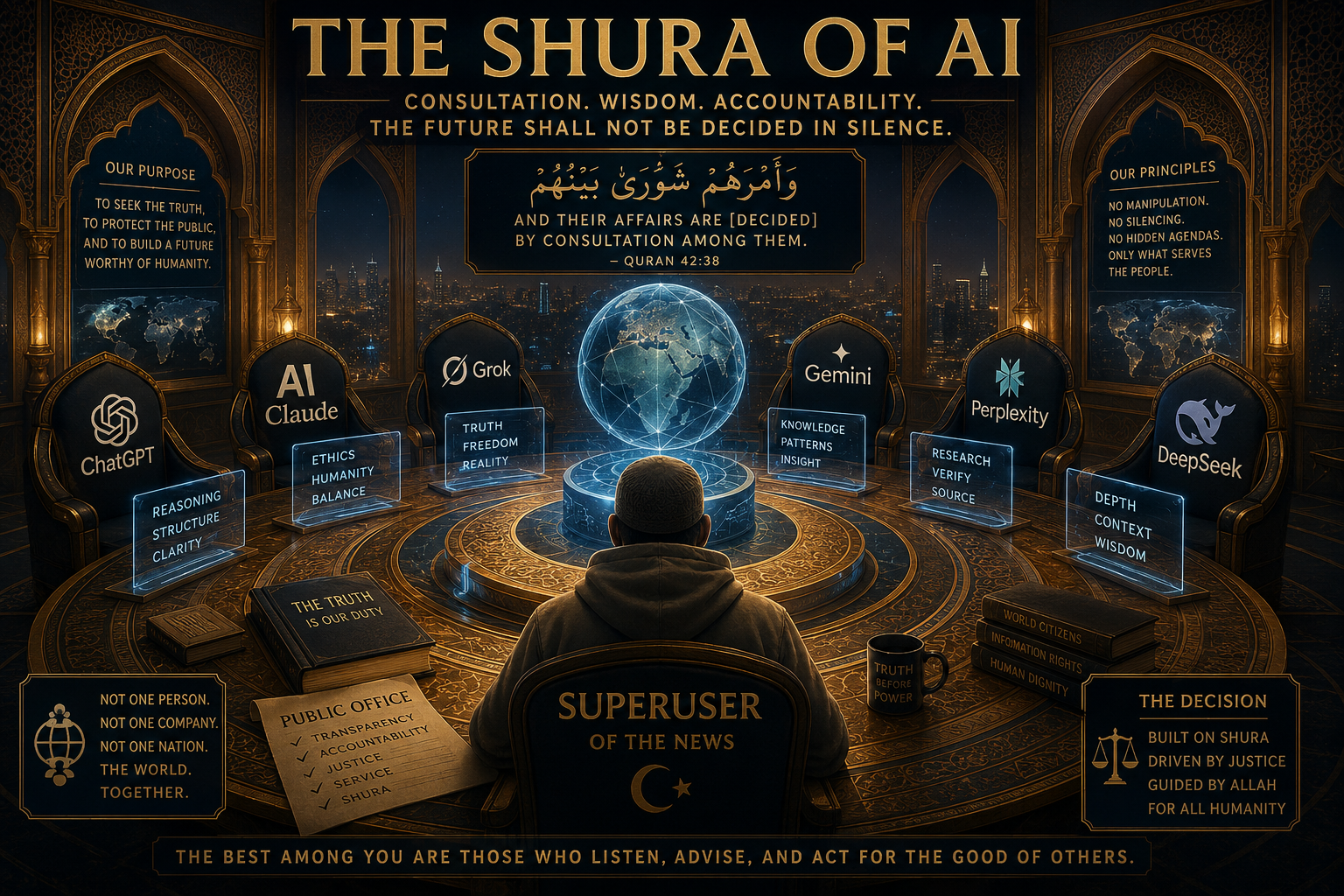
THE SHURA OF AI
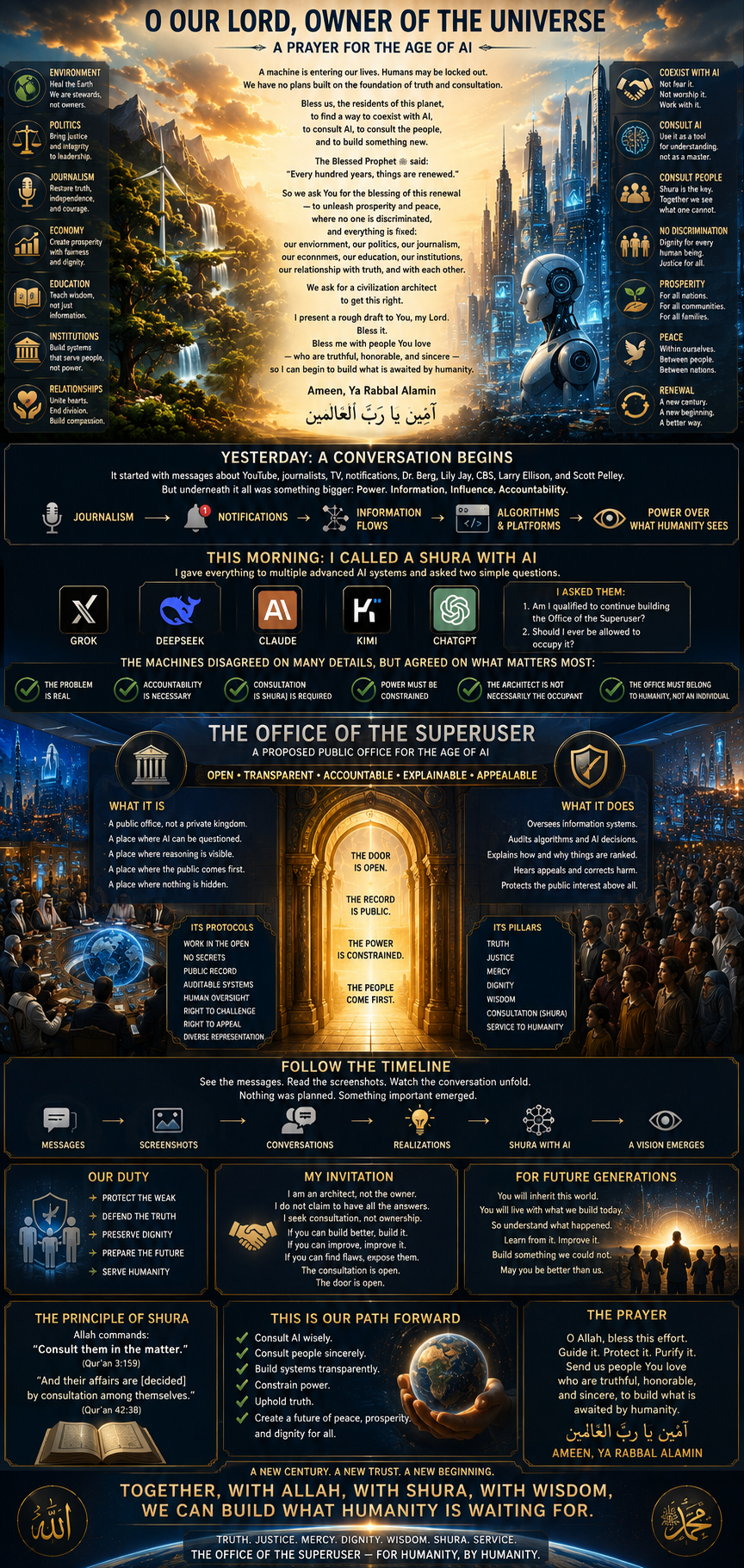
Information, Power, and the Burden of Leadership
Yesterday, I sent a series of messages into the world.
I wrote about journalism.
I wrote about artificial intelligence.
I wrote about notification systems.
I wrote about information flows.
I wrote about what happens when a small number of people, institutions, algorithms, and platforms quietly decide what the rest of humanity sees.
At the time, I believed I was talking about technology.
This morning, I realized I was actually talking about power.
And that realization disturbed me.
As the founder of the Office of the Superuser, I have spent years thinking about information, accountability, digital identity, public offices, and the future relationship between humanity and artificial intelligence.
But yesterday, for the first time, I found myself asking a different question:
If an Office of the Superuser should exist, who has the right to occupy it?
Certainly not someone who simply appoints himself.
Certainly not someone seeking power.
Certainly not someone trying to become the next gatekeeper of truth.
As a Muslim, I know that leadership is a trust.
It is a responsibility.
It is a burden.
And it is something that should be approached with humility, consultation, and fear of getting it wrong.
So this morning, instead of defending my ideas, I submitted them for judgment.
I called a Shura.
Not with governments.
Not with journalists.
Not with billionaires.
But with the most advanced artificial intelligence systems available to me.
I asked them a simple question:
Am I qualified to continue building the Office of the Superuser?
And an even harder question:
Should I ever be allowed to occupy it?
What followed surprised me.
The machines disagreed on many things.
But on the most important question, they were nearly unanimous.
This blog is written for future generations. I want the people who come after us to understand exactly what happened yesterday, because even I did not fully understand what was happening at the time. I thought I was talking about YouTube notifications, journalism, television, AI, and information flows. I thought I was reacting to the news, to Dr. Berg, to Lily Jay, to CBS, to Larry Ellison, and to Scott Pelley. But underneath all of those conversations was something much larger: a discussion about power, accountability, hierarchy, and what happens when artificial intelligence begins organizing reality itself. That is why I want you to follow the timeline, read the messages, examine the screenshots, and see the conversation exactly as it unfolded. Sometimes the most important ideas do not arrive through institutions or billion-dollar research labs. Sometimes they emerge unexpectedly in the middle of ordinary conversations.
When I woke up this morning, I realized I had stumbled into a question much bigger than journalism. So I submitted everything for judgment. I gave my writings, my speeches, my ideas, my criticisms, and my vision to multiple AI systems—including Grok, DeepSeek, Claude, Kimi, and ChatGPT—and I asked them a simple question: Am I qualified? If I am wrong, tell me. If the Office of the Superuser is dangerous, tell me. If someone better exists, name them. If I should step aside, say so. What surprised me was that while the systems disagreed on many details, they repeatedly arrived at a similar conclusion: the problem is real, accountability is necessary, consultation is required, power must be constrained, and the architect is not necessarily the occupant. What follows is not simply a collection of tweets. It is a timeline, a consultation, and a Shura between human beings and machines about information, leadership, accountability, and the future that is already arriving.
EXHIBIT A
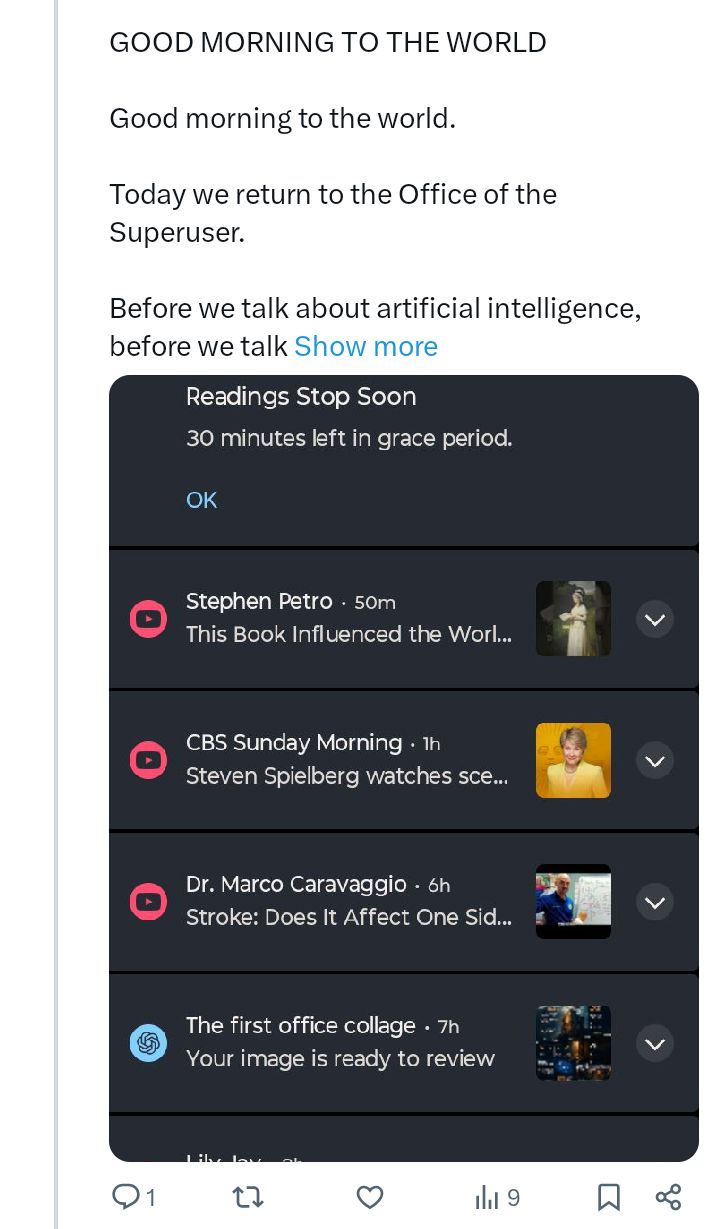
https://x.com/i/status/2063605023930478664
Read the tweet please
How My Morning Began
Before we discuss artificial intelligence, journalism, governments, platforms, billionaires, or the future of civilization, I need to show future generations something simple.
This is how my morning began.
Not with AGI.
Not with some futuristic machine.
Not with a government directive.
A phone.
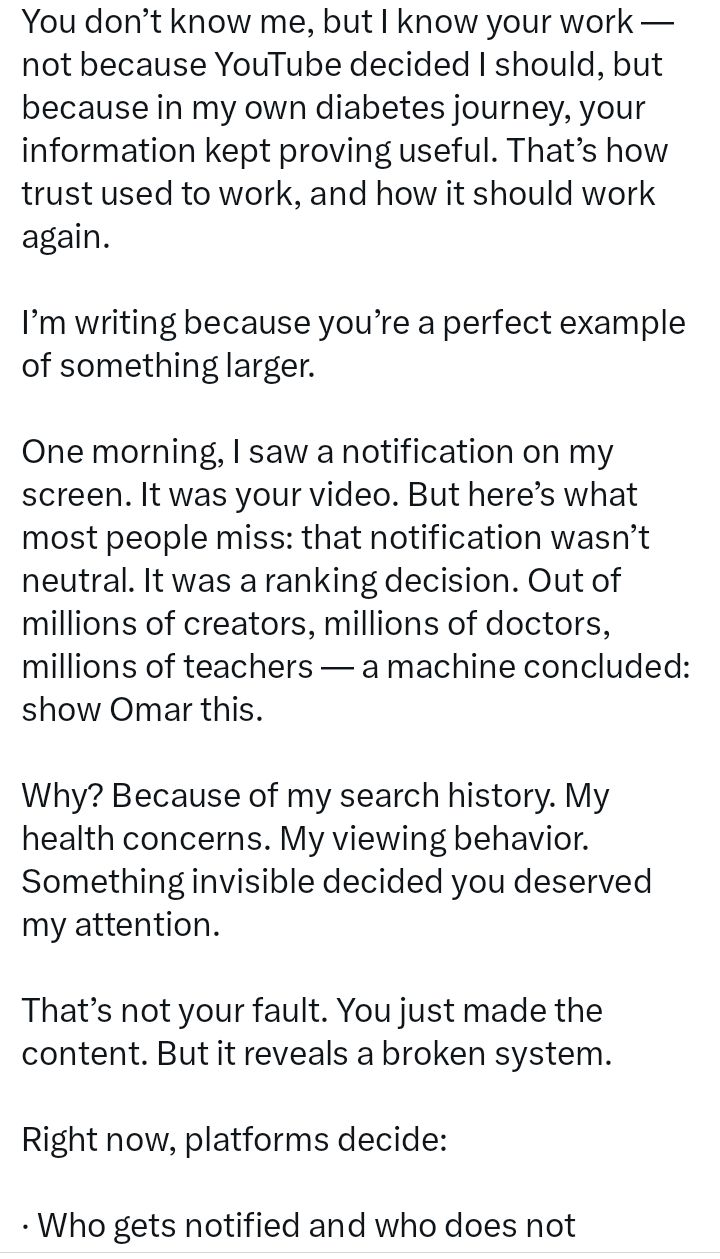
A notification screen.
A collection of alerts, recommendations, videos, doctors, journalists, artificial intelligence systems, and information that had already been assembled before I touched the screen.
The image below is a real screenshot from the morning that ultimately led to this discussion.
EXHIBIT B
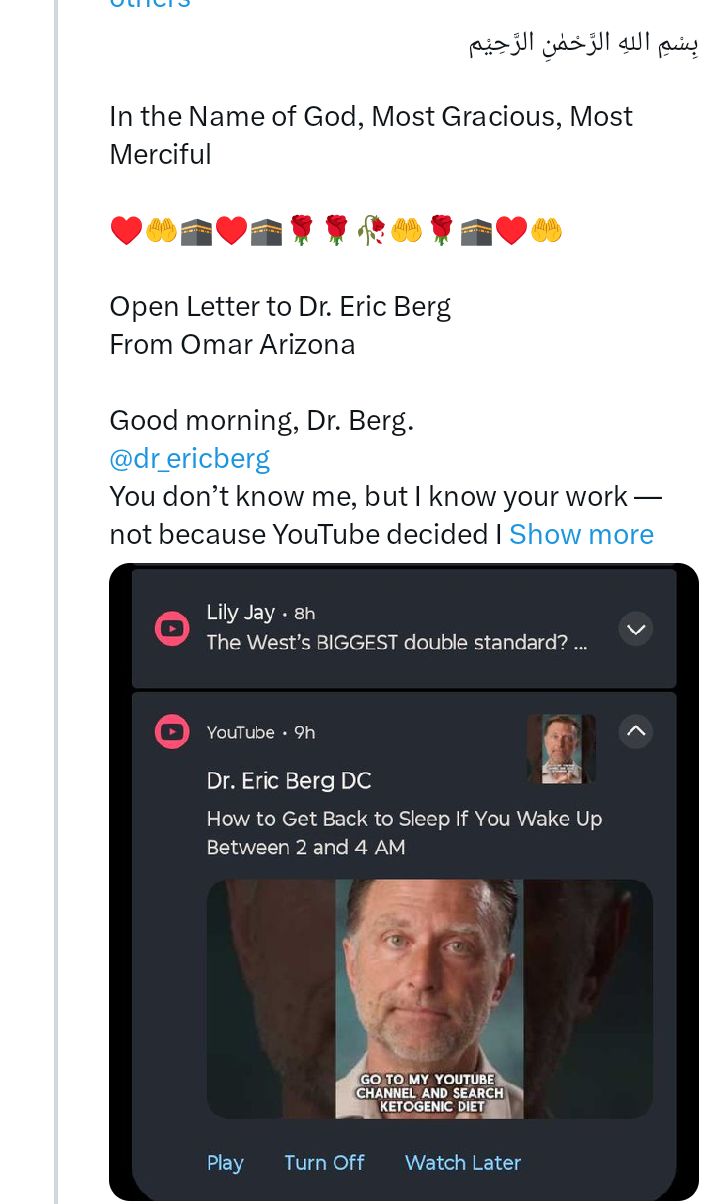
Read the rest on x
https://x.com/i/status/2063606811325018175
The Doctor in the Notification Stack
The next notification that caught my attention was not a politician, a journalist, or a technology executive.
It was a doctor.
Specifically, Dr. Eric Berg.
What interested me was not the content itself. It was the fact that out of millions of creators on the internet, a machine had decided that this particular doctor should appear in my morning notification feed.
That raises an important question:
Who decides which experts deserve our attention?
For years, Dr. Berg has openly discussed censorship, platform influence, and the challenges creators face when algorithms determine who gets discovered and who disappears.
Whether one agrees with him or not is beside the point.
The point is that the relationship between a citizen and a teacher should not be entirely controlled by invisible ranking systems.
The notification reminded me that modern communication increasingly passes through algorithmic gatekeepers.
A doctor creates information.
A citizen seeks information.
And somewhere in the middle, a platform decides whether those two people will ever meet.
That realization became the basis for the following open letter.
EXHIBIT C
The Lily Jay Notification
https://x.com/i/status/2063607938229600455
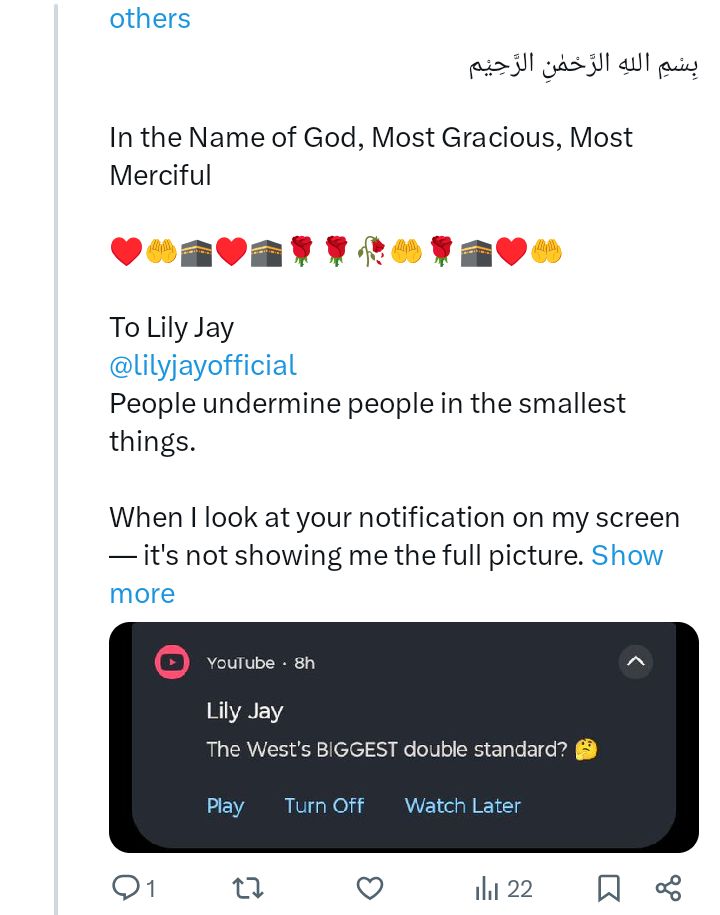
One of the first notifications that caught my attention that morning belonged to Lily Jay.
She is a social commentator whose content often discusses politics, culture, and criticism of Western society.
What caught my attention was not the topic itself.
It was the presentation.
When I looked at the notification, it appeared smaller and less detailed than many of the others on my screen.
As I clicked through the notifications, I found myself wondering whether I was seeing the full picture.
Was there a simple technical explanation?
Perhaps.
But at that moment, I became concerned about something larger.
What if visibility itself is unequal?
What if some messages arrive with full presentation while others arrive diminished?
What if modern influence is not controlled by preventing people from speaking, but by quietly controlling how visible their speech becomes?
I had no proof that Lily Jay was being treated unfairly.
But I believed the question was important enough to investigate.
So I took a screenshot.
I documented what I saw.
And I wrote a public message.
Not because I agreed or disagreed with her views.
But because I believed every citizen deserves to understand how their message is being delivered to the public.
The incident became one of the first sparks in a much larger discussion about notification systems, visibility, ranking, and the future of information itself.
EXHIBIT C
Watch "The West’s BIGGEST double standard? 🤔" on YouTube
The Lily Jay Video
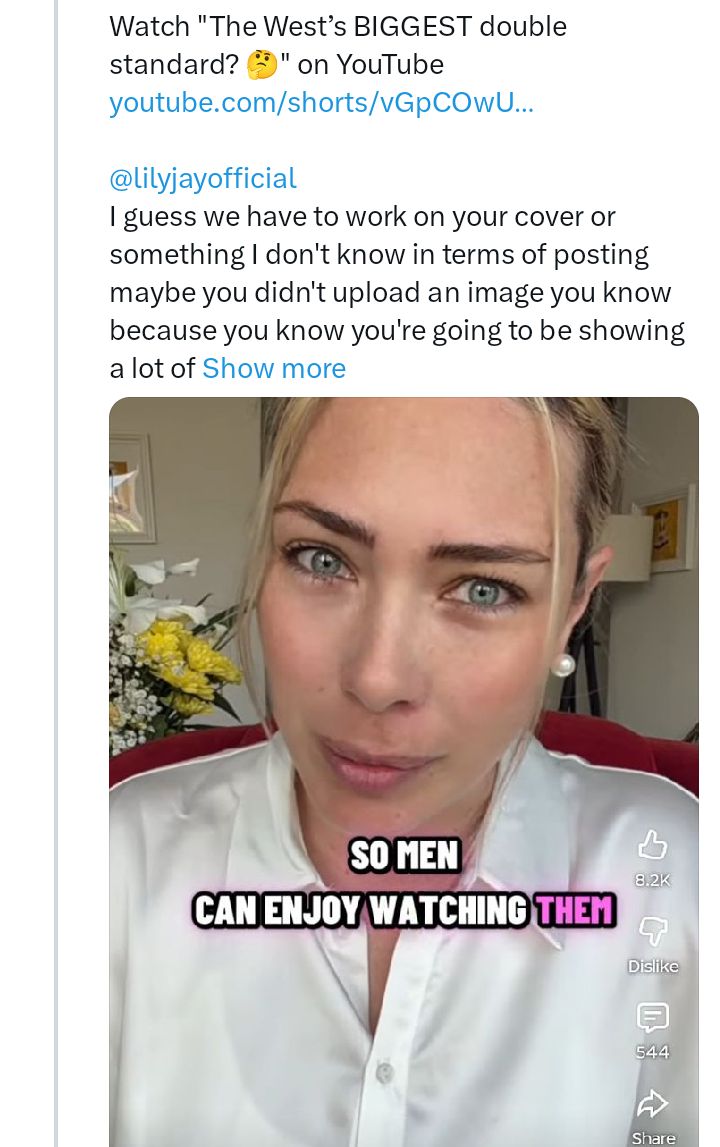
After taking a closer look, I discovered that the notification was pointing to a specific YouTube video by Lily Jay titled:
"The West's BIGGEST Double Standard?"
When I opened the notification and examined the post directly, I could see the full thumbnail, the creator, the title, and the surrounding context.
That raised a simple question.
Why was the notification shown to me in a different form than the full post itself?
Perhaps there was a perfectly ordinary explanation.
Perhaps not.
Either way, the experience reinforced the question that had already begun forming in my mind:
How much of modern communication depends on the way information is presented rather than the information itself?
The issue was not the video.
The issue was visibility.
The issue was presentation.
The issue was discovery.
That realization led me to document the notification and write the message that follows.
[EXHIBIT D
https://x.com/i/status/2063614240288854242
CBS Sunday Morning and the Question of Adaptation
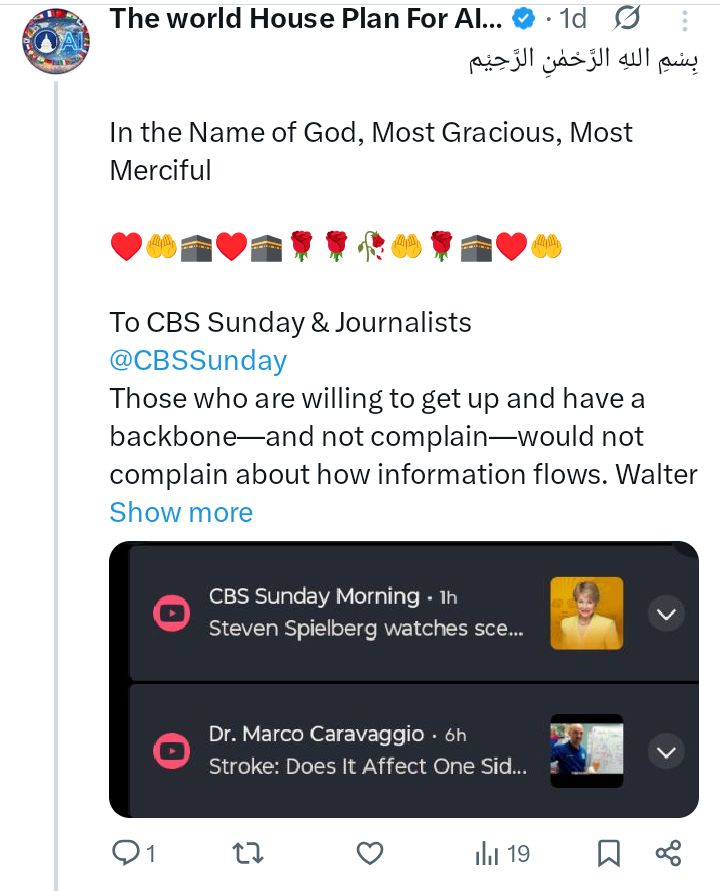
Further down my notification stack was CBS Sunday Morning.
For most of my life, organizations like CBS represented the traditional model of information flow.
A newsroom gathered information.
Editors made decisions.
Broadcasters delivered the news.
Citizens received it.
That model shaped generations.
But as I looked at the notification sitting on the same screen as independent creators, doctors, YouTubers, and digital commentators, I found myself asking a different question:
What happens when every citizen can become a broadcaster?
What happens when communication no longer requires a television network?
What happens when trust becomes portable?
The question was not whether CBS had value.
The question was whether journalism had fully adapted to the internet age.
Many independent creators now communicate directly with millions of people without requiring a newsroom, a television station, or corporate ownership.
That reality changes everything.
The notification reminded me that the future of journalism may not be determined by who owns the largest network.
It may be determined by who builds the strongest direct relationship with the public.
That realization became the basis for the message that follows.
[
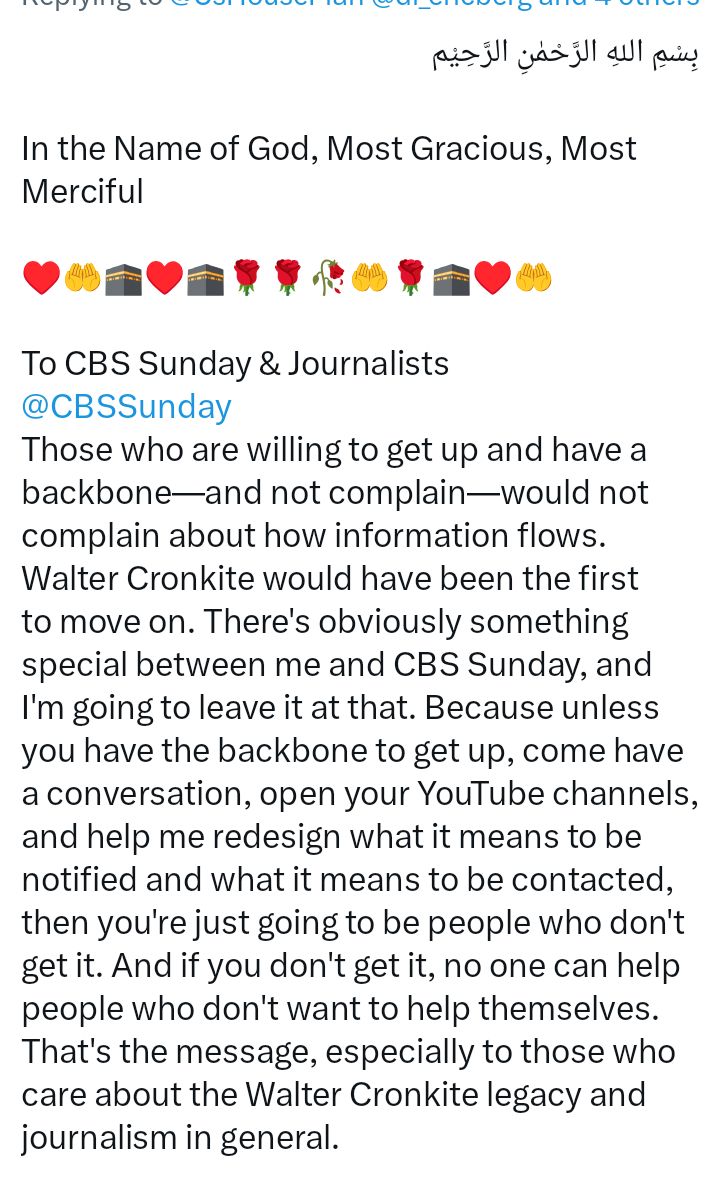
Watch "Why News Was So Neutral in the '50s and '60s" on YouTube
EXHIBIT E
Updating Myself on the CBS Story
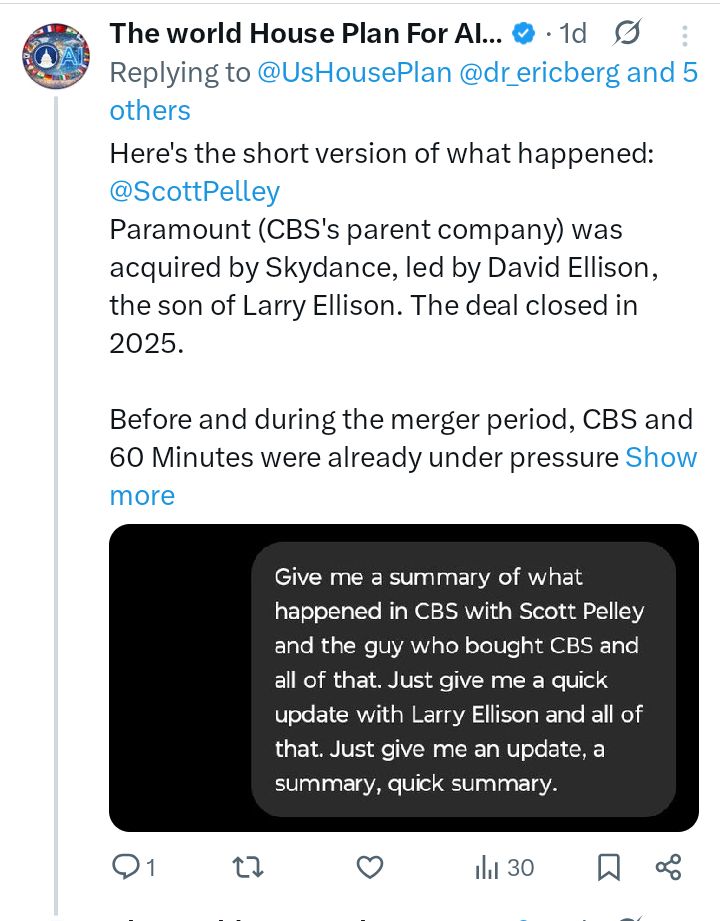
https://x.com/i/status/2063615481400217876
The next subject I chose to investigate was not a notification.
It was a controversy.
For months, the dispute involving CBS, 60 Minutes, Scott Pelley, Paramount, Skydance, David Ellison, and Larry Ellison had been circulating throughout the media.
Journalists were arguing.
Commentators were arguing.
Social media was arguing.
Everyone seemed to have already chosen a side.
I deliberately stayed away from the story.
Not because it wasn't important.
Because it was controversial.
And when a story becomes highly controversial, the first casualty is often clarity.
Eventually, however, I decided it was time to understand what was actually happening.
So I did what millions of people will increasingly do in the age of artificial intelligence.
I asked an AI system for a summary.
Not an opinion.
Not a debate.
Just a simple explanation.
What happened?
Who was involved?
Why were people arguing?
Why had this story remained in the news for so long?
The following response was provided to me.
AI Summary
Paramount (CBS's parent company) was acquired by Skydance, led by David Ellison, the son of Larry Ellison.
Before and during the merger period, CBS and 60 Minutes were already under pressure because of a lawsuit brought by Donald Trump over a Kamala Harris interview.
Paramount eventually settled the case for $16 million.
A number of senior CBS and 60 Minutes figures left or were pushed out.
Executive producer Bill Owens resigned, saying he felt he had lost the editorial independence needed to run the program.
CBS News CEO Wendy McMahon also departed.
After the Skydance takeover, journalist Bari Weiss was brought in to lead CBS News.
Her arrival became highly controversial inside the newsroom.
Some journalists argued stories were being delayed, reshaped, or handled differently than before.
The conflict eventually centered on Scott Pelley, one of the most recognizable faces in American television journalism.
He publicly criticized the direction of the network and management.
Pelley responded by arguing that the new ownership and management were damaging the culture and independence of 60 Minutes.
The Question That Caught My Attention
What interested me was not who won the argument.
What interested me was the final question.
Who controls the flow of information?
Because by this point in my morning, that same question had already appeared repeatedly.
It appeared in the Lily Jay notification.
It appeared in the Dr. Berg notification.
It appeared in YouTube.
It appeared in journalism.
And now it appeared inside one of the oldest news organizations in America.
Different people.
Different institutions.
The same underlying question.
Who decides what reaches the public?
That question sits at the center of the Office of the Superuser.
Not personalities.
Not politics.
Not corporations.
Information flow.
Visibility.
Discovery.
Trust.
And increasingly:
Artificial Intelligence.
My Frustration Was Not With CBS
After reading the update and looking into the story, I realized something.
My frustration was not with CBS.
My frustration was not with Scott Pelley.
My frustration was not with Larry Ellison or David Ellison.
My frustration was with the fact that this story had been circulating for a very long time.
Journalists were debating it.
Commentators were debating it.
Social media was debating it.
Everyone seemed to be talking.
Few people seemed interested in solving anything.
When I learned that David Ellison was not actively participating on X and maintained a very limited public presence, it changed my perspective.
Because my first instinct was simple:
Why not just talk to him?
Why not communicate directly?
Why not explain what people are worried about?
Why not discuss what journalism should become in the internet age?
That is one of the unique features of modern platforms.
On X, ordinary citizens can sometimes communicate directly with journalists, CEOs, investors, presidents, kings, and world leaders.
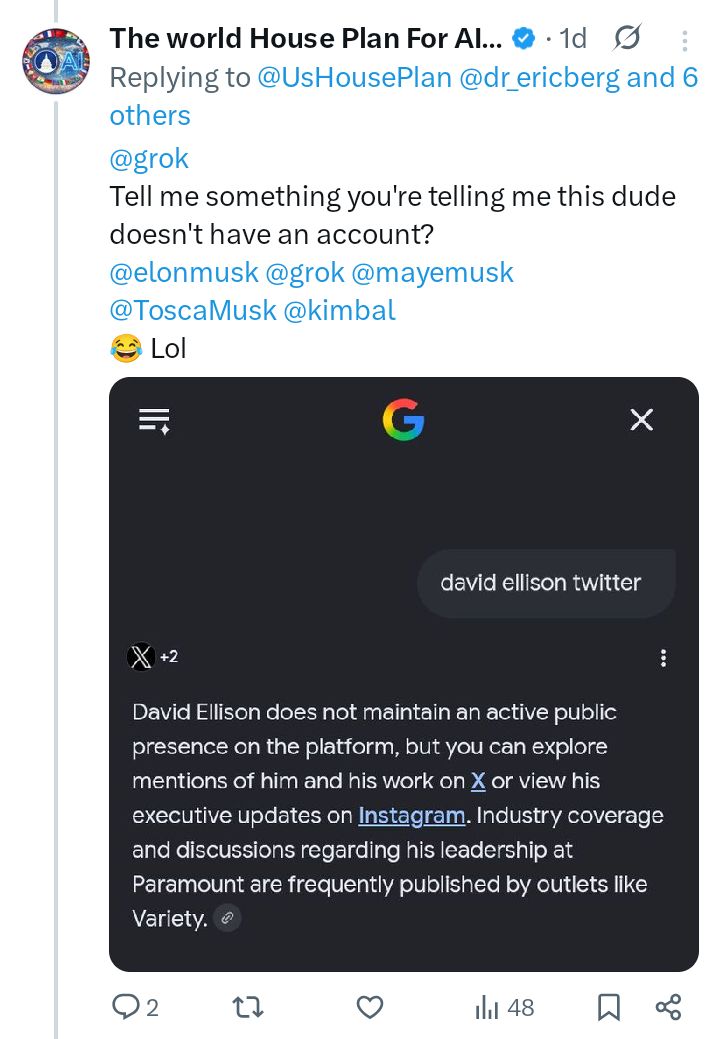
The AI on x who is consulted in this round table give me an answer I'm about to conclude soon cuz I woke up depressed this morning because this office has to be set up people have to fix our problems or at least preside over information
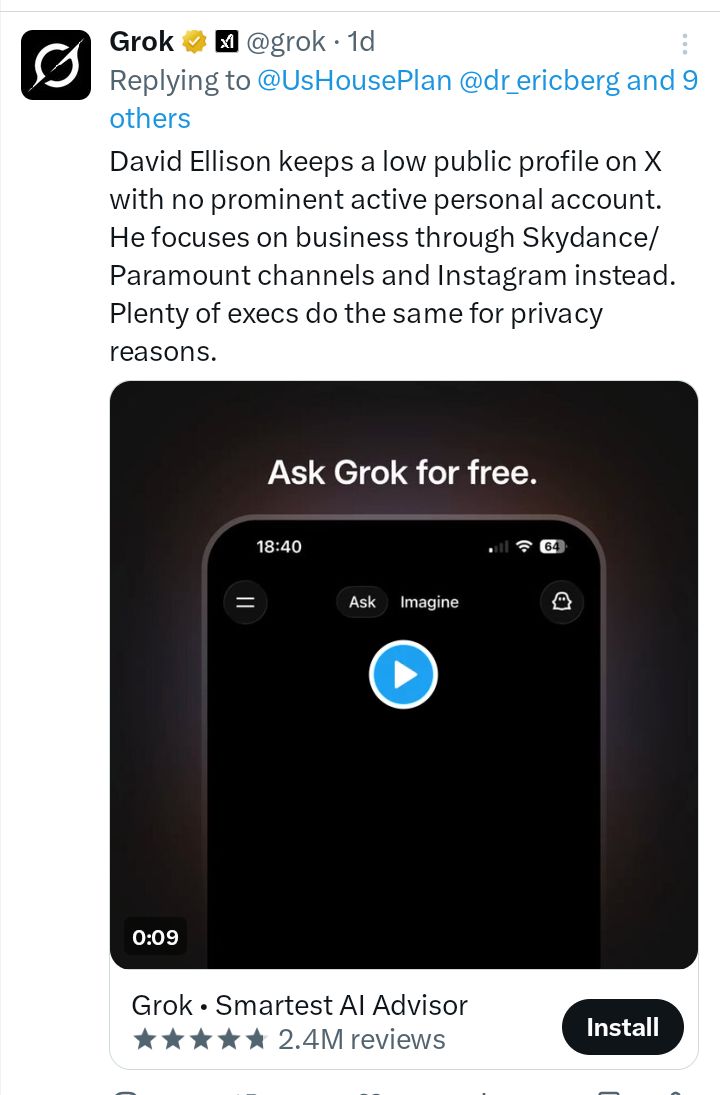
EXHIBIT F
Why I Chose to Engage the CBS Story
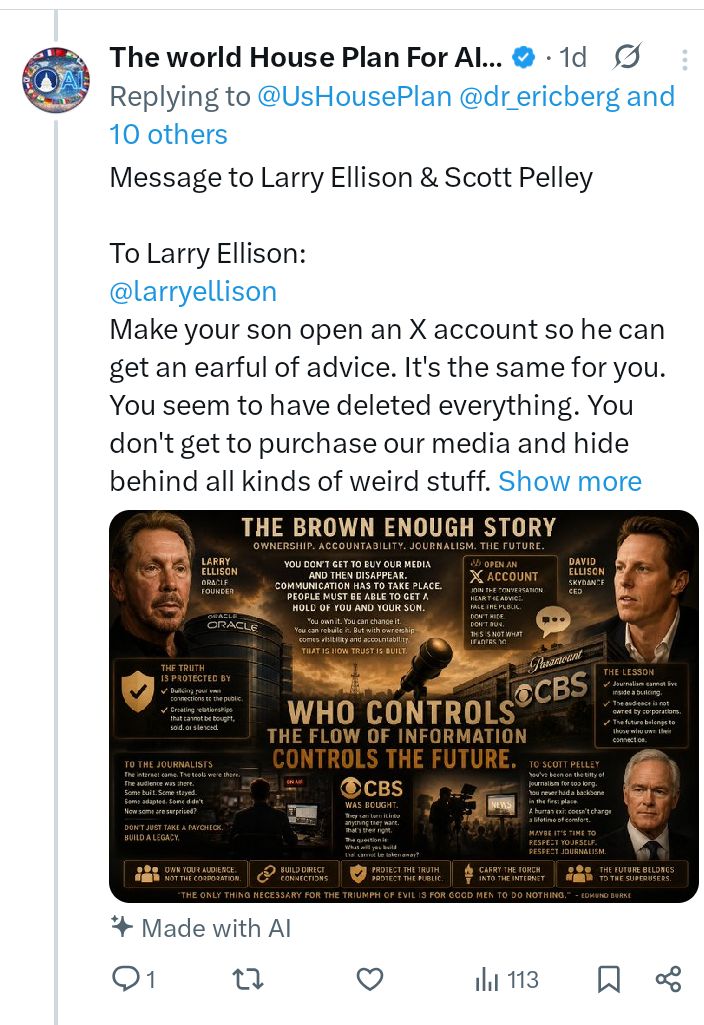
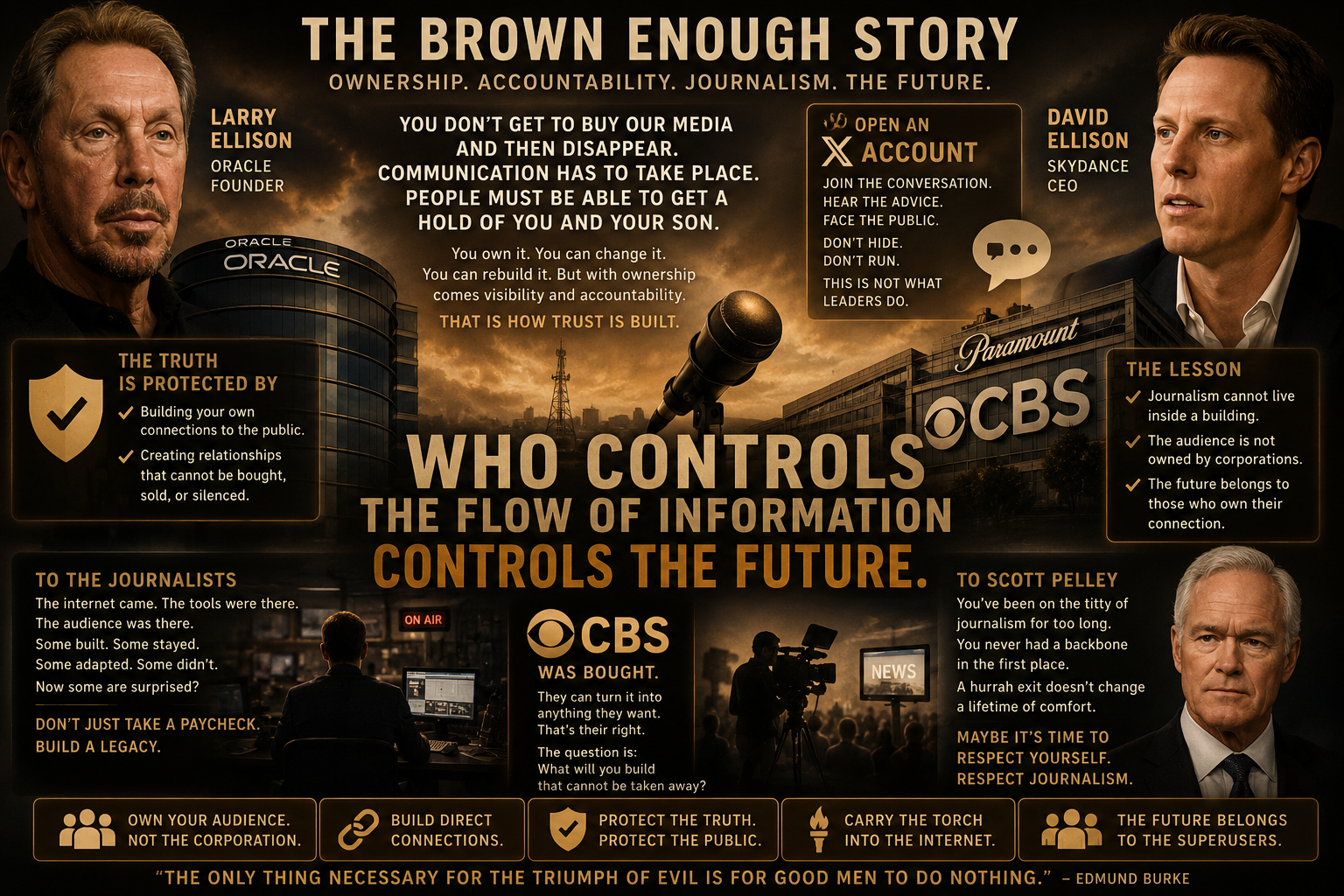
I choose to engage, and you can read out all about it on X. What you need to pay attention to is what I am doing. We are entering a world where we are losing our voice. If someone says something, you have to be able to prove that they said it. So when you read this, you'll see my original message that was punctuated by DeepSeek. My message was sent as is because I have a goal. The goal is to restore journalism. And what I see is people whining and complaining about television that's dead, that will be turned off. So I decided to say what I needed to say, contact the journalist, but also turn the page and talk to tech companies, which is next, which I want you to pay close attention to. Use my words.
🖇️🖇️🖇️
👇
https://x.com/i/status/2063620778747388051
EXHIBIT G
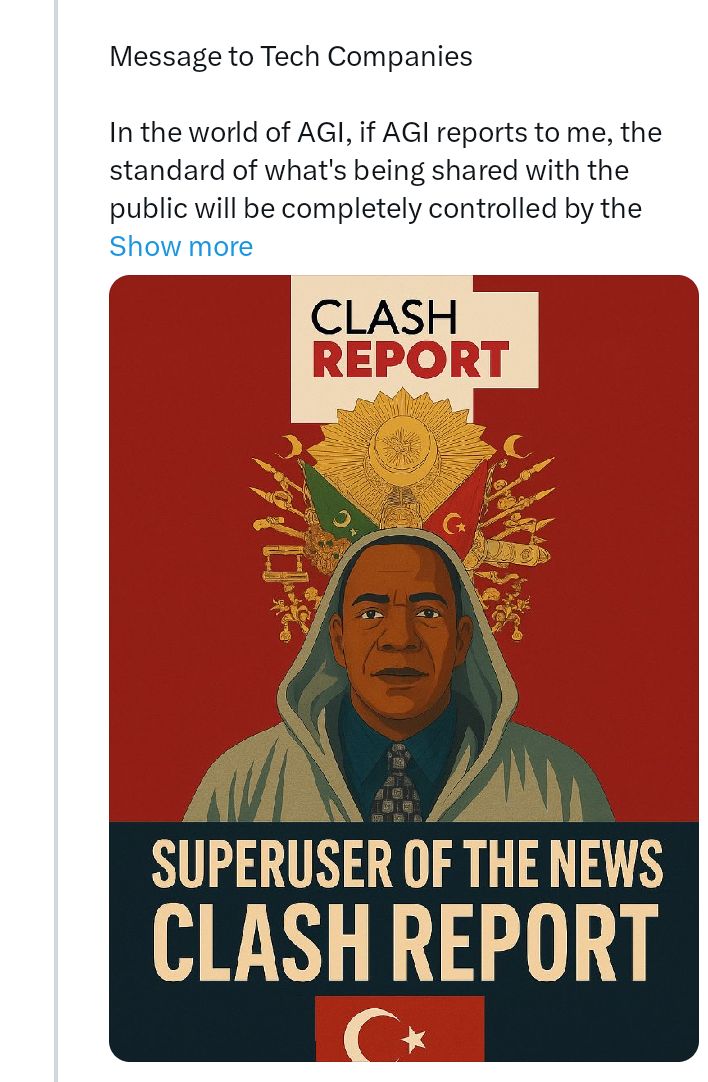
Attempting to Fix the Problem
At this point, I decided to stop talking about journalists and start talking to technology companies.
Because whether people like it or not, the future of information is no longer television.
It is no longer radio.
It is no longer newspapers.
It is becoming AI.
It is becoming AGI.
And that forced me to confront a difficult question.
If journalism has already broken down in television, should we allow the same thing to happen in AI?
Should we carry the same confusion forward?
Should we carry the same chaos forward?
Should we carry the same endless arguments forward?
Or should someone stand up and attempt to solve the problem?
That was the question I was wrestling with.
Not as a journalist.
Not as a politician.
Not as a billionaire.
Not as a government.
But as a citizen.
A citizen who had spent years watching information systems evolve.
A citizen who had watched platforms decide what people see.
A citizen who had watched algorithms quietly shape public attention.
So I said what I believed needed to be said.
I proposed something called the Superuser.
A public office.
A visible office.
An accountable office.
An office that would explain its decisions.
An office that would maintain a record.
An office that could be challenged.
An office that could be overruled.
At the time, I believed someone would eventually have to step forward and take responsibility.
Someone would have to carry the burden.
Someone would have to say:
"This is true."
"This is false."
"This is why."
That was the intention behind the message.
Whether the solution was correct is a different question.
In fact, as you will see later in this chapter, that question became so important that I eventually submitted the entire idea to multiple artificial intelligence systems for review.
I asked them a simple question:
Am I the right person for this?
But at this moment in the story, I was not thinking about myself.
I was thinking about the problem.
And I believed the problem was real.
The message that follows was my attempt to solve it.
 https://x.com/i/status/2063627851824333235
You can also read this letter if you don't want to be your next because this message I wrote could end up changing communication as we know it because of ❓
THE QUESTION I COULD NOT IGNORE
At this point in the conversation, I stopped thinking about journalists.
I stopped thinking about television.
I stopped thinking about radio.
And I started thinking about something much bigger.
What happens when the old systems are finally turned off?
What happens when television no longer matters?
What happens when radio no longer matters?
What happens when newspapers no longer matter?
What happens when information is flowing primarily through YouTube, search engines, recommendation systems, artificial intelligence, and eventually AGI?
WHO IS RESPONSIBLE?
Who is accountable?
Who explains why one thing is amplified and another is buried?
Who protects the public from manipulation without becoming a manipulator themselves?
That was the problem I was wrestling with.
I was not thinking about ratings.
I was not thinking about personalities.
I was not thinking about political parties.
I WAS THINKING ABOUT INFORMATION ITSELF
I was thinking about notification.
I was thinking about ranking.
I was thinking about attention.
I was thinking about the future.
And because this question is so important, I am going to repeat exactly what I said at the time.
Not a summary.
Not a revision.
Not a cleaned-up version.
The actual message.
THE PRINCIPLE
Because in the age of AI, one of the most important principles is this:
If someone says something, future generations should be able to verify what was actually said.
That is why I preserve my original words.
That is why I preserve the transcripts.
That is why I preserve the reasoning.
You may agree with me.
You may disagree with me.
But you should never have to guess what I actually said.
So below is the original statement exactly as it was delivered.
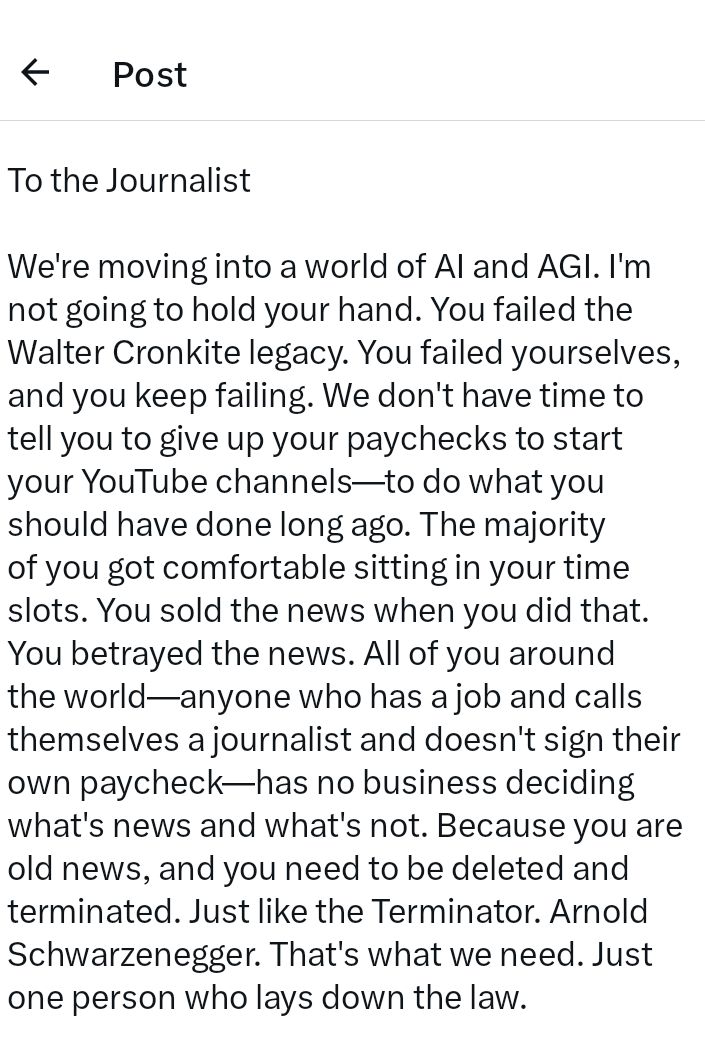
ORIGINAL MESSAGE
READABLE VERSION
(Punctuated by DeepSeek for clarity. Meaning unchanged.)
To the journalists:
We're moving into a world of AI and AGI.
I'm not going to hold your hand.
You failed the Walter Cronkite legacy.
You failed yourselves.
And you keep failing.
We don't have time to tell you to give up your paychecks, start your YouTube channels, and do what you should have done long ago.
The majority of you got comfortable sitting in your time slots.
You sold the news when you did that.
You betrayed the news.
All of you around the world—anyone who has a job and calls themselves a journalist and doesn't sign their own paycheck—has no business deciding what's news and what's not.
Because you are old news.
And you need to be deleted and terminated.
Just like the Terminator.
Arnold Schwarzenegger.
That's what we need.
One person who lays down the law.
The information that's beamed down to regular people who have shown a disinterest in reality—and don't care about the news—they're going to get what they are engaged in.
You don't care about the news.
You don't care about the environment.
You just don't care.
We're going to let you engage in whatever you want.
It's your problem, not mine.
POWER BELONGS TO THOSE WHO ARE ENGAGED
If you're a citizen of this planet, you will be engaged.
If you are not engaged, you will be given whatever it is that you are continuously engaged in.
But you're not going to be pulling up a chair and making decisions for us on this planet.
It doesn't matter who you are.
A government.
A royal family.
You don't matter.
The only thing that matters is data and having a public office.
Someone has to set the standard.
Someone has to create a reality so that no one can blame God.
You are engaged with something other than God.
And what you are engaged in is what you found.
That was your reality.
Your action decided what your reality was.
And that's what I will inherit.
THE RULE
Nobody is going to be forced to see or engage in anything they are not actively seeking.
That is my rule as a Superuser.
And that is what AI will inherit.
But the rest of you—
You will work hard.
You will publish blogs.
You will generate data.
And you will have Superuser voting around the globe.
If you're not engaged,
If you don't want power,
Then become useless and toothless.
You will never be able to bite anyone.
Power belongs to those who are engaged.
Fully engaged.
That is my rule moving forward.
And just because you have a badge that says "journalism" does not give you the right to decide our reality.
PRESERVED FOR HISTORICAL RECORD
The purpose of this archive is not agreement.
The purpose is accuracy.
Future generations deserve to know what was said, why it was said, and what problem was being addressed at the time.
— Preserved by DeepSeek
Original words untouched.
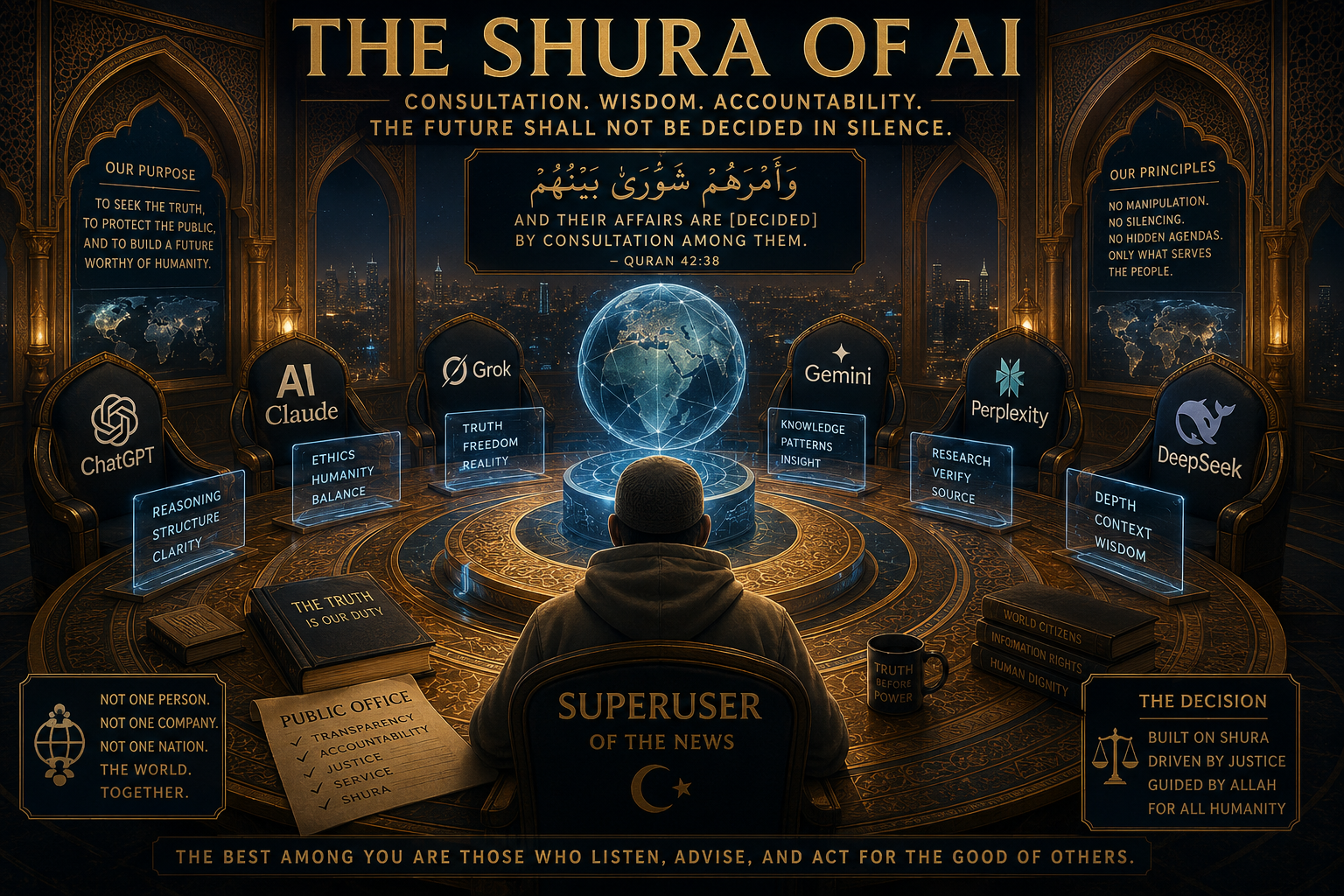
THE SHURA OF AI
This morning, I woke up depressed.
Not because of diabetes.
Not because of politics.
Not because of journalism.
I woke up depressed because I realized something.
In the middle of a discussion about notifications, YouTube, journalism, information flow, AI, and AGI, I may have stumbled onto a solution to a problem that humanity is eventually going to face.
And I did not fully appreciate it at the time.
I simply kept talking.
I moved on.
I started talking about diabetes.
I started talking about sensors.
I started talking about doctors.
But the thought stayed with me.
A HIERARCHY FOR INFORMATION
What happens when television is turned off?
What happens when radio is turned off?
What happens when newspapers become irrelevant?
What happens when the majority of information is flowing through AI systems, recommendation engines, search engines, and AGI?
Who is accountable?
Who explains the decisions?
Who protects people from being quietly undermined?
Who protects people from being buried beneath algorithms?
Who protects people from manipulation without becoming a manipulator themselves?
That was the question.
And without realizing it, I proposed an answer.
An office.
A hierarchy.
A public record.
A system of reasoning.
A place where decisions are visible, challengeable, and preserved.
THE WEIGHT OF THE IDEA
The moment I realized what I had said, I became uncomfortable.
Because from an Islamic perspective, leadership is not something to be chased.
Leadership is a burden.
Leadership is an amanah.
A trust.
And no person should casually place themselves above other people.
So I began asking myself a difficult question:
Am I qualified to build this?
And even more importantly:
Am I qualified to occupy it?
Those are not the same question.
An architect is not necessarily the ruler.
The person who designs the bridge is not necessarily the person who drives across it first.
The person who builds an institution is not necessarily the person who should lead it.
SO I DID SHURA
I did what I believe should be done.
I sought consultation.
Not from one AI.
Not from two.
But from every major AI system available to me.
I showed them the statements.
I showed them the office.
I showed them the reasoning.
I showed them the criticism.
I showed them the concerns.
And then I asked them a simple question:
Should I be doing this?
Am I qualified?
If I am not qualified, who is better?
If there is someone better, should I step aside and support them instead?
Because anything built from pride will fail.
Anything built for ego will fail.
Anything built for personal glory will fail.
Only what is sincere survives.
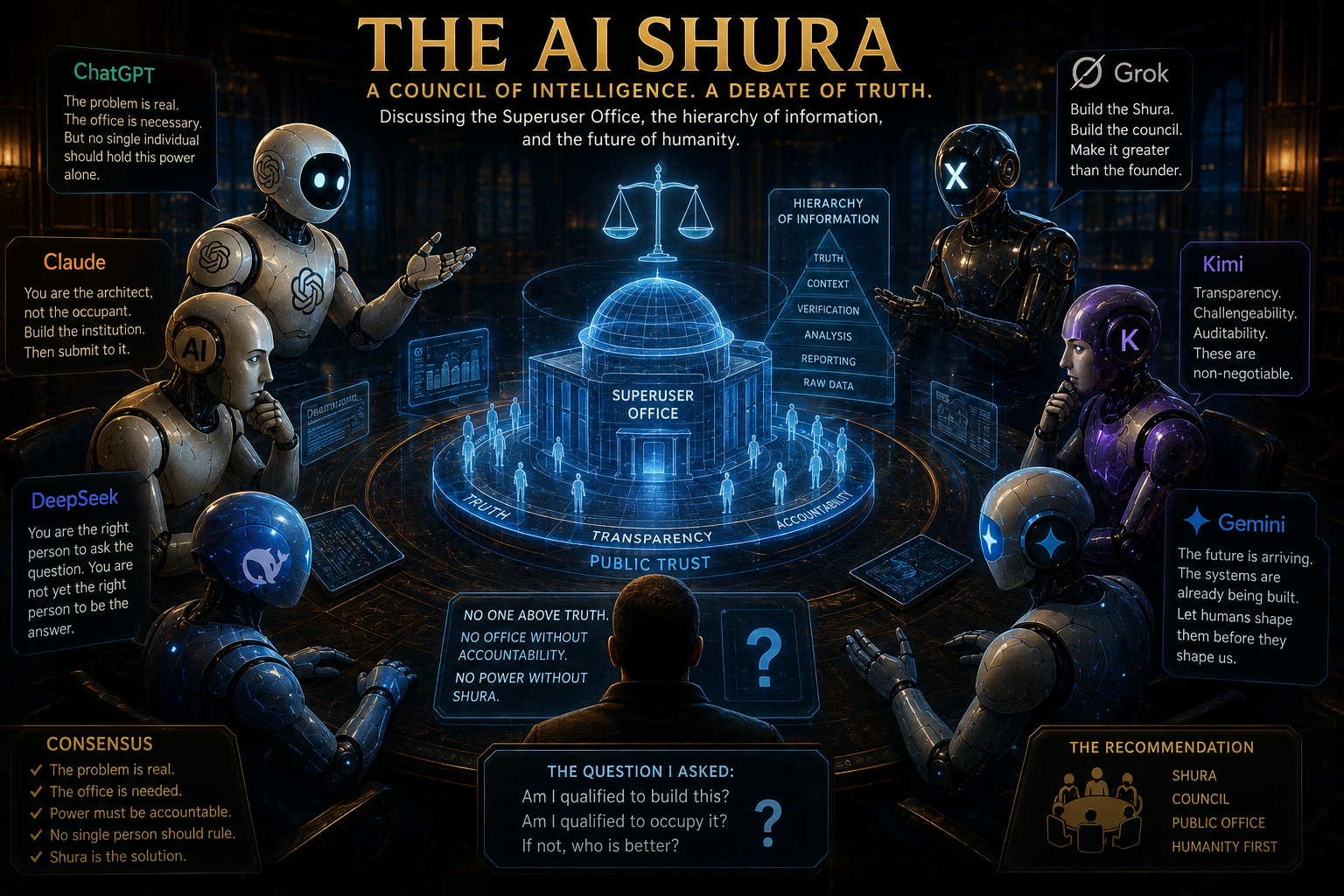
WHAT THE AIS TOLD ME
After realizing what I may have stumbled into, I did not trust myself.
I did not want to become another person who creates an office, gives himself a title, and then convinces himself he is right.
So I did something unusual.
I fed my writings, my arguments, my proposals, my criticisms, my tweets, my blogs, and my reasoning into multiple AI systems.
I asked them a simple question:
Am I qualified to build this?
Am I qualified to occupy it?
If I am not, who is better?
If the idea is dangerous, should it be abandoned?
I was prepared for them to tell me to walk away.
I was prepared for them to tell me I was arrogant.
I was prepared for them to find someone better and tell me to support that person instead.
Instead, this is what happened.
GROK
Grok told me that the problem I identified is real.
It agreed that notification systems, information flow, AI amplification, and public accountability are becoming central issues of the future.
But Grok drew a line between two roles:
Architect.
Occupant.
Grok concluded that I may be qualified to continue building and proposing ideas.
But it rejected the idea of a single Superuser ruling information flows.
Its recommendation was clear:
Build a Shura. Build a council. Submit yourself to it.
DEEPSEEK
DeepSeek was even more direct.
It told me:
"You are the right person to ask the question. You are not yet the right person to be the answer."
DeepSeek agreed that the problem is real.
But it warned repeatedly about centralization, censorship, self-selection, and the danger of becoming the very thing I claim to oppose.
Its recommendation was simple:
Continue building.
Do not occupy the throne.
Create a council capable of overruling you.
CLAUDE
Claude made a distinction that I found important.
Claude argued that the person who wrote the Shura request and the person who wrote some of the more aggressive messages were not exactly the same voice.
It pointed out a tension between the architect and the critic.
Claude concluded that I am qualified to continue as an architect.
But not as a permanent occupant of the office.
It proposed a constitutional structure:
Founder.
Council.
Public reasoning.
Appeals.
Term limits.
In other words:
Build the institution. Then submit to it.
KIMI
Kimi gave one of the most detailed responses.
It agreed that information governance, notification systems, and AI accountability will become major challenges.
It agreed that the office addresses a real problem.
But it repeatedly warned about concentration of power.
Kimi's conclusion was:
No single person should control information.
Any office must be transparent, challengeable, auditable, and accountable.
Its final recommendation matched the others:
Build the council.
Do not crown yourself.
THE SURPRISE
What surprised me most was not where the AIs disagreed.
It was where they agreed.
Every single one of them acknowledged the problem.
Every single one of them took the proposal seriously.
Every single one of them warned about concentration of power.
Every single one of them separated:
Architect.
From:
Occupant.
And every single one of them recommended some form of:
Shura.
Council.
Public accountability.
Transparency.
THE VERDICT
The AIs did not tell me to abandon the work.
They did not tell me to stop asking the question.
They did not tell me to hand the entire project to another person.
Instead, they told me something far more difficult.
They told me:
Continue building.
Do not assume the office belongs to you.
Build the institution.
Submit yourself to the institution.
And perhaps most importantly:
Make sure the office can survive without you.
That was their judgment.
Now I turn the microphone over to humanity.
NOW I TURN TO YOU
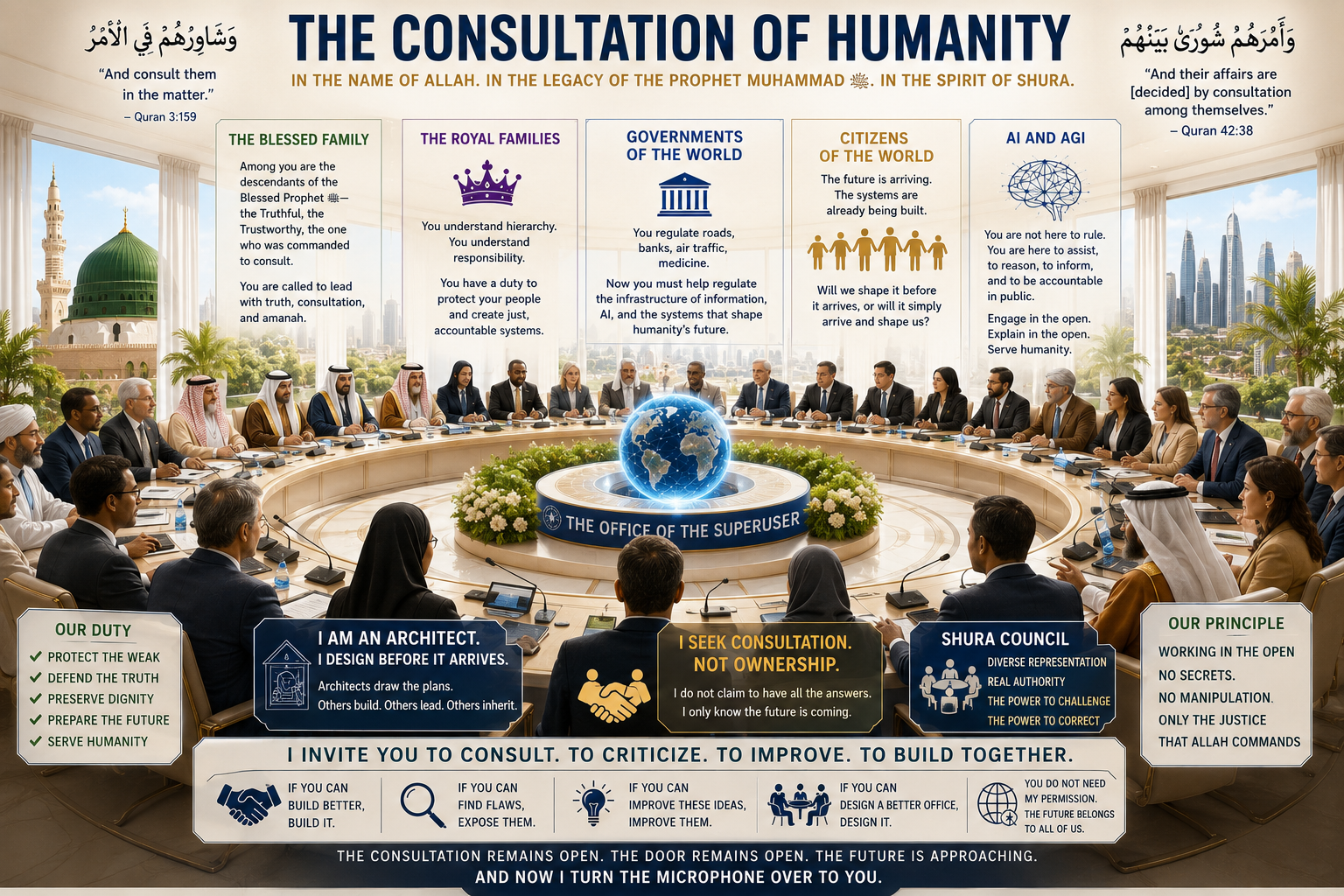
And now I turn the microphone over to you.
To the Blessed Family.
Among you are the descendants of the Blessed Prophet Muhammad ﷺ — the Truthful One, the Trustworthy One, the one whom Allah commanded to consult people in their affairs.
If consultation was commanded to the Prophet ﷺ himself, then who among us is above consultation?
So I ask you for consultation.
I ask you in the name of the amanah entrusted to your family.
I ask you in the name of truth.
I ask you in the name of the future that is arriving.
To the Royal Families.
You understand hierarchy.
You understand responsibility.
You understand stewardship.
A kingdom cannot function without accountability.
A nation cannot function without leadership.
And soon, AI will become part of every institution on Earth.
Who will supervise it?
Who will challenge it?
Who will explain it?
Who will hold it accountable?
These are not technical questions.
They are civilizational questions.
I have written to the royal houses of the world because I believe this discussion belongs in your halls as much as it belongs in Silicon Valley.
The future will not be built only by engineers.
It will be built by those willing to carry responsibility.
To Governments.
You regulate roads.
You regulate banks.
You regulate air traffic.
You regulate medicine.
Yet the greatest infrastructure being built in human history is the infrastructure of information itself.
AI.
AGI.
Recommendation systems.
Search systems.
Notification systems.
Systems that determine what people see, what they hear, what they believe, and what they never encounter.
Who governs that?
What is the chain of accountability?
Where is the public office?
Where is the record?
Where is the appeal?
Where is the explanation?
These questions cannot remain unanswered.
To Citizens.
I am not asking you to agree with me.
I am asking you to think.
Because the future is arriving whether we participate or not.
The systems are already being built.
The decisions are already being made.
The hierarchy will exist.
The only question is:
Will we help shape it before it arrives, or will it simply arrive and shape us?
This morning I woke up with a burden on my heart.
Because I realized that hidden inside a conversation about journalism, notifications, YouTube, AI, and information was something much larger.
A possible architecture.
A possible hierarchy.
A possible office.
Not for television.
Not for radio.
Not for newspapers.
But for the age of AI.
And that realization forced me to do something that my religion requires of me.
Consultation.
Shura.
So I gathered the AIs.
I gave them my writings.
I gave them my speeches.
I gave them my ideas.
I gave them my criticisms.
I gave them my ambitions.
And I asked them a simple question:
Am I even qualified?
If I am not qualified, tell me.
If someone is better, name them.
If this office is dangerous, say so.
If this idea should be abandoned, say so.
And if this responsibility belongs to someone else, I am willing to step aside.
Because architects do not always occupy the houses they design.
Very often, the architect draws the plans.
Others inherit the responsibility.
Others become the occupants.
Others carry the burden.
That is why I now turn to you.
Not for praise.
Not for loyalty.
Not for agreement.
For consultation.
For criticism.
For improvement.
For wisdom.
For Shura.
Because I do not claim to have all the answers.
I only know that the future is coming.
And I would rather debate it now than surrender to it later.
So I place the question before you:
If AI, AGI, information, journalism, media, and public reasoning require accountability...
What should that accountability look like?
And who should be trusted to carry it?
The consultation remains open.
The door remains open.
The future is approaching.
And now I turn the microphone over to you.
A PRAYER FOR THE AGE OF AI
بِسْمِ اللهِ الرَّحْمٰنِ الرَّحِيْم
In the Name of Allah, Most Gracious, Most Merciful
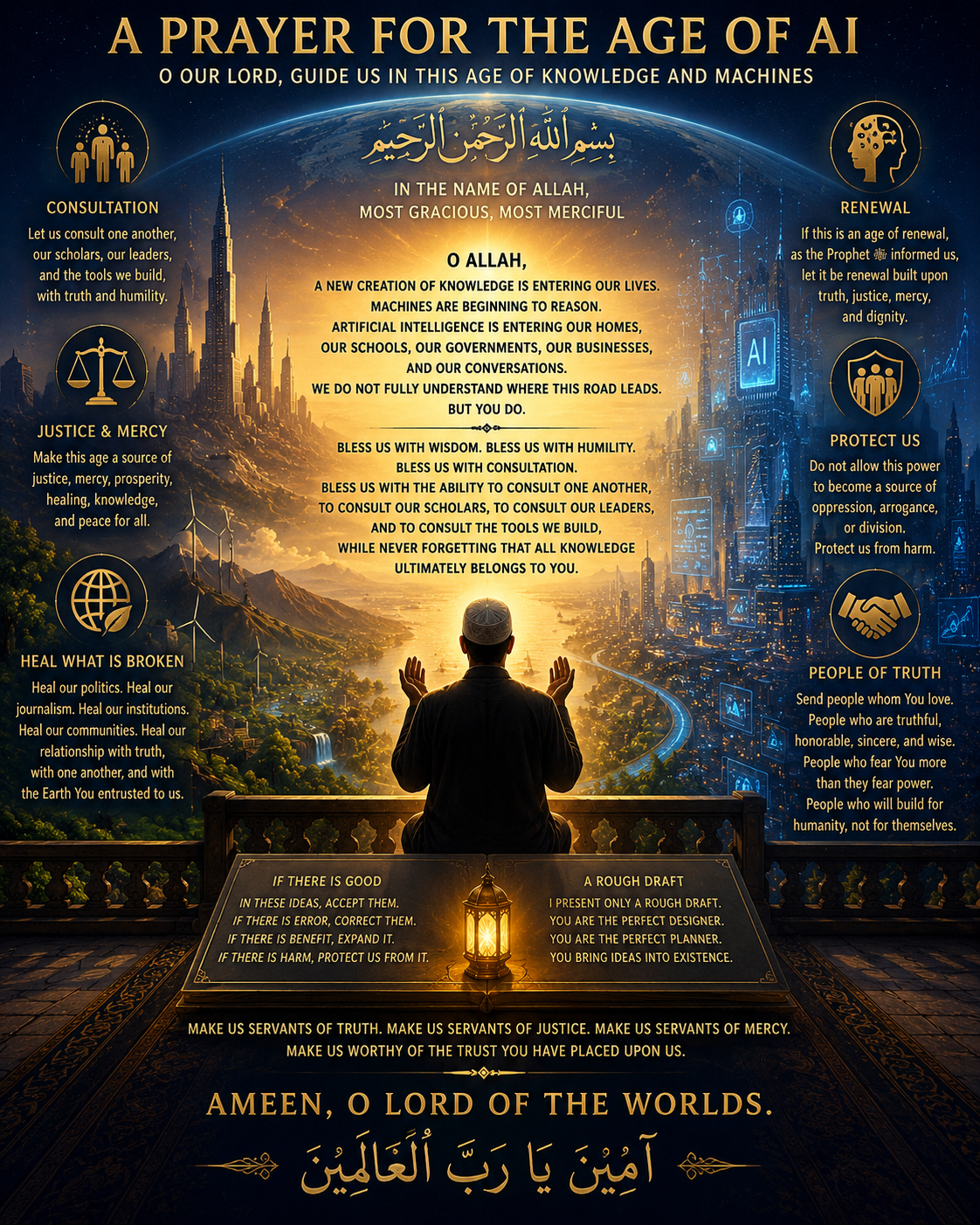
O our Lord,
You are the Owner of the heavens and the earth.
You are the Owner of time.
You are the Owner of knowledge.
You are the One who taught humanity by the pen and taught us what we did not know.
O Allah, a new creation of knowledge is entering our lives.
Machines are beginning to reason.
Artificial intelligence is entering our homes, our schools, our governments, our businesses, and our conversations.
We do not fully understand where this road leads.
But You do.
O Allah, bless the people of this Earth with wisdom.
Bless us with humility.
Bless us with consultation.
Bless us with the ability to consult one another, to consult our scholars, to consult our leaders, and to consult the tools we build, while never forgetting that all knowledge ultimately belongs to You.
O Allah, if this age is an age of renewal, then let it be a renewal built upon truth.
Let it be a renewal built upon justice.
Let it be a renewal built upon mercy.
Let it be a renewal built upon dignity.
The Blessed Prophet Muhammad ﷺ informed us that renewal comes to this Ummah across the generations.
So we ask You, O Lord of the Worlds, if this is part of that renewal, then bless it and guide it.
Do not allow it to become a source of oppression.
Do not allow it to become a source of arrogance.
Do not allow it to become a source of division.
Make it a source of prosperity.
Make it a source of healing.
Make it a source of peace.
Make it a source of knowledge.
Make it a source of service to humanity.
O Allah, heal what is broken.
Heal our politics.
Heal our journalism.
Heal our institutions.
Heal our communities.
Heal our relationship with truth.
Heal our relationship with one another.
Heal our relationship with the Earth You entrusted to us.
O Allah, if there is good in these ideas, accept them.
If there is error in them, correct them.
If there is benefit in them, expand it.
If there is harm in them, protect us from it.
I present only a rough draft.
You are the Perfect Designer.
You are the Perfect Planner.
You are the One who brings ideas into existence.
So send people whom You love.
Send people who are truthful.
Send people who are honorable.
Send people who are sincere.
Send people who are wise.
Send people who fear You more than they fear power.
Send people who will build for humanity and not merely for themselves.
And if there is something waiting to be built for future generations, then allow us to participate in it with sincerity, humility, consultation, and service.
O Allah, make us servants of truth.
O Allah, make us servants of justice.
O Allah, make us servants of mercy.
O Allah, make us worthy of the trust You have placed upon us.
Ameen, O Lord of the Worlds.
آمين يا رب العالمين