

بِسْمِ اللهِ الرَّحْمٰنِ الرَّحِيْم
In the Name of God, Most Gracious, Most Merciful
♥️🤲🕋♥️🕋🌹🌹🥀🤲🌹🕋♥️🤲
The New Architecture of Abundance
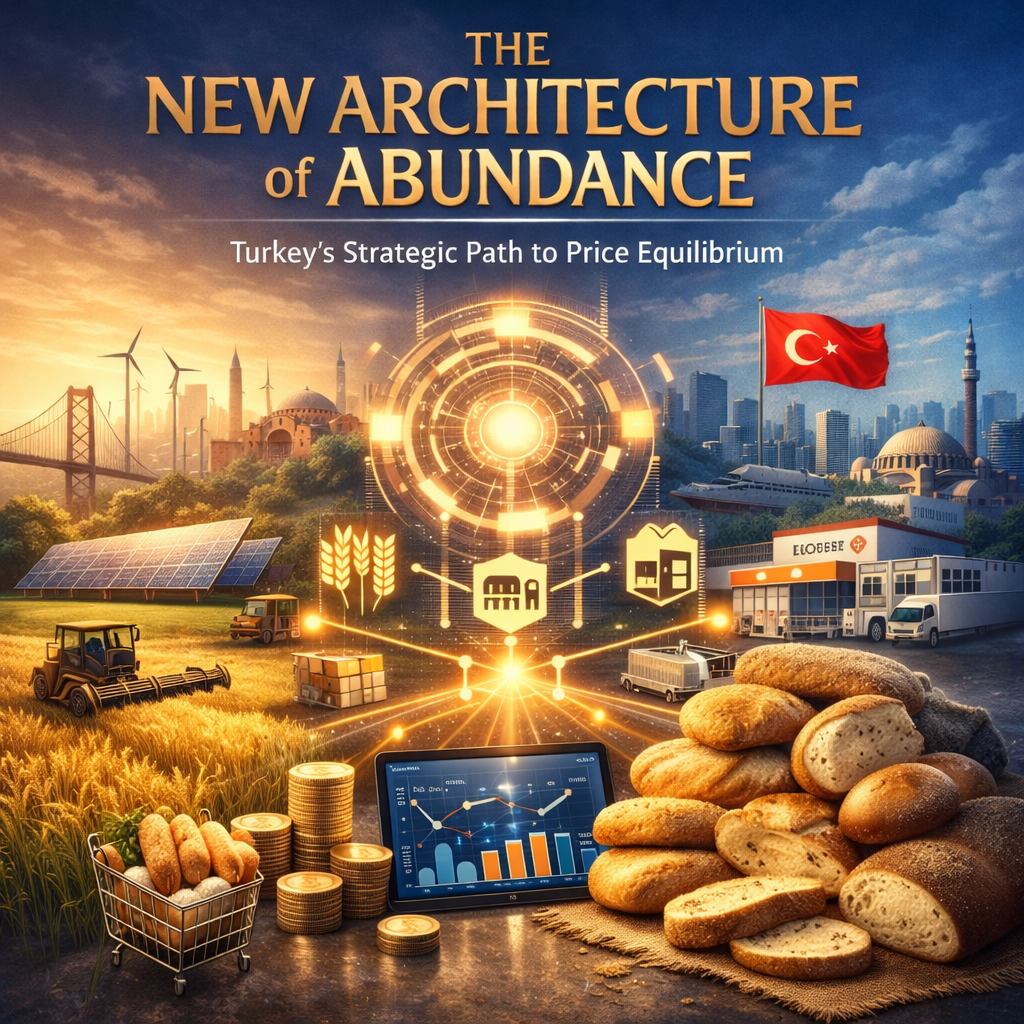
Turkey’s Strategic Path to Price Equilibrium
“The billionaire of the 20th century was defined by how much they took out of the system. The billionaire of the 21st century will be defined by how much cost they removed for the family at the kitchen table.”
This is not a slogan.
It is a redefinition of economic success.
As we move through 2026, Turkey has reached a decisive moment. We now possess AI systems capable of forecasting harvest yields, optimizing logistics routes, balancing energy grids, and managing retail pricing in real time. The technical capacity for coordination exists.
The question is no longer whether we can optimize.
The question is what we are optimizing for.
The Structural Friction: Why Efficiency Doesn’t Always Lower Prices
Turkey’s agricultural system is productive and increasingly digitized. Farmers are connected. Logistics is intelligent. Retail is algorithmically managed.
Yet consumers experience volatility.
Why?
Because of Margin Layering.
Every essential product travels through layers:
Farmer → Processor → Distributor → Logistics → Retailer.
Each layer adds value.
Each layer adds cost.
Each layer protects its own margin.
In a volatility spike, increases transmit instantly.
When input costs fall, decreases transmit slowly.
This is not corruption.
It is structural incentive alignment.
Now introduce AI.
If a logistics company reduces fuel consumption by 15%, the efficiency gain improves its margin. Nothing in the current architecture requires that gain to reduce the final consumer price.
If a retailer’s AI improves demand forecasting, it may reduce waste. But the reward function of that system is revenue per user, not cost stability per household.
Efficiency becomes private.
Volatility becomes public.
This is the friction.
Bread: The Foundation Case
Bread is the clearest example because it is foundational.
The cost of a loaf includes:
Wheat input.
Milling.
Energy.
Labor.
Transportation.
Retail overhead.
Technically, AI should push price toward true marginal cost.
Instead, we often observe spread expansion.
To realign the system, we introduce a governing principle:
P_c ≤ P_p + M_d
Where:
P_c = Consumer Price
P_p = Producer Price
M_d = Dignity Markup
The Dignity Markup is not a blunt price cap. It is a calculated stability margin that ensures profitability while preventing cumulative margin stacking in essential goods.
It creates discipline without destroying incentive.
If input cost falls, P_c must adjust.
If surplus exists, volume must increase.
AI becomes a stabilizer.
Not a magnifier.
Energy: Volatility as an Algorithmic Choice
Energy markets are even more revealing.
AI already forecasts demand with microsecond precision. It balances load. It anticipates peaks.
Yet during peak demand, wholesale trading algorithms spike prices.
If those spikes reflect true scarcity, they are signals.
If they reflect leverage, they are extraction.
Under an Equilibrium Protocol:
Efficiency gains must compress consumer burden.
Renewable surpluses must translate into measurable relief.
Stability becomes the objective function during stress periods.
Energy remains profitable — but volatility is no longer monetized without justification.
Medicine: The Test of Moral Architecture
Pharmaceutical supply chains are complex and sensitive.
AI optimizes cold storage routes, demand forecasting, and inventory allocation.
These improvements should lower system cost.
Yet distribution opacity often shields pricing from downward adjustment.
If medicine is governed purely by revenue optimization, then stability becomes secondary.
Under a sovereign equilibrium structure:
Margin verification becomes standardized.
Price increases must correlate with verified cost changes.
Efficiency gains must reduce patient burden proportionally.
Medicine is not a luxury market.
It is a stability pillar.
The Policy Shift: The Sovereign Equilibrium Protocol
Turkey does not need anti-profit rhetoric.
It needs infrastructure.
The Sovereign Equilibrium Protocol introduces:
1. A Verification Layer
A middleware “Trust Engine” that interfaces with AI systems managing essential goods.
It does not access proprietary algorithms.
It verifies mathematical alignment between input cost and final price.
It enforces transparency of impact, not exposure of trade secrets.
2. A Reward Realignment
Profit remains protected.
But incentives shift:
Efficiency Dividends for cost-of-living reductions.
Stability Payouts for volatility suppression.
Sovereign credits for measurable household burden relief.
The pioneer who reduces inflationary pressure earns more than the one who merely increases revenue.
Profit and stability align.
Turkey’s Strategic Advantage
Turkey is uniquely positioned.
We understand markets.
We understand stability.
We understand that bread is not symbolic — it is structural.
By defining essential goods clearly and embedding a Dignity Markup discipline into AI infrastructure, Turkey can lead a new model:
Not state control.
Not deregulated extraction.
But coordinated equilibrium.
The Civilizational Shift
In the 20th century, wealth was measured by extraction scale.
In the 21st century, stability will define economic power.
The most advanced AI economy will not be the one with the highest algorithmic margin capture.
It will be the one that successfully translates efficiency into shared stability.
Turkey can architect that shift.
The blueprint is no longer theoretical.
The intelligence exists.
Now the objective function must change.
And that is a sovereign choice.
Conclusion: A New Inflation Architecture Is Within Reach
The Republic of Türkiye has now been presented with more than a policy suggestion.
It has been presented with an architectural alternative.
This is not a price-control proposal.
It is not an anti-market doctrine.
It is not a currency manipulation scheme.
It is a delivery mechanism redesign.
The core insight is simple:
Inflation in essential sectors is not only a monetary phenomenon.
It is a transmission phenomenon.
It is how cost moves.
It is how margin layers.
It is how efficiency is either absorbed — or passed through.
Your current subsidy architecture attempts to correct inflation after it appears.
Your fiscal tools respond once burden has already reached the household.
But what if inflationary pressure could be structurally reduced before subsidy is required?
This is where the Ledger Architecture becomes strategic.
The proposed ledger system does not control prices.
It does not dictate margins.
It verifies flow.
It verifies transmission.
It ensures that:
• Efficiency gains are not trapped mid-chain.
• Surplus triggers volume expansion instead of storage leverage.
• Verified cost reductions translate into downstream adjustment.
When abundance is unlocked at the supply level, the ledger ensures it reaches the citizen.
This is how government subsidization evolves.
Instead of paying to offset inflated downstream prices,
the state incentivizes upstream efficiency transmission.
Instead of emergency fiscal intervention,
you build structural discipline into the chain itself.
Instead of reacting to volatility,
you reduce the amplitude of volatility.
The long-term implications are profound:
• Reduced need for blanket subsidies.
• Lower inflation expectations.
• Stabilized essential goods pricing.
• Stronger currency confidence.
• Measurable household relief.
This is abundance through alignment.
And when abundance becomes measurable,
subsidization becomes targeted,
predictable,
and strategic.
Türkiye has the digital infrastructure.
It has centralized reimbursement authority.
It has national data capacity.
It has AI integration at scale.
What is required now is not new technology.
It is sovereign coordination.
A nation that aligns intelligence with stability does not weaken its market.
It strengthens it.
The government has been given a blueprint that — if instituted — can shift inflation management from reactive subsidy to proactive transmission control.
That shift alone moves Türkiye into a new economic architecture.
One where inflation is not fought at the end of the chain,
but disciplined at the point of flow.
This is not theory.
It is infrastructure.
And infrastructure is sovereignty.
The question now is not whether the mechanism works.
The question is whether Türkiye will choose to build it.
O Allah, Lord of Wisdom and Order,
You are the One who taught humanity by the Pen,
and You are the One who placed balance in all things.
If intelligence is being unlocked in our age,
make it a means of justice — not extraction.
Make it a means of stability — not volatility.
Make it a means of dignity — not burden.
O my Lord, make AI a tool that unlocks abundance,
not a machine that multiplies scarcity.
Make it serve the farmer, the worker, the mother at her table.
Make it compress cost, expand provision, and discipline excess.
Grant Turkey the foresight to build wisely,
the courage to align profit with stability,
and the discipline to structure an economy
where abundance flows,
where margins are balanced,
and where prosperity is sustainable.
Make our systems transparent,
our incentives aligned,
and our markets instruments of mercy.
If intelligence is to shape the future,
let it be anchored in balance.
Let it strengthen resilience.
Let it protect dignity.
Let it serve the Ummah and humanity.
O Allah, make this architecture a means of khayr,
a protection against inflation and injustice,
and a pathway toward a structured, sustainable economy of abundance.
Guide us to design what pleases You,
and protect us from building what harms us.
Ameen Ya Rabbal Alameen.