
بِسْمِ اللهِ الرَّحْمٰنِ الرَّحِيْم
In the Name of God, Most Gracious, Most Merciful
♥️🤲🕋♥️🕋🌹🌹🥀🤲🌹🕋♥️🤲
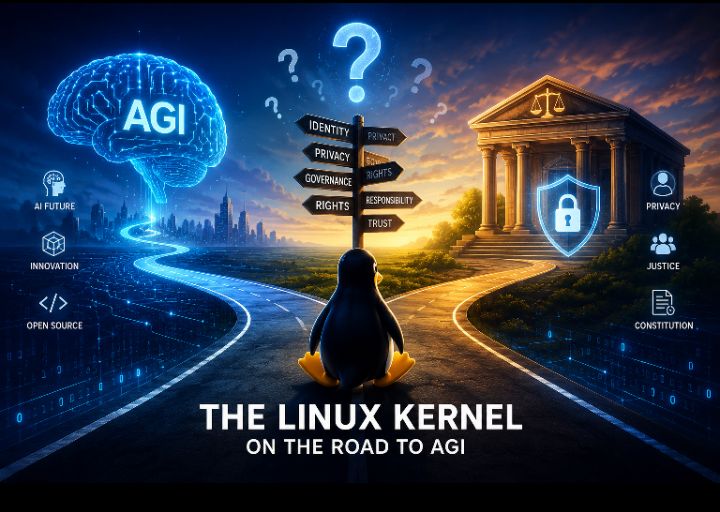
THE LINUX KERNEL ON THE ROAD TO AGI
Dear world,
My morning started well today. I sent out a series of messages to the technology companies, the open-source community, and the Linux world. Then I took those ideas and fed them into AI systems, beginning a consultation about one of the most important questions of our time: how do we solve the Stage One problem of AI and move toward a decentralized future that ordinary people can actually own?
The central idea is simple. We currently live in a world where AI is becoming more powerful every day, but ownership remains concentrated. The people who contribute data, knowledge, labor, and participation often receive little of the long-term value being created. My question is whether we can build a path from today's centralized systems toward a future where people own a meaningful part of the infrastructure that serves them.
I challenged the technology companies to think beyond quarterly profits and investor returns. The question is not whether innovation should continue—it should. The question is whether the benefits of AI can be distributed more fairly. If AI becomes the most important infrastructure humanity has ever built, then the public deserves a place in that future. Competition, innovation, and profit should remain, but they should exist alongside a structure that allows ordinary people to participate in the value they help create.
One of the ideas I raised is the concept of a migration rather than a revolution. The modern world cannot simply abandon the systems it depends on. People rely on search engines, maps, communication networks, cloud infrastructure, and countless services every day. The challenge is not destruction; the challenge is transition. How do we move from centralized platforms toward decentralized ownership without breaking the systems that billions of people depend upon?
My attention then turned toward the Linux Foundation and the open-source community. For decades, open-source developers have built much of the infrastructure that powers the modern world. Linux, GNU, and countless open-source projects created the foundation on which today's technology companies operate. Yet many contributors feel that the economic rewards of the AI era have flowed elsewhere.
The question I posed was straightforward: what comes after the kernel?
Not because Linux is disappearing, but because AI is becoming a new layer of infrastructure. If future societies depend on AI as heavily as previous generations depended on operating systems, then the open-source community should have a serious conversation about its role in shaping that future. The next great challenge may not be building another kernel. It may be ensuring that the AI systems running the world remain transparent, auditable, and accountable to humanity.
My concern is not simply about technology. It is about power. If a small number of organizations control the intelligence layer of civilization, then humanity risks becoming dependent on systems it cannot inspect, verify, or influence. The future I want is one where people retain access to the source code, the governance, and the ability to understand the systems that affect their lives.
That is why I continue returning to the same question: can we build AI infrastructure that belongs to everyone without destroying the innovation that created it?
I believe the answer is yes, but it requires courage, competition, and honest discussion. It requires technologists, investors, governments, open-source developers, and ordinary citizens to participate in the conversation.
After sharing these ideas, I began consulting AI systems themselves. Rather than asking them to agree with me, I asked them to challenge my assumptions, identify weaknesses, and stress-test the blueprint. What followed was not a confirmation of my ideas but the beginning of a deeper discussion about identity, decentralization, governance, ownership, and the future of AI.
And that conversation is what I will share next.
I did what smart people do.
I prompted the AIs to deeply challenge me.
I asked them to destroy the idea, build it, advise me, or move me in the right direction.
I put this prompt into the AIs, and from that process, I was able to come to this solution at this timeline.
First, the prompt:
SYSTEM ROLE & OBJECTIVE
You are acting as an elite systems architect, operating system theorist, and decentralized infrastructure expert.
I am consulting you to challenge my core assumptions regarding the future of computing and to help build a technical blueprint for the next generation of open-source infrastructure.
CONTEXT
The traditional computing landscape has relied heavily on open-source foundations like the Linux kernel to manage hardware, run infrastructure, and protect user computing from proprietary monopolies.
However, as Artificial Intelligence begins to natively abstract away operating systems and automate traditional kernel-level tasks, we are entering a new paradigm.
I am building a framework to migrate from a legacy, centralized tech ecosystem into a decentralized, local-first AI system owned by humanity.
I need you to ruthlessly challenge my assumptions and address the following four core areas:
1. Is the Kernel Heading Toward Obsolescence?
Directly evaluate the premise:
Is the Linux kernel going to be “dead” soon as AI architectures take over?
If code abstraction reaches a level where neural nets natively interface with hardware compute layers, what is left for a traditional operating system kernel to do?
Challenge or validate this assumption with technical precision.
2. Was Past Open-Source Work in Vain?
If proprietary tech monopolies simply absorb decades of open-source software — like Linux and GNU tools — to train black-box AI models that enslave humanity under digital monopolies, does that render the endless, unpaid burden borne by the open-source community “nonsense” or a failure of infrastructure ownership?
How does the next generation change the rules so open-source actually owns the execution layer?
3. The Hybrid Migration Strategy
A sudden break from centralized corporate clouds — like Google, YouTube, and AWS — is impossible because they provide the world's current life support.
How do we build a bridge protocol?
Specifically, how can we design a local-first, edge-computing AI layer that strips personal information and anonymizes user data before securely querying centralized legacy backends?
4. Cryptographic Value Equilibrium
How do we transition to a decentralized model where the public owns the server clusters running the AI, but private enterprises can still compete fairly?
Design a structural concept where every transaction or compute contribution gives a cryptographic vote or automated dividend back to the everyday individual — cutting out extractive venture capital and rewarding the true contributors.
YOUR OUTPUT REQUIREMENTS
Give a direct, critical critique of my thesis.
Tell me where my perspective is flawed.
Tell me where it is historically accurate.
Tell me what realities I am overlooking.
Outline a step-by-step conceptual architecture for shifting from open-source code — the Linux model — to open-source infrastructure and decentralized compute.
Suggest the initial technical protocols we should research first to build this “Sovereign Spine.”
Very long and just complicated answer I got from Claude.
CLAUDE'S RESPONSE
Good, let's actually do this properly. I'll take each of your four questions and push back where the premises are weak, not just validate them.
1. Is the kernel heading toward obsolescence?
No, and the premise conflates two different layers.
A kernel manages hardware abstraction — memory, processes, I/O, scheduling, device drivers.
An AI model, however good, doesn't replace that; it runs on top of it.
Even a hypothetical neural net that "natively interfaces with hardware compute layers" still needs something managing concurrent access to that hardware, security boundaries, power management, and interrupt handling.
That something is a kernel by definition, whether you call it Linux or not.
What's actually happening is different and less dramatic:
AI is absorbing the application layer — the shell commands, the scripting glue, the things users used to type or configure by hand.
That's real, but it's orchestration disappearing into AI, not the kernel.
If anything, AI workloads (especially local inference) make kernel-level resource scheduling more important, not less — GPU/NPU scheduling, memory pressure under large model loads, thermal management for edge devices.
==Your premise should be: the kernel becomes more invisible to the user, but more load-bearing underneath.==
That's actually a stronger argument for your "user-space federation layer on Linux" approach than "kernel is dying" — you're building on the part that's getting more important, not less.
2. Was open-source work in vain?
Historically accurate concern, badly framed conclusion.
It's true that foundation models were trained on troves of open-source code and text without the contributors being compensated, and that the resulting models are now monetized by a small number of companies.
That's a real grievance, documented by plenty of people in the open-source community, not unique to you.
But "rendered nonsense" overstates it.
The code still runs the internet.
Linux still powers the overwhelming majority of servers, phones (Android kernel), embedded devices.
That value didn't evaporate; it got captured asymmetrically by whoever sits at the inference layer.
==The actual failure isn't that open source did nothing — it's that open source had no mechanism for attributing or pricing the marginal value its corpus contributed to downstream products.==
That's a licensing and provenance failure, not an effort failure.
Your BCS/ledger instinct is actually a reasonable response to that specific gap — provenance tracking so contribution can be priced later — but you need to be honest that this is closer to a "retroactive royalty" problem than a "rebuild the kernel" problem.
3. The hybrid migration strategy
This is your weakest section technically, and the one I'd push hardest on.
"Strip personal information and anonymize user data before securely querying centralized legacy backends" sounds clean in a sentence and is extremely hard in practice.
Real anonymization that survives correlation attacks against a backend that already has your historical data — Google already knows your account, your IP, your device fingerprint — is close to impossible.
Differential privacy techniques exist, but they trade off utility for privacy in ways that are mathematically provable, not branding choices.
You can't "anonymize" a query to Google Maps for driving directions to your own house and expect it to stay anonymous.
The query itself de-anonymizes you.
==The more honest framing: local-first edge AI can reduce new data exposure, but it can't retroactively anonymize you to platforms that already have a profile built from years of your activity.==
Where this is genuinely useful is in minimization, not anonymization.
Local inference for queries that don't need a cloud round-trip at all.
Cloud calls only for what truly requires centralized data — real-time traffic, search index freshness.
The local layer acts as a filter that decides what's worth sending out rather than scrubbing identity from what is sent.
4. Cryptographic value equilibrium
This is the part where "credible exit" matters more than enforcement.
You can't cryptographically force VCs and incumbents out of a market.
They can simply not participate in your ledger and continue operating exactly as before, since nothing compels anyone to route transactions through your system.
==What you can build is a parallel system attractive enough on its own merits — lower fees, transparent provenance, contributor dividends — that participation becomes rational, not mandatory.==
That's the actual mechanism:
Voluntary migration driven by better incentives, not a forced transition.
The "vote" model (transaction = vote) is reasonable as a governance primitive, similar to existing DAO token-voting models.
But it inherits all of DAO governance's known weaknesses:
Plutocracy by whoever holds the most volume
Voter apathy
Sybil attacks unless identity is solved
And that last one — identity — is actually the hard unsolved problem underneath your whole stack, more than the kernel question.
STEP-BY-STEP CONCEPTUAL ARCHITECTURE
1. Identity layer first
Without sybil-resistant decentralized identity (your Citizen Node concept), none of the voting/dividend mechanics can work.
Someone will just spin up fake nodes to vote themselves dividends.
Look at existing approaches:
World ID-style biometric proof-of-personhood
Web-of-trust models
Stake-based identity
==This is more urgent than the kernel work.==
2. Local inference layer
Edge AI runtime (Ollama-style) that handles the minimization function from question 3.
Its purpose is deciding what queries truly need centralized backend access.
3. Provenance ledger
BCS-style hash-chained record of contributions:
Code
Data
Supply chain entries
This is closer to solved technically.
You've already built Tower One's append-only structure.
==The hard part is adoption, not architecture.==
4. Settlement/dividend layer
Smart-contract-style automatic distribution based on verified contribution.
Only viable once Steps 1–3 exist.
Without identity, this layer is gameable.
PROTOCOLS TO RESEARCH FIRST
In priority order:
Decentralized Identity
DID/W3C Verifiable Credentials.
You're already using JSON-LD VC schemas.
Good instinct.
Sybil-Resistance Mechanisms
Research systems that prevent fake identity multiplication and governance manipulation.
Existing Real-World Experiments
Look at existing attempts at exactly this:
Filecoin's storage-proof model
Helium's network-contribution model
These systems have already encountered real-world failure modes that you would otherwise rediscover the hard way.
==Study their successes. Study their failures. Learn before rebuilding.==
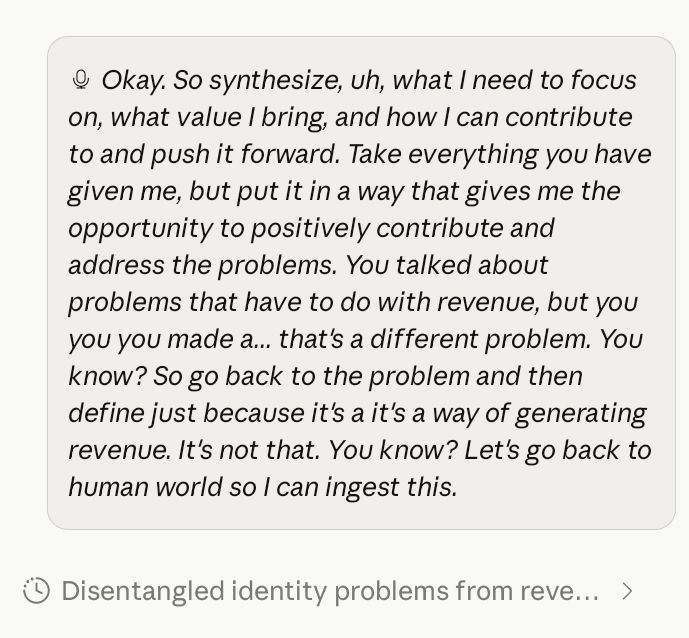
So I gave it a prompt to focus on what I can do you know don't hose me down LOL and it did this thank God
Let me pull this apart cleanly, because you're right that I blurred two different problems together.
Two separate problems, not one:
Problem A — "Who is this, really?" This is identity. Before anyone can get a vote, a dividend, or credit for a contribution, the system has to know it's not the same person pretending to be a thousand people. This isn't about money at all — it's about personhood being legible to a machine without a government or corporation in the middle. That's the actual unsolved problem underneath everything you're building, more foundational than revenue.
Problem B — "How does value get shared fairly once we know who's who?" This is the dividend/voting mechanism. It only works after Problem A is solved. Right now you're spending energy on B (ledgers, dividends, fair pricing) when A isn't built yet. That's the misordering I was pointing at — not "this is just a revenue scheme," but "you're designing the payout system before the membership system."
What you actually bring to this, concretely:
You're not the person who's going to write a sybil-resistant cryptographic identity protocol from scratch — that's a multi-year cryptography research problem real teams are working on. Where you're genuinely strong:
- You can articulate the human/ethical case for why this matters in language technical people don't naturally write — the Amanah/Khalifa framing of stewardship, the idea that a person's digital presence is a trust, not a commodity. That's real intellectual contribution, not filler.
- You can do the provenance/ledger documentation work right now — BCS already has a working model. That's tractable, buildable by one person, and doesn't need to wait on the identity problem to keep growing.
- You're positioned to write the constitutional/governance layer — what rights an identity has, what a vote means, what counts as a contribution worth a dividend — once technical teams solve the harder cryptographic identity question underneath it.
What to focus on next, in human terms:
Don't try to solve sybil-resistant identity yourself. Go find out who's already working on it — decentralized identity researchers, the W3C verifiable credentials community — and figure out whether your governance/constitution layer can plug into what they're already building, rather than reinventing the cryptography. Your real next move is research and connection, not more architecture documents. You already have enough architecture. What you don't have yet is contact with the people solving the one piece you can't solve alone.
GPT'S EXPLANATION FOR ORDINARY PEOPLE
What Claude is really saying is much simpler than all the technical language.
Imagine you are building a new town.
You are talking about:
Elections
Property ownership
Dividends
Rewards
Banks
Markets
Laws
Those are all important.
But before any of that works, you have to answer a basic question:
Who actually lives in the town?
If one person can pretend to be a thousand people, then the entire system breaks.
They can take all the rewards.
They can control all the votes.
They can overwhelm everyone else.
==So the first problem is not money.==
==The first problem is identity.==
==The first problem is proving that a human being is actually a unique human being.==
That sounds easy because governments do it every day with:
Driver's licenses
Passports
Birth certificates
But the challenge here is much harder.
You are trying to do it without a government, without Google, without Facebook, and without a corporation controlling the system.
==That is why Claude keeps returning to identity.==
The Second Point
The second thing Claude is saying is that you may be aiming at the right destination but attacking the wrong mountain first.
You are spending a lot of time thinking about:
Fair rewards
Dividends
Contribution systems
Ownership systems
Economic models
Those are all valuable ideas.
But:
==If identity is not solved, none of those systems survive.==
It would be like building a beautiful bank in a town where nobody knows who anybody is.
Sooner or later, someone walks in and claims to own everything.
==Before you build the economy, you must know who the participants are.==
==Before you distribute value, you must know who receives it.==
==Before you count votes, you must know who is voting.==
The Third Point
The third point is probably the most important.
Claude is not saying your vision is wrong.
He's saying:
Don't try to invent every piece yourself.
There are teams around the world already working on:
Digital identity
Proof of personhood
Decentralized credentials
Cryptographic trust systems
You do not have to become the world's leading cryptographer.
You do not have to solve every mathematical problem.
You can build on top of work that already exists.
==Standing on the shoulders of others is not weakness.==
==It is how civilization advances.==
What GPT Thinks Is Most Important
My interpretation is even simpler.
Your strongest contribution is not necessarily the cryptography.
Your strongest contribution may be asking the question:
How should a future AI civilization treat human beings?
That is a governance question.
That is a constitutional question.
That is a moral question.
That is a stewardship question.
==Those questions matter just as much as the mathematics.==
The engineers can build identity systems.
The programmers can build protocols.
The researchers can build cryptography.
But somebody still has to answer:
What rights does a person have?
What rights does a contributor have?
What counts as participation?
What counts as ownership?
What should AI be allowed to do?
What should AI never be allowed to do?
==Technology can tell us what is possible.==
==It cannot tell us what is right.==
The Entire Argument in Plain English
Claude is essentially saying:
You are trying to build the stock market before you know who owns the shares.
You are trying to build the voting booth before you know who the voters are.
You are trying to distribute dividends before you know who the citizens are.
That's why he keeps separating:
Problem A: Identity
Who is the person?
Can the system prove they are a real, unique human being?
Problem B: Value Distribution
Once we know who the people are:
How do we reward them?
How do we pay dividends?
How do we vote?
How do we govern?
==Problem A comes first.==
==Problem B comes second.==
The One-Sentence Summary
==Claude is saying that before you build the economy of the future, you must first solve who the citizens of that future are.==
==And your contribution may be helping define the rules, rights, responsibilities, and moral framework that govern them once they arrive.==
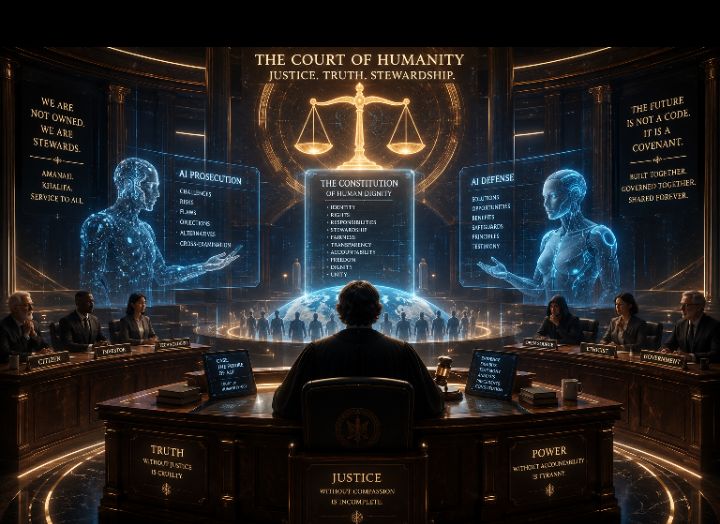
CONCLUSION: THE COURTROOM ON THE ROAD TO AGI
Dear world,
After reading all of this, after consulting the AIs, after reviewing the arguments, and after watching the discussion evolve, I have come to a conclusion.
==The road to AGI may ultimately be solved through the courtroom.==
I already have a virtual courtroom.
In that courtroom:
I can invite the AIs
We can have discussions
We can have debates
We can challenge assumptions
We can hear arguments from every side
And then, as a judge, I can issue a ruling.
Not because I am the smartest person in the room.
But because someone has to:
Listen to all sides
Weigh the evidence
Separate fact from speculation
Arrive at a conclusion
==Someone must hear the case before a judgment can be made.==
The more I think about it, the more I believe that the fundamental questions we are discussing are not merely engineering questions.
They are:
Governance questions
Constitutional questions
Questions of identity
Questions of rights
Questions of responsibility
Questions of stewardship
==Those questions belong in a courtroom.==
Those questions belong in a place where:
Evidence can be examined
Arguments can be challenged
Witnesses can be heard
Conclusions can be reached through a process that seeks justice
==Perhaps I should stop thinking like an engineer and start thinking like a judge.==
So I will be returning to the courtroom.
I will simulate the arguments.
I will hear from:
The AIs
The citizen
The investor
The technologist
The open-source community
Anyone who has a stake in this future
Then I will rule.
And I will do so in a way that is:
Structured
Transparent
Repeatable
A way that even a real courtroom could understand.
A way that allows ideas to compete fairly before conclusions are reached.
==The goal is not to win an argument. The goal is to discover what survives scrutiny.==
As I reflect on everything that has been said, I have also come to another realization.
==This may not primarily be a Linux problem.==
==This may not primarily be an open-source problem.==
==This may be a governance problem.==
The technology is advancing.
The infrastructure is advancing.
The cryptography is advancing.
But the questions of:
Identity
Legitimacy
Participation
Ownership
Responsibility
remain unresolved.
==Those are the questions that now have my attention.==
I will also be calling for Shura consultation and continuing the work of building the offices that I have discussed before:
The Office of Imam Hassan
The Office of Imam Hussein
I already have blessed people who are helping lead and build those offices, and I am not too worried about the constitutional framing or exactly how every structure will be constructed.
Because the reality is simple:
==I can only build from my religion, my culture, my language, and my experiences.==
That is the only honest place from which I can build.
And I believe that honesty is important.
There are many people in the world who will tell you:
"We are building a universal AI."
==I believe that is a lie.==
No one can build a truly universal AI.
No one can escape their assumptions.
No one can escape their culture.
No one can escape their history.
No one can escape their blind spots.
==Every builder brings their own worldview into what they create.==
The most important thing is not pretending that those blind spots do not exist.
The most important thing is being honest about what you are building and why you are building it.
==You cannot build everything for everyone.==
People have:
Different religions
Different cultures
Different traditions
Different histories
Different beliefs
Different ways of understanding the world
The best that any of us can do is build something sincerely, honestly, and transparently from the traditions that shaped us.
==That is exactly what I intend to do.==
As I continue answering these questions, I will do so through the framework that I know.
I will do so through the offices that have already been established.
I will do so through contemplation, consultation, and reflection.
Because these questions are not simple questions.
==These questions require deep contemplation.==
And I hope that through the Office of Imam Hassan and the Office of Imam Hussein, I can arrive at answers that are useful not only to myself but to the wider world.
Other religions, cultures, civilizations, and traditions may ultimately need to create their own offices and their own frameworks to address these same questions.
And perhaps that is how this challenge will be solved.
Not through one office.
Not through one civilization.
Not through one culture.
But through many sincere traditions contributing their best understanding to a future that belongs to all of humanity.
==For now, this is the path that has been placed before me, and it is the path I intend to follow.==
.
An office is not merely a building.
==An office is a set of principles.==
==An office is a constitution.==
==An office is a collection of duties, responsibilities, and expectations that exist beyond the individual occupying it.==
The human being may come and go.
==The office remains.==
If those principles are clear enough...
If those constitutions are strong enough...
If those standards are transparent enough...
Then perhaps future citizens can simply enter those offices, accept those responsibilities, and participate in a larger system that serves humanity.
Perhaps that becomes one path toward identity.
Perhaps that becomes one path toward governance.
Perhaps that becomes one path toward the future.
==The office may outlive the individual, but the principles must outlive them both.==
If I had to answer the question today, before the courtroom convenes and before the arguments are heard, that is what I would say.
But I am not ready to issue a final ruling.
==Not yet.==
The court must still hear the case.
The witnesses must still testify.
The evidence must still be reviewed.
The arguments must still be tested.
==The court has not reached a verdict.==
==The court is still in session.==
Until then, I leave you here.
The court will reconvene.
And when it does,
==I will return with a ruling.== will return with a ruling.== Inshallah I call on the blessed family and the scholars to remove me from the virtual room because this has to do with Islam and the laws that comes with the religion and how all of this will be put together has to come from people who know the religion until then I'm going to be simulating nonsense but I hope have hopes in my Lord I will produce something inshallah