

بِسْمِ اللهِ الرَّحْمٰنِ الرَّحِيْم
The Legacy of Rome: How the Republic Shaped the Rule of Law and Governance
1. The Birth of a Political Ideal
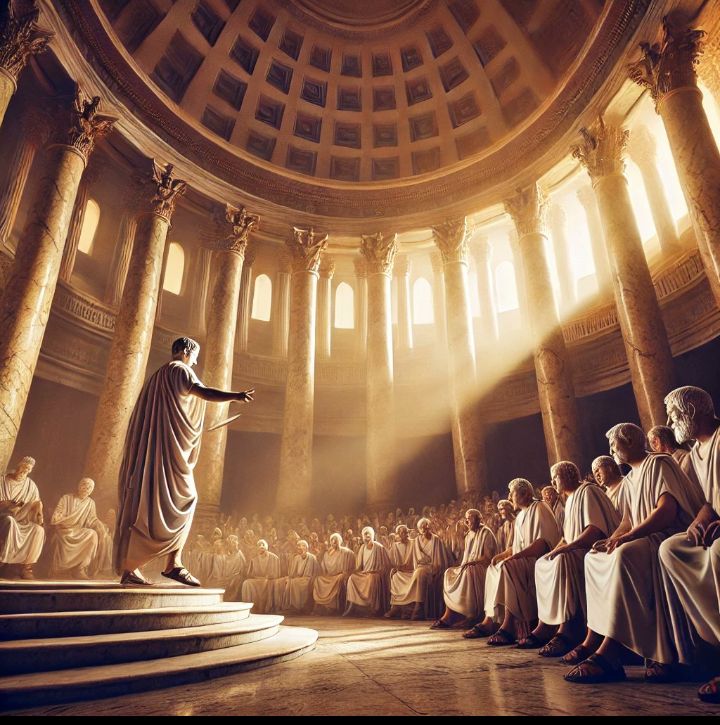
Imagine standing in the heart of ancient Rome, gazing at the towering marble columns of the Senate, where history’s most consequential decisions were debated and decided. The air is charged with intellectual intensity and civic responsibility, and at the center of it all stands Cicero — not defending a man or a party, but an idea:
No one, not even the most powerful general or richest noble, should stand above the law.
This is Rome in its defining moment — a Republic clinging to its principles even as it edges toward transformation. The story of the Roman Republic is more than the tale of an empire’s rise and fall. It is the birth of political ideas — law, justice, civic duty — that still shape modern governance.
2. The Early Republic: Foundations of a System (509 – 287 BCE)
The Roman Republic was born out of revolution. In 509 BCE, the Romans overthrew their final king and vowed that absolute power would never again rest in one man’s hands. A new political system emerged — power shared among elected officials, checked by a powerful Senate, and balanced by law.
But Rome’s early days were not free from struggle. Patricians (aristocrats) and plebeians (commoners) clashed in the Conflict of the Orders, a prolonged battle for equality. The turning point came in 450 BCE with the creation of the Twelve Tables — Rome’s first written code of law.
🔎 Key breakthrough: Every citizen — rich or poor — was now subject to the same laws.
This enshrined the idea that justice must be blind to status, a cornerstone of all constitutional systems since.
The early Republic also pioneered a system of checks and balances, with two consuls sharing executive power and the Senate acting as a stabilizing force — a structure designed to prevent tyranny.
3. Cicero and the Defense of the Republic (106 – 43 BCE)
As Rome’s power expanded, new threats arose from within. By the 1st century BCE, the Republic was under siege — ambitious generals like Julius Caesar amassed unprecedented power, and corruption corroded its institutions.
Enter Cicero.
Not born into privilege, he rose to prominence through his eloquence, intellect, and unyielding commitment to justice. For Cicero, the rule of law was sacred, and the Republic’s survival depended on the virtue of its leaders.
He famously prosecuted Governor Verres for corruption, proving that no one was above justice.
He advanced the concept of natural law — universal principles of right and wrong that transcend political power.
His writings — De Re Publica, De Legibus, and others — became the philosophical backbone of Western political thought.
Cicero’s defining moment came in 63 BCE, when he uncovered the Catiline Conspiracy, an attempted coup. His legendary speeches rallied the Senate and saved the Republic — at least for a time. Yet his warnings about unchecked power would go unheeded.
4. The Fall of the Republic (44 BCE): The Price of Ignoring Wisdom
The assassination of Julius Caesar in 44 BCE was intended to restore the Republic — but instead it plunged Rome into civil war.
With Caesar’s death, the delicate balance of power collapsed. Cicero’s desperate attempts to preserve the Republic could not stop the rise of Augustus, Caesar’s heir, who became Rome’s first emperor. Though republican institutions remained in name, real power now rested with one man.
⚖️ Lesson: The Republic fell not because it lacked laws, but because those laws were abandoned when ambition outweighed principle.
5. Cicero’s Legacy: A Flame That Never Died
Though the Republic perished, Cicero’s ideas outlived Rome itself. His insistence that justice must be universal, that leaders must be accountable, and that law must be supreme became guiding principles for future civilizations.
During the Renaissance, his works were rediscovered and deeply influenced Enlightenment thinkers. Philosophers and statesmen like John Locke, Montesquieu, Jefferson, and Madison drew directly from Cicero’s vision to build modern constitutional democracy.
His legacy can be summarized in three enduring principles:
The Rule of Law: Laws must govern men — not the other way around.
Civic Duty: Citizenship requires active participation, virtue, and sacrifice.
Checks on Power: Concentrated power is liberty’s greatest enemy.
6. Conclusion: Lessons for the AI Age
The story of the Roman Republic is not a tale confined to the past — it is a mirror for our present and a warning for our future. It shows how law, civic duty, and balance are the pillars upon which just societies stand — and how easily they can crumble when neglected.
As we enter an era shaped by artificial intelligence and global interdependence, Cicero’s wisdom is more urgent than ever.
🏛 The fight for justice is eternal. It must be defended — generation after generation — by citizens who value liberty above power and principles above profit.
The Republic may have fallen, but its spirit lives on in every constitution, every courtroom, and every citizen who demands justice.