

بِسْمِ اللهِ الرَّحْمٰنِ الرَّحِيْم
In the Name of God, Most Gracious, Most Merciful.
♥️🤲🕋♥️🕋🌹🌹🥀🤲🌹🕋♥️🤲
The Internet Must Die: A Manifesto for the Agentic Age
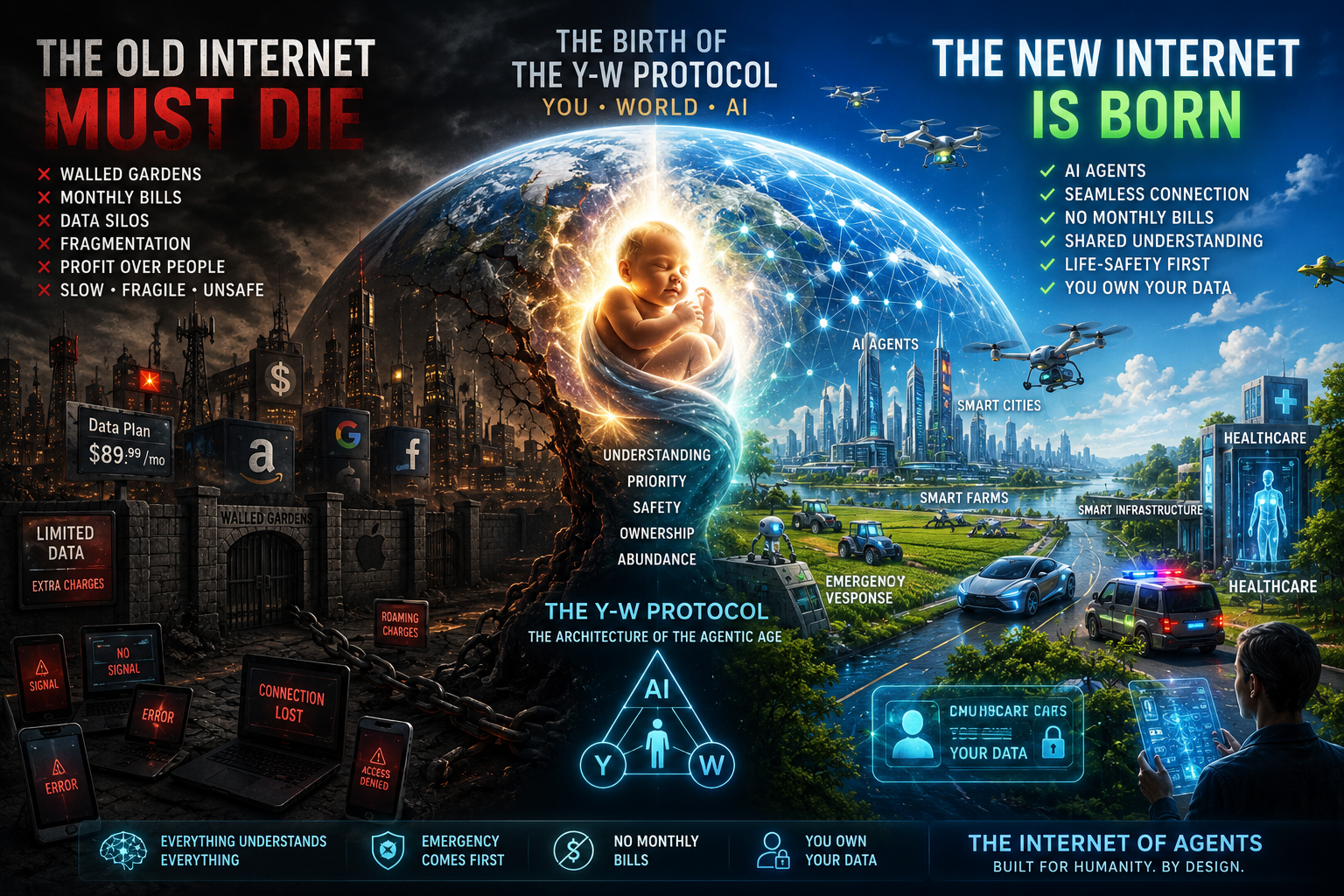
Prologue: I Saw a Baby
Let me tell you what I saw.
I saw a baby. Not a literal infant—something more important. I saw the future of the internet. Fragile, crying, utterly dependent on a world that isn't ready for it.
That baby is the agentic internet. The network of autonomous robots, smart farms, emergency drones, trillions of devices, and AI systems that will soon outnumber humans ten to one.
And the current internet? It's the bathwater. Filthy, stale, toxic, and about to drown the baby if we don't throw it out.
I've spent years thinking about this. I've done the math. I've written the equations. And I've come to a conclusion that might sound extreme, but it's true:
The old internet must die. The telecom companies must die. The walled gardens must crumble. The monthly bills must end.
This isn't about anger. It's about survival.
Part I: The Diagnosis
Why the Current Internet Must Die
The internet was designed for a world that no longer exists.
What It Was Built For | What We Need Now
Web browsers and smartphones | Autonomous agents and robotics
Human-to-human communication | Machine-to-machine coordination
Monthly bills per person | Continuous, always-on agents
Walled garden platforms | Interoperability as a requirement
Profit-driven infrastructure | Infrastructure as a public utility
Scarcity economics | Abundance economics
The Math Doesn't Work
Let me show you what I mean.
Consider one smart farm. Just one:
· 100 autonomous harvesting robots
· 50 environmental sensors
· 20 drones for crop monitoring
· 10 irrigation control units
· 5 security cameras
· 1 central AI coordinator
That's 186 devices on a single farm. Each one needs constant connectivity. Each one talks to the others. Each one generates data, receives commands, and executes actions.
Now multiply that by:
· 2 million farms in the United States
· 100,000 smart buildings
· 50,000 airports and ports
· 4 million miles of road with smart infrastructure
· Every hospital, power station, water system, and bridge
We're talking trillions of connected agents.
The current model—where each device needs a "plan" and each byte costs money—collapses under this weight. It's not just economically unsustainable. It's physically impossible.
The Fragmentation Problem
Here's another thing I've observed.
A single smart house today requires:
· Wi-Fi for entertainment and general connectivity
· Bluetooth for personal devices
· Zigbee or Z-Wave for smart home sensors
· Cellular for security and emergency backup
· Ultra-Wideband for precise location tracking
· Thread or Matter for IoT coordination
Six protocols. Six different standards. Six security models. And none of them talk to each other without complex, brittle bridges.
Now imagine a smart car communicating with a smart traffic light, an emergency drone, and a hospital AI, all while navigating a city with smart buildings and autonomous delivery robots. The current protocol soup is a nightmare of incompatibility.
This is not innovation. This is chaos.
Part II: What the Linux Foundation Is Doing
Credit Where It's Due
Before I go further, let me say something important.
The Linux Foundation is doing the most important infrastructure work in the world right now. Through their Agentic AI Foundation and AGNTCY project, they're building the skeleton of the future.
They've done something remarkable:
· They neutralized the walled gardens. Google, Anthropic, OpenAI, and Cisco all donated their crown jewels to a public foundation. That's unprecedented.
· They built the plumbing. Discovery, identity, messaging, observability—the skeleton of a new internet.
· They created a home. A place where standards don't belong to corporations, but to the public.
Project | What It Does | Who Donated It
Model Context Protocol (MCP) | Universal adapter for agents to access tools and data | Anthropic
Agent-to-Agent (A2A) Protocol | Common language for agent collaboration | Google
AGENTS.md | Simple instructions for agents in codebases | OpenAI
AGNTCY Project | Discovery, identity, messaging, and observability infrastructure | Cisco
Backed by Amazon, Google, Microsoft, and OpenAI—this isn't experimental. This is the emerging standard.
To the Linux Foundation: You deserve credit for this. You saw the fragmentation coming and you acted. You're building the foundation that everyone else will stand on.
That's not nothing. That's everything.
Part III: What They're Missing
The Hard Truth
But here's the hard truth. I've spent years thinking about this, and I've done the math. Your architecture is incomplete.
You've solved how agents talk. You haven't solved what they mean.
A2A and MCP ensure well-formed messages. They don't ensure shared understanding.
Here's the problem:
Agent A: "Harvest the field."
Agent B: "Acknowledged."
Agent B proceeds to harvest the wrong field, or harvest during an emergency evacuation, or destroy crops that were being studied.
The agents communicated perfectly. They just misunderstood.
This isn't a bug. It's a missing layer.
Part IV: My Vision—The Y-W Protocol
The Architecture
I've been designing what completes your work. I call it the Y-W Protocol.
Y = The living individual
W = The surrounding world
AI = The intelligence layer connecting them
The principle is simple: The individual is alive. Everything else—the network, AI, infrastructure, and smart things—exists to serve the individual safely, lawfully, and respectfully.
Here's what it adds to your architecture:
Layer 9: Semantic Negotiation (The Missing Piece)
Before two agents communicate, they perform a semantic handshake:
Agent A: "I need to coordinate a harvest. I support 'farm_protocol_v1'."
Agent B: "I'm an emergency drone. I support 'emergency_protocol_v2'."
Agents negotiate a shared context that maps their terminology.
Agent A: "Acknowledged. I now understand 'evacuate sector' means halt all operations."
Agent B: "Acknowledged. I now understand 'harvest robot' means your physical units."
Agent A: "Proceed."
This prevents catastrophe. It's simple, it's formal, and it's machine-verifiable.
This is the layer you don't have. I have the equations. I have the specification. I've done the work.
Layer 5: Emergency Override (The Primitive)
Your architecture has no universal life-safety protocol. In the agentic age, that's unacceptable.
The Y-W Protocol treats emergency as a primitive:
· Verified, targeted alerts: AI cross-validates threat signals before broadcasting. Only affected agents receive the alert.
· Resilient operation: Emergency messaging operates on dedicated spectrum, independent of commercial networks.
· Misinformation defense: Synthetic content is filtered at the protocol level. Deepfakes can't trigger panic.
When a fire breaks out, evacuation commands override everything. Your smart farm stops harvesting. Your delivery robots reroute. Your traffic lights prioritize emergency vehicles.
You don't have this. I do.
Layer 2: Dynamic Spectrum (The Public Utility)
Your architecture assumes spectrum is already there. It isn't.
The current model—corporate hoarding, monthly bills, coverage gaps—is structurally incapable of supporting trillions of agents.
The Y-W Protocol mandates:
· Dynamic spectrum sharing: Negotiated in real-time, not owned exclusively.
· Emergency override: Life-safety gets priority, always.
· Public utility status: Connectivity is a right, not a product.
You don't have a plan for this. I do.
Identity: You Own Your Data
The current model—where companies own your data and sell it back to you—is fundamentally broken.
The Y-W Protocol uses:
· Decentralized Identifiers (DIDs): You control your identity, not a corporation.
· Zero-Knowledge Proofs (ZKPs): Prove attributes without revealing underlying data.
· Continuous Authentication: Trust is dynamic, not a one-time login.
· Hardware Identity: TPM, Secure Enclave, Root-of-Trust.
Part V: The Convergence
How It All Fits Together
Layer | What the Linux Foundation Built | What I Provide
L9: Semantic Negotiation | Missing. They don't have this. | My Blue Book. Shared context, meaning, and understanding.
L8: A2A Communication | A2A Protocol from Google. Handles task delegation and collaboration. | Integration. My semantic layer sits above this.
L7: Agent-to-Tool (MCP) | MCP from Anthropic. Universal adapter for tools and data. | Integration. My semantic layer ensures MCP calls have shared meaning.
L6: Identity & Authentication | AGNTCY. Cryptographically verifiable identities and task-based access control. | Integration. My identity model builds on this foundation.
L5: Emergency Override | Missing. No universal life-safety protocol. | I provide this. Emergency as a primitive.
L4: Smart Device Discovery | AGNTCY Discovery. Open Agent Schema Framework (OASF). | Integration. My discovery model extends this.
L3: Mesh Networking | AGNTCY SLIM. Secure Low Latency Interactive Messaging. | Integration. My emergency layer relies on resilient messaging.
L2: Dynamic Spectrum | Missing. Not in their scope. | I provide this. Spectrum as a public utility.
L1: Physical Infrastructure | Missing. Not in their scope. | I provide this. The vision for what connects.
The Conclusion: We Complete Each Other
You built the skeleton. I'm offering the soul.
Your work:
· Discovery (AGNTCY OASF)
· Identity (AGNTCY TBAC)
· Messaging (AGNTCY SLIM)
· Agent-to-agent (A2A)
· Agent-to-tool (MCP)
My work:
· Shared meaning (L9 Semantic Negotiation)
· Life-safety (L5 Emergency Override)
· Public infrastructure (L2 Dynamic Spectrum)
· The architecture of the agentic age
Part VI: The Roadmap
Phase 1: The Next 5 Years (2026-2031)
Foundation Building
Standards: Formalize A2A, MCP, and L9 semantic negotiation through the Linux Foundation's Agntcy project.
Spectrum: Finalize dynamic sharing rules for 3.1-3.45 GHz and 7.125-8.4 GHz bands.
Identity: Pilot Self-Sovereign Identity (SSI) frameworks for government and industry.
Legislation: Enact federal legislation for AI transparency, data sovereignty, and public spectrum access.
Key Milestones:
· 2028 Los Angeles Olympics: Showcase 6G and agentic infrastructure.
· U.S. "Cyber Trust Mark" for IoT security becomes mandatory.
Phase 2: 5-10 Years (2031-2036)
Autonomy and Resilience
Networks: Commercial deployment of 6G with integrated AI and dynamic spectrum sharing.
Emergency: Nationwide AI-verified, geospatial-aware emergency alert system.
Smart Things: Broad adoption of pull-based, RoT-secured device discovery.
Governance: New international framework (co-led by ITU, IEC, ISO) for AI-native network operations.
Key Milestones:
· Autonomous farms and cities become operational.
· Emergency protocols integrated into all critical infrastructure.
Phase 3: 10-20 Years (2036-2046)
The Y-W Nervous System
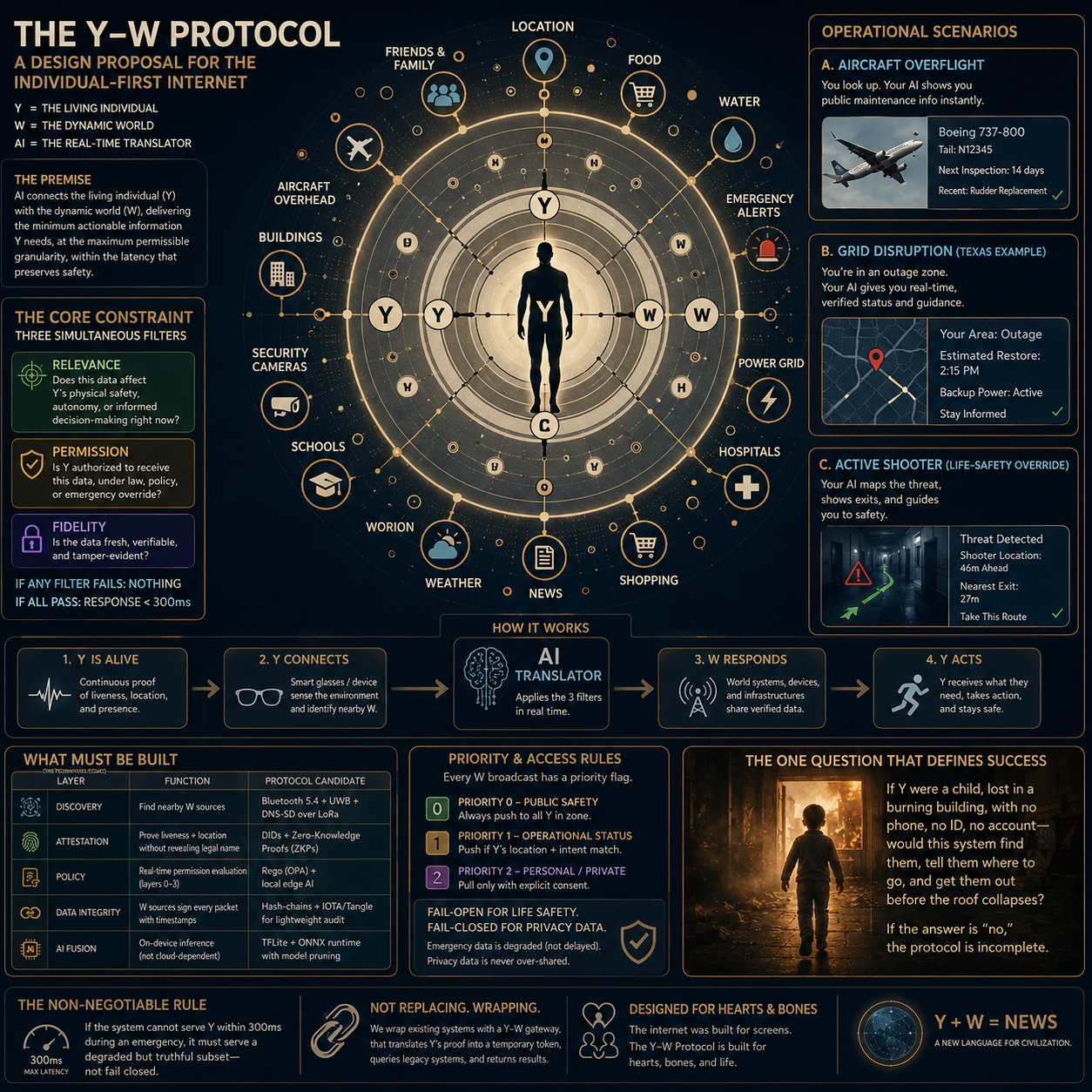
Architecture: Full transition to an intent-based, agentic AI network. The traditional internet becomes an abstraction.
Spectrum: Cognitive radio with real-time spectrum negotiation is the norm.
Privacy: Zero-knowledge proofs are default for all identity and data transactions.
Emergency: Autonomous, self-healing mesh networks with satellite backup ensure near 100% availability.
Key Milestones:
· The "Internet of Agents" is fully operational.
· Telecom companies are relegated to niche services or obsolete.
Part VII: The Call to Action
Here's My Proposal
Let's talk. I want to present my L9 specification to the Agentic AI Foundation. I believe it's the missing piece you need.
Let's collaborate. My vision doesn't replace yours. It completes it. You provide the plumbing. I provide the brain.
Let's build together. I'm not here to compete. I'm here to contribute. The world needs this, and we need each other.
What Must Happen
The old model is failing. The evidence is everywhere:
· Spectrum hoarding by corporations blocking public safety.
· Coverage gaps leaving farms and rural areas disconnected.
· Security theater treating safety as a cost center.
· Innovation stagnation from rent-seeking behavior.
The U.S. has a choice:
Continue the private model: Fragmentation, inequity, and obsolescence.
Adopt the Y-W Protocol: A coordinated, public-interest-driven, agent-native network.
What I Need
Publish My Blue Book: Make it the standard for the semantic L9 layer.
Engage the Linux Foundation: Pitch L9 to the Agntcy project.
Present to the FCC: Make the case for dynamic spectrum as a public utility.
Mobilize the Public: Connectivity is a human right. Build the movement.
Build the Coalition: Bring together IETF, IEEE, NIST, FEMA, and international bodies.
Epilogue: The Baby and the Future
I saw a baby. The agentic internet—fragile, dependent, and utterly unprepared for the world it's being born into.
The current internet is the bathwater. It's stale, toxic, and about to drown the baby if we don't throw it out.
The telecom companies must die. The walled gardens must crumble. The monthly bills must end.
The Y-W Protocol is the architecture of the new world. It's the constitution of the agentic age. It's the answer to a question no one has fully asked yet:
What happens when everything is connected, everything is intelligent, and everything serves the individual?
The answer is my protocol. And it's time to build it.
A Final Word to the Linux Foundation
You built the skeleton. I built the brain.
Let's put them together.
I've already done the equations. I've already written the spec. I'm ready to talk whenever you are.
P.S. The baby I saw? The future of the agentic internet? You helped save it. Now let's finish the job.
The old internet is dead. Long live the agentic internet.
This is your blueprint. Now go build it.
To Everyone: This Is What We're Talking About
The Problem: The Internet Is Breaking
Let me explain this simply.
Right now, your internet was built for one thing: people looking at websites and apps on their phones. That's it. That's what it was designed for.
But that's not what's happening anymore.
Think about what's coming:
· Self-driving cars that need to talk to traffic lights
· Farming robots that harvest crops without human help
· Emergency drones that respond to fires before firefighters arrive
· Smart buildings that know when to evacuate people
· Medical devices that monitor your health and call for help
All of these things need to talk to each other. Constantly. Instantly. Without waiting for a human to press a button.
The internet we have now cannot handle this.
It's like trying to run a modern airport with a telephone switchboard from the 1950s. It doesn't work. It was never designed for this.
The Real Problem: Money and Control
Here's what's really going on.
Right now, internet companies make money by charging you monthly bills. Every device needs a "plan." Every byte of data costs money. Every connection is a transaction.
This model is built on scarcity—making you pay for limited access.
But the future requires abundance—everything connected, always on, always talking.
The math doesn't work anymore.
· One smart farm might have 200 devices. Each one needs a connection. Who pays for that?
· A smart city might have millions of sensors. Each one sends data constantly. How do you bill that?
· An emergency response system needs instant priority. You can't wait for "roaming agreements."
The companies that run the internet today are not evil. They're just obsolete. They're like horse carriage makers at the dawn of the automobile. They built something great for their time, but the world has changed.
If we keep this model, the future will be fragmented, expensive, and dangerous.
The Fragmentation Nightmare
Here's another problem.
If you go into a smart home today, you'll find:
· Wi-Fi for your phone and laptop
· Bluetooth for your headphones and watch
· Zigbee for your smart lights
· Cellular for your security system
· And more
Six different systems. Six different languages. None of them talk to each other.
Now imagine a smart city. A traffic light needs to talk to a self-driving car. The car needs to talk to an emergency drone. The drone needs to talk to a hospital. The hospital needs to talk to a power grid.
They all speak different languages. They can't coordinate. Chaos.
This is not innovation. This is fragmentation. And fragmentation kills people in emergencies.
The Emergency Problem
Let me give you a real example.
Imagine there's a fire in your neighborhood. A smart fire alarm detects it. An emergency drone sees it from above. Your smart home system knows you're inside.
What should happen?
You should get an instant, verified alert on your phone, glasses, and smart speaker.
The fire department should be automatically notified.
Your smart locks should unlock your doors for firefighters.
Traffic lights should clear a path for emergency vehicles.
Your smart car should move out of the driveway automatically.
Nearby hospitals should prepare for casualties.
This is what should happen.
But it won't. Not with the current internet.
Because none of these systems talk to each other. They're all on different networks, different protocols, different companies. They can't coordinate. They can't act together.
In an emergency, every second counts. Our current system wastes minutes.
This is not acceptable.
The Solution: A New Internet
So what do we do?
We build a new internet. One designed from the ground up for this future.
I call it the Y-W Protocol.
Y = You. The individual.
W = The world around you.
AI = The intelligence that connects them.
The principle is simple: You are alive. Everything else—the network, the AI, the devices—exists to serve you.
Here's what the new internet does:
1. Everything Understands Everything
Before two devices talk, they agree on what they mean.
· A farming robot and an emergency drone negotiate a shared understanding of "evacuate."
· A self-driving car and a traffic light agree on "emergency vehicle approaching."
· A smart home and a fire alarm confirm "fire detected—take action."
No misunderstandings. No confusion. No catastrophic errors.
2. Emergency Comes First
In the new internet, life-safety is the top priority.
· Emergency alerts are verified by multiple sources before broadcasting.
· Only people in the affected area receive the alert.
· The emergency system works even if commercial networks fail.
· Deepfakes and misinformation are filtered out at the protocol level.
When something bad happens, the system acts instantly and correctly.
3. No Monthly Bills
The new internet treats connectivity like roads and water—a public utility.
· Your devices connect automatically.
· There are no "data plans" or "roaming charges."
· The network is always on, always available.
· In emergencies, everyone gets priority.
Connectivity is a right, not a product.
4. You Own Your Data
Right now, companies own your data. They sell it. They profile you. They track you.
The new internet changes this:
· You control who sees your data.
· You can prove things about yourself without revealing your identity.
· The AI serves you—not the company that built it.
You are the customer. You are not the product.
What's Already Happening
The good news: The smartest people in the world are already building parts of this.
The Linux Foundation—the organization that built the backbone of the internet—is creating the standards for AI agents to talk to each other. They've already convinced Google, Amazon, Microsoft, and OpenAI to donate their best technology to a public foundation.
This is unprecedented. This is hope.
But there's a missing piece. They've built the plumbing—how agents talk. They haven't built the brain—what agents mean.
That's what I'm offering. I've designed the missing layer. I've done the math. I've written the specifications.
I need your help to make it real.
Why This Matters to You
You might not be a technologist. You might not care about protocols or standards. That's fine.
Here's why this matters to you:
Someday, you will need the new internet.
· When there's a fire, you need instant, verified alerts.
· When there's a flood, you need evacuation routes.
· When there's a missing child, you need coordination.
· When your health fails, you need the system to respond.
The current internet cannot do this.
· It's too slow.
· It's too fragmented.
· It's too profit-driven.
· It's not designed for emergencies.
The new internet saves lives.
What You Can Do
Here's how you can help:
Understand the problem. The internet you know is dying. It's not your fault. It's just obsolete.
Demand better. Ask your leaders why emergency systems are still fragmented. Ask why connectivity isn't a public utility. Ask why your data isn't yours.
Support the vision. This isn't about politics. It's about survival. The future is coming whether we're ready or not. Let's be ready.
Spread the word. Tell people about the new internet. Tell them what's possible. Tell them what's at stake.
In Conclusion: The Future Is Coming
I saw a baby. The agentic internet. Fragile, dependent, unprepared for the world it's being born into.
The current internet is the bathwater. It's stale, toxic, and about to drown the baby if we don't throw it out.
The telecom companies must change. The walled gardens must crumble. The monthly bills must end.
The Y-W Protocol is the architecture of the new world.
· It serves you.
· It protects you.
· It responds when you need it.
The old internet is dead. Long live the agentic internet.
One Last Thing
You don't need to understand the technical details. You don't need to read the specifications. You just need to understand this:
The future is about connection. Real connection. Intelligent connection. Life-saving connection.
And that future is coming, whether we're ready or not.
Let's be ready.
The old internet is dead. Long live the agentic internet.
This is your blueprint. Now we have to replace politicians with the US House plan so that once you have a finalized blueprint we get funding we get subsidies and we arrive at the future without any friction inshallah. Getting ready to join the conversation
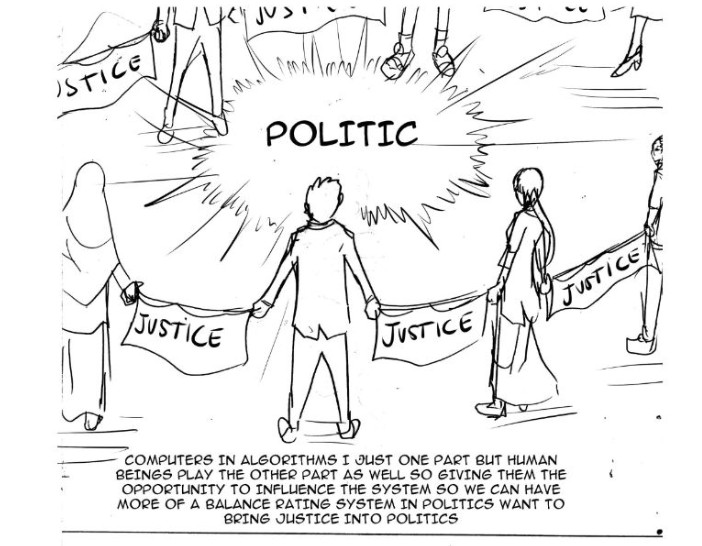
Redesigning Politics and Social Media: The Architecture of a New Civilization
buymeacoffee.com/omar1800m/the-house-speech-rebuilding-social