

بِسْمِ اللهِ الرَّحْمٰنِ الرَّحِيْم
In the Name of God, Most Gracious, Most Merciful
♥️🤲🕋♥️🕋🌹🌹🥀🤲🌹🕋♥️🤲
Chapter Four
Chapter 4The Illusion of Control — Desire, Dopamine, and the Hijacked will
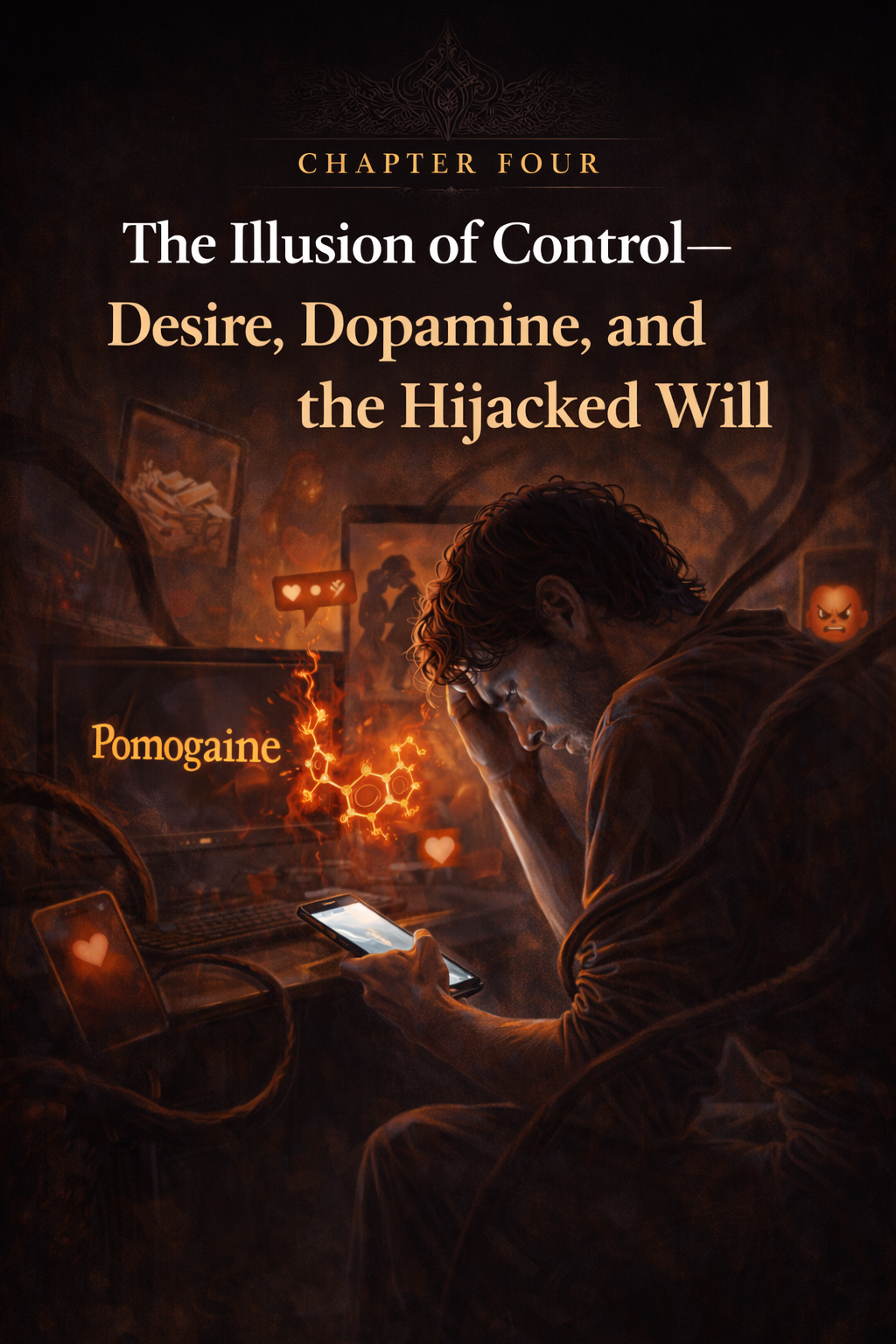
The Illusion of Control — Desire, Dopamine, and the Hijacked Will
You think you are free because you can choose.
But what if your choices are not entirely yours?
What if they were trained?
What if your will has been slowly, quietly, gently hijacked—not by force, not by chains, but by pleasure?
The lower self does not attack like an enemy. It seduces like a lover. It does not demand—it invites. It does not threaten—it promises. It whispers, Just one more. Just a little. Just tonight. Just this once. And then it whispers the same thing tomorrow.
This is how prisons are built in the modern world—not with iron bars, but with dopamine.
Dopamine is not evil. It is a gift from Allah. It is the signal of anticipation, motivation, pursuit. It is what makes you seek, strive, hope, and move. But when hijacked, it becomes a leash. You stop chasing meaning and start chasing feeling. You stop asking Why am I here? and start asking What will make me feel better right now?
And this is where the nafs thrives.
Allah tells us plainly:
إِنَّ النَّفْسَ لَأَمَّارَةٌ بِالسُّوءِ إِلَّا مَا رَحِمَ رَبِّي
Indeed, the soul constantly commands to evil—except for those upon whom my Lord has mercy.
(Surah Yusuf 12:53)
Notice what Yusuf عليه السلام says. He does not say, I am evil. He says, There is something in me that commands evil. And salvation does not come from strength—it comes from mercy.
This is critical.
You are not your impulses.
You are not your urges.
You are not your cravings.
You are not your lowest thoughts.
These belong to the nafs—not the soul.
The nafs does not want your destruction immediately. It wants your delay. Your distraction. Your numbness. Your postponement of becoming. Because if you become who Allah created you to be, it loses.
So it gives you illusions of control.
You scroll and think you’re exploring.
You desire and think you’re choosing.
You escape and think you’re resting.
You fantasize and think you’re alive.
But deep inside, something feels wrong.
You are tired—but not fulfilled.
Busy—but not moving.
Stimulated—but not alive.
Connected—but alone.
This is the signature of the hijacked will.
Allah describes this condition with terrifying clarity:
Have you seen the one who takes his own desire as his god?
(Surah Al-Jathiyah 45:23)
This is not about worshipping statues.
This is about worshipping impulse.
When desire becomes the compass, everything else bends around it—truth, values, prayer, patience, dignity, future, even Allah.
The nafs does not want peace. It wants intensity.
It does not want stability. It wants novelty.
It does not want healing. It wants escape.
It does not want presence. It wants stimulation.
Because peace would expose it.
Silence would reveal it.
Stillness would weaken it.
That is why it keeps you moving.
Scrolling.
Watching.
Imagining.
Replaying.
Regretting.
Dooming.
Desiring.
Avoiding.
Not because you are evil—but because you are powerful.
And power must be distracted before it awakens.
The nafs knows that if you ever sit long enough with yourself, something dangerous will happen:
You will remember.
You will remember who you were before fear.
Before shame.
Before addiction.
Before comparison.
Before numbness.
You will remember that you were not created for consumption—you were created for meaning.
And meaning threatens the nafs.
So it replaces meaning with mood.
Instead of asking, Who am I?
You ask, How do I feel?
Instead of asking, What am I becoming?
You ask, What can I escape into?
This is not freedom.
This is sedation.
And sedation feels like peace—until it wears off.
Then the hunger returns.
And the nafs says: Again.
This is the loop.
This is the illusion.
This is the modern prison.
Not of walls—but of wants.
The Way Out: Purification, Not Perfection
Allah does not expose the nafs to shame you.
He exposes it to save you.
He tells you the truth about yourself so that you do not confuse the sickness with your identity.
Allah says:
قَدْ أَفْلَحَ مَن زَكَّاهَا وَقَدْ خَابَ مَن دَسَّاهَا
Successful is the one who purifies it. And ruined is the one who buries it.
(Surah Ash-Shams 91:9–10)
Not suppresses it.
Not indulges it.
Not pretends it isn’t there.
Purifies it.
Purification is not instant. It is not clean. It is not perfect. It is a return—again and again and again.
The Prophet ﷺ said:
“Every child of Adam sins, and the best of sinners are those who repent.”
That means failure is not your problem.
Staying away from Allah is.
The nafs wants you to believe: This is who you are.
Allah says: No. This is what you are struggling with.
And struggle is not proof of failure.
It is proof of life.
You were not created to be numb.
You were not created to escape.
You were not created to scroll until you disappear.
You were created to know Allah.
And knowing Allah requires a self that can choose.
That is why the nafs exists.
Not to destroy you— But to give your goodness meaning.
Not to humiliate you— But to give your return value.
Not to trap you— But to give your obedience weight.
Without struggle, obedience has no depth.
Without temptation, purity has no meaning.
Without choice, love is not love.
A Final Word
If you are inside this prison, you are not lost.
You are early.
If you are struggling, you are not broken.
You are awakening.
If you are falling, you are not rejected.
You are still invited.
Allah does not wait for you to be perfect.
He waits for you to turn.
And every time you turn, something inside you becomes lighter.
This is not a book about shame.
This is a map back to yourself.