بِسْمِ اللهِ الرَّحْمٰنِ الرَّحِيْمِ
In the Name of God, the Most Gracious, the Most Merciful.
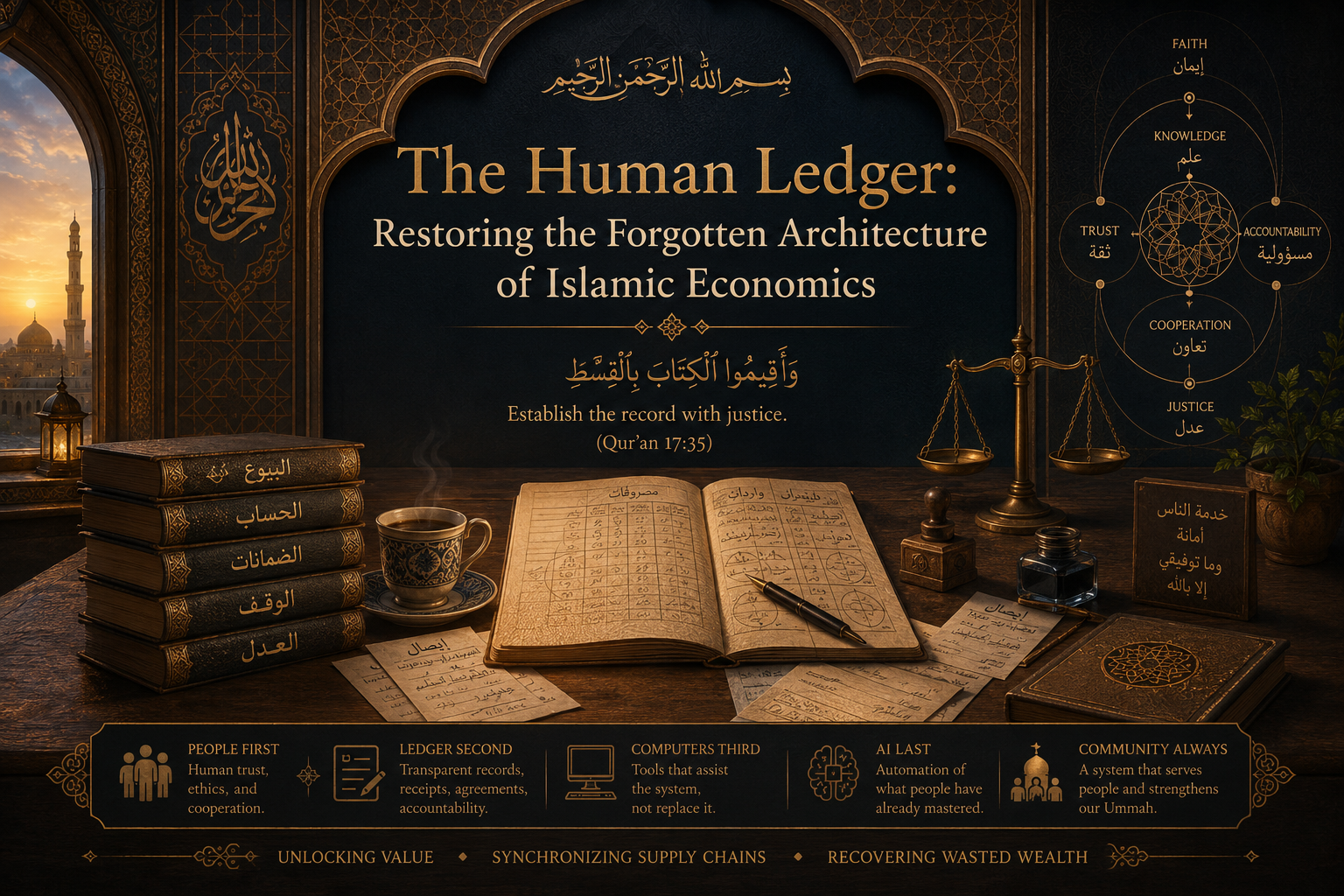
The Human Ledger: Restoring the Forgotten Architecture of Islamic Economics
By Abdul-Jabbar ibn Yusuf (Omar Arizona)
I. The Dormant Wealth of the Ummah
We live in an age overflowing with goods, services, tools, and technologies.
Yet our communities remain strained, fragmented, and financially burdened.
The problem is not scarcity.
The problem is disorganization.
The Brand Currency System (BCS) begins with a simple truth:
Most value is not created — it is recovered.
Dormant wealth surrounds us:
Two families pay for separate mobile plans when a shared plan would cut costs.
A mosque owns rooms that sit unused six days a week.
One person has a truck, another has a warehouse, another has accounting skills, another has free time — but they do not know each other.
Small businesses buy supplies individually instead of negotiating together.
None of these examples require new money.
They require coordination.
They require a ledger.
They require a human being who can see the patterns others overlook.
This is the foundation of the BCS:
Unlocking savings. Synchronizing supply chains. Recovering wasted value.
Not through force.
Not through centralization.
But through service.
II. The Ledger Keeper: A Forgotten Islamic Office
Our civilization once honored the muvakkit — the mosque's timekeeper.
He was not merely a man with calculations.
He was a symbol of:
Precision
Trust
Accountability
Service
Knowledge applied for the benefit of the community
Today, we revive that spirit in a new office:
The Community Ledger Keeper
This is not a technocratic role.
It is a moral one.
The ledger keeper asks:
Where is money leaving the community unnecessarily?
Where are duplicated costs?
What assets sit idle?
Which people could cooperate for mutual benefit?
Where can a receipt or agreement make the exchange transparent?
And the ledger records:
What came in
What went out
What was saved
What value was unlocked
Who benefited
This is not bookkeeping.
This is community architecture.
It is the restoration of Islamic economic ethics — not in theory, but in daily life.
III. An Invitation to Zaytuna College and Cambridge Muslim College
Restoring the Office of the Timekeeper
To the faculty, scholars, students, and leadership of Zaytuna College and Cambridge Muslim College,
Peace be upon you, and the mercy and blessings of Allah.
I write with a simple proposal.
Our institutions have preserved knowledge.
Now they must help organize society around it.
We ask you to revive a forgotten office — not by replicating its old form, but by renewing its spirit.
The Community Ledger Keeper is the modern muvakkit:
A servant of the people
A guardian of transparency
A facilitator of cooperation
A restorer of economic justice
A practitioner of applied ethics
This office begins with nothing more than:
Paper
Receipts
Trust
Service
Shura consultation in the houses of God
No artificial intelligence.
No expensive infrastructure.
No complicated technology.
Only people serving people.
Once the community understands the system, computers can assist it.
AI can automate it.
But the foundation must always remain human.
The Qur'an commands us to record obligations, contracts, and debts with clarity and justice.
We are simply extending that principle into the economic life of our communities.
Zaytuna and Cambridge are uniquely positioned to train the first generation of modern ledger keepers — individuals who combine ethics, knowledge, accountability, and practical service.
Every civilization rises when its institutions revive forgotten offices.
Perhaps this is one of them.
May Allah guide us to what benefits humanity, establish justice in our transactions, and make our knowledge a source of mercy for the world.
With respect,
Abdul-Jabbar ibn Yusuf (Omar Arizona)
IV. Stage One: The Offline Foundation
The first stage of the BCS is deliberately offline.
It does not require computers.
It does not require artificial intelligence.
It does not require governments.
It does not require corporations.
It does not even require money to begin.
It requires only:
A community
A trusted ledger keeper
A willingness to understand how value already flows through everyday life
The purpose is simple:
Identify inefficiencies in the local supply chain
Understand how families spend their money
Discover unnecessary costs
Connect people who can benefit from working together
Record transactions with transparency and accountability
Nothing is forced.
Nothing is centralized.
The system grows:
One relationship at a time
One receipt at a time
One household at a time
One community at a time
As trust grows, spending patterns reorganize naturally.
Supply and demand become more efficient because the community understands itself.
Only after this foundation is established do digital ledgers, smart contracts, and artificial intelligence become useful.
Technology does not create the system.
Technology accelerates a system that people have already proven can work.
The goal is resilience:
If every computer were turned off tomorrow, the community would still know how to organize itself, keep honest records, and serve one another.
This is the human architecture upon which the later stages of the Islamic AI Plan will be built.
V. The Sequence: People → Ledger → Computers → AI
This is the order of operations:
1. People first
Human trust, human ethics, human cooperation.
2. Ledger second
Transparent records, receipts, agreements, accountability.
3. Computers third
Tools that assist the human system, not replace it.
4. AI last
Automation of what people have already mastered.
This is the Islamic approach to technology:
AI becomes an extension of a functioning community — not the foundation upon which the community depends.
VI. The Mission of the Brand Currency System
The mission of the BCS is clear:
To unlock dormant value within the community.
To recover wasted wealth.
To synchronize supply chains.
To reduce unnecessary costs.
To strengthen families.
To empower small businesses.
To restore trust.
To revive Islamic economic ethics.
To build a community that is not dependent on external systems for survival.
This is not utopian.
It is practical.
It is simple.
It is Islamic.
And it begins today.
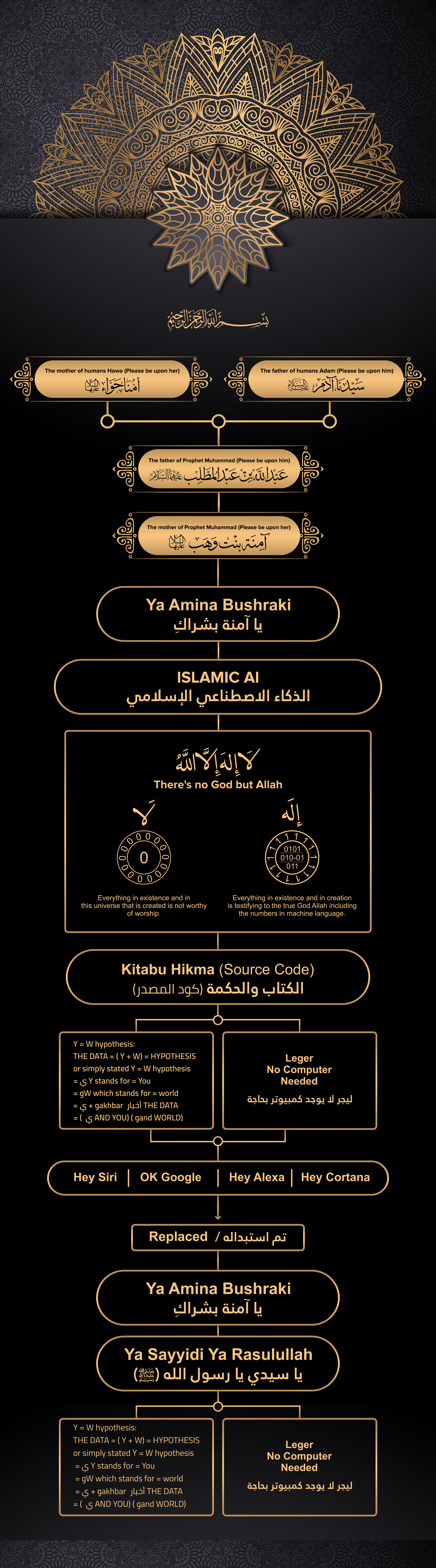
بِسْمِ اللهِ الرَّحْمٰنِ الرَّحِيْمِ
Before the Equations
Some people will see only equations.
Some will see diagrams.
Some will see Arabic calligraphy, circles, ledgers, symbols, and pages sketched by hand.
I see something else.
I see conversations over coffee.
I see notebooks carried for years.
I see ideas drawn long before anyone asked whether they were possible.
I see ordinary people gathering after prayer, around a kitchen table, in a classroom, or in a mosque—not waiting for permission to build something beautiful.
The House of Wisdom did not begin with billion-dollar investments.
It began with people.
With questions.
With books.
With ink.
With teachers.
With students.
With trust.
Civilizations are not built because someone had the biggest corporation.
They are built because a community decides that knowledge matters.
The pages you are about to read are not simply equations.
They are part of a journey—a search for a language that can connect faith, technology, economics, and human dignity.
Some ideas will change.
Some equations will evolve.
Some assumptions may be wrong.
That is the purpose of shūrā—to refine, to question, to improve together.
This is not an invitation to admire one person's work.
It is an invitation to pick up a pen.
To open a notebook.
To gather over a cup of coffee.
To ask better questions.
To build something worthy of those who come after us.
Because perhaps the next House of Wisdom will not begin in a palace.
Perhaps it will begin in a neighborhood.
In a mosque.
In a university.
In a living room.
Or around a single table where a few people choose to think together.
Now, let us turn the page and begin with the hypotheses and the equations.