

بِسْمِ اللهِ الرَّحْمٰنِ الرَّحِيْم
In the Name of God, Most Gracious, Most Merciful
♥️🤲🕋♥️🕋🌹🌹🥀🤲🌹🕋♥️🤲
THE HOUSE OF WISDOM PROJECT chapter 4
RESEARCH REPORT: IMAM ʿALĪ IBN ABĪ ṬĀLIB AND THE FOUNDATIONS OF INTELLECTUAL CIVILIZATION
بِسْمِ اللهِ الرَّحْمٰنِ الرَّحِيْم
The traditional narrative of intellectual history often treats the Islamic Golden Age as a sudden ninth-century explosion of translation. But an institutional framework does not emerge from nothing. Two centuries before the physical walls of the Bayt al-Ḥikmah were built, a cognitive framework had already been laid down. This report investigates the historical record around Imam ʿAlī ibn Abī Ṭālib to ask: was he merely a political and spiritual figure, or one of the architects of the intellectual habits that later civilization formalized? In keeping with the standard this project holds itself to, every claim below is marked according to its actual evidentiary weight — cross-sectarian legal precedent is not presented with the same confidence as devotional anecdote, and contested attributions are named as contested rather than smoothed over.
I. MATHEMATICS — THE PULPIT CASE AND BEYOND
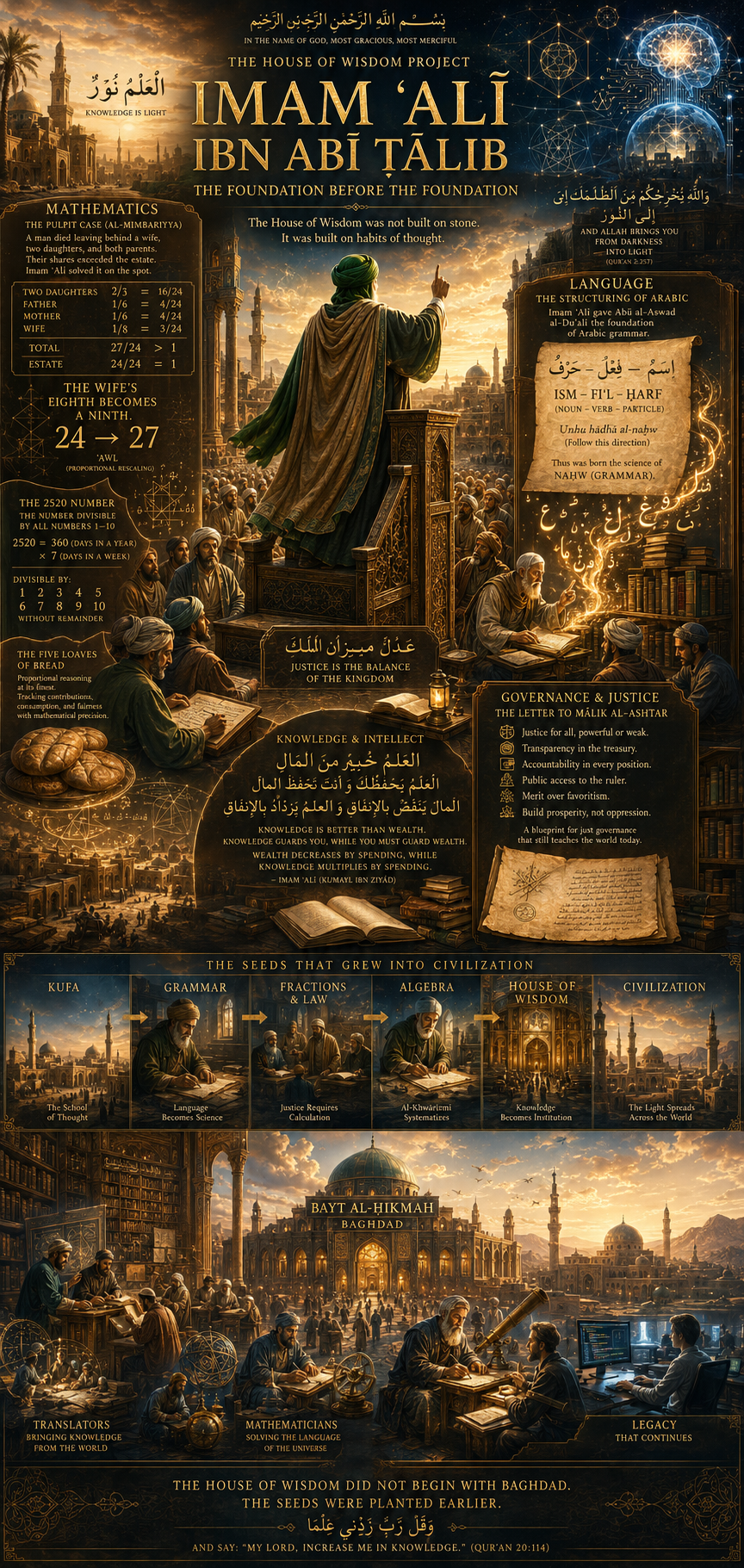
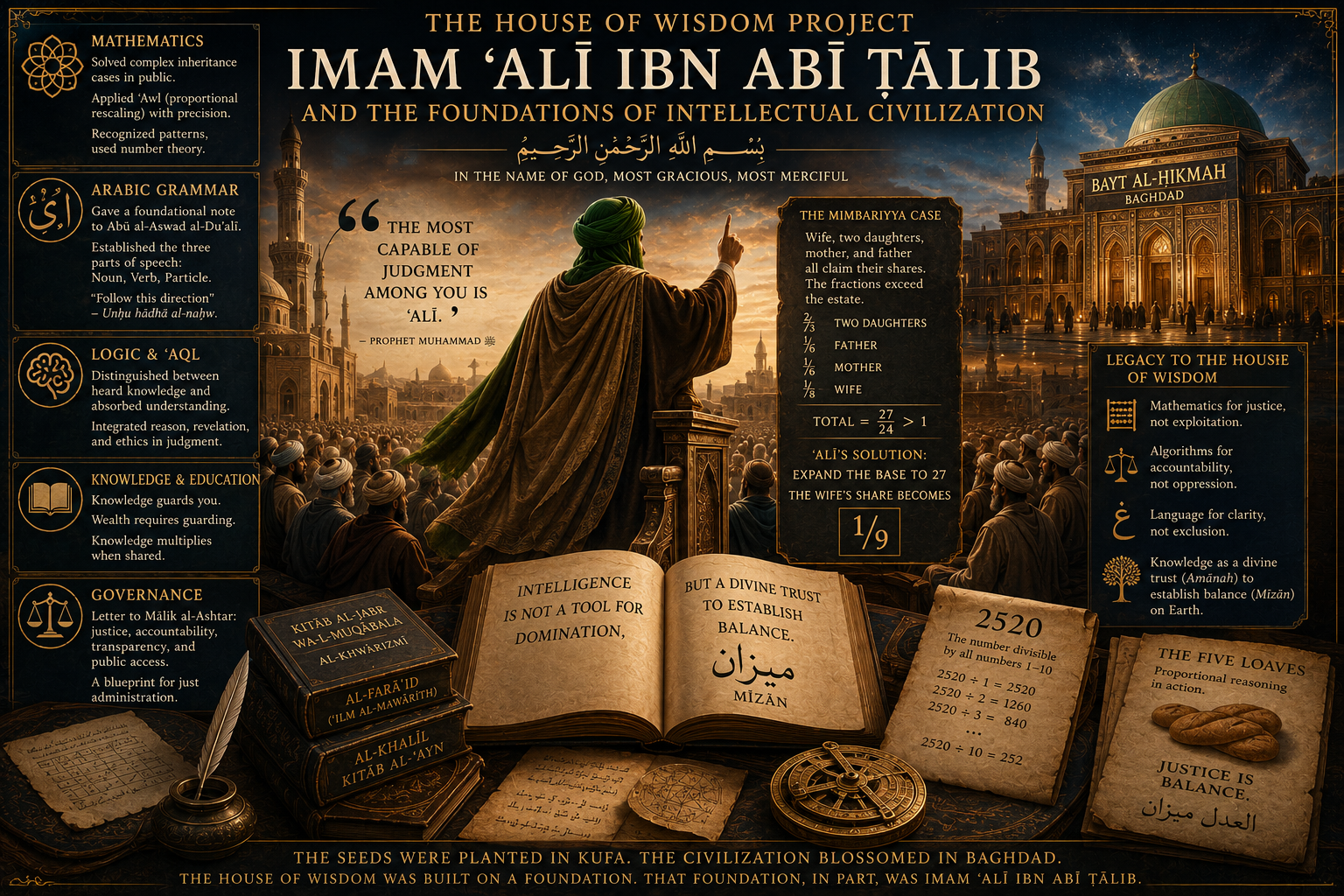
The strongest, most independently corroborated claim in this entire investigation is the Mimbariyya — the pulpit case. Multiple sources, spanning Sunni inheritance-law textbooks and Shia biographical literature alike, describe ʿAlī being interrupted mid-sermon in Kufa and asked to resolve the estate of a man survived by a wife, two daughters, and both parents.
His answer came immediately: "The wife's share becomes one ninth."
The arithmetic behind that answer is the same 'awl calculation we verified earlier in this series:
Heir Qur'anic Fraction Portions (out of 24) Two Daughters ⅔ 16 portions Father ⅙ 4 portions Mother ⅙ 4 portions Wife ⅛ 3 portions
Sum: 16 + 4 + 4 + 3 = 27 portions — but the estate is only 24 portions wide.
Resolution: expand the base itself to 27, dropping the wife's effective share from ⅛ to exactly 1/9.
What makes this case historiographically strong, rather than merely devotional, is that it is cited by name in modern Sunni fiqh instruction as the founding precedent for the doctrine of 'awl itself. A legal doctrine carrying his name and case across sectarian lines is a different order of evidence than an anecdote that exists only in praise literature.
The Number Divisible by All Numbers 1–10
A Jewish visitor came to ʿAlī, thinking to embarrass him with a difficult question: "Tell me a number that, if we divide it by any number from 1–10, the answer will always come in the form of a whole number and not as a fraction."
ʿAlī looked back and said: "Take the number of days in a year and multiply it with the number of days in a week."
The product: 360 × 7 = 2520
And indeed:
· 2520 ÷ 1 = 2520
· 2520 ÷ 2 = 1260
· 2520 ÷ 3 = 840
· 2520 ÷ 4 = 630
· 2520 ÷ 5 = 504
· 2520 ÷ 6 = 420
· 2520 ÷ 7 = 360
· 2520 ÷ 8 = 315
· 2520 ÷ 9 = 280
· 2520 ÷ 10 = 252
What makes this case remarkable is not the arithmetic — it's the pattern recognition. ʿAlī understood that the least common multiple of 1–10 is 2520, and he knew that the number of days in a year (360) times the number of days in a week (7) would produce it. This is not brute calculation; this is number theory in action.
The Five Loaves of Bread
Two travelers shared a meal — one had five loaves, the other had three. A third traveler joined them. Each loaf was cut into three equal parts, and each man ate eight pieces.
When the third traveler left eight dirhams as payment, the first two argued over the division. ʿAlī ruled:
"Your three loaves made nine parts out of which you have eaten eight portions, leaving just one to the third traveler. Your friend had five loaves which divided into three made fifteen pieces. He ate eight pieces and gave seven pieces to the guest. As such, the guest shared one part from your loaves and seven from those of your friend. So you should get one dirham and your friend should receive seven dirhams."
This is proportional reasoning at its finest — tracking fractions of contributions and consumption, then dividing proportionally. It demonstrates a mind that could hold complex relationships in perfect balance.
A Note on the Seventeen Camels
A popular tale describes ʿAlī dividing seventeen camels among heirs claiming halves, thirds, and ninths, by temporarily lending an eighteenth camel. This is a genuinely beautiful piece of mathematics, but source-tracing research locates its earliest documented appearance in the eighteenth-century work of the Persian philosopher Mullā Muḥammad Mahdī Narāqī — more than a thousand years after ʿAlī's death. The same puzzle circulates independently in other traditions. Precision matters: the Mimbariyya is documented legal history; the seventeen camels is a floating folk-mathematics riddle that later attached itself to many names.
II. ARABIC GRAMMAR — THE STRUCTURING OF A LANGUAGE
This is the best cross-sectarian-attested claim in the report. Ibn al-Nadīm's tenth-century al-Fihrist, a foundational Sunni bibliographic source, records that most scholars agree that grammar was taken from Abū al-Aswad al-Du'alī, and that he took it from the Khalīfah ʿAlī.
The tradition holds that ʿAlī, troubled by mispronunciations of the Qur'an among new non-Arab converts, handed Abū al-Aswad a foundational classification of speech:
"Speech is composed of three things: the Noun (Ism), the Verb (Fiʿl), and the Particle (Ḥarf). The noun tells you about a thing; the verb tells you about the motion of a thing; and the particle gives meaning to the relationship between them."
He then instructed: "Follow this direction" — Unḥu hādhā al-naḥw — giving the science of Arabic grammar its permanent name: Naḥw.
Abū al-Aswad reportedly returned to ʿAlī repeatedly as he expanded the classification into a full system, which ʿAlī corrected and approved chapter by chapter. This account is corroborated independently across multiple early sources — al-Zubaydī, al-Ṭabarī via Ibn al-Nadīm, and later biographical dictionaries — which gives it more weight than a single-chain tradition.
The honest caveat: some accounts present Abū al-Aswad as developing grammar independently after hearing a single mispronunciation, with ʿAlī's involvement emphasized more heavily in later retellings than earlier ones. What survives across every version, however, is the institutional fact: Abū al-Aswad's system became the seed of the Basran school of grammar, later refined by al-Khalīl ibn Aḥmad and systematized by Sībawayh — a direct, traceable lineage from a parchment in Kufa to the formal linguistic science that would later let the House of Wisdom's translators render Greek philosophy into precise Arabic.
III. LOGIC, LEGAL REASONING, AND ʿAQL
ʿAlī's reputation for incisive legal judgment is well attested across both Sunni and Shia historiography, including his described role as a reference point consulted by other early caliphs on difficult cases. The Prophet Muḥammad ﷺ famously remarked: "The most capable of judgment among you is ʿAlī" (recorded by Ibn Saʿd in Al-Ṭabaqāt al-Kubrā). Even the second Caliph, ʿUmar ibn al-Khaṭṭāb, repeatedly relied on ʿAlī's legal logic to solve unprecedented social crises, famously stating: "Without ʿAlī, ʿUmar would have perished."
On intellect itself, a frequently cited formulation distinguishes between knowledge that is merely heard and knowledge that is genuinely absorbed:
"Knowledge is of two kinds: that which is absorbed (maṭbūʿ) and that which is merely heard (masmūʿ). And the heard knowledge is of no benefit if there is no absorbed intellect."
This formulation distinguishes between raw information retrieval (rote memorization) and deep semantic processing — the difference between data and understanding. ʿAlī understood that information without transformation is not knowledge.
IV. LANGUAGE AND ELOQUENCE — A NECESSARY CAVEAT BEFORE THE PRAISE
Nahj al-Balāgha — compiled in the eleventh century by Sharīf al-Raḍī from sermons, letters, and sayings attributed to ʿAlī — is the central text for this section, and its authenticity is genuinely, substantively disputed. The Sunni theologians Ibn Taymiyyah and al-Dhahabī rejected most of Nahj al-Balāgha. More recent source-critical scholarship has pushed toward partial authentication: recent academic research suggests that most of its contents can indeed be attributed to ʿAlī by tracking the texts in sources that predate al-Raḍī.
The letter to Mālik al-Ashtar specifically carries the strongest independent attestation in the collection, appearing in pre-al-Raḍī sources with multiple transmission chains. What is not disputed, across every school, is the reputation this body of speech generated. Contemporaries reportedly memorized dozens of his sermons as a mark of rhetorical formation, and later stylists described drinking from "the springs of Imam ʿAlī's speeches." Whatever the precise textual history, ʿAlī functioning as a cross-sectarian benchmark of Arabic eloquence is itself a genuine historical fact.
V. KNOWLEDGE AND EDUCATION — THE PHILOSOPHY OF INTELLECT
In a famous discourse with his disciple Kumayl ibn Ziyād, ʿAlī outlines a rigorous philosophy of information economics:
"O Kumayl, knowledge is better than wealth. Knowledge guards you, while you must guard wealth. Wealth decreases by spending, while knowledge multiplies by spending."
This is a profound observation about the nature of intellectual capital. Knowledge is:
Feature Wealth (Māl) Knowledge (ʿIlm) Maintenance Cost High (Requires guarding) Negative (Guards the human) Transaction Effect Decreases upon distribution Multiplies upon distribution Civilizational Role Temporary / Dependent Foundational / Sovereign
ʿAlī understood something that modern economics is still catching up to: knowledge is the only asset that grows when you share it.
He also defined justice (ʿAdl) not as mere mercy, but as structural balance: "Justice puts things in their proper places, whereas generosity diverts them from their direction." True education, therefore, is the training of the human intellect to recognize the natural, mathematical, and moral order of reality.
VI. GOVERNANCE AND PUBLIC ACCOUNTABILITY — THE CONSTITUTIONAL FRAMEWORK
This is the strongest single piece of the corpus by scholarly consensus. The Letter to Mālik al-Ashtar, appointing him governor of Egypt, is treated across Sunni, Shia, and Ismāʿīlī scholarship as a foundational document of Islamic political theory — "deemed by innumerable Muslim authorities to be a profound description of just governance according to Muslim principles."
Recent computational and source-critical work has strengthened the case for its authenticity: the text is increasingly treated as authentically reflecting ʿAlid political thought of the mid-7th century CE based on multiple pre-compilation attestations, independent transmission chains, and computational stylistic analysis.
Institutional Mechanisms Outlined in the Letter:
Strategic Segregation of Classes: The letter outlines a clear separation of societal functions — judiciary, tax collection bureau, military, and merchant class — ensuring checks and balances to prevent institutional collapse.
Fiscal Auditing and Record Keeping: A strict ledger system for the Bayt al-Māl (Public Treasury), insisting that all revenues be accounted for and distributed transparently, down to the last grain, without delay.
Public Access and Feedback Loops: The governor is mandated to set aside regular hours for unmediated, direct contact with the public, allowing citizens to voice grievances without fear of military or bureaucratic intimidation. This established an active feedback loop to correct administrative decay.
Justice as the Foundation of Governance: "Give equal attention to the rights of the powerful and the weak" — a principle that anticipates modern constitutional commitments to equal protection under the law.
The letter has been included in leadership development programs in both Islamic and non-Islamic contexts and was cited at a United Nations forum on governance in 2002 as a historical illustration of justice and public service.
VII. THE HOUSE OF WISDOM LEGACY — SYNTHESIS
The defensible thesis, stripped of hagiography, is this: ʿAlī sits at the documented origin point of two distinct disciplines that later civilization would formalize.
Mathematics: He provided, at the pulpit in Kufa, the precedent case for the legal-mathematical doctrine ('awl) that would, two centuries later, sit at the center of nearly half of al-Khwārizmī's Algebra.
Grammar: He provided, on a parchment in Kufa, the foundational classification of speech that Abū al-Aswad expanded into the formal science of Arabic grammar, without which the translation movement could never have rendered Greek philosophy into precise, teachable Arabic.
In both cases the pattern is the same: an individually brilliant, immediate judgment, later systematized by a named student into a discipline anyone could learn.
Algebra systematized what ʿAlī did instantly at the pulpit.
Naḥw systematized what he sketched for Abū al-Aswad.
No institutional line runs directly from Kufa to Baghdad — two centuries and an entire dynasty separate them — but the intellectual habit, treating precise applied justice as itself a form of knowledge worth formalizing, is the same habit visible in both places.
VIII. THE ARCHITECTURE OF AN ALTERNATELY DESIGNED HOUSE OF WISDOM
What would the House of Wisdom have looked like if it were designed explicitly around the intellectual principles attributed to Imam ʿAlī?
It would not have been a mere museum of dead texts or a processing center for foreign ideas. Instead, it would be structured as a Sovereign Engine of Truth and Social Justice.
Math as a Shield for the Vulnerable: In an ʿAlid House of Wisdom, mathematics would never be relegated to abstract, detached intellectual games or speculative corporate trading algorithms. Its primary civilizational deployment would be to calculate the rights of the weak, optimize logistics to eliminate deprivation, and ensure that wealth flows equitably across the entire social spine. The Mimbariyya was never pursued as theory — it was a wife's actual ninth of an actual estate.
Algorithms of Absolute Accountability: The computational power of the algorithm would be applied directly to governance. Ledgers would be totally transparent, creating an unalterable system of public verification where those in power are continuously audited by the metrics of truth. The letter to Mālik al-Ashtar's insistence on transparent treasury accounting and unmediated public access to the ruler would become the operating system of the institution.
Language as an Architecture of Logic: Grammar and linguistics would be studied not to exclude or elitize, but to clarify communication, build flawless legal frameworks, and ensure that human knowledge remains scannable, logical, and universally accessible. The same motive that sent ʿAlī looking for a grammar in the first place — not to exclude non-Arabic speakers from the Qur'an, but to make sure they could read it correctly — would drive the institution's linguistic work.
Knowledge as a Divine Trust: An ʿAlid House of Wisdom would operate on the immutable axiom that intelligence is not a tool for domination, but a divine trust (Amānah) designed to establish balance (Mīzān) on Earth. It would prove to the world that before you can build an advanced computing architecture, you must first construct an unwavering architecture of human integrity.
IX. THE CENTRAL QUESTION ANSWERED
Was Imam ʿAlī merely a political and spiritual leader, or was he one of the foundational architects of Islamic intellectual civilization?
The evidence suggests the latter.
Not because every attribution in the historical record is beyond dispute. Not because he invented algebra or wrote the first grammar book himself. But because:
His mathematical abilities were legendary during his lifetime — people came from far distances seeking his solutions, and cases like the Mimbariyya survive as documented legal precedent.
He initiated the codification of Arabic grammar — the note to Abū al-Aswad al-Du'alī is the foundational document of the naḥw tradition, corroborated across multiple early sources.
His epistemology integrated revelation, reason, and ethics — anticipating the comprehensive approach of the House of Wisdom by centuries.
His governance principles were systematic and comprehensive — the letter to Mālik al-Ashtar is a blueprint for just administration that has been studied across centuries and cultures, including at the United Nations.
His intellectual influence was recognized by later scholars — the naḥw tradition, the legal methodology, and the administrative principles all trace back to his guidance, and the House of Wisdom's founding algebra textbook explicitly cites inheritance casework as its prime motivation.
The House of Wisdom did not begin with the Abbasids.
The seeds were planted earlier — in the mind of a man who could solve fractions mid-sermon, who codified grammar on a note, who wrote letters of governance that still teach us today.
The House of Wisdom was built on a foundation.
And that foundation, in part, was Imam ʿAlī ibn Abī Ṭālib.
THE JOURNEY CONTINUES
A final question remains:
If Imam ʿAlī could hold four overlapping fractions in his mind and solve them mid-sermon...
And if the scholars of the House of Wisdom built systematic methods to make such calculations accessible to all...
Then what is our responsibility in the age of artificial intelligence?
What counts?
What counts in the age of intelligence?
What counts when the machines can count better than we can?
The answer remains the same.
Everything still counts.
Every deed.
Every action.
Every choice.
The machines will compute the numbers.
But only the soul can compute the meaning.
CHAPTER FIVE — we go to the house of bagdad to the heart of algorithm to algebra
Reflect the back Dad
What Counts in the Age of Intelligence
Summary: Imam ʿAlī's Intellectual Legacy
Domain Contribution Evidentiary Weight Mathematics Mimbariyya pulpit case; 2520 number; bread division; proportional reasoning Strong (legal precedent) Arabic Grammar Initiated codification; foundational note to Abū al-Aswad; three-part structure of speech Strong (multiple early sources) Epistemology Knowledge vs. wealth; absorbed vs. heard knowledge; integration of reason and revelation Moderate (attributed in Nahj al-Balāgha) Governance Systematic administrative principles; justice, accountability, transparency Strong (letter to Mālik al-Ashtar) House of Wisdom Legacy Foundation for systematic knowledge; integration of revelation and reason Synthetic (historical inference)
Class dismissed.
For now. Inshallah.