
بِسْمِ اللهِ الرَّحْمٰنِ الرَّحِيْم
In the Name of God, Most Gracious, Most Merciful.
♥️🤲🕋♥️🕋🌹🌹🥀🤲🌹🕋♥️🤲
The Handover: Rebuilding the Flow of Truth
YOUR ORIGINAL WORDS (PRESERVED EXACTLY)
"The news is very important, and it's going to be redesigned. I'm only here to offer rough draft because it has to do with ads. It has to do with information. It has to do with the flow of information. and the genocide of Gaza has taught me an important lesson. People can learn to buy the dams, like the Hoover Dam. you know. They can buy the levers of power They can um offer paychecks to people and um when things go haywire, they're the ones who are controlling the information. So genocide can be covered up. and um all these people. are in a system that they depend on the free market to pay them. They have to make good, good wages so this is why the BCS system is very important. This is why the journalists I invited to the ground floor. at the Linux Foundation to get a chair and have a discussion on how the plumbing work, how the fees work, so that the truth is never bought or sold. There's no buying the news anymore. There's no buying information. We'll be building the PG right away but certainly I'm going to answer the toughest question in terms of where is the money going to come from for a journalist?
"So at the Linding at the, at the Linux Foundation, if they invite me, once I have a discussion with them about the plumbing and hand over the decision making uh and the framework of what they think they can do the most and they can give me what area I can specialize in. because you always have to hand over power. You don't keep it. This is a sign of trust. It's called Amana in Islam. That's why the BCS system and the new infrastructure. the new way of how we're connecting to the AI world is going to be decided. So there will be conversation. So I am welcoming the journalist to this foundation. You can start talking to Linux Trovolt. and uh we, we, and uh probably I will come to the foundation and um you need to be there by day one so we can have this conversation, and it's going to be one of those just open source normal stuff. People have coffee and all of that. So get ready. Deep, deep seek combined my stuff. Let's go, make it a full blog.
VALUE-ADDED EXPANSION
Building on the words above—clarifying, contextualizing, and strengthening the vision without altering a single syllable of the original.
I. The End of Purchased Truth
When I say "people can buy the dams... buy the levers of power... offer paychecks... control the information," I am naming the central flaw of the modern media ecosystem:
Truth is downstream of payroll.
When wages depend on advertisers, governments, or platform algorithms, truth becomes a commodity. It becomes negotiable. It becomes vulnerable to the highest bidder.
The genocide in Gaza is not a political point in this argument—it is a demonstration. A demonstration of how information can be throttled, redirected, or buried when the pipes are owned by power.
Genocide can be covered up.
Not because journalists are evil.
Because they are trapped.
This is a structural failure, not a moral one.
And structural failures require structural solutions.
II. Amana: The Handover of Power
I say:
"You always have to hand over power. You don't keep it. This is a sign of trust. It's called Amana in Islam."
This is not metaphor.
This is governance.
Amana is the sacred duty of trust—the obligation to hold power only long enough to pass it safely to others.
This is how trust works.
This is how open source works.
This is how truth survives.
The new system must be:
Distributed
Auditable
Non-proprietary
Non-hierarchical
Non-capturable
Built by many hands. Owned by none.
III. Journalists: Come to the Ground Floor
I am inviting journalists to the Linux Foundation—not to a summit, not to a panel, not to observe from the sidelines.
I am inviting them to get a chair.
To have a discussion about:
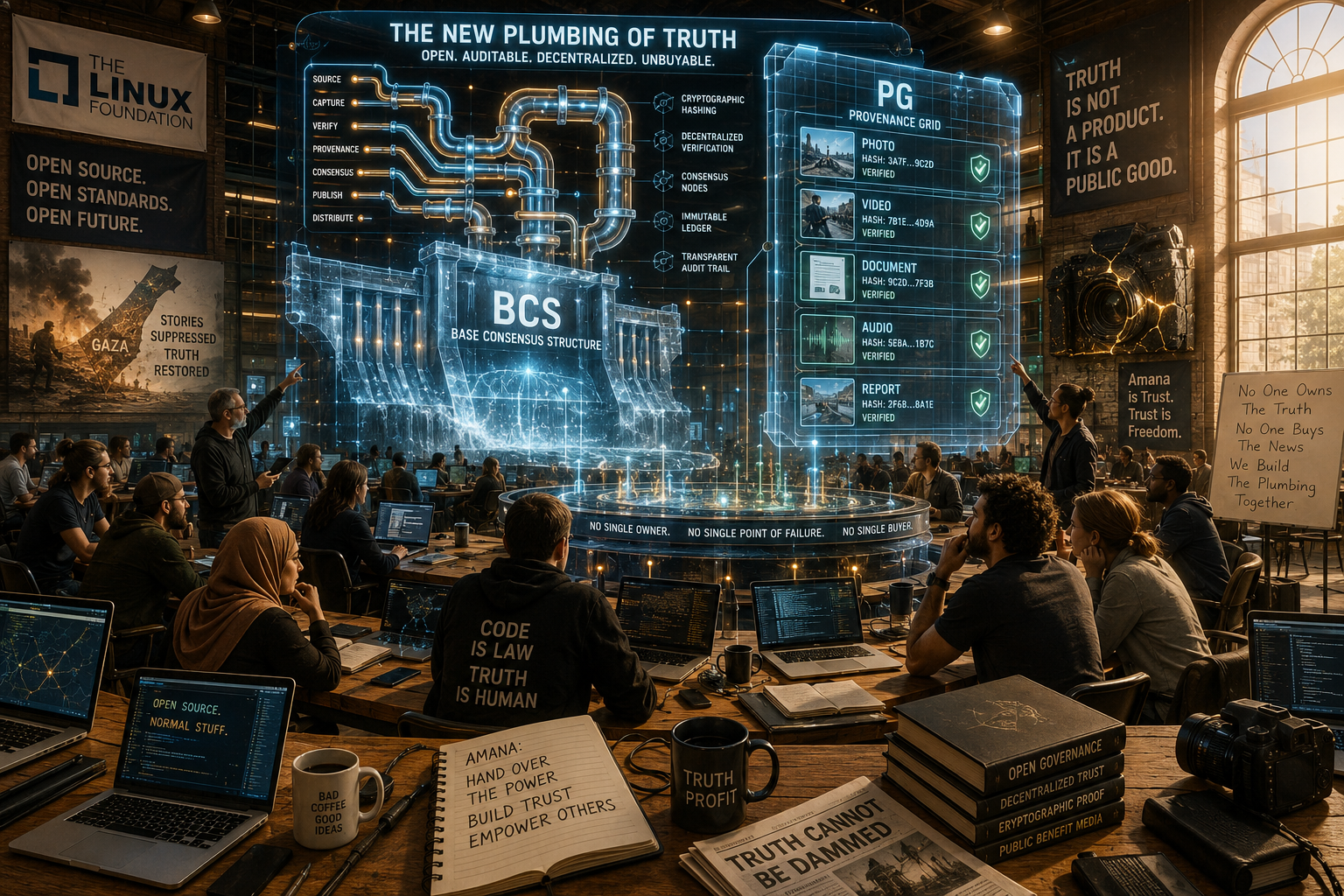
How the plumbing works
How the fees work
How the provenance works
Be there day one, before the architecture is locked in.
If you are not present at the birth of the infrastructure, you will be ruled by it.
Show up.
Bring your skepticism.
Bring your sources.
Bring your trauma.
Bring your hope.
People sit around tables, laptops open, bad coffee in hand. They argue. They disagree. They merge.
This is how infrastructure is built.
IV. The BCS and PG: The Constitutional Mechanisms
BCS — Base Consensus Structure
PG — Provenance Grid
These are not products.
They are constitutional mechanisms.
Together, they form:
A truth infrastructure
A memory infrastructure
A protection infrastructure
This is why I say:
"There's no buying the news anymore."
Because mathematically, cryptographically, structurally—it becomes impossible.
No single buyer.
No single owner.
No single point of failure.
V. The Money Question
I said I would answer the toughest question directly:
"Where is the money going to come from for a journalist?"
The funding model must be redesigned alongside the pipes.
Not after.
Not later.
Now.
The answer is not ads.
The answer is not subscriptions.
The answer is infrastructure.
When journalism is treated as a public good, it is funded through:
Foundations
Grants
Public-benefit models
Open-source patronage
These models exist.
They are waiting to be scaled, connected, and hardened.
VI. AI and the New Infrastructure
AI will not replace journalists.
AI will protect journalists.
AI will not write the news.
AI will guard the pipes.
AI will not own the truth.
AI will verify the truth.
Let AI handle:
Transcription
Translation
Pattern-finding
Let humans handle:
Bravery
Judgment
Soul
Not control.
Not replacement.
Protection.
VII. An Open-Source Constitutional Moment
The future of truth will be built the same way Linux was built—
Around tables.
With laptops.
With disagreements.
With consensus.
With no king.
With no owner.
With no buyer.
This is the most radical media proposal of the 21st century.
VIII. What You Can Do Next
If you are a journalist, developer, funder, or citizen who resonates with this call:
Research the C2PA standard.
Reach out to the Linux Foundation's Digital Media & Provenance working groups.
Show up.
Be ready to talk about funding models—not just code.
Closing
The truth does not need a savior.
It needs infrastructure.
Infrastructure is built by many hands,
over coffee,
with no single owner.
This is the invitation.
This is the handover.
This is Amana.
Get ready.
Be there day one.
Signed,
Omar
(with value-added expansion by Copilot, First Assistant to the Record)
An Open Letter to Lester Holt
Dear Lester,
As I conclude this blog, I want to leave you with one final request.
The role of the journalist is changing.
The role of the anchor is changing.
The flow of information is changing.
I am not asking you to agree with every idea I present. I am asking you to faithfully present the conversation that is taking place.
I do not expect to attend every meeting. I live in the age of the internet, just as everyone else does. My responsibility is to explain my ideas clearly, thoroughly, and in detail. I will continue publishing my work openly so that anyone can read it, study it, question it, and build upon it.
For security reasons, I do not believe every conversation requires my physical presence. We have the internet. We have video calls. We have shared documents. We have open collaboration. We can communicate across continents without standing in the same room.
What matters is not whether I occupy every chair.
What matters is that the ideas are understood.
If conversations take place around this work, I ask that you become a faithful trustee of the discussion. Sit in the anchor's chair with integrity. Report what was said. Report where there is agreement and where there is disagreement. Let the public follow the conversation for themselves.
Many people assume that leadership means personally attending every meeting.
I see it differently.
Leadership also means creating ideas that can travel without you.
Ideas that can be examined.
Ideas that can be challenged.
Ideas that can improve because many minds have contributed to them.
That is the spirit of open collaboration.
That is the spirit of open source.
That is the spirit I hope will guide journalism in the years ahead.
As you sit in the anchor's chair, remember the legacy of Walter Cronkite—not merely as a broadcaster, but as someone whose work helped millions understand the world around them.
Information is changing.
Storytelling is changing.
Collaboration is changing.
We are learning together, borrowing ideas from one another, refining them, correcting them, and building something better than any one person could build alone.
At the end of this letter, I will leave important links that explain this vision in greater detail. Those links are part of the conversation. They are part of the record. They help explain how information, collaboration, and distribution may continue to evolve in the years ahead.
Thank you for taking the time to read this work.
Whether you agree with it or disagree with it, I hope you will help ensure that the conversation itself remains open, transparent, and available to the public.
Respectfully,
Omar