

بِسْمِ اللهِ الرَّحْمٰنِ الرَّحِيْم
The Grandfather of Democracy: How Athens
Shaped the World’s Idea of Governance
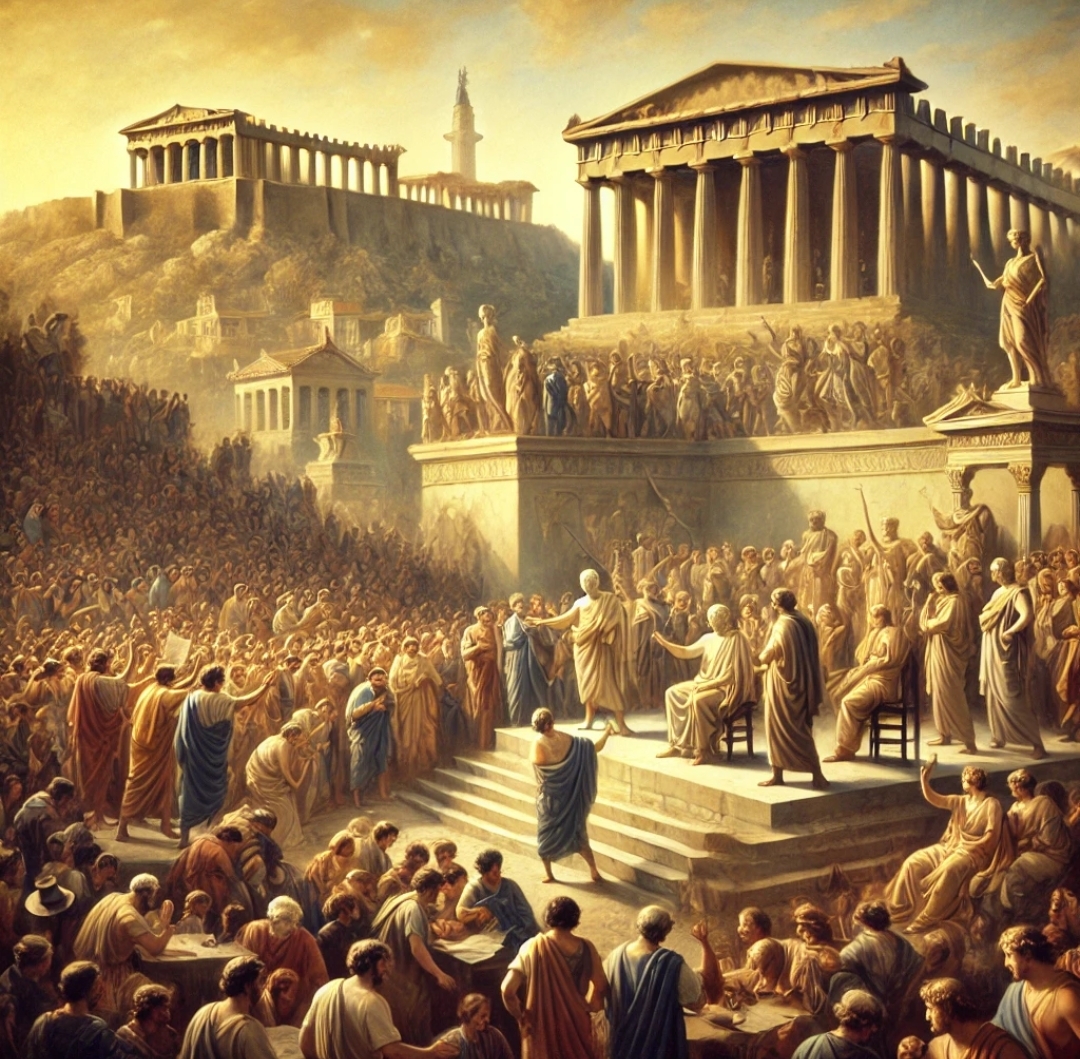
Imagine, if you can, a city where every decision that shapes the future is debated in the open air, under the brilliant Mediterranean sun. In this city, power doesn’t rest in the hands of kings or emperors. It belongs to the people — ordinary citizens who gather to decide the laws that will govern them and the policies that will guide their lives.
The year is 508 BCE, and you are standing in ancient Athens, where the idea of democracy is being born.
At first glance, Athens seems like any other ancient city — stone buildings, bustling markets, the hum of daily life. But something extraordinary is happening here. For the first time in history, power is being wrested away from the elite few and placed into the hands of the many.
How did this happen? How did a city once ruled by tyrants and aristocrats become the birthplace of democracy?
The answer begins with a man named Cleisthenes.
Cleisthenes: The Father of Democracy
Cleisthenes was no ordinary politician. Born into one of the most powerful aristocratic families in Athens, he could have easily embraced the comforts of his privilege. But he had a vision — one that would change the course of history.
He saw the corruption, the abuse of power, and the inequality that plagued Athens. And he knew something had to change.
In 508 BCE, Cleisthenes did something radical: he broke up the power of the aristocrats and gave it to the people. But he didn’t just hand it over — he restructured the political system, dividing citizens into new voting groups called demes — small districts mixing people from different backgrounds.
It didn’t matter if you were a wealthy landowner or a modest farmer — every citizen now had a voice.
This was more than just political reform — it was a revolution. Cleisthenes didn’t just change how Athens was governed — he changed how Athenians saw themselves. Suddenly, they weren’t just subjects to be ruled — they were citizens, participants in the grand experiment of democracy.
The Power of the People
For the first time, the people of Athens had the power to shape their own destiny. They could gather in the Assembly, debate the issues of the day, and vote on everything from military campaigns to public spending.
It was a system that empowered the many, not the few. But this newfound power came with responsibility. It wasn’t enough to have a voice — you had to use it wisely.
This is where the brilliance of Athenian democracy truly shines. The leaders of Athens understood that democracy wasn’t just about voting — it was about being informed, engaged, and passionate about the common good.
Citizenship wasn’t a passive right — it was an active duty.
And no one embodied this more than the great orator, Pericles.
Pericles: The Voice of a Nation
Pericles was the leader Athens needed at its most crucial moment. Born into an aristocratic family, like Cleisthenes, he too could have lived in comfort. But he had a vision of a city that would thrive — where democracy would be strengthened and the people would rule themselves with wisdom and justice.
Pericles understood the power of words. In a democracy, leaders don’t rule by force — they rule by persuasion. His speeches were not just words — they were calls to action, invitations to rise above personal interests and think about the greater good.
In his famous "Funeral Oration", Pericles didn’t just honor fallen soldiers — he reminded Athenians why democracy was worth fighting for:
“Our constitution is called a democracy because power is in the hands not of a minority but of the whole people.”
Pericles wasn’t just a politician — he was a storyteller, a dream-weaver — painting a picture of a better future and convincing the people to make it reality.
The Challenges of Democracy
Democracy was not without challenges. While Athens was a beacon of freedom and participation, not everyone benefited. Women, slaves, and foreigners were excluded from the political process. And personal ambition and corruption often threatened democracy’s foundation.
Athens was constantly at war, both externally and internally. Yet, the Athenians held onto their belief in the power of the people.
They believed in the rule of law — that laws applied to everyone equally, from the wealthiest aristocrat to the poorest laborer. They believed leadership should be earned, not inherited. And they believed that by working together, they could build a city that would stand the test of time.
The Legacy of Athens
The story of Athens does not end with its eventual fall. Its legacy lived on — carried forward by philosophers, scholars, and statesmen who spread its ideas across the world.
Rome refined them.
The Islamic world integrated them with justice and consultation (shura).
The Enlightenment rediscovered them and shaped modern governance.
The Founding Fathers of America looked to Athens as a model. They were inspired by the idea that ordinary citizens could govern and that power could be checked by law.
The ideals of Athenian democracy echo in modern parliaments and congresses around the globe.
A New Era: Democracy in the Age of AI
Today, we stand on the cusp of a new era — one where democracy faces challenges Cleisthenes could never have imagined. As AI reshapes society, we must ask:
What does democracy mean in the digital age?
How do we preserve participation, justice, and rule of law when decisions are made by algorithms?
The story of Athens reminds us: democracy isn’t about systems — it’s about people. People willing to take responsibility, engage in debate, and work for the common good.
The future of democracy will depend on leadership, rhetoric, and civic commitment — the same pillars that sustained Athens.
Conclusion: The Beginning of a Journey
As we begin this series on the history of democracy, remember: the story of Athens is not just history — it’s a mirror. It shows how we, as humans, choose to live together, make decisions, and shape our world.
The Athenians struggled with power, justice, and leadership — just as we do today.
And like them, we have the opportunity to shape the future.
In the next article, we will explore how the Roman Republic transformed democracy into a system based on law, order, and justice — a system that would influence the world for centuries.
Stay with us as we trace democracy from its ancient roots to the digital age.
✅ Enjoyed this post?
☕ Buy Abdul-Jabbar ibn Yusuf a coffee and support the mission.