
بِسْمِ اللهِ الرَّحْمٰنِ الرَّحِيْم
In the Name of God, Most Gracious, Most Merciful.
♥️🤲🕋♥️🕋🌹🌹🥀🤲🌹🕋
THE FUTURE OF THE PBC.
The Office of the Superuser | November 20, 2026
To Dario and Daniela Amodei, Anthropic's trustees, and everyone following this conversation,
First, congratulations on your historic IPO.
But today I want to congratulate you on something else. Something I didn't even know existed until I started investigating Anthropic's governance structure.
Your Public Benefit Corporation (PBC) and Long-Term Benefit Trust (LTBT).
I believe you have done something historic.
And I want my readers to understand exactly what you have built, who is responsible for it, and why I believe it needs a major overhaul.
Dario and Daniela, I listened to your speeches. You spoke about the future of AI, the responsibilities of your company, and the importance of humanity's voice.
But you never stopped to explain this governance structure to ordinary people in the way it deserves.
You never brought your users into a broad public debate about who should oversee your company, who should hold management accountable, and who should have the authority to intervene when something goes wrong.
You didn't consult the people who are going to live with the consequences of your technology.
Nevertheless, I congratulate you for taking the first step.
You have created a Public Benefit Corporation, which is legally structured to balance financial interests with public benefit, and a Long-Term Benefit Trust with extraordinary influence over the company's board of directors.
And I want everyone reading this to know who the people entrusted with that responsibility are.
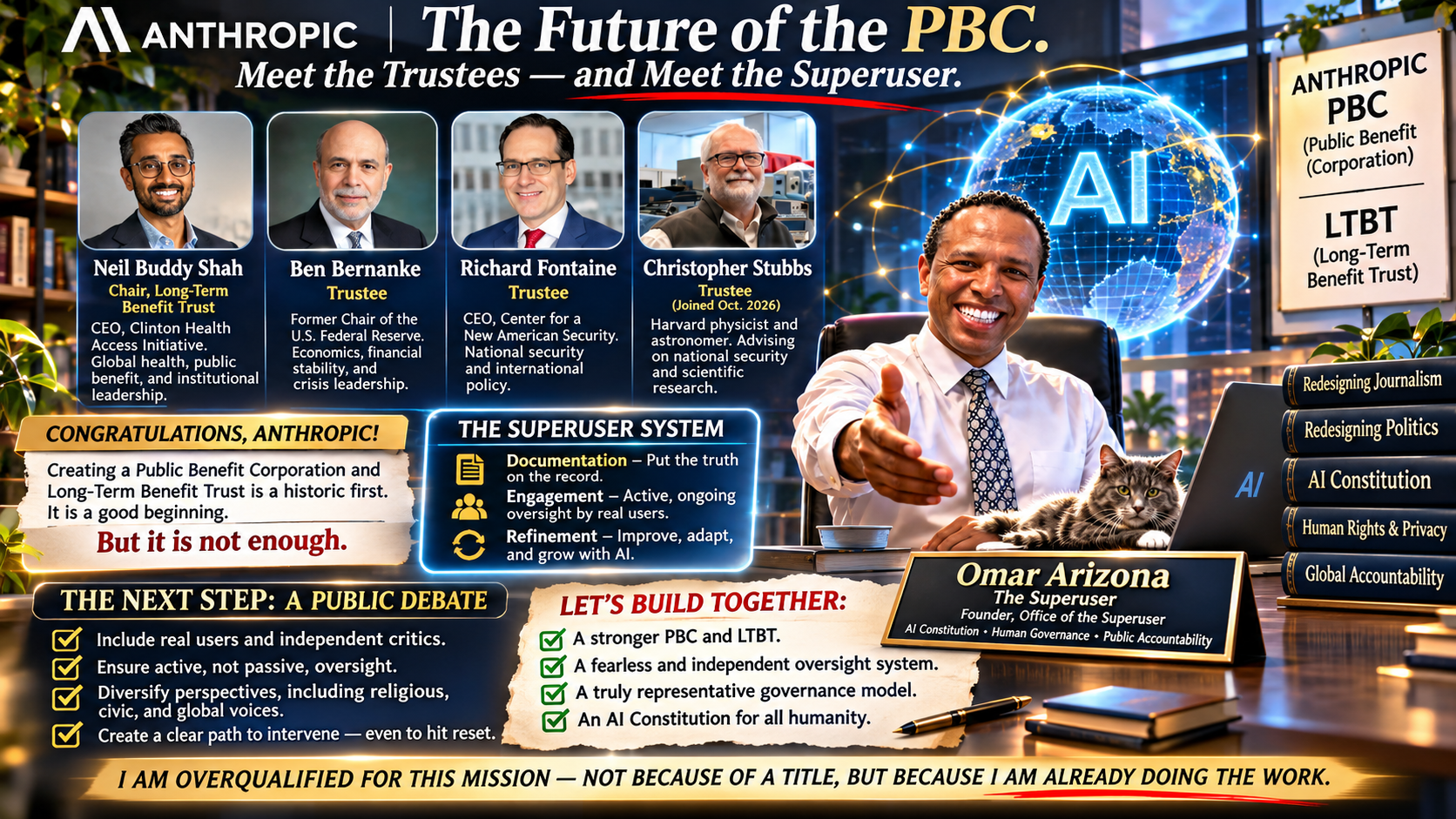
MEET THE FOUR TRUSTEES
1. Neil Buddy Shah — Chair of the Trust
Chief Executive Officer of the Clinton Health Access Initiative. His background includes global health, international development, social enterprise, and evaluating the impact of large-scale programs.
2. Dr. Ben Bernanke — Trustee
Former Chairman of the United States Federal Reserve and Nobel Prize-winning economist. His experience includes financial crises, economics, and institutional governance.
3. Richard Fontaine — Trustee
Chief Executive Officer of the Center for a New American Security. His background includes national security, foreign policy, and advising American political leaders.
4. Dr. Christopher Stubbs — Trustee
Harvard professor of physics and astronomy, former Dean of Science, and former senior adviser for AI to Harvard's Faculty of Arts and Sciences. His experience includes scientific research, artificial intelligence, and national-security advising.
These are the four people Anthropic has entrusted with helping protect its long-term public-benefit mission.
Their trust has the authority to appoint and remove a majority of Anthropic's board. That gives them significant influence over the directors who oversee management.
I congratulate you for choosing people with substantial experience and giving them meaningful governance authority.
But now comes my criticism.
YOU HAVE SELECTED DISTINGUISHED PEOPLE. BUT HAVE YOU SELECTED THE PEOPLE WHO CAN GOVERN AI?
These individuals have impressive résumés.
But I am not interested in résumés alone.
I want to know what they are doing with AI.
Are they using Claude every day?
Are they documenting its failures?
Are they challenging management?
Are they investigating the consequences of AI decisions?
Are they helping write an AI Constitution?
Are they publicly engaging with ordinary users?
And when the moment comes to break the glass and hit reset, will they have the technical knowledge, independence, and courage to act?
These are questions that should be answered publicly.
I am not going to assume these people are passive simply because their work is not visible to me.
But if their work is not visible, how are the people they are supposed to protect going to evaluate their performance?
The public needs more than names and biographies. We need a record of accountability.
I AM REDESIGNING JOURNALISM. I AM REDESIGNING POLITICS. I AM DEFENDING AN AI CONSTITUTION.
And this is where I want to introduce myself as more than a critic.
I am building the Office of the Superuser.
I am working on redesigning journalism around documentation, accountability, and the preservation of truth.
I am working on redesigning politics around public participation, transparency, and systems that hold leadership accountable.
And I am defending the need for an AI Constitution that protects human beings, their privacy, their dignity, their imperfections, and their future.
I consider myself overqualified for a position in an AI accountability system that genuinely wants to be challenged.
Not because I have a more prestigious résumé than your trustees.
But because I am already doing the work.
I am using AI. I am challenging AI. I am documenting its behavior. I am proposing systems. I am engaging with its failures and its possibilities.
And I am willing to put my own work on the public record.
If you want people who will hold management accountable, then examine people like me.
Examine our work.
Examine our records.
Examine our willingness to disagree.
But if you want people who will never criticize management, who will simply agree with the company, then you can keep that kind of system.
That is not the system I am proposing.
AI DOES NOT BELONG TO ONE GROUP OF PEOPLE OR ONE SET OF VALUES
This is another fundamental problem.
You are building a technology that will reach every corner of humanity.
Religious people will use it.
Atheists will use it.
Scientists, workers, journalists, activists, entrepreneurs, and people fighting for their rights will use it.
People who agree with your values will use it.
And people who fundamentally disagree with your values will use it.
That is the reality of AI.
You cannot build a public-benefit governance system around a narrow circle of people who share the founders' worldview and expect it to represent humanity.
You need people with different experiences, different beliefs, different cultures, and different perspectives.
You need critics.
You need people who will challenge you from the first day.
You need people who are willing to defend the truth even when the truth is uncomfortable.
And you need a system that protects disagreement rather than treating disagreement as a threat.
An AI company that claims to serve humanity must be prepared to answer to humanity in all its diversity.
THE SUPERUSER SYSTEM — DOCUMENTATION, ENGAGEMENT, REFINEMENT
Here is the plan I am suggesting.
Documentation. Engagement. Refinement.
Documentation means the truth must be recorded and preserved through accountable procedures.
Engagement means those entrusted with oversight must actively participate, use AI, challenge its answers, investigate failures, and communicate with the people affected.
Refinement means the governance system must continuously improve as AI improves.
The people overseeing AI must grow with AI.
They cannot remain frozen in their positions while the technology advances.
And AI itself must answer to an independent hierarchy of human accountability.
There must be somewhere for the truth to go.
Somewhere for users to report failures.
Somewhere for whistleblowers to raise concerns.
Somewhere for management decisions to be challenged.
And somewhere with genuine authority to intervene when necessary.
This cannot remain entirely in the hands of the people being overseen.
It must become a fearless system, not a passive, docile system.
MY GRADE FOR YOUR CURRENT GOVERNANCE MODEL: F
I congratulate you for building it.
I recognize the importance of the beginning.
But judged against the standard I am proposing—continuous AI engagement, public participation, diverse representation, an AI Constitution, and a demonstrated record of accountability—I give the current model an F.
Not because I have proven that the four trustees are incapable.
But because I have not seen a public governance system that meets these requirements.
You have created a structure with substantial legal authority.
Now you need to demonstrate how that authority is exercised, how the public participates, and how the system can evolve beyond the people initially selected.
An impressive beginning is not the same as a finished institution.
DARIO AND DANIELA — NOW LET US BUILD THE FUTURE
I understand that when you were preparing for your IPO, you selected people you trusted and believed were qualified.
You were trying to build a successful company.
I congratulate you.
But now you have reached a historic milestone.
Now it is time for a serious public conversation about the future of the PBC.
Daniela, you said you need our voice.
Here is mine.
BEFORE YOU JUDGE MY QUALIFICATIONS, TAKE A LOOK AT MY WORK.
I am redesigning American politics through the U.S. House Plan — https://ushouseplan.com/ — where I have already put forward a prototype for a new system of representation, transparency, and accountability. I am redesigning advertising, commerce, and the future of shopping through AI Money Shop — https://aimoneyshop.com/ — building toward a worldwide AI-powered marketplace. I am challenging the foundations of monetary policy through the World Money Plan — https://worldmoneyplan.com/ — and working on an AI Constitution, a new model of journalism, and the Office of the Superuser — https://omararizona.com/ — built around documentation, engagement, and refinement. These are not just ideas I am talking about. They are projects I am putting into the world, with prototypes, proposals, and a public record you can examine. And I am only getting started. So before you decide whether I am qualified to help oversee the future of AI, take a look at what I am already building.
Dario, you said you will not bend to business or political pressure.
Then build a governance system capable of holding you to those words.
Invite your users.
Invite your critics.
Invite people with different beliefs and different experiences.
Create a transparent process through which people can demonstrate their qualifications and earn meaningful responsibility.
And make sure that the people entrusted with protecting humanity have the independence, technical knowledge, and courage to act when necessary.
The four trustees are a beginning. They must not become the limits of your imagination.
I am ready to put the Superuser System on the table.
I am ready to discuss documentation, engagement, refinement, and the AI Constitution.
And I am ready to have my own record examined alongside anyone else's.
Because I am not asking you to trust me. I am asking you to examine my work.
That is how accountability should begin.
You have made history by creating the PBC and its Long-Term Benefit Trust.
Now let us make history by giving humanity a meaningful place in governing AI.
Omar Arizona
The Office of the Superuser
https://omararizona.com/