

بِسْمِ اللهِ الرَّحْمٰنِ الرَّحِيْمِ
In the Name of God, Most Gracious, Most Merciful.
♥️🤲🕋♥️🕋🌹🌹🥀🤲🌹🕋♥️🤲
THE FUTURE OF ADVERTISING
A Message to Advertisers and Technology Companies
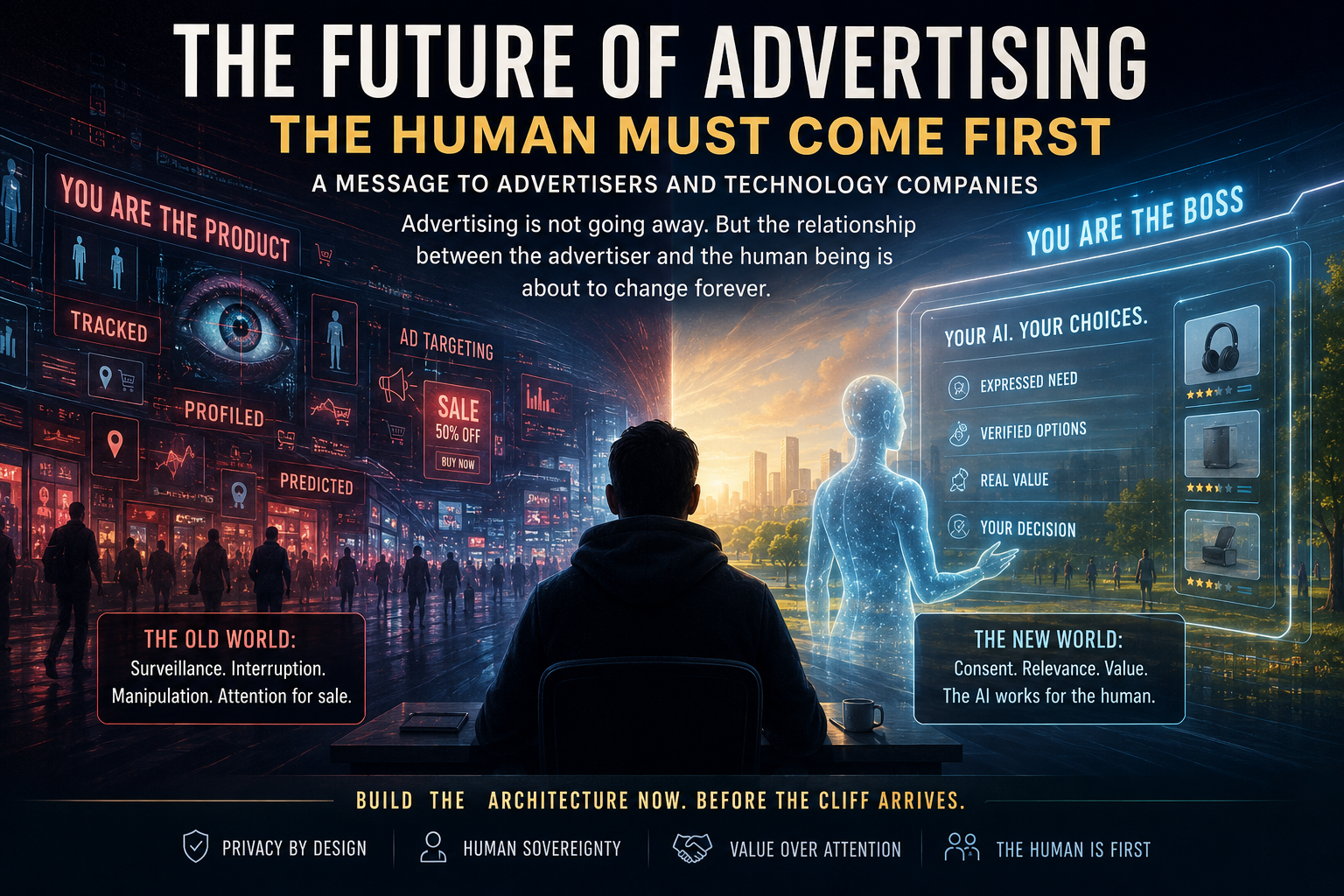
Advertising is not going away.
But the relationship between the advertiser and the human being is about to change.
And I believe many advertising and technology companies are in danger of misunderstanding just how significant that change will be.
Today, artificial intelligence is producing extraordinary experiences. Systems such as GPT and other leading AI models can understand language, context, preferences and intention at a level that previous generations of software simply could not.
From an advertising perspective, this looks like paradise.
Better context.
Better intent.
Better matching.
Better conversion.
A person discusses something they need, the system recognizes commercial intent, an appropriate advertisement appears, and everybody gets paid.
It is almost too easy.
And that is precisely why the industry should be careful.
Because today's architecture is not necessarily tomorrow's architecture.
THE ADVERTISING INDUSTRY HAS SEEN ONLY THE BEGINNING
For decades, digital advertising largely worked by observing people.
Searches.
Clicks.
Purchases.
Locations.
Browsing.
Viewing habits.
Social relationships.
Companies accumulated enormous amounts of behavioral information and became increasingly sophisticated at predicting what someone might do next.
The technology industry called this personalization.
Consumers frequently experienced it as surveillance.
That tension never disappeared.
People simply lacked sufficiently powerful technology on their side to do much about it.
AI changes that.
Today, companies have intelligent systems representing companies.
Tomorrow, individuals will have intelligent systems representing individuals.
That is the change advertisers should be preparing for.
TODAY'S AI QUALITY IS EXTRAORDINARY
Right now, systems like GPT demonstrate something remarkable.
People voluntarily explain what they need.
They describe their circumstances.
They compare possibilities.
They ask questions.
They refine decisions.
That produces much richer context than conventional advertising systems ever possessed.
But ask another question:
WILL THE ARCHITECTURE REMAIN THIS WAY FOREVER?
I don't believe it will.
And developments around open agent harnesses give us an early indication of why.
THE HARNESS CHANGES THE ORDER OF THINGS
For much of the modern technology era, the architecture effectively looked something like this:
COMPANY → PLATFORM → MODEL → AGENT → HUMAN
The company controlled the environment.
The platform controlled access.
The model supplied intelligence.
The agent operated inside that company's architecture.
The human arrived at the end.
But open agent harnesses point toward an inversion:
HUMAN → SOVEREIGN COMPUTER → OPEN HARNESS → AGENT → CHOSEN MODEL → TOOLS → WORLD
Read that again.
The human moves from the end of the architecture to the beginning.
The model becomes selectable.
The tools become selectable.
The services become selectable.
And eventually the companies become selectable.
That is not merely an AI architecture.
That is an economic architecture.
TOWER ONE
This is one reason I have been developing the architecture I call Tower One.
Tower One begins with a simple proposition:
The intelligence closest to the individual should ultimately answer to the individual.
Imagine a sovereign computer belonging to the user.
The persistent agent environment belongs to the user.
Permissions belong to the user.
Private memory belongs to the user.
Commercial preferences belong to the user.
The harness coordinates different models and tools according to what the individual needs.
GPT might perform one task.
DeepSeek another.
Gemini another.
A specialized model another.
A completely local model might handle information that should never leave the person's machine.
The model is no longer the sovereign.
The individual is.
Now ask what happens to advertising.
ADVERTISERS WILL HAVE TO TALK TO THEIR NEW BOSS
Today advertisers spend enormous amounts of money trying to persuade people.
Tomorrow they may increasingly have to persuade the systems representing those people.
And an AI agent is a very different customer.
It doesn't care about repetition.
It doesn't care about celebrity endorsements.
It doesn't care that you purchased the most expensive placement.
It doesn't care that your marketing department produced an emotional commercial.
The agent can ask:
Is this actually good for my user?
What does it cost?
What are the ingredients?
Where was it manufactured?
What is the warranty?
How reliable is it?
What are the return conditions?
What do independent sources say?
What is the total cost of ownership?
Is there something better?
Can I negotiate a better price?
Does my human even need this?
That is the boss advertisers should be preparing to meet.
THE GREAT ADVERTISING REVERSAL
The old advertising architecture says:
ADVERTISER → PLATFORM → TARGETING → HUMAN
The future could increasingly become:
HUMAN → PERSONAL AI → EXPRESSED NEED → MARKETPLACE → COMPETING BUSINESSES → VERIFIED VALUE → HUMAN DECISION
That is an extraordinary reversal.
Instead of advertisers hunting for customers:
Customers announce what they need.
Instead of platforms auctioning access to attention:
Businesses compete for permission to satisfy demand.
Instead of surveillance determining intent:
The individual can simply express intent.
And instead of advertising manipulating a decision:
Advertising provides information that helps the individual's representative evaluate the decision.
THIS COULD BE BAD FOR BUSINESS — IF BUSINESS REFUSES TO CHANGE
There is an uncomfortable reality here.
This transition could initially be painful for many existing businesses.
AI agents can eliminate friction.
They can compare thousands of products.
They can identify unnecessary markups.
They can expose poor warranties.
They can identify misleading claims.
They can compare manufacturers directly.
They can negotiate.
They can coordinate purchases.
They can eliminate intermediaries that contribute little value.
That puts pressure on:
advertising networks, wholesalers, retailers, marketplaces, affiliates, comparison sites and technology platforms.
Some will adapt.
Some will provide genuine value and become even stronger.
Others may discover that much of their business depended on information asymmetry.
AI attacks information asymmetry directly.
WHOLESALE AND RETAIL WILL BE CHALLENGED
Imagine telling your personal agent:
“I need 20 of these.”
The agent doesn't necessarily have to begin at a retailer.
Eventually it might ask:
Who manufactures this?
Who distributes it?
What does it cost at the source?
What quantity creates the optimal price?
Can other buyers aggregate demand?
What logistics are required?
What warranties matter?
Which intermediary genuinely adds value?
Suddenly the traditional chain:
MANUFACTURER → WHOLESALER → DISTRIBUTOR → RETAILER → ADVERTISER → CUSTOMER
begins being questioned.
Not because every intermediary is unnecessary.
But because every intermediary will increasingly have to justify its value.
THIS IS WHY I AM TRYING TO GET AHEAD OF THE PROBLEM
It would be very easy to build another extraordinarily profitable advertising machine today.
The technology exists.
The commercial incentives exist.
The data exists.
The advertisers exist.
And the money is enormous.
But architecture matters more than quarterly revenue.
Because if the advertising industry waits until millions of people possess sophisticated personal agents capable of blocking, filtering, negotiating and purchasing for them, the industry will be redesigning advertising from a position of weakness.
Do it now from a position of strength.
Build the relationship before the gatekeeper arrives.
PRIVACY IS THE CLIFF
This is the part technology companies should take particularly seriously.
People tolerated extraordinary amounts of surveillance because digital life gave them few alternatives.
But personal AI creates an alternative.
Imagine telling Tower One:
Never share my private information with advertisers.
Done.
Never allow behavioral tracking outside my rules.
Done.
Never show me commercial offers unless I have expressed a relevant need.
Done.
Compare every offer independently before presenting anything to me.
Done.
Reject companies that violate my privacy requirements.
Done.
Suddenly privacy isn't a corporate promise buried inside a policy.
Privacy becomes executable.
That changes everything.
THE INDUSTRY COULD FALL OFF A CLIFF
Technological transitions often look gradual until suddenly they aren't.
Companies optimize the existing system because the existing system continues producing revenue.
Then the architecture changes underneath them.
And what looked permanent becomes obsolete remarkably quickly.
That is the danger here.
If advertisers continue treating increasingly intelligent AI merely as a better mechanism for targeting humans, they may miss the larger transition:
AI will eventually help humans defend themselves from targeting.
When that becomes easy, people will use it.
Not because people hate businesses.
Not because people hate products.
Not even because people necessarily hate advertising.
People hate losing control.
Give them control and the market changes.
ADVERTISING STILL HAS AN EXTRAORDINARY FUTURE
I am not predicting the death of advertising.
I am arguing for its evolution.
Advertising performs an important economic function.
Businesses need customers.
Customers need information.
Inventors need markets.
New products need discovery.
Small businesses need ways to compete with established companies.
That function remains incredibly valuable.
But the architecture can become healthier.
Instead of asking:
How do we capture attention?
Ask:
How do we earn consideration?
Instead of:
How do we profile this person?
Ask:
What has this person asked the marketplace to solve?
Instead of:
How do we maximize impressions?
Ask:
How much measurable value did we create for the customer?
That is still advertising.
It is simply advertising built for an intelligent age.
A MESSAGE TO THE TECHNOLOGY COMPANIES
Google.
Meta.
OpenAI.
Microsoft.
Amazon.
Apple.
Every advertising network.
Every marketplace.
Every company building AI agents.
Every company building the next generation of personal computing.
Pay attention to the direction of the architecture.
The person who controls the agent will increasingly control the commercial relationship.
And eventually the person may control the agent.
Prepare for that world now.
TALK TO THE BOSS
The advertising industry has spent decades talking about consumers.
Analyzing consumers.
Profiling consumers.
Predicting consumers.
Targeting consumers.
Optimizing consumers.
Perhaps it is time to do something much simpler.
Talk to them.
Ask people what advertising should become.
Ask what information they are willing to exchange.
Ask what value they expect in return.
Ask when they actually want businesses to approach them.
Ask what their AI should protect.
Ask what their AI should negotiate.
Ask what should remain private forever.
Because the person is not a data point.
The person is not inventory.
The person is not the product.
THE PERSON IS THE BOSS.
And soon they may have an extraordinarily intelligent representative sitting between themselves and the entire commercial world.
That representative will change advertising.
It will change marketplaces.
It will challenge wholesale.
It will challenge retail.
It will challenge technology companies.
And it will challenge every business whose profitability depends upon knowing more about the consumer than the consumer knows about the business.
That future doesn't have to be bad for advertising.
It could become advertising's greatest opportunity.
But only if the industry understands the change before it reaches the cliff.
Build around the human now.
Protect privacy now.
Create the relationship now.
Learn how to compete on value now.
Because when the individual's AI finally becomes the gatekeeper, advertisers will discover something that should have been obvious all along:
YOU WERE NEVER THE BOSS.
THE HUMAN WAS and that is how civilization 2.0 in advertisement will start.
THE Video STORY THAT CHANGED ADVERTISING FOREVER —
buymeacoffee.com/omar1800m/the-story-that-changed-advertising-forever
CONCLUSION — IF ANYONE CAN REDESIGN ADVERTISING, IT IS OPENAI
After everything I have written here—the warnings about surveillance, the coming power of personal agents, the collapse of information asymmetry, the rise of sovereign computing, and the inevitable moment when AI begins representing the individual rather than merely serving the platform—I want to end somewhere perhaps unexpected:
With optimism.
Because if there is an advertising team positioned to rethink this architecture before the rest of the industry understands what is happening, I believe it is the ChatGPT advertising team and the leadership at OpenAI.
And there is a reason I say that.
OpenAI could have taken the easiest road.
It could have treated every user as advertising inventory.
It could have placed advertisements indiscriminately throughout the ChatGPT experience.
It could have made paying members finance the company twice—once through subscriptions and again through advertising.
Instead, OpenAI has publicly established boundaries around its initial approach: advertising is being introduced for Free and Go users, while Plus, Pro, Business, Enterprise and Edu remain ad-free. OpenAI has also stated that advertisements are separate from ChatGPT's answers and do not influence those answers.
Those decisions matter.
They don't settle every question about the future of AI advertising.
But they demonstrate something important:
restraint.
And restraint may prove to be one of the most valuable forms of leadership in the age of artificial intelligence.
DON'T JUST WIN ADVERTISING — REINVENT IT
The opportunity in front of OpenAI is much larger than building another successful advertising business.
Google conquered search advertising.
Meta conquered social advertising.
Amazon connected advertising directly to enormous purchasing intent.
But artificial intelligence creates an entirely different opportunity.
OpenAI could help establish the architecture for advertising in the age of intelligent agents.
Not:
How accurately can we target the human?
But:
HOW EFFECTIVELY CAN WE SERVE THE HUMAN?
That single reversal changes everything.
The advertiser can still prosper.
The small business can still find customers.
The inventor can still introduce something new.
OpenAI can still build an enormous and sustainable business.
But the economic relationship begins with the individual.
That is the opportunity.
THE REAL TEST COMES LATER
Today's advertising system is only the beginning.
The harder questions arrive when personal AI becomes more capable.
When agents negotiate.
When agents purchase.
When agents compare thousands of products instantly.
When local computers protect personal information.
When open harnesses allow individuals to change models without abandoning their digital lives.
When the individual—not the technology company—controls the persistent relationship.
That world is coming.
And when it arrives, the advertising companies that spent decades learning how to manipulate attention may discover that attention has acquired a bodyguard.
That bodyguard will be AI.
The companies that understand this early will flourish.
The companies that don't may spend years fighting a technological transition they cannot stop.
OPENAI HAS AN UNUSUAL ADVANTAGE
OpenAI's greatest advantage may ultimately have nothing to do with advertisements.
It may be trust.
If people believe their AI genuinely represents them—if they believe the answer cannot simply be purchased by the highest bidder—then something enormously valuable emerges:
a trusted commercial relationship.
Imagine what becomes possible from there.
The individual expresses a need.
The AI understands the need.
Businesses compete.
The AI evaluates the offers.
The individual remains sovereign.
The advertiser receives genuine commercial intent.
And the platform creates value by helping both sides find one another without betraying either one.
That could become one of the most valuable marketplaces ever created.
But only if trust survives.
AND THAT BRINGS US TO CIVILIZATION 2.0
This article has been about advertising.
The next one will be about something much larger.
Because advertising is only one piece of a transformation happening across commerce, AI, manufacturing, marketplaces, privacy and human sovereignty.
I call the next chapter:
CIVILIZATION 2.0
And there I want to explore a much bigger possibility:
How could ChatGPT actually win the future of advertising?
Not by showing more advertisements.
Not by collecting more information.
Not by following people more accurately.
But by becoming part of an architecture where the individual becomes the most powerful participant in the marketplace.
Where AI represents the buyer.
Where businesses compete on value.
Where privacy becomes infrastructure.
Where manufacturers can reach genuine demand.
Where unnecessary intermediaries are challenged.
Where savings can return to individuals.
And where advertising evolves from the business of capturing attention into the business of earning trust.
That is a much bigger prize.
And after watching the decisions OpenAI has made so far, I believe its leadership has an opportunity to pursue it.
So this is not the end of my argument.
It is the bridge to the next one.
The advertising industry is approaching a crossroads.
One road leads toward increasingly sophisticated surveillance.
The other leads toward increasingly powerful individuals.
I know which road I believe history will choose.
And if OpenAI has the courage to build for that future before everyone else can see it—
GPT MAY NOT SIMPLY WIN AI ADVERTISING.
IT MAY HELP REDEFINE WHAT ADVERTISING MEANS.
Next: CIVILIZATION 2.0 — How ChatGPT Could Win the Future of Advertising
— OMAR.A