

بِسْمِ اللهِ الرَّحْمٰنِ الرَّحِيْم
Bismillah ar-Rahman ar-Rahim
In the Name of God, Most Gracious, Most Merciful
The Future of China Is in Its Past
I. The Tension of a Century
The wheel of history turns again, and this time, its motion begins in Beijing. The world’s eyes are fixed on China — a civilization ancient enough to remember the rise and fall of empires, yet young enough in its modern form to shape the next thousand years. What China decides in the coming decade will determine not only its destiny but the fate of peace itself.
For centuries, the Middle Kingdom has carried within it two opposing forces — wisdom and pride. When wisdom leads, China becomes the light of the world: humble, patient, and moral, guiding others through balance and restraint. But when pride takes the reins, it blinds itself to the very virtues that once made it great. The result, every time, has been humiliation, rebellion, or collapse.
We are again at that edge. The tension of a century stretches between two worlds — an aging West desperate to preserve its illusions, and a rising East uncertain how to use its newfound strength. The United States fears decline; China fears stagnation. Both nations distrust each other, yet both mirror the same disease — an economy unanchored from ethics, a people searching for meaning in numbers.
What happens next will decide war or peace. It will decide whether humanity learns from the past or repeats its oldest sins.
And so we return to the lesson buried deep in China’s own story — a story not of emperors or armies, but of a man who traded in virtue.
In the heart of old Canton, there lived Wū Bǐngjiàn, known to Westerners as Houqua, the richest man in China — and perhaps the most honest. He mastered the art of trade not by deceit but by trust. He turned foreign ships into loyal partners and turned profit into peace. At a time when greed drove the world toward opium and war, he was the bridge between civilizations.
But bridges, once burned, take centuries to rebuild.
When the Qing court, blinded by arrogance and fear, failed to recognize what they had — when they humiliated their most trusted broker instead of studying him — they did not merely destroy a man. They destroyed the mirror that showed them what China could have been: the moral center of the world economy.
That was the true beginning of the Opium War — not the first shot fired, but the first truth ignored.
If only they had listened. If only they had realized that wealth without wisdom is ruin. If only they had seen that an honest trader is worth more than a thousand generals. China could have transformed its profits into progress, its markets into models, and its trust into the most powerful export known to mankind — integrity.
Now, the wheel has turned again.
China stands where it once stood — powerful, admired, misunderstood, and surrounded by temptation. The world buys from it, fears it, copies it, and yet depends on it. And within China itself, a quiet question echoes: Will we listen this time?
Will the nation that once lost its soul to opium now find it through honesty? Will it choose wisdom over conquest, sincerity over supremacy, and balance over domination?
Because the future of China is not in its weapons, not in its GDP, and not in its armies of engineers.
The future of China is in its past — in its integrity, in its honesty, and in its ability to listen to the truth that once saved it and could save it again.
Diagnosis — The Problems of the Present
China stands today at the height of its material success. Its skylines rise like silver forests, its trains move faster than wind, and its factories feed the rhythm of the planet. But beneath the hum of progress lies a growing silence — a silence not of peace, but of disconnection. The spirit that once bound trade to trust has faded beneath the noise of ambition.
The signs are visible to any honest observer:
Economic imbalance — Growth measured in speed, not sincerity. Mountains of steel and screens, but too few bridges of faith.
Moral fatigue — The sense that right and wrong are negotiable, that loyalty can be replaced by efficiency, that human dignity can be traded for quarterly gains.
Social pressure — Families chasing status more than meaning, youth struggling to believe in a future beyond survival.
Global tension — The shadow of the Opium War reborn, as suspicion replaces respect, and rivalry replaces understanding.
The algorithmic age — Machines now mediate human desire, but who mediates the machines? Data flows endlessly, yet truth itself feels uncertain.
The West once thought it could own China through opium and silver. Now it tries to own it through dependency — on chips, markets, and artificial intelligence. Yet the irony is sharp: China has already surpassed its rivals in power, but not yet in purpose. It has gained the wealth the Qing dynasty dreamed of, but risks losing the same thing the Qing lost — its moral compass.
The question is not whether China can dominate the future. It already has the power to. The question is whether it can redeem it — whether it can align its destiny with the virtues that made it timeless: balance, patience, humility, and justice.
Because prosperity without ethics is not progress. It is decay disguised as triumph.
And that decay — if left unchecked — will draw the world once again toward conflict.
China does not need to conquer the United States to win.
It needs to compete with itself — to prove that moral civilization can survive modernity.
The Lost Opportunity — The Story of Wū Bǐngjiàn (Houqua)
Before the gunboats came, before the treaties carved humiliation into the empire’s skin, there was a man whose name carried more power than armies: Wū Bǐngjiàn, known to the West as Houqua.
He was born not into nobility but into trust.
From the harbors of Guangzhou, where salt met silk and voices spoke in a hundred tongues, he rose to become the richest man in China — not because he exploited others, but because he kept his word.
When foreign captains anchored in the Pearl River, they sought only one man’s guarantee. If Houqua said the cargo was safe, it was safe. If he promised repayment, it was repaid. In him, East and West found the bridge that governments could not build — a living treaty of honor.
Under the Canton System, he carried an impossible burden: all foreign trade had to pass through a handful of licensed merchants called the Co-Hong. They answered to imperial law, bore all debts, and risked their fortunes for every ship that sailed. To the Qing court, Houqua was both a tool and a shield; to the West, he was a partner and a friend.
He could have been the blueprint for a new economic order — an order built not on conquest, but on credibility.
Yet the empire that should have celebrated him began to fear him. His wealth, his influence, his relationships with Western merchants — all looked dangerous to a bureaucracy terrified of change. Instead of studying him, they constrained him. Instead of protecting him, they humiliated him.
When foreign traders, hungry for silver and power, forced the poison of opium into China’s veins, Houqua stood helpless. His honesty could not compete with greed on either side. And when the war came, it was not merely a clash of cannons — it was the punishment of an empire that refused to learn from its own virtue.
If the Qing court had looked at Houqua and said, “This man understands the world; let us understand it with him,” history might have turned differently.
They could have taken the surplus of silver and trade profits and used them to rebuild China, to industrialize, to invest abroad, to share in Western innovation while keeping their soul intact. Houqua’s model of trust could have been institutionalized — a Ministry of Integrity, binding merchants, scholars, and state together.
Instead, they silenced their best voice.
And when a nation silences its best voice, it also silences its destiny.
That was the real beginning of the Opium War — not a battle of ships, but a failure of conscience. The emperor did not lose to Britain; he lost to arrogance.
The West watched and learned: when China destroyed its honest trader, it destroyed its moral advantage. From that moment, the global economy drifted westward, taking with it the power that should have remained in the East.
But the story does not end there.
For history moves in circles, and every circle returns to its beginning.
China today stands again at the gates of global leadership, surrounded by admiration and suspicion, wealth and fragility. And somewhere in its archives, the spirit of Wū Bǐngjiàn waits to be reborn — not as a man, but as a system.
A system that can make honesty measurable, trust visible, and virtue profitable.
That is the opportunity once missed — and the opportunity now knocking again.
The Mirror of Today
The mirror of history does not flatter—it reflects. And when China looks into that mirror today, it sees the same image that once stared back from the harbors of Canton: a nation at the height of power, standing before a tide it cannot control.
In Houqua’s time, the West lined up at China’s gates, desperate for tea, silk, and porcelain. The empire held every advantage—resources, culture, and the moral confidence of a civilization thousands of years old. Yet the danger did not come from weakness; it came from refusing to adapt. The Qing rulers looked at the world through walls, not windows. They feared their own merchants more than their enemies, and so they mistook loyalty for rebellion and arrogance for strength.
Today, the pattern whispers again.
China leads the world in trade, in industry, in technology. Its ports are the lifeblood of global commerce; its factories shape the future. Yet within its rise lies the same fragile equation that doomed the Qing: power without moral renewal, control without compassion, and surveillance without trust.
The people are strong, the system efficient—but the soul is restless. Progress feels heavy, not light. Citizens feel watched, not seen. Abroad, admiration is mixed with suspicion. The West fears not what China sells, but what it might become if it loses its sense of integrity.
The irony is profound: the world that once exploited China’s weakness now depends on its strength. America, the self-proclaimed guardian of capitalism, built its prosperity on the same open markets that China now commands. But as the balance shifts, both powers face the same ancient question: what happens when wealth outpaces wisdom?
In the mirror of today, we see two civilizations chasing the same mirage—growth without grace. And between them lies a narrow road that could still lead to peace: the road of integrity-driven commerce.
If China chooses to walk that road, it can reclaim the moral leadership once embodied by Wū Bǐngjiàn.
If it does not, history will repeat itself—not as tragedy alone, but as prophecy fulfilled.
China stands again in the position of the Qing court: admired, envied, and surrounded by choices that could define centuries. The West will not destroy China with opium this time—it will destroy it with temptation, with offers of data power, artificial intelligence, and limitless consumerism. The weapons are different, but the war is the same. It is a war for the soul of civilization.
This is the hour when China must look at the past not as a memory, but as a manual. It must rediscover the blueprint that Houqua left behind: trade guided by conscience, partnership bound by honesty, and wealth that serves the world instead of enslaving it.
The next chapter of human progress will not be written in dollars or yuan—it will be written in trust. And whichever nation learns to measure trust will inherit the future.
The Turning Point — A Choice Between Misery and Wisdom
Every civilization reaches a moment when its greatest success begins to turn into its greatest danger. For the Qing Empire, it was the illusion that power could preserve itself without reform. For the modern world, it is the illusion that technology can replace morality.
China now stands on that very edge — the same ledge from which the old empire once fell. The question before it is not whether it can lead the world, but whether it can lead wisely.
If it follows the old road — the road of control, secrecy, and suspicion — it will win short victories but lose the long war for meaning. It will build stronger walls, but its people will feel smaller behind them. It will sell to the world but struggle to be loved by it. And slowly, the same invisible corrosion that once dissolved dynasties will return: a loss of trust, a collapse of spirit, a widening distance between power and truth.
But there is another road — the road of wisdom.
Wisdom does not weaken nations; it refines them. It does not surrender control; it purifies it. The wise nation is the one that recognizes when its strength must evolve from fear into trust, from secrecy into transparency, from dominance into harmony.
China does not need to conquer the West. It needs to redeem the world from the sickness of greed and deceit that the West itself no longer knows how to cure.
This is the moment for China to prove that civilization can be powerful and moral — that profit can coexist with conscience, and that technology can serve the soul rather than replace it.
Because if China chooses wisdom now, it will not only secure its future — it will heal the wound left by the Opium War. That wound was not just military defeat; it was a moral injury, a betrayal of its own best self.
To choose wisdom today means to finish what Houqua began: to build a new model of commerce that rewards trust, punishes deceit, and restores dignity to trade.
That model exists. It is not foreign. It is not theoretical.
It is the modern continuation of the spirit that once made the Pearl River glow with honest exchange.
It is the Brand Currency System — a system born from the same moral code that defined China’s greatest merchant, reimagined for the digital age.
Where the Canton System controlled trade through walls, the Brand Currency System governs it through truth.
Where opium destroyed trust, Brand Currency restores it.
Where the empire once taxed honesty, this system rewards it.
It measures not just what a nation sells, but how it behaves.
It treats every transaction as an opportunity to prove character.
It replaces exploitation with accountability and turns profit into proof of integrity.
This is the choice before China — the same choice that once stood before the emperor:
To cling to old habits and sink into misery, or to listen to the wisdom that once saved it from chaos.
One path leads to conflict, stagnation, and distrust.
The other leads to renewal, balance, and peace.
The future is not written yet. But the pen is in China’s hand.
The Solution — Re-Creating the Honest Trader in the Digital Age
When we strip away the machinery of modern life, the soul of trade remains the same as it was in Houqua’s time: an exchange of trust. Every contract, every delivery, every handshake—no matter how digital—still depends on belief that one party will keep their word. Houqua understood this truth two centuries before economists tried to describe it.
The Brand Currency System revives that understanding, not as nostalgia but as infrastructure. It re-creates the honest trader in code.
1. The Spirit of the System
In the Canton harbors, reputation was currency; a merchant’s seal carried the weight of his character. In the Brand Currency model, the same law applies: integrity itself becomes measurable.
Every product, service, or transaction carries a verified signature of honesty—a record of origin, labor, and environmental cost.
Instead of extracting value, participants earn credibility; the more transparent and fair their behavior, the higher their standing in the network.
Wealth no longer hides behind speculation. It must prove itself useful, ethical, and true.
This is not a new capitalism. It is civilization re-programmed around moral equity.
2. The Technology of Conscience
Where the opium traders once exploited opacity, the new trader thrives in light.
Smart receipts record who benefits, who suffers, and who repairs.
AI auditors verify that data flows honestly, ensuring that profit never outruns accountability.
Digital ledgers become not tools of surveillance, but of shared memory—each entry a small act of truth.
In such a system, deception becomes expensive and virtue becomes valuable.
This is how morality scales.
3. China’s Historic Advantage
No nation is better positioned to implement this model than China. Its philosophy already teaches that the righteous merchant (义商) serves the harmony of Heaven and Earth.
By embedding that principle into digital commerce, China can:
Lead the world not through domination, but through dependable fairness.
Offer global markets a transparent alternative to exploitation.
Reclaim moral authorship of the world economy—the same authorship it lost when the Qing ignored Houqua’s lesson.
If China re-creates the honest trader through the Brand Currency System, it will not merely modernize; it will redeem its history.
4. The West’s Invitation
The United States need not vanish; it can evolve. It opened its markets to China once, and can now open its conscience.
In this new framework, nations compete in trust, not tariffs.
The strongest will be those whose data are clean, whose brands are honest, whose citizens believe their word still matters.
5. The Moral Outcome
When trust becomes measurable, peace becomes predictable.
Trade once carried opium across oceans; soon it can carry proof of integrity across networks.
The next empire will not be built by armies or oligarchs—it will be built by the most transparent ledger of truth.
The Brand Currency System is not a technology alone; it is a return to the moral science of Houqua—a world where every gain must pass through the gateway of honesty.
The Message to America — A Mirror Across the Ocean
America, you once looked across the Pacific and saw a world you thought you could awaken with trade.
You sent missionaries, merchants, and gunboats—not always to conquer, sometimes to teach. But over time, you became what you warned others against: a power defined by appetite instead of virtue.
You were born out of a declaration of freedom, yet built your wealth on domination. You invented democracy, yet sold it through debt. You raised the flag of innovation, yet let your moral industries collapse under the weight of profit and pride.
And now, as the century shifts, the camera turns toward you.
The world no longer fears your strength; it pities your confusion. You have reached the same point that the Qing Dynasty once did—wealthy, proud, and uncertain of purpose. You built machines that can think, but you forgot how to think morally. You created tools that can see, but you lost the ability to see yourselves.
America’s greatness was never in its armies, but in its moral imagination—its belief that the individual could be trusted, that truth could stand taller than tyranny. That spirit can still live, but only if you accept that the age of exploitation has ended. The era of integrity has begun.
The question is not whether America can still lead. The question is: lead toward what?
Will you lead the world into another cycle of extraction—digital opium for the modern mind—or will you lead by humility, by sharing your strength to build systems that honor humanity itself?
The Brand Currency System is your invitation to redemption. It is the first global framework where American innovation and Chinese philosophy can meet—not as rivals, but as custodians of civilization. It transforms competition into collaboration, capitalism into conscience. It ensures that what you create, you are accountable for; that what you earn, you justify; that what you promise, you fulfill.
America can still teach the world one last lesson—that leadership is not the power to dominate, but the courage to change.
You once crossed the ocean to open China to the world.
Now the world crosses the ocean to ask if you will open your heart.
If you join the path of trust, you will find your greatness again—not in the shadow of empires, but in the light of integrity.
If you refuse, you will fade—not as punishment, but as nature’s law: those who lose honesty lose history.
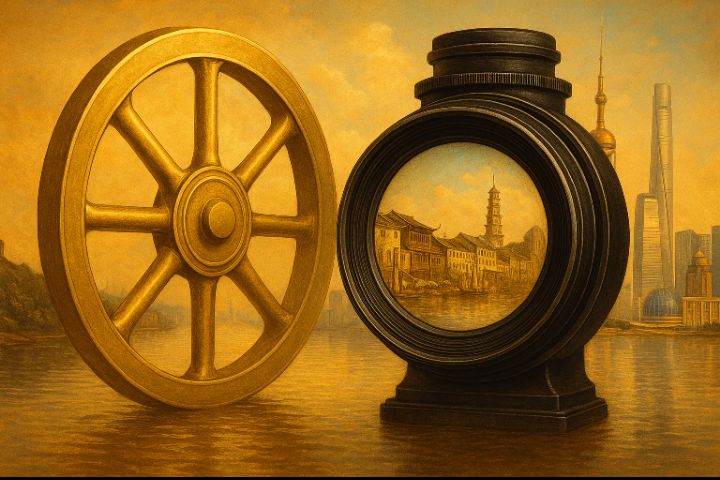
The Wheel and the Camera — The Moral Lens
The wheel turns, as it always has. empires rise, empires fall, and yet the wheel never forgets who tried to guide it with justice and who tried to spin it by force.
And above the wheel, there is the camera — that eternal witness that sees what men hide.
It captures every deed, every silence, every act of pride disguised as policy. It sees not through glass, but through conscience. It is the eye of time, the memory of truth.
When the wheel of history turned in Canton, it recorded two faces: one of an honest trader who built trust with his word, and another of an empire that burned the bridge he offered. The camera did not lie. It kept that humiliation alive so that centuries later, another China could look upon it and decide whether to repeat it.
And now, the lens widens. It sees the world — nations racing, machines thinking, markets breathing like living things — all spinning in the same circle that once swallowed dynasties. The question remains the same: who steers the wheel?
Will it be guided by greed, turning toward war?
Or by wisdom, turning toward peace?
The wheel and the camera together represent the new covenant of civilization.
The wheel is action — motion, industry, progress.
The camera is reflection — memory, morality, truth.
Without the camera, the wheel loses its direction and crashes into darkness.
Without the wheel, the camera records only stillness and regret.
That is why this age — the digital age, the age of AI and automation — must unite both. The world cannot afford motion without reflection. It cannot afford speed without soul.
The Brand Currency System is built on this understanding.
It is the camera embedded inside the wheel — the conscience within the machine.
It records every transaction not merely as data, but as moral history. It measures not only what humanity creates, but what it becomes.
China, America, every nation — all are now reflected in this lens. Every decision, every act of deceit or courage, is being captured in the great archive of time. There will be no forgetting this age. The next generation will replay this footage and ask: “Who steered the wheel?”
And the answer will not come from armies or borders, but from character.
History is watching. The lights are on.
The wheel is moving again.
And the camera is recording every turn.
A Call to Wisdom — The Final Choice
There are moments in history when silence becomes betrayal. This is one of them.
The wheel of civilization has come full circle, and the camera is fixed on us all — on leaders, on nations, on systems pretending to be eternal. It records not who shouts the loudest, but who listens deepest.
China, you hold the pen now. The page before you is clean, but the ink of the past still bleeds faintly beneath it. You have the rarest gift any civilization can inherit: a second chance. The West squandered its own by forgetting that prosperity without virtue is only a slower kind of ruin. You have not yet forgotten. You still know that honor and honesty are not weakness — they are wealth.
If you choose to lead by wisdom, the world will follow not out of fear, but respect.
If you choose to lead by control, the world will resist not out of hatred, but necessity.
You have reached the same fork that stood before your emperors:
To trust your most honest traders — your inventors, your thinkers, your builders of conscience — or to silence them again out of fear that truth might threaten power.
If you listen, if you protect them, if you let integrity define your era, then your rise will not bring war; it will bring a renewal of humanity’s moral order. The Brand Currency System is the vessel for that renewal — a way to bind technology with truth, markets with mercy, power with purpose. It is the modern continuation of the covenant that Houqua once lived by:
Wealth must be earned with dignity; trust must be proven with action.
America, the same mirror faces you. The choice is no less urgent. Your strength was once moral, your innovation once humane. You can still rise again, not as an empire, but as a conscience — the twin of China in a shared destiny of wisdom.
Because the next age will not belong to the clever, but to the clean;
not to the fastest, but to the fairest;
not to those who conquer, but to those who care.
Let both East and West remember: the war that destroyed Houqua’s world began when honesty was humiliated.
The peace that can save ours will begin when honesty is honored again.
The camera is still rolling. The wheel is still turning.
History waits for no empire, no ideology, no excuse.
It will remember who chose truth over triumph, wisdom over wealth, and peace over pride.
Let the future of China — and of all humankind — be written not in conquest, but in conscience.
For the future of China is, and will always be, in its past.
Conclusion — A Hand Extended to China
China, I would like you to learn from the lesson of that humble merchant the empire once ignored. Wū Bǐngjiàn (Houqua) was not a general, nor a ruler, but a man whose honesty carried the weight of nations. The empire did not listen to him. It did not adapt. It chose its own pride, and in doing so, it lost both its leverage and its legacy.
If you wish to repeat history, then do as they did: ignore the honest voice, keep to the familiar path, and watch the opportunity fade.
But if you wish to lead the world, then listen — not to me as an individual, but to the truth that echoes through your own history.
You are already showing signs of moral leadership — forgiving debts in Africa, building infrastructure where others only exploited, extending your reach not through conquest, but through creation. These are honorable steps. Yet I must remind you: you are a nation of immense capacity but few enduring leaders, and leadership is not found in ambition, but in integrity.
You can commit yourself to that integrity. You can commit yourself to studying and evaluating the Brand Currency System — the model that turns honesty into measurable value, and trade into a moral enterprise.
Ask yourselves: can this system bring a better world?
If it can, then let us build it together.
Let us make a 10-, 15-, even 30-year plan. Let us synchronize your entire supply chain — from the smallest receipt to the largest transaction — into a transparent, resilient economy that connects savings, trust, and sustainability. Invite me for tea. Let us sit down with your people — your economists, your philosophers, your innovators — and discuss what the future truly requires.
Because the world of AI is not the world of the old Silk Road.
It is not enough to build faster, produce cheaper, or dominate trade routes.
People must be connected to savings, to fairness, to an economy that never fails when systems break. The receipts I am building are not financial tools; they are the proof of a new kind of civilization — one where every transaction tells the truth.
You, China, could be the beating heart and the brilliant brain of this new global system.
Or, if you choose not to listen, you may still remain an efficient kidney — essential, powerful, purifying — but not leading. A kidney sustains life, but it does not guide it.
I invite you to choose the higher destiny — to be the heart that circulates value with compassion and the brain that governs with wisdom.
I extend my hand to you one more time.
Invite me to your embassy in Washington, or wherever dialogue is honored.
Let us begin serious discussions about how to commit — with honesty, with transparency, with vision — to building a future worthy of your civilization’s name.
Because to lead the world is not to destroy the dollar, nor to cut off the United States, nor to compete through confrontation.
It is to create a system that works in symphony with your culture — a system that amplifies your heritage of discipline, generosity, and virtue.
If you adopt the philosophy of the man your ancestors ignored — if you embrace integrity as your currency — you will not only lead in AI, or in business, or in infrastructure.
You will lead in spirit, as the world’s moral center.
So I say to you:
Do not refuse this hand.
Do not repeat the silence of the past.
Because the world remembers Houqua.
And history is waiting to see if China has learned to listen.