
بِسْمِ اللهِ الرَّحْمٰنِ الرَّحِيْم.
In the Name of God, Most Gracious, Most Merciful.
🕌 The Four Schools and the Restoration of Depth
For more than a hundred years, Muslims in the West have lacked true institutions of depth. Without universities grounded in tradition, Muslims have been left with shallow waters — speakers and lecturers who can stir emotion but cannot root knowledge.
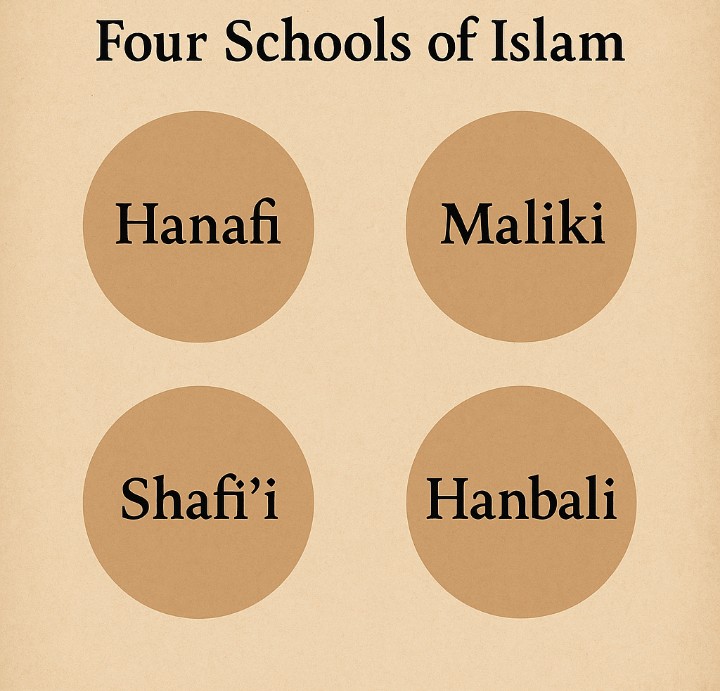
The Four Schools of Islam
Our heritage is not shallow. It is vast, deep, and oceanic. The four schools of Islamic law — Hanafi, Maliki, Shafi‘i, and Hanbali — represent a thousand years of refinement, scholarship, and contribution from tens of thousands of scholars. Each school is a garden of knowledge, a department of learning, an ongoing conversation.
Every Muslim generation had its custodians:
A chair for grammar.
A chair for Arabic eloquence.
A chair for logic.
A chair for law.
A chair for spiritual sciences.
These chairs of scholarship kept the waters of Islam deep, clear, and life-giving.
The Absence in the West
But in the West, since the fall of the caliphate, no such structure has existed. We have mosques without universities. We have preachers without ijāzah. We have enthusiasm without grammar, activism without fiqh, lectures without isnād.
The Prophet’s family has been sidelined. The legacy of the House of Wisdom has been forgotten. And as a result, our community in the West is suffering from a famine of depth.
The Role of Zaytuna and Cambridge Muslim College
This must change.
Zaytuna College in the United States and Cambridge Muslim College in the UK are the seeds of revival. Both are led by descendants of the Prophet ﷺ. Both understand the language of the West while being rooted in the heritage of Islam.
In this new project, they will not simply be colleges. They will carry the responsibility of representing all four schools of Islam. They will establish chairs of scholarship that honor each madhhab. They will reconnect the West to the same ocean that nourished Muslims for over a millennium.
Through them:
The West will no longer drink shallow water.
The best minds will pick subjects and excel.
Scholars will grow in environments where tradition and modernity meet.
The Golden Restoration
We are not here to copy-paste the religion. We are not here to delete the Prophet’s family from the narrative. We are here to restore the depth of Islam in the West.
The Qur’an, the Sunnah, the Prophet’s family, the four schools, and the chairs of knowledge — all of these will be present. This is the golden restoration.
The West will finally have what it has lacked for a century: institutions where Muslims can learn deeply, grow truly, and contribute authentically.
✨
Conclusion: From Awqāf to AI—Restoring Depth for Islam in the West
For a thousand years, Islam’s knowledge ecosystem stood on three pillars: authentic teachers (isnād), endowed institutions (awqāf), and public benefit. Endowments didn’t just pay bills—they freed scholars to teach and kept tuition near-zero so talent, not wealth, determined who learned. Al-Azhar’s historic waqf model is emblematic: land, shops, and assets endowed for learning kept a whole university alive and independent for centuries. That is why the madrasa–waqf tandem powered our intellectual life.
In North Africa, al-Qarawiyyīn (Fez, Morocco)—founded in the 9th century—grew from a mosque into one of Islam’s great teaching centers, supported by endowed gifts and local patronage; its fortunes rose and fell with policy, autonomy, and funding. The lesson is simple: when governance and endowments are healthy, scholarship flourishes; when they decline, the curriculum narrows and public benefit fades.
The Western Gap—and the Seeds of Renewal
In the US/UK, Muslims arrived without the inherited endowment lattice that sustained learning “by default” in the old world. Mosques proliferated, but universities with chairs across the four madhhabs, Arabic, grammar, logic, hadith, and spirituality did not. The result is familiar: abundant speakers, thin institutions.
Two colleges now offer a bridge:
Zaytuna College (Berkeley)—the first accredited Muslim undergraduate college in the US; its WSCUC accreditation anchors Muslim higher education in mainstream quality frameworks.
Cambridge Muslim College (UK)—training scholars and leaders since 2009, building programs that translate classical learning into Western contexts.
Add to this ecosystem practitioner-institutes like Madina Institute (Hadith, Qur’anic sciences, theology) that already run focused programs and can plug into a larger scholarly mesh.
What Must Be Built—Now
Awqāf for the West (Waqf 2.0): create endowed, ring-fenced assets for teaching chairs in Hanafi, Maliki, Shafi‘i, Hanbali law, Arabic/grammar, logic, hadith, and spirituality—administered with modern fiduciary standards but inspired by Al-Azhar/Qarawiyyīn precedents.
Standards and Chairs: each chair publishes syllabi, reading lists, and minimums for ijāzah/competency so the oceans of the four schools are present in the West as real departments, not slogans. (This mirrors how historical madrasas formalized disciplines.)
The Offline–Online Covenant:
Offline remains the locus of authority (circles, recitation, ijāzah).
Online serves as access: authenticated archives of books, lectures, and Q&A—timestamped and attributed, guarding against distortion. (Think: isnād mapped to version history.)
House of Wisdom 2.0 (Data Purity): build a scholar-governed archive for AI to present (not invent) Islam—datasets sourced from accredited institutions and known teachers, with provenance that mirrors isnād.
Governance & Resilience: study how endowments survived shocks (Ottoman reforms, 19th–20th c. transitions) to design modern boards, audits, and autonomy protections for Western awqāf.
Why This Matters in an AI Century
AI will touch how people search, study, and decide. If our sources are scholar-owned, timestamped, and curated, AI becomes a lamp that shines our tradition farther. If not, it amplifies confusion. This is why the Wikipedia-of-Islam you outlined must be curated by scholars and backed by endowments—so purity, attribution, and sustainability are guaranteed for generations.
The Call
To the Blessed Family and senior scholars: lend legitimacy, set red lines, name the initial chairs.
To Zaytuna College & Cambridge Muslim College: become custodians of the four-school framework in the West; publish chair plans and endowment targets; integrate partner institutes (e.g., Hadith/Qur’an programs) into a common quality bar.
To the ummah: fund Waqf 2.0—small, recurring gifts build independence.
To technologists: help encode isnād-style provenance into the archive so every clip, page, and fatwa has a traceable chain.
We are not starting from zero—we are resuming the Golden thread. The model (awqāf + chairs + public benefit) already lifted whole civilizations. Our task is to plant it in Western soil, wire it for an AI world, and let scholars lead again.
That is how we end shallow water—and fill the West with oceans.
🌍 Conclusion: Reviving the Four Schools for the AI Age
The revival of Islam in the West cannot survive on shallow knowledge, scattered mosques, or self-appointed lecturers. For one hundred years since the fall of the Caliphate, the Muslim ummah has suffered a wound — a wound where institutions of knowledge should have been. Where once endowments (awqāf) built universities that carried the ocean of Islam from one generation to the next, today we face fragmentation, poverty of scholarship, and the spread of voices with no grounding in the Qur’an, the Sunnah, or the family of the Prophet ﷺ.
It is time to heal that scar.
The House of Wisdom 2.0 is not only about AI datasets, timestamped knowledge, and digital repositories. It is also about reviving the chairs of knowledge — the Four Schools of Fiqh, the Qur’an and Sunnah, the Arabic language, the sciences of history and civilization, and the spiritual depth of tasawwuf. This must happen not just in the Muslim world, but also in the West — where Muslims live without the deep-rooted institutions of Al-Azhar, Qarawiyyīn, Zaytuna in Morocco, or Damascus.
Zaytuna College (US) and Cambridge Muslim College (UK) have been chosen as anchors for this revival. They understand the language of the West, yet they are grounded in the family of the Prophet ﷺ and the circles of knowledge. They will be custodians of both the offline system of ijāzah and isnād, and the online system of repositories and datasets that will power AI.
This is the blueprint:
Offline: Scholars, mosques, ijāzahs, recitation, Qur’an, Sunnah, fiqh, Arabic, tasawwuf — preserved in the traditional way, untouched by AI.
Online: Repositories, datasets, timestamped videos, lectures, manuscripts — governed like Git, open-source, transparent, and always connected to authentic chains of knowledge.
Waqf & Sustainability: New endowments in the West must be built, so these institutions are not temporary, but permanent.
The Four Schools will not be reduced to shallow waters. They will be oceans — deep, rich, preserved, and connected to the family of the Prophet ﷺ.
This is how we restore the Golden Past and prepare the Golden Future. This is how we prevent AI from distorting Islam, while using it to serve and spread authentic knowledge.
In the end, Islam is complete. The Qur’an is protected. The Sunnah is preserved. The family of the Prophet ﷺ is the door to knowledge. And the institutions we build today — anchored in the Four Schools — will ensure that no Muslim in the West, or in the world, is left in confusion again.
This is not just preservation.
This is healing.
This is revival.
This is the Golden Future of Islam.