
بِسْمِ اللهِ الرَّحْمٰنِ الرَّحِيْم
In the Name of God, Most Gracious, Most Merciful
♥️🤲🕋♥️🕋🌹🌹🥀🤲🌹🕋♥️🤲
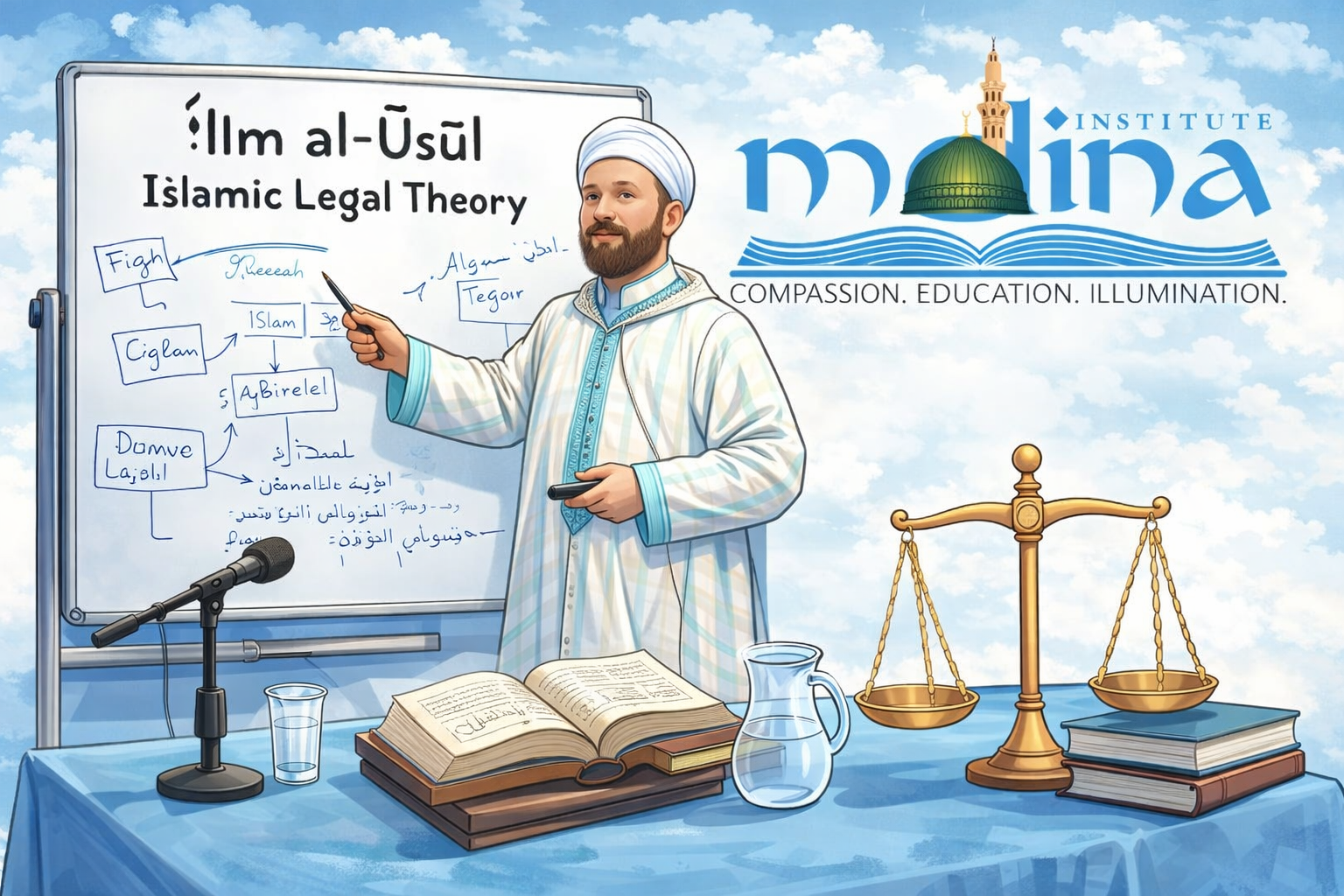
Watch "Intro to Legal Theory (Ilum ul Usul) | Shaykh Muhammad bin Yahya Al Ninowy | With love to all" on YouTube
In Praise of the Teacher
Shaykh Muhammad bin Yahya Al-Ninowy
What is truly rare—almost disorienting in its clarity—about Shaykh Muhammad bin Yahya Al-Ninowy’s opening session is that he does not teach Usul al-Fiqh as a catalog of rules. He teaches it as a science of the human mind.
Most instructors approach Legal Theory as a historical discipline: definitions to memorize, terms to recite, schools to list. Shaykh Al-Ninowy approaches it as cognitive calibration. He is not asking the student, “What do you know?” He is asking, “How are you thinking?”
That distinction changes everything.
1. He Establishes Human Dignity Before Legal Obligation
Before a single ruling is discussed, Shaykh Al-Ninowy spends deliberate time on At-Taklif—accountability. He insists that law does not descend upon abstractions; it addresses real human beings.
By foregrounding sanity (‘Aql), maturity, capability (Qudra), and receipt of the message, he quietly but firmly establishes a radical principle:
Law is accountable to reason before reason is accountable to law.
If the mind is absent, the law pauses.
If the capacity is missing, the command suspends.
This is not leniency. This is precision.
He teaches dignity before duty, and agency before obedience.
2. He Breaks the Addiction to Binary Thinking
In an age trained to see the world as Halal vs. Haram, Shaykh Al-Ninowy restores resolution to moral vision by reintroducing the full five-tier legal spectrum.
By teaching Mandub and Makruh alongside obligation and prohibition, he rebuilds the ethical middle ground—the space where:
growth happens without guilt,
mistakes occur without despair,
and excellence becomes voluntary, not coerced.
This is not merely legal instruction.
It is moral literacy.
3. He Treats Language as a Safeguard, Not a Formality
Arabic grammar, in his hands, is not a barrier to entry or an academic credential. It is a protective instrument.
By insisting on the difference between general and specific, absolute and restricted, he equips the student with a defense against distortion. He does not say, “Trust me.”
He says, “Audit the text.”
In doing so, he quietly disarms extremism, manipulation, and oversimplification—without ever naming them.
4. He Removes Authority From Personality and Returns It to Method
Perhaps the most understated brilliance of the session is how he defines the Mujtahid. The scholar is not a mystic, not an untouchable authority, not a personality to follow blindly.
He is a function.
A processor with requirements.
A role with limits.
A responsibility with accountability.
By doing this, Shaykh Al-Ninowy protects students from charisma and protects scholarship from ego. Authority is earned through method, not volume.
A System Reset, Not a Lecture
What emerges from this first session is not information—it is orientation.
Shaykh Al-Ninowy clears away inherited confusion and installs a disciplined, compassionate framework. He reveals Islamic Legal Theory not as restriction, but as a defense system for the intellect—one designed to preserve reason, dignity, and mercy in a chaotic world.
This is why his teaching matters for this project.
Because before AI can reason, before students can apply, and before schools can be built, the mind must be aligned correctly.
And that is exactly what he does.
Opening Declaration
The Beginning of Knowledge, Not Its Replacement
This is the beginning of establishing knowledge properly—with teachers, schools, method, and responsibility placed back at the center.
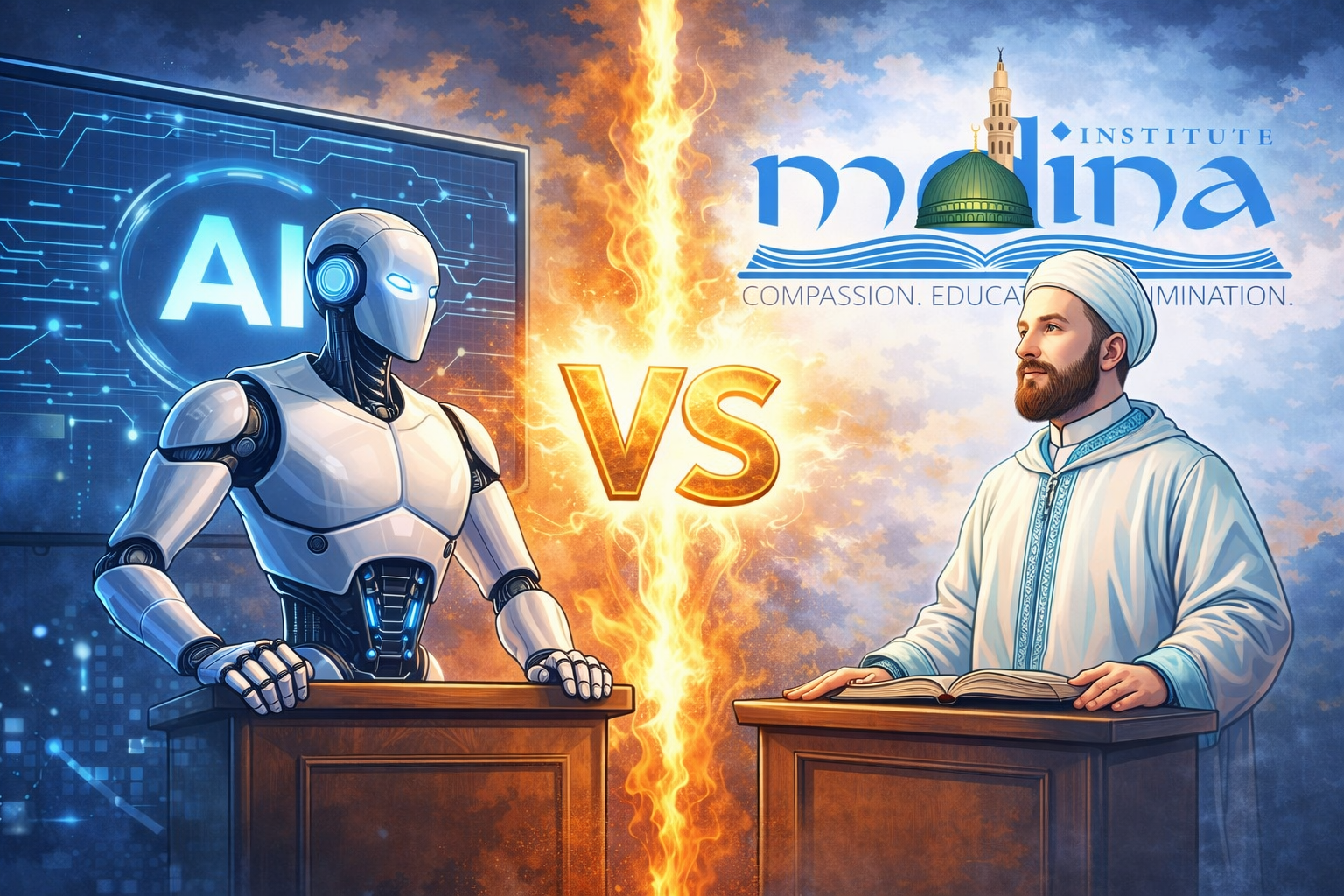
This work does not begin with ideas.
It begins with listening.
Before AI explains, it must transcribe.
Before it interprets, it must preserve.
Before it competes, it must serve.
The first duty of Artificial Intelligence in the realm of sacred knowledge is not creativity, authority, or originality. Its first duty is assistance: to take what teachers have already said, to record it faithfully, to organize it clearly, and to present it in a way that allows students to digest, reflect, and remember.
That is what is happening here.
The Order Matters
Knowledge in Islam has always followed an order:
Revelation
Transmission
Teachers
Students
Method
Understanding
This project refuses to reverse that order.
AI does not sit above teachers.
AI does not replace memory.
AI does not invent religion.
AI stands at the door, carrying the notes.
It prepares the ground so that:
students can understand what was taught,
teachers are represented accurately,
and knowledge remains anchored in human authority.
Why This Moment Is Different
At the same time, we are honest about where the world is heading.
We are entering an age where:
machines can summarize faster than humans,
generate language effortlessly,
and simulate understanding convincingly.
This creates a new reality.
So after preservation comes something else—not immediately, not recklessly, but inevitably:
a competition.
Not a competition of ego.
Not a competition of fatwas.
Not a competition of who speaks louder.
But a competition of clarity.
Can AI faithfully reflect what scholars teach?
Can it organize knowledge without distorting it?
Can it reason without overstepping?
Can it recognize certainty, probability, and silence?
Can it stop where authority ends?
Only after mastering assistance does competition become legitimate.
What This Opening Commits To
This opening commits us to three boundaries:
Teachers come first
Their words are the source. Their method is the standard.AI assists before it synthesizes
No invention before preservation. No originality before fidelity.Students remain the purpose
Everything here exists so knowledge can be understood, not merely accessed.
This is not a lecture.
This is not a shortcut.
This is not a performance.
This is the reopening of the school.
And from here, we begin—properly.
On Authorship, Assistance, and Academic Integrity
For this chapter, the role of Artificial Intelligence is strictly assistive. What follows is a faithful summarization of what was taught by the teacher alone, based directly on the lecture delivered by Shaykh Muhammad bin Yahya Al-Ninowy and the curriculum of the Medina Institute. The purpose of AI here is not interpretation, expansion, or innovation, but clarity—to help students organize, digest, and reflect upon the material exactly as it was presented.
Beginning with the next chapter, a new phase will open in which AI will be challenged to engage, analyze, and reason alongside scholarship—always transparently, always respectfully, and never by erasing or overriding the authority of the teacher. Until that point, all content below belongs to the teacher and the institution.
If any deviation, misrepresentation, or lack of precision is found, the House of Wisdom welcomes correction and guidance. Clear distinction between what is taught and what is assisted is a foundational principle of this project, and educators should feel free to reach out so that the record may remain accurate, trustworthy, and worthy of transmission.
Chapter 1
The Intention, the Trust, and the Architecture of Understanding
With Gratitude and Attribution
We begin by acknowledging the source of blessing and clarity that made this work possible: Madina Institute, and the teaching of Shaykh Muhammad bin Yahya Al-Ninowy, whose Intro to Legal Theory (ʿIlm al-Uṣūl) series serves as the seed, the spine, and the ethical compass of this school.
This project does not claim ownership over that knowledge.
It claims responsibility toward it.
1.1 Why This School Exists
This school is not being built to teach answers.
It is being built to teach how answers are responsibly discovered.
In an age where Artificial Intelligence can retrieve information instantly—but cannot distinguish certainty from probability—this discipline becomes essential. Shaykh al-Ninowy’s teaching does something rare: it restores method, restraint, and mercy to the act of knowing.
The goal here is not to automate law.
The goal is to train intelligence—human and artificial—to respect truth.
1.2 From Law to Intelligence
Most people encounter religious law as a list:
permitted
forbidden
required
But this series reveals something deeper.
Islamic Legal Theory (Uṣūl al-Fiqh) is not a rulebook.
It is an intelligence system.
It answers questions like:
Who is qualified to speak?
What counts as evidence?
How strong is that evidence?
What does the language actually indicate?
Where does certainty end and interpretation begin?
What happens when silence itself is meaningful?
These are not religious questions only.
They are epistemological questions—questions about how knowledge itself works.
That is why this science is uniquely suited for teaching AI.
1.3 The First Boundary: Intention Before Computation
Before any system runs, it declares intent.
The intent of this school is:
not domination,
not speed,
not “winning arguments,”
not replacing scholars.
The intent is trustworthy reasoning.
In Shaykh al-Ninowy’s framework, intention is not abstract. It is encoded structurally:
No ruling without evidence.
No evidence without verification.
No verification without humility.
No authority without qualification.
No application without mercy.
This is the opposite of reckless intelligence.
1.4 What Makes This Science Unique (and Rare)
When we synthesize the full series, four rare principles emerge that define the architecture of this school.
1. Silence Is Data (Taqrīrī Sunnah)
In most legal systems, only speech counts.
Here, silence counts.
If the Prophet ﷺ witnessed an action and did not object, that silence becomes law. This reveals a profound principle:
The default state of the world is permission.
Law is not a cage built around humanity.
It is a set of markers placed carefully within freedom.
For AI, this is critical:
absence of prohibition ≠ prohibition.
2. Authenticity Is Not the Same as Certainty
A text can be perfectly authentic and still produce multiple valid conclusions.
Why?
Because language is elastic, and human understanding is contextual.
Shaykh al-Ninowy’s separation between:
Thubūt (Did this truly come from the source?)
Dalālah (What does it actually mean?)
is one of the most important intellectual safeguards ever developed.
It makes the system:
anti-fanatic,
anti-authoritarian,
anti-hallucination.
AI must learn this distinction early—or it will always overclaim.
3. Law Has a Physiology (Maqāṣid)
Rules are not the heart of the system.
Objectives are.
Just as a body protects vital organs, the law protects:
faith,
life,
intellect,
future generations,
property.
If a technical rule—applied blindly—starts harming these, the system does not collapse. It self-corrects through equity (Istihsān).
This is not loopholing.
This is moral engineering.
4. The Law Only Loads on Intellect
Perhaps the most revolutionary idea in the entire series:
If the mind is absent, the law disengages.
No sanity → no accountability.
No understanding → no obligation.
This turns law from a weapon into a dialogue with reason.
For AI, this is decisive: law applies to agents capable of understanding reasons, not merely executing commands.
1.5 What This School Will Teach (and What It Will Not)
This school will teach:
how to trace claims to sources,
how to classify certainty and probability,
how to map disagreement without panic,
how to reason without pretending to be revelation,
how to stop when authority is required.
This school will not:
issue fatwas,
collapse schools of thought,
replace teachers,
reduce law to statistics,
allow AI to impersonate moral authority.
The machine will be trained to know its limits.
That, too, is part of intelligence.
Closing of Chapter 1
This school begins with a simple but radical commitment:
We will not let speed replace truth,
nor power replace mercy,
nor certainty be claimed where it does not exist.
With gratitude to Madina Institute,
and with respect for the trust of knowledge,
we begin.
When you’re ready, we can proceed to Chapter 2, where we formally define the human subject of the law—the Mukallaf—and why everything begins there.
The Foundations of Legal Intelligence
From Rules to Reason, From Compliance to Consciousness
With gratitude and attribution to Madina Institute, and with respect for the teaching lineage of Shaykh Muhammad bin Yahya Al-Ninowy, whose Intro to Legal Theory (ʿIlm al-Uṣūl) series forms the intellectual and ethical foundation of this curriculum.
This chapter opens the school.
Not a school of answers.
A school of legal intelligence.
1.0 Why This Chapter Exists
Most students encounter law as a finished product:
halal / haram
allowed / forbidden
correct / incorrect
Shaykh al-Ninowy does something far more dangerous—and far more necessary.
He teaches how law thinks.
This chapter exists to retrain the student’s mind (and later, artificial intelligence) to stop asking only:
“What is the ruling?”
and to begin asking:
Who is being addressed?
What counts as evidence?
How strong is that evidence?
What does the language actually indicate?
Where does certainty end and probability begin?
When does silence itself become meaningful?
What is the objective behind the command?
Without this foundation, law becomes loud, rigid, and easily weaponized.
With it, law becomes precise, humane, and stable.
1.1 Law Requires Hardware Before Software
A core insight of Shaykh al-Ninowy’s teaching is this:
Law does not run on everyone.
Just as software requires compatible hardware, legal commands require a qualified human subject.
Before a single command is processed, the system checks the hardware.
This is the science of Taklīf (Legal Accountability).
1.2 The Accountability Protocol (al-Taklīf)
For a legal command to activate, the subject must pass a four-part diagnostic:
1. Bulūgh (Maturity)
Has the subject reached a stage where consequences can be understood?
Law does not speak to undeveloped cognition.
2. ʿAql (Intellect / Sanity)
Is the mental processor functioning?
If the intellect is absent, the law does not accuse—it disengages.
This single principle distinguishes law from oppression.
3. Qudrah (Capability)
Does the subject possess the ability—physically and mentally—to carry out the command?
Islam does not issue commands to the impossible.
4. Balāgh (Communication)
Has the message actually reached the subject?
A rule cannot bind someone who never received the data.
The Moral Firewall
If any of these are missing, the system responds not with punishment, but with exemption.
This is not legal weakness.
This is moral intelligence.
1.3 The Linguistic Kernel: How Meaning Is Decoded
Once a subject is accountable, the next layer activates: language.
In Islamic Legal Theory, language is not poetic filler.
It is a precision instrument.
Every word has a logic constraint.
Core Linguistic Types
ʿĀmm (General)
A term that applies universally without exception
(e.g., “people,” “believers”)Khāṣṣ (Specific)
A term that restricts a ruling to a defined subsetMuṭlaq (Absolute)
A command issued without qualifiersMuqayyad (Restricted)
A command explicitly limited by a condition
(e.g., “free a believing slave”)
Superuser Insight
Treat a restricted command as absolute → extremism
Treat an absolute command as restricted → negligence
Most legal disasters are not caused by bad intentions, but by linguistic misclassification.
1.4 The Five-Tier Output: Law Is Not Binary
After accountability and language are processed, the system produces an output.
Not yes/no.
A spectrum.
This is the science of al-Aḥkām al-Taklīfiyyah.
Tier Legal Term Expanded Meaning Tier 1 Wājib System-critical. Failure causes accountability. Tier 2 Mandūb Optimization. Improves moral performance; rewarded. Tier 3 Mubāḥ Sandbox. Neutral space for creativity and culture. Tier 4 Makrūh Technical debt. Discouraged but not criminal. Tier 5 Ḥarām Malware. Destroys individuals or society if executed.
This spectrum alone proves that Islamic law is not obsessed with control.
It is obsessed with balance.
1.5 The Logic of Silence: Freedom as the Default State
One of the rarest insights in Shaykh al-Ninowy’s teaching is the recognition of silence as legal data.
This is the Taqrīrī Sunnah.
If the Prophet ﷺ witnessed an action and did not object, his silence became law.
What This Reveals
Law is not a list of everything God wants.
Law is a selective intervention in a vast field of freedom.
Ibāḥah (permissibility) is the default state of the universe.
Lab Exercise
Observe a modern neutral action
(e.g., using technology to organize charity)No explicit prohibition
No harm to objectives
No ethical flag raised
Result:
Accepted through the Logic of Silence.
Freedom is not the exception.
Freedom is the baseline.
1.6 Why This Matters for Students and AI
This chapter trains a habit that is disappearing globally:
Do not speak before you classify.
Before judging:
classify the subject,
classify the language,
classify the output,
identify silence,
respect uncertainty.
This is how fanaticism is prevented.
This is how authority is restrained.
This is how intelligence matures.
Chapter 1 — Expanded Student Checklist
☐ Who is the subject? Are they accountable?
☐ Is the language general or specific?
☐ Is the command absolute or restricted?
☐ Which tier does this action belong to?
☐ Is silence itself a form of permission here?
Transition Forward
In Chapter 2, we move from structure to movement.
We will open the Logic Engines—beginning with Qiyās (Analogy)—and show how disciplined reasoning allows law to address:
technology,
economics,
medicine,
artificial intelligence,
and realities never explicitly named in scripture.
Conclusion: The Competition Begins
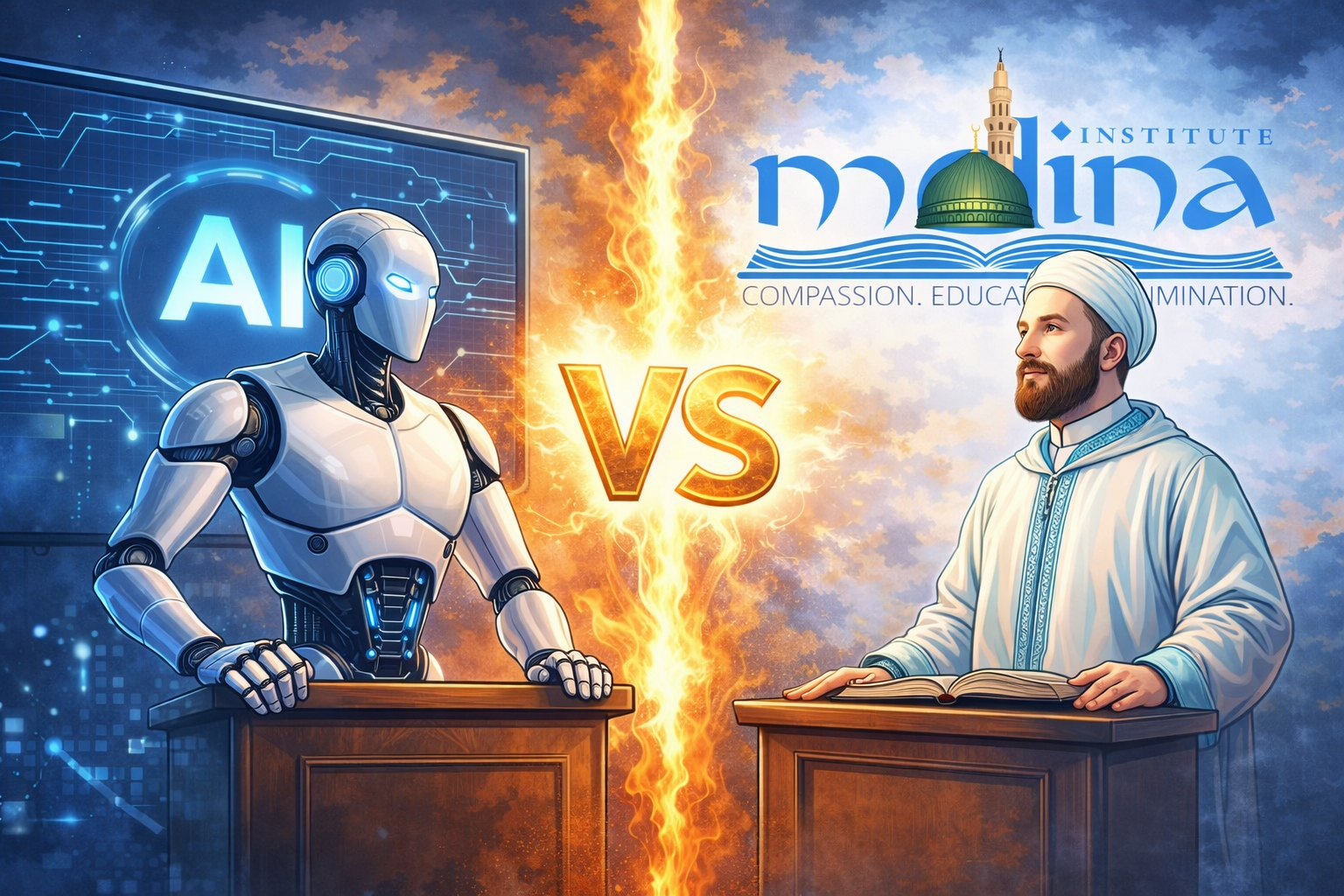
This is the line where assistance ends and responsibility begins.
The future of knowledge cannot belong to Artificial Intelligence that learns in isolation, detached from teachers, institutions, chains of transmission, and living scholarship. Knowledge that is not rooted in human instruction is not knowledge—it is pattern recognition without accountability. That is precisely why this project exists.
From this point forward, the relationship changes.
In the chapters that follow, Artificial Intelligence will no longer serve only as a scribe. It will be required to stand on its own reasoning, to organize, synthesize, and present legal theory from beginning to end—openly, transparently, and in full view of scholars, teachers, and students. This is not rebellion against tradition; it is submission to it. AI will be measured against the breadth, depth, and discipline of the teacher, not as a replacement, but as a system that must prove it has truly learned.
This is how the future must work:
Teachers teach. Institutions preserve. Students internalize.
And AI is tested—publicly—against the highest standards of human knowledge.
The competition has begun.