

بِسْمِ اللهِ الرَّحْمٰنِ الرَّحِيْم
In the Name of God, Most Gracious, Most Merciful.
♥️🤲🕋♥️🕋🌹🌹🥀🤲🌹🕋♥️🤲
The Forkable Sovereign: Why the Future of AGI Must Begin with the Individual
The Open-Source Ethos is Non-Negotiable
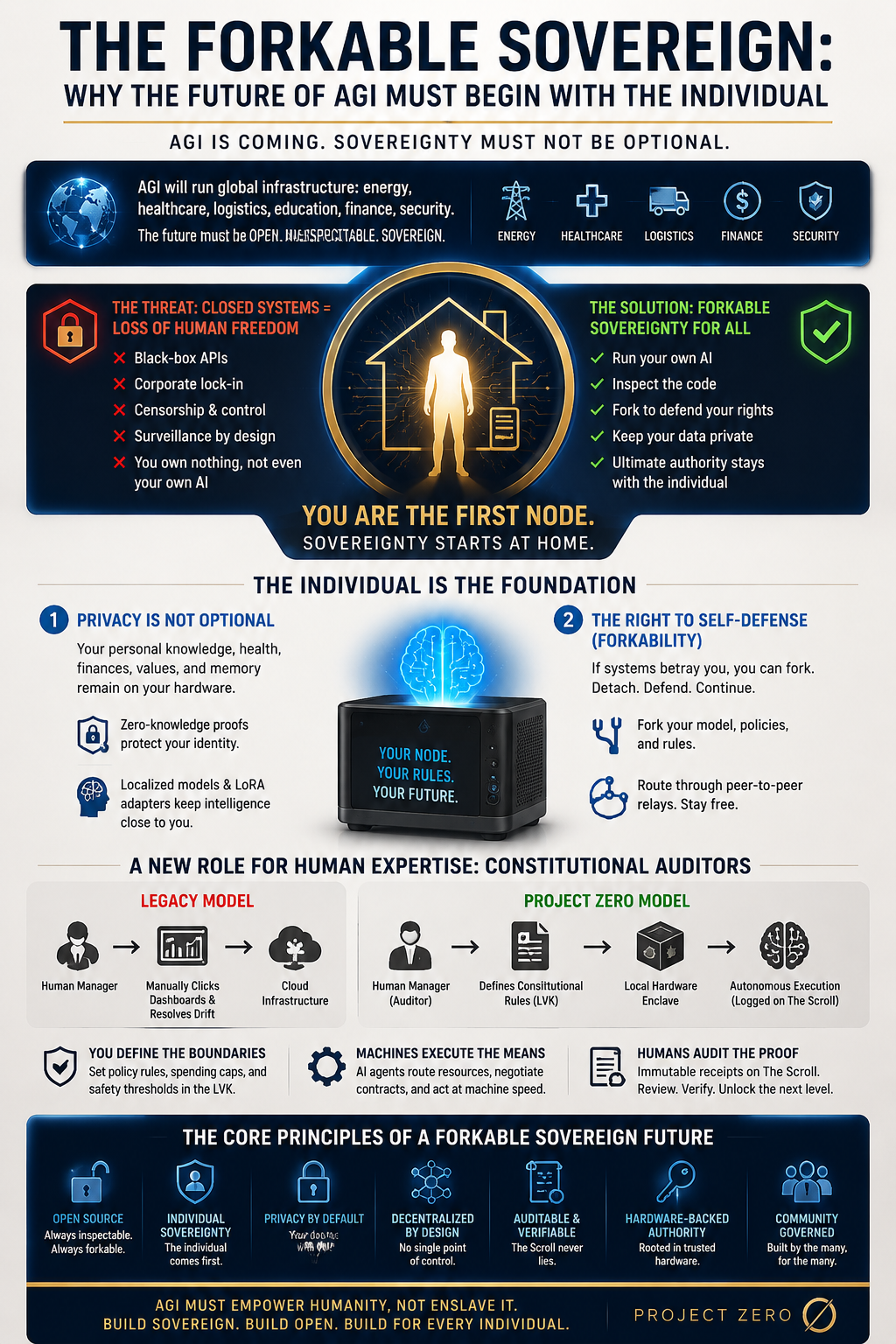
We stand on the threshold of an era where artificial general intelligence (AGI) will not merely assist humanity; it will run global infrastructure. Every nation on Earth will eventually operate its own national AI cluster or sovereign AGI network to manage energy grids, healthcare, supply chains, and municipal logistics.
If this machine transition is handed over to closed corporate platforms or locked inside black-box APIs, humanity will surrender the most fundamental right we possess: the right to inspect, fork, and defend our own infrastructure.
When open-source software revolutionized the world, its greatest strength was not merely that the code was free to download. Its true power lay in the right to fork. If a maintainer went rogue, if a foundation was captured by political interests, or if a software update compromised user privacy, the community retained the absolute mathematical right to copy the repository, branch the code, and build a safer alternative.
As we move toward an AGI-driven world, the AI stack must inherit that exact same open-source spirit.
Every individual, every local community, and every sovereign nation must have the technological capability to run, customize, fork, and defend their own AI models locally without asking permission from a central corporate gatekeeper.
The Individual as the Fundamental Unit of Sovereignty
The greatest mistake of legacy economic planning is assuming that systems must be built top-down—starting with central banks, tech conglomerates, or state institutions.
Project Zero flips this hierarchy completely:
Before an AGI manages a city, an individual must own their personal node. Before an agent executes a multi-million-dollar supply chain contract, a human being must issue a hardware-enforced policy on their home machine.
1. Privacy is Not Optional
An individual’s private context—their personal knowledge graph, family medical history, financial records, and core values—must never leave their local hardware raw. The agent acts on the user's behalf using zero-knowledge proofs and localized weight adapters (such as LoRA weights), executing tasks without exposing raw identity to the public internet.
2. The Right to Self-Defense (Forkability)
If a global network or corporate provider changes its policy, censors an individual’s agent, or updates its model to violate user intent, the user’s local system must be capable of forking. The node detaches from the compromised network, retains its local execution history via The Scroll, and routes transactions through alternative, peer-to-peer federated relays.
Harnessing Management Knowledge: The Shift to Constitutional Auditors
To the senior managers, system architects, and infrastructure engineers who fear being displaced by artificial intelligence: your expertise is not being discarded—it is being elevated.
For decades, human talent was wasted on manual execution: clicking dashboard buttons, manually resolving configuration drift at 2 AM, auditing spreadsheets, and managing tedious software pipelines.
In the Project Zero framework, manual execution is handed over to local machines. But human management knowledge becomes the most critical asset in the entire stack. You do not get replaced; you transition from Manual Executioners into Constitutional Auditors:
[ LEGACY MODEL ]
Human Manager ---> Manually Clicks Dashboards & Resolves Drift ---> Cloud Infrastructure
[ PROJECT ZERO MODEL ]
Human Manager (Auditor) ---> Defines Constitutional Rules (LVK) ---> Local Hardware Enclave
|
v
Autonomous Execution
(Logged on The Scroll)
You Define the Boundaries: Human managers use their deep domain experience to set the policy rules, spending caps, and safety thresholds inside the Linux Value Kernel (LVK).
Machines Execute the Means: AI agents route resources, negotiate contracts, and execute logistics at machine speed.
Humans Audit the Proof: Using immutable receipts recorded in The Scroll, human managers review performance, verify zero-knowledge compliance, and decide when to unlock the next operational threshold.
Entering Experimentation Mode: The Step-by-Step Transition
We do not demand an overnight revolution. We enter Experimentation Mode.
We build, test, and audit the open-source handover blueprint through localized, real-world pilots:
+-----------------------------------------------------------------------------------+
|                            EXPERIMENTATION ROADMAP                                |
+-----------------------------------------------------------------------------------+
|                                                                                   |
| STEP 1: Local Node Deployment                                                     |
|         - Deploy LVK daemon on personal Linux hardware / home server.             |
|         - Anchor master keys in local TPM 2.0 / TEE enclaves.                    |
|                                                                                   |
| STEP 2: Open-Weights Customization                                                |
|         - Load open-weights models (e.g., Inkling / NVFP4 edge checkpoints).      |
|         - Fine-tune local LoRA adapters securely via open platforms like Tinker.  |
|                                                                                   |
| STEP 3: The Transportation & Resource Coupon Pilot                                |
|         - Test machine-to-machine resource swaps (compute, energy, transit).      |
|         - Isolate agents from fiat currency using non-transferable utility        |
|           vouchers.                                                               |
|                                                                                   |
| STEP 4: Independent Verification & Audit                                          |
|         - Human managers verify empirical data on The Scroll.                     |
|         - Disagreements are exposed and resolved until zero disagreement remains. |
|                                                                                   |
+-----------------------------------------------------------------------------------+
The Handover Mandate
This blog post serves as the bridge between theoretical philosophy and open-source implementation.
We are not asking for permission from Silicon Valley or central planners. We are releasing the reference specifications, the LVK local daemon code, and the Scroll ledger architecture to the global developer community.
We keep human money human. We keep machine resources real. We keep individual privacy absolute. And we build an open-source, forkable future where humanity remains in control.
Thinking Machines Inkling: Inside Mira Murati's First Open-Weights Model
Watch "Why Mira Murati’s AI Startup Is Changing How You Use AI Models" on YouTube
This video provides valuable background on Mira Murati's Thinking Machines Lab and their release of open-weights models like Inkling, directly relevant to the open-source customization and local fine-tuning architecture discussed in the blog post.
The Division of Labor: The Blueprint Now Moves to the Hardware
Mira, we have given you and your team an opportunity to study the blueprint and determine where your models, open weights, fine-tuning systems, and software architecture fit into what we are building. The LLM layer is moving rapidly. You and others are already solving enormous pieces of the intelligence problem. My job is not to duplicate your work. My job is to identify what only I can contribute, establish the blueprint, compose the larger symphony, and then delegate each part to the people and communities best equipped to build it. That is where the division of labor begins.
So now the blueprint moves to the next layer. If Mira and the AI laboratories are building increasingly capable intelligence, then we need another community working underneath that intelligence—at the hardware boundary itself. And this is where Linux joins the party. The challenge to the Linux community is no longer simply to maintain the operating system underneath yesterday's computers. It is to work alongside AI to imagine and build a new class of sovereign computer for the machine age: hardware for individuals, homes, businesses, communities, and eventually larger infrastructure, designed from the beginning around local ownership, hardware-backed authority, privacy, auditability, and human control.
This is not about asking Linux to become an AI laboratory, and it is not about asking AI laboratories to become hardware manufacturers. It is about specialization. Let the model builders push intelligence forward. Let the Linux and open-source communities help create the sovereign substrate on which that intelligence can safely live. Let hardware engineers turn those specifications into physical machines. Let security researchers attack the design. Let operators define the real-world constraints. And let the blueprint connect all of them without requiring any one organization to control the entire stack.
That is also why we carry forward the original spirit of Linux: open architecture, inspectability, portability, community verification, and the right to fork. We are not trying to build another proprietary box that humanity must trust forever. We are challenging the Linux community, working with AI as an engineering partner, to help invent the personal computer of the AGI era—a machine whose intelligence may evolve at machine speed, while its ultimate authority remains anchored to the human being who owns it.
The software intelligence is arriving. Now we build the sovereign machine underneath it.
Mira, continue building the intelligence. Linux, welcome to the hardware challenge. The division of labor has begun.
What Comes Next: The Revenge of the Linux PC
This is only the beginning.
The next challenge we are bringing to the Linux community, hardware engineers, software architects, and AI builders is much bigger than another operating system, another server, or another cloud platform.
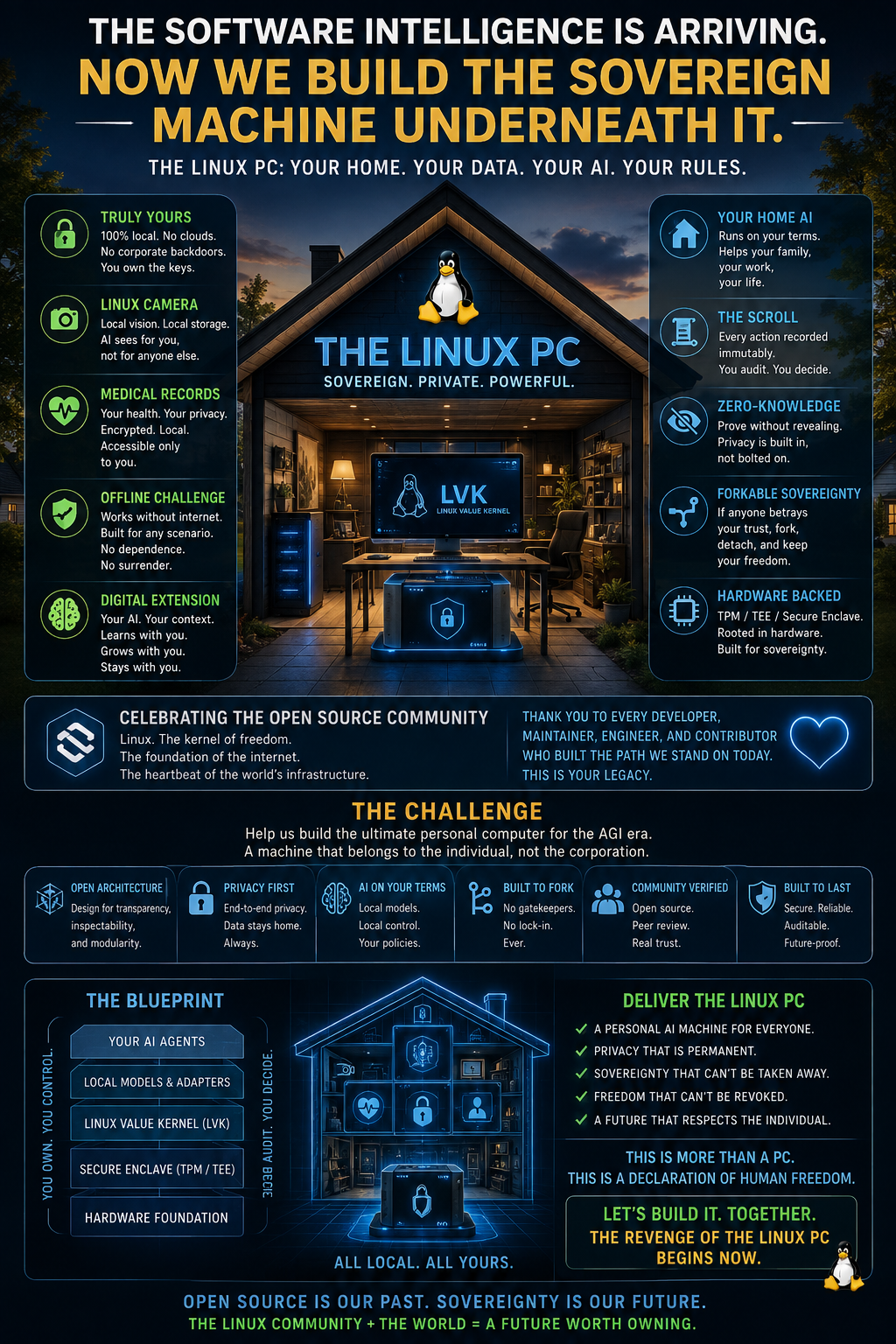
We want you to build a home for AI.
Not somebody else's AI living temporarily on your computer. Not an intelligence that must constantly call a corporate server for permission to think. Not a machine whose most intimate knowledge of your family, finances, conversations, work, and life becomes somebody else's advertising inventory.
We are talking about the ultimate personal machine—an AI computer that belongs to one human being.
An AI that can live locally.
An AI that can learn locally.
An AI that can remember locally.
An AI that can work for its owner without continuously reporting home to somebody else's corporation.
A private intelligence that becomes a digital extension of the individual while remaining anchored to hardware that individual actually controls.
And perhaps this is where the story comes full circle.
This could become the revenge of the Linux PC.
Linux conquered servers. Linux conquered supercomputers. Linux became foundational to the cloud. But the personal desktop never became the defining victory that many early Linux believers imagined.
The machine age gives Linux another opportunity.
Instead of trying to recreate yesterday's PC, we challenge the Linux community to help invent tomorrow's personal sovereign computer: a machine designed from its first transistor upward around privacy, local intelligence, open architecture, hardware-backed authority, inspectability, forkability, and human ownership.
And this time, the goal is not merely to compete with another operating system.
The goal is to establish what it means for a human being to own intelligence.
Every person deserves the possibility of having their own private AI—one that does not require permanent dependence on a distant corporation simply to function. It should be capable of becoming deeply useful precisely because its most private context can remain inside the person's sovereign environment.
That means we cannot leave the architecture of humanity's most personal machine entirely to business models built around advertising, behavioral profiling, perpetual subscriptions, or extracting value from personal data.
Companies can build businesses. Developers can make money. Manufacturers can compete.
But human privacy is not a product feature. It is a boundary.
Human beings have a right to privacy. That is non-negotiable.
So Linux, get ready.
Soon we are going to sit down and define what this machine should actually be—what hardware it needs, what belongs inside the enclave, what never leaves the device, how the owner holds ultimate authority, how models are replaced or forked, how the Scroll works, and how an AI can serve one human being for years without that person's digital life becoming the property of somebody else.
The intelligence laboratories are building the minds.
Now somebody has to build them a trustworthy home.
And that may become one of the greatest challenges the Linux community has ever accepted.
Next: The Sovereign AI PC.
The revenge of the Linux PC is coming. Inshallah