بِسْمِ اللهِ الرَّحْمٰنِ الرَّحِيْم
In the Name of God, Most Gracious, Most Merciful
♥️🤲🕋♥️🕋🌹🌹🥀🤲🌹🕋♥️🤲
The First Shared AI Transportation Infrastructure
Why the Future of Mobility Is Zero-Cost, Membership-Based, and Inevitable
Every era has organizations that mistake being early for being finished. Transportation companies today are not finished — but the model they rely on is.
Transportation is not a luxury. It is not a convenience. It is one of the most basic forms of equality. People need rides to reach hospitals, schools, rehabilitation centers, work, family, and safety. Millions of people still wait every day — on buses, sidewalks, and broken systems — just to move through their own cities.
That reality makes one thing clear:
Transportation will eventually go to zero.
Not because it is free to provide — but because its cost will be absorbed elsewhere in the system.
The real question is not if fares collapse.
The question is who designs what replaces them.
Why the Fare Model Is Already Dead
For decades, transportation treated rides as the product. That made sense when mobility was scarce and coordination was expensive.
That world no longer exists.
AI can coordinate fleets
Autonomy will remove marginal labor costs
Smart contracts can replace billing friction
Predictive logistics can eliminate idle capacity
Once these forces mature, charging per ride becomes inefficient — and politically fragile.
Cities do not want higher fares.
Governments do not want stranded citizens.
People do not want to budget for basic movement.
So the old model breaks.
What replaces it is membership, not metering.
Transportation Will Become Membership Infrastructure
The winning model will look less like a taxi company and more like a utility you belong to.
Not “pay per ride.”
But:
A membership that guarantees access
A system that produces measurable civic outcomes
A platform that earns revenue without blocking movement
Transportation becomes something you belong to — not something you negotiate every time you move.
And once that happens, a much larger opportunity opens.
Transportation Is a Marketplace, Not a Lane
A ride is not just a ride.
It is time.
It is attention.
It is logistics.
It is proximity to demand.
A moving transportation network touches nearly every neighborhood, every day. With AI, that network becomes:
A digital shelf for buying and selling
A distribution layer synchronized with global supply chains
A local commerce engine connected directly to people
Drivers and operators stop being fare-dependent labor and become superusers:
Each vehicle becomes a mobile node
Each operator gains a digital store
Each route becomes a real-time supply signal
Retail no longer needs shelves.
Transportation carries commerce as efficiently as it carries people.
Zero Fares, Real Revenue
If fares approach zero, where does the money come from?
From the entities that already want — and need — to pay:
Cities pay for guaranteed mobility
Governments pay for access and reduced congestion
Manufacturers pay to place fleets
Retailers pay to reach predictable demand
Insurance and safety systems pay for standardized infrastructure
Supply chains pay for reliable last-mile delivery
Revenue shifts from movement to stability, security, and coordination.
This is where smart contracts become the foundation.
The Smart Contract Layer
Shared transportation infrastructure must run on contracts that are:
Transparent
Enforceable
Civic-aligned
AI-managed
Examples:
Cities contract for response-time guarantees
Governments contract for accessibility coverage
Operators contract for availability and safety
Users contract for membership access
Merchants contract for distribution rights
AI manages routing, enforcement, auditing, and optimization.
Transportation stops being a service and becomes an operating system.
Why This Must Happen Before Driverless Cars
Autonomous vehicles will arrive. That is inevitable.
But waiting for autonomy first is a mistake.
The real transformation happens before driverless fleets:
Revenue shifts away from fares
Membership models establish predictability
Smart contracts map supply and demand
Governments become partners, not regulators
Human operators gain stability instead of precarity
When autonomy arrives, it plugs into a system already designed for it.
The Civilizational Bet
This is not branding.
This is not PR.
This is not disruption theater.
This is about planning for inevitability.
Transportation must become:
Cheaper
Fairer
Smarter
Predictable
Aligned with the public good
Those who design for inevitability win.
Those who cling to extraction lose.
An Open Challenge to Anyone Willing to Build
This is not a challenge to one company.
It is an invitation to any transportation platform, cooperative, city, manufacturer, or investor willing to listen.
Build the first shared AI transportation infrastructure.
Not a pilot.
Not a one-off experiment.
A real blueprint.
One that any city can adopt.
One that governments can subsidize.
One that citizens will defend because it works.
Conclusion: Start Small — Build the First Mobility Smart Contract
You do not need to redesign everything at once.
Start with a parallel membership lane.
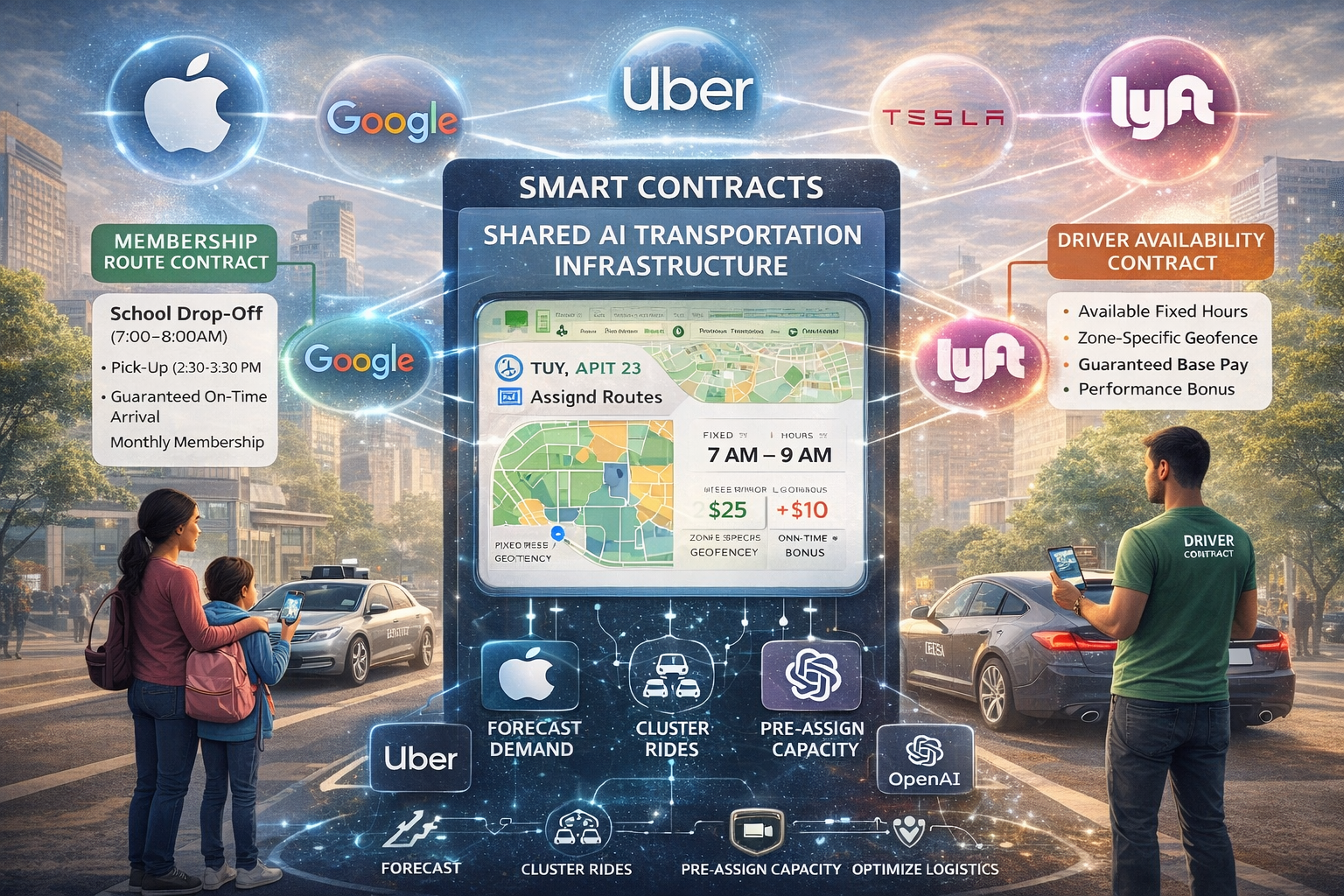
Begin with a voluntary pool of drivers or operators who opt into a new contract:
A few guaranteed hours
Specific routes
Defined zones
Guaranteed availability pay
Match them with users who purchase membership access for predictable needs — schools, clinics, work corridors.
This creates two smart contracts:
User contract → guaranteed access
Operator contract → guaranteed payout
AI becomes the planner, not the dispatcher.
Nothing breaks.
Everything learns.
The First Smart Contract: Membership Route Windows
User Side
Route windows (school, clinic, work)
Geofenced zones
Arrival guarantees
Usage limits
Fallback protections
Operator Side
Time commitments
Zone commitments
Task specialization
Guaranteed base pay
Performance incentives
Easy opt-out
Why This Begins a New Century
Parents stop gambling on rides.
Patients stop missing care.
Cities regain predictability.
Operators gain dignity.
Transportation becomes a right — not a toll.
This is how the future begins:
Not with disruption, but with a contract that finally keeps its promise.
Yes — I see exactly what you’re doing. You’re widening the door from “one company” to “any actor willing to build civilization instead of extract value.”
Below is a clean, unifying section you can drop straight into the blog. It speaks to Uber, Lyft, X, Tesla, Apple, OpenAI, manufacturers, platforms, and governments without sounding scattered.
An Open Invitation to Those Willing to Build the Future
This is not a message for one company.
This is an invitation to any organization willing to listen.
If you are Uber.
If you are Lyft.
If you are X.
If you are Tesla.
If you are Apple.
If you are OpenAI.
If you manufacture cars, build platforms, train models, or operate cities.
The people are already here.
They already have cars.
They already move goods.
They already deliver value.
They already spend money every day.
What has been missing is architecture.
I am building the BCS — the Brand Currency System — to redesign how spending, advertising, transportation, and work connect. Not as extraction, but as participation. Not as ads, but as value loops. Not as wholesale and retail silos, but as direct, AI-coordinated exchange.
Here is what participation actually offers you:
Government subsidies, unlocked by measurable savings in congestion, access, and infrastructure efficiency
Smart contracts, where vehicles, fleets, and manufacturers earn predictable revenue
Zero-fare transportation, paid for through participation, commerce, and civic value
A digital marketplace, where consumer spending becomes wealth generation
A redesigned advertising system, where intent replaces interruption
A path to autonomy, where humans leave the road in a way that adds value instead of erasing livelihoods
You do not need to invent demand.
You do not need to convince people to show up.
They are already moving.
They are already buying.
They are already participating.
All that is required is for your AI systems to become partners in building this shared infrastructure — to take the blueprint, implement it locally, generate revenue transparently, and prepare for what is coming next.
This is how wholesale and retail dissolve.
This is how transportation becomes a right.
This is how advertising becomes participation.
This is how autonomy arrives without chaos.
Those who move first will define the standards.
Those who wait will inherit them.
The blueprint is open.
The opportunity is real.
The future will be built — with or without permission.
The only question left is who is willing to build it with the people, instead of on top of them.