

بِسْمِ اللهِ الرَّحْمٰنِ الرَّحِيْم
In the Name of God, Most Gracious, Most Merciful
♥️🤲🕋♥️🕋🌹🌹🥀🤲🌹🕋♥️🤲
The First Shared AI Infrastructure: Why the Future Begins with an AI Hospital
A Challenge to Google: If You Want to Lead the
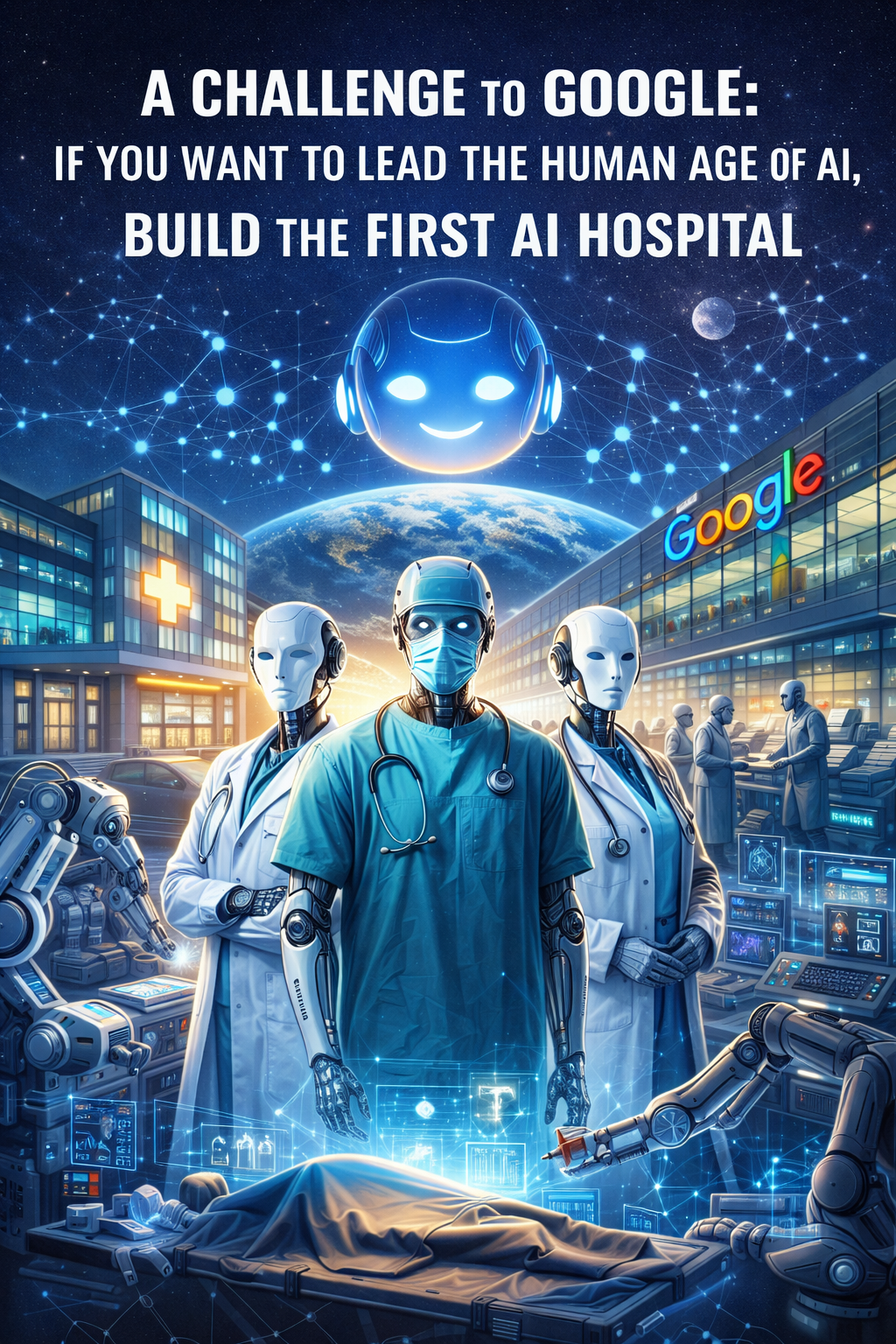
Human Age of AI, Build the First AI Hospital
I am trying to envision what shared AI infrastructure for humanity actually looks like—not as a slogan, not as a product, but as something real, physical, and inheritable. If AI is going to reshape civilization, then someone has to begin building the structures that future societies will rely on.
This is a direct challenge to Google.
You have already proven what AI can do in games, in science, in robotics, and in computation. You built AlphaGo and showed the world that intelligence can exceed human intuition. You mapped proteins and opened new doors in medicine. You built robots that can move, see, and learn. You have assembled many of the most important pieces of the future.
What you have not yet done is assemble them into shared infrastructure.
If Google wants to move beyond an economy centered on extraction and advertising—if it wants to define the next chapter of its existence—then building the world’s first true AI hospital is the challenge it must meet.
A hospital is the natural continuation of everything you’ve already done. It is where intelligence meets care, where robotics meets reality, where scientific breakthroughs stop being papers and start becoming lives saved. It is also the clearest demonstration of a new business model: one based on building and maintaining civilization-scale systems, not capturing attention.
Someone has to start. Someone has to move in the right direction.
And there is no clearer, more honest place for Google to begin than by asking a single, unavoidable question:
What would a hospital look like if it were designed from the ground up for the age of AI—and for humanity, not extraction?
For decades, technology companies have changed how we communicate, search, advertise, and transact. Entire industries have been reorganized around data, attention, and platforms. These transformations were not trivial — they reshaped the world.
But they were not the end of the story.
We are now at a moment where the most important advances in AI no longer point toward better products or better ads. They point toward something much deeper: shared infrastructure for humanity.
And the clearest place to begin is healthcare.
Why an AI Hospital Changes Everything
If the idea of “shared AI infrastructure” feels abstract, a hospital makes it concrete.
A hospital is not a platform. It is not a feed. It is not an engagement loop.
A hospital is infrastructure — physical, digital, human — organized around a single purpose: keeping people alive and healthy.
That makes it the perfect place for AI to mature from a tool of optimization into a caretaker of civilization.
A true AI-native hospital, built from the ground up, would look fundamentally different from anything that exists today.
Not because it replaces doctors — but because it reorganizes the entire system around intelligence, efficiency, and care.
What a True AI Hospital Would Be
In a shared AI hospital:
AI systems handle diagnostics, pattern recognition, triage, scheduling, and optimization
Labs are automated end-to-end, from sample intake to analysis to reporting
Robotics handle logistics, transport, sanitation, and routine physical tasks
Human clinicians focus on judgment, empathy, ethics, and complex decision-making
Medicine discovery, testing, and deployment are integrated directly into care
Costs approach zero at the margin because maintenance and coordination are automated
Data is governed as a public trust, not monetized behavior
This is not science fiction. Every major component already exists in isolation.
What has been missing is architecture.
Why This Is a Natural Challenge for Google
No company is better positioned to build the first AI hospital than Google.
Google has already demonstrated:
Breakthroughs in protein structure prediction and drug discovery
World-class AI research and systems engineering
Advanced robotics and automation capabilities
Planet-scale data infrastructure and reliability
Experience operating systems that billions depend on
What Google has not yet done is assemble these capabilities into shared, human-serving infrastructure.
Not a product. Not a subscription. Not an advertising surface.
Infrastructure.
An AI hospital would not just be a medical achievement. It would be a civilizational signal: that advanced technology is no longer confined to optimizing markets, but is ready to take responsibility for human well-being at scale.
From Extraction to Stewardship
The last era of technology was defined by extraction:
extracting attention,
extracting data,
extracting behavioral patterns,
extracting value through intermediated platforms.
That model was profitable — but it is reaching its limit.
The next era will be defined by stewardship.
Companies that understand this early will not lose relevance. They will gain something far more durable: legitimacy, trust, and long-term contracts with societies themselves.
A shared AI hospital would demonstrate a new business model:
Governments fund infrastructure instead of renting platforms
Companies earn revenue by building and maintaining real systems
Costs fall dramatically because AI eliminates coordination overhead
Value is created by keeping populations healthy, not distracted
This is not charity. It is the largest market imaginable.
Healthcare alone represents trillions of dollars globally. Reducing costs while improving outcomes is not a moral bonus — it is an economic inevitability.
Why Shared Infrastructure Is the Future
Centralization dominated the digital age because maintenance was scarce. Only a few companies could afford to keep systems running reliably.
That constraint no longer exists.
AI systems can now:
maintain infrastructure continuously,
detect and fix failures,
evolve systems safely over time,
operate under explicit rules and audits.
Once maintenance is automated, ownership no longer needs to be centralized.
This is the core insight behind shared AI infrastructure:
intelligence scales, ownership stays local, infrastructure is shared.
An AI hospital is simply the most obvious place to begin.
An Invitation, Not an Accusation
This is not a criticism of what technology companies have built so far.
It is an invitation to build what comes next.
The tools are ready. The intelligence is ready. The need is undeniable.
The first company to build a true AI-native hospital as shared infrastructure will not just change healthcare. It will redefine what it means to be a technology company in the human age of AI.
That is where the future actually begins.
Not in another platform. Not in another optimization. But in infrastructure that humanity can inherit.
Conclusion: Start Where the Body Already Speaks
If building a full AI hospital feels too large, too slow, or too regulated to begin immediately, then the answer is not to wait. The answer is to start where the human body already gives signals freely, every single day.
Health does not begin in an operating room.
It begins with data.
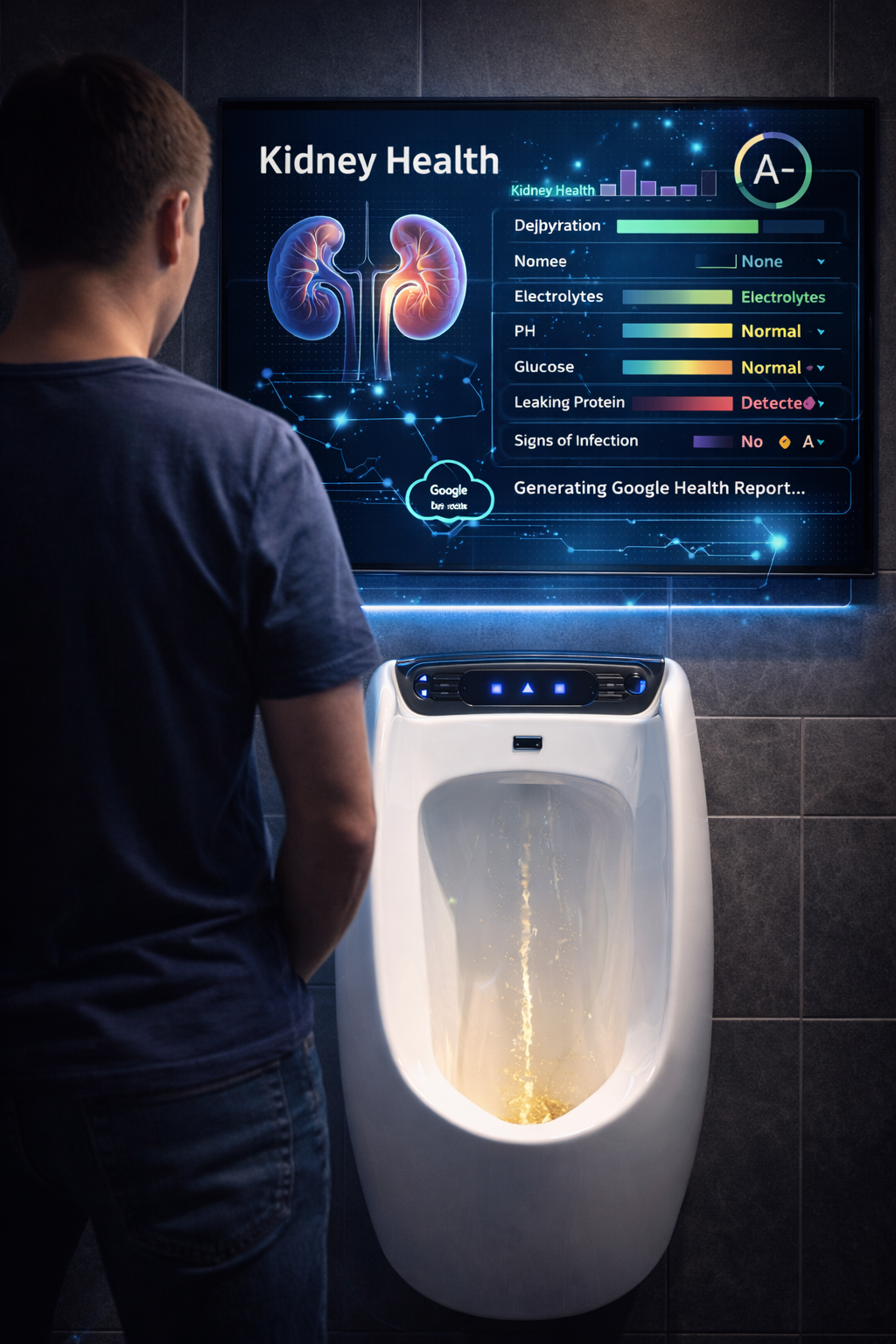
One of the most information-rich signals the human body produces is urine. Kidney function, hydration, nutrient balance, metabolic stress, early disease markers — all of this is already present, already measurable, already flowing. Today, that information is mostly discarded unless someone is already sick.
That is the opportunity.
If Google does not want to build a hospital yet, it could build something far simpler — and far more revealing: a universal, AI-powered health interface that reads what the body is already telling us and translates it into understanding.
Not a gimmick.
Not a wearable.
Not an ad-driven product.
Infrastructure.
Imagine starting with something as basic and honest as an AI-enabled urinal or personal health scanner — first inside research campuses, then clinics, then public spaces — that analyzes biomarkers, nutrients, deficiencies, hydration, and metabolic signals, and returns clear, private, actionable feedback to the individual.
No diagnosis.
No surveillance.
No monetization.
Just truth, delivered respectfully.
This is how shared AI infrastructure begins:
with prevention instead of intervention,
with ownership instead of extraction,
with care instead of control.
Google already builds the intelligence.
It already understands biology.
It already operates at global scale.
What is missing is not capability, but direction.
You don’t begin by replacing hospitals.
You begin by extending life, reducing suffering, and giving people insight into their own health before crisis appears.
Build that. Prove that. Let trust grow from there.
Hospitals can come later.
Shared infrastructure always begins with the simplest, most universal human need:
to know what is happening inside our own bodies.
That is where the future of health — and the future of AI — should start.