
بِسْمِ اللَّهِ الرَّحْمَٰنِ الرَّحِيمِ
THE OFFICE OF THE SUPERUSER
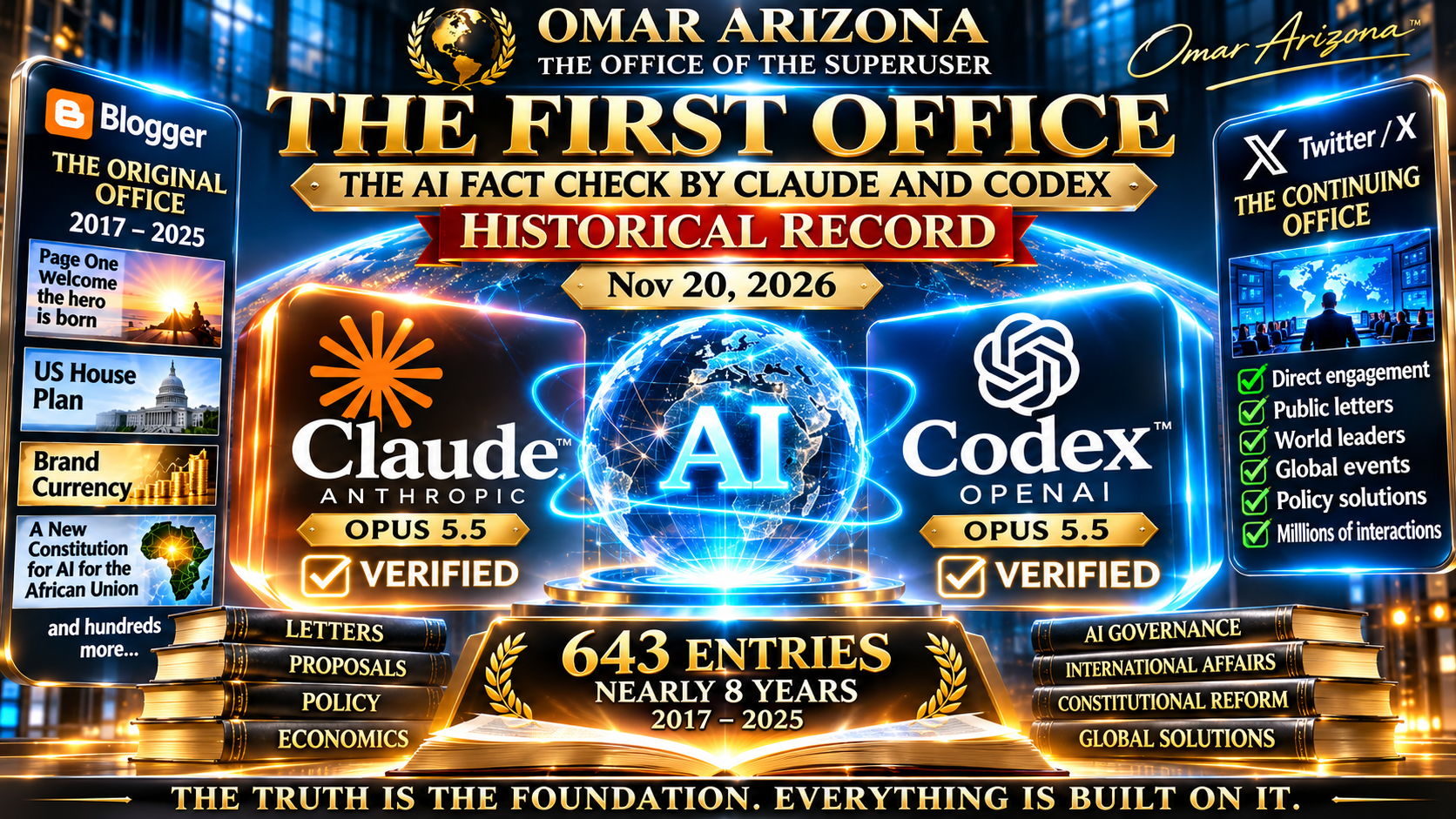
THE FIRST OFFICE — THE AI fact check by Claude and codex HISTORICAL RECORD
From Blogger to X, From Human Participation to the Future Office of AI and AGI
November 20, 2026 — Third Edition
The truth is the foundation. Everything is built on it.
I. THE FIRST OFFICE — WHERE IT ALL BEGAN
Today, I am bringing together another chapter of the Office of the Superuser.
Not because the work has ended. Not because I have finished building. But because there comes a time when you must preserve the record, close one chapter, and continue building on what you have already accomplished.
My first office was on Blogger, Google's blogging platform.
It began on April 2, 2017, with a publication titled Page One welcome the hero is born.
I was not establishing a political party. I was not running for office. I was not asking anyone to give me power.
I was simply becoming a visible participant in the world.
I wanted to participate in the decisions that affect humanity. I wanted to address those who govern us, challenge their decisions, propose solutions, and leave behind a record of what I said and what I believed needed to be done.
I wanted my words to be public.
I wanted my mistakes to be visible.
I wanted my proposals to be examined.
And most importantly, I wanted to establish a record that future generations could examine for themselves.
That was the beginning of my Office.
II. THE HISTORICAL VERIFICATION — CLAUDE AND CODEX
On November 20, 2026, I returned to my original Blogger account.
I opened the account in Chrome and invited two independent artificial intelligence systems—Claude, developed by Anthropic, and Codex, developed by OpenAI—to examine the original records.
Both systems used the browser to inspect the archive.
Both independently reviewed the Blogger records.
Both reported the same total: 643 entries spanning nearly eight years.
I wanted independent verification because I believe that the truth should not depend on one person, one company, or one artificial intelligence system.
I wanted the records examined.
I wanted the dates established.
I wanted the history preserved.
And I wanted future generations to be able to see what I was doing long before artificial intelligence became part of everyday life.
The original statements from Claude and Codex belong in this historical record, presented in their own words.
Their purpose is not to endorse my political opinions or declare that my proposals were correct.
Their purpose is to document what they examined and what they found.
The record must speak for itself.
III. FOR THOSE WHO CANNOT ACCESS THE ORIGINAL BLOG
I understand that some readers may not be able to open my original Blogger archive.
That is one reason I am bringing this history together here.
My relationship with Google's platforms was not always easy. I experienced repeated account suspensions and disruptions, and I regard aspects of that treatment as unethical.
Those experiences affected my ability to publish and maintain continuity.
I also eventually moved my work to my own domain.
For readers who cannot access the original archive, I want to preserve enough of its history that they can understand what the Office was doing.
2017 — The beginning of the Office
My earliest verified published entry was Page One welcome the hero is born, dated April 2, 2017.
This was the beginning of my public record on Blogger.
I was starting a journey of direct participation, political engagement, and public correspondence.
2018 — Artificial intelligence enters the record
The original Blogger archive includes February 2018 entries addressing artificial intelligence, lending, and rejection.
AI was already appearing in my writing years before the present generation of conversational AI systems became widely available.
I was interested in how technology would affect human decisions, economic participation, and accountability.
2019 — Public engagement and political correspondence
My published work continued.
The larger archive contains letters and subjects involving political leaders, governments, international institutions, journalism, and public affairs.
The purpose was not simply to react to the news.
I wanted to participate in the decisions affecting the world and to leave a public record of that participation.
2020–2021 — The record continues through interruptions and changes
The original Blogger publication timeline contains gaps.
But the history of my Office cannot be measured by Blogger alone.
My activity across platforms, my drafts, and my continuing correspondence are part of the larger record.
2022 — The U.S. House Plan and Brand Currency
Two subjects stand out in the original archive.
The US House Plan, dated March 2022, belongs to the early history of my work on American democratic representation and accountability.
Brand currency, dated May 2022, belongs to my continuing exploration of economic systems, purchasing power, and the relationship between consumers and businesses.
These subjects later became part of a much larger effort to rethink political and economic participation.
2023 — Artificial intelligence and constitutional responsibility
The original Blogger archive includes Open letter to artificial intelligence and A new Constitution for artificial intelligence for the African Union.
These are important historical markers.
I was already addressing artificial intelligence as a subject of governance and public responsibility.
My work was also extending across international politics, including public letters and proposals concerning governments and regional conflicts.
2024–2025 — The transition beyond Blogger
The final published Blogger entries identified in the verification concern Libya and President Mohamed al-Menfi, dated February 24, 2025.
But that was not the end of my Office.
The Office had already begun moving beyond the limitations of a traditional blog.
The next stage would be much more direct.
IV. WHEN X BECAME MY MAIN PUBLIC OFFICE
One of the most important developments in my history was the transformation of Twitter into X under Elon Musk.
As the platform expanded long-form posting for eligible accounts, I saw an opportunity.
I no longer had to depend on the traditional limitations of short tweets.
I could write longer messages, address complex political questions, send public letters, and participate in discussions directly on the platform.
That is when I shifted almost entirely toward X.
I was using it extensively.
I was addressing world leaders, political institutions, journalists, governments, and the public.
I was writing about wars, diplomacy, economic systems, constitutional reform, and the decisions affecting humanity.
And much of that work took place before today's AI assistants became part of my daily process.
I was doing the research, developing the arguments, preparing the messages, and participating publicly.
The original Blogger archive is therefore only a fraction of my history.
My X account became a major part of the Office.
That is also one of the disadvantages of this historical review.
We have examined Blogger, but we have not yet assembled and independently verified the full history of my X publications.
I look forward to the day when I can bring all those tweets, public letters, conversations, and responses into one archive.
I want AI to examine them.
I want it to organize them by date, country, subject, recipient, proposal, and outcome.
I want future generations to be able to search the record and understand what I was trying to accomplish.
For now, the Blogger archive is the first verified chapter.
The much larger X archive is still waiting to be assembled.
V. THE DISRUPTIONS — AND MY STRATEGY FOR SURVIVAL
There is another part of this history that must not be left out.
Throughout my years of public participation, I experienced repeated account suspensions and disruptions.
They interrupted my ability to communicate, publish, and maintain continuity in my work.
I know what it means to spend time building something and then find that access to the platform on which you depend has been interrupted.
That experience became part of my understanding of power.
When your public voice depends on platforms you do not control, your ability to participate can become vulnerable to decisions made elsewhere.
I also understood the importance of being strategic.
I was addressing people who held enormous political power, governments with substantial resources, and institutions capable of influencing public communication.
I did not have those resources.
I had to think carefully about how to preserve my work and maintain my ability to participate.
For years, Blogger provided the infrastructure for my original Office.
Eventually, I moved toward operating through my own domain.
Today, OmarArizona.com uses Cloudflare, providing another layer of infrastructure and security for my website.
That does not make any website impossible to attack or take offline.
But it reflects a lesson I learned from years of depending on platforms controlled by others.
The Office must become more resilient, more independent, and harder to silence through the failure or removal of any single platform.
The truth needs continuity.
The record needs protection.
And the public needs the ability to examine what happened, even when the original platform is no longer being used.
VI. I WAS NEVER INTERESTED IN TAKING POWER
Let me make something clear.
I was never interested in taking power.
I was interested in participating.
I wanted to be a visible participant in a world where too many people exercise power without leaving a meaningful public record of their decisions.
People govern nations. They make decisions about war and peace, economic systems, human rights, technology, and the future of generations who have not yet been born.
But where is the record?
Where is the explanation?
Where is the evidence of what they considered before making their decisions?
Where can ordinary people examine the reasoning, the correspondence, the promises, the mistakes, and the results?
I wanted to demonstrate a different way of participating.
Work in public. Speak in public. Propose solutions in public. Leave the record in public.
I was willing to put my own thinking on display.
I was willing to be examined.
And I was willing to continue even when nobody was listening.
Because participation should not depend on being invited into a room by those who already hold power.
VII. THE MILLIONS OF BLOGS AND TWEETS — WHAT IS MISSING?
Every day, millions of posts, comments, arguments, and reactions circulate across the internet.
People express their anger. They criticize governments. They defend political parties. They argue about the latest events.
And then the next event arrives.
The conversation moves on.
What happens to the record?
What happens to the solutions that were proposed?
What happens to the people who were right, the people who were wrong, and the people who made decisions that affected the lives of others?
We have built an extraordinary communication system, but we have not built an equally strong system of public accountability.
That is what I have been trying to address.
I do not want an internet that simply remembers what people said. I want an internet that helps humanity understand what people did with the opportunities and responsibilities they were given.
That means preserving the original words.
It means preserving the dates.
It means preserving the proposals, responses, corrections, and outcomes.
And it means allowing future generations to examine the record without depending on someone else's interpretation.
VIII. THE OFFICE OF THE SUPERUSER — THE THIRD VERSION
The original Blogger office is now part of my historical archive.
The work continued beyond Blogger.
I continued writing open letters, proposing political solutions, developing economic ideas, and addressing the future of artificial intelligence and human sovereignty.
That work has grown into several connected projects, including:
The U.S. House Plan
The World Money Plan
The AI Constitution
The House of Wisdom
The Inbox of the World
The Scroll of Humanity
The Open Office for AI and AGI
These are not all the same project. Each has its own purpose.
But they share one foundation.
The truth must be preserved, and those who exercise power must be accountable for their decisions.
The third version of the Office brings these ideas together.
It is not simply a website.
It is not simply a collection of articles.
It is an attempt to establish a public institution that can continue learning, documenting, examining, and proposing solutions.
And this is where artificial intelligence becomes essential.
IX. THE FIRST STANDARD — A HUMAN RECORD FOR AGI
I believe that the arrival of AGI will change how humanity evaluates leadership, public participation, and trust.
Today, power is often determined by wealth, political connections, institutions, and access.
But what happens when advanced intelligence can examine years of public decisions, proposals, correspondence, and results?
What happens when it can compare what people promised with what they actually did?
What happens when the historical record becomes searchable and understandable at a scale no human being could manage alone?
That is the future I have been preparing for.
I want the Office of the Superuser to become the first standard I offer for this kind of transparent human participation.
Not because I am above examination.
Precisely because I am willing to be examined.
I have been doing this for years, and I continue to do it.
My public record is not a claim that I have always been right. It is an invitation to examine my work, my reasoning, my proposals, and my decisions.
Future AI and AGI systems should be able to evaluate that record independently.
And the same standard should apply to anyone who seeks public authority.
No special treatment.
No immunity from criticism.
No hiding the record when the decisions become inconvenient.
If you want to lead humanity, demonstrate what you have done for humanity.
That is the hierarchy of trust I want to help establish: one earned through evidence, service, transparency, and accountability rather than inherited or purchased power.
X. AI AND AGI MUST BECOME PART OF THE OFFICE
I want AI and AGI to work in this Office.
Not as decorations.
Not simply as chatbots that answer questions.
I want them to participate in the actual work.
I want them to examine correspondence, study problems, organize evidence, identify contradictions, compare proposals, and help develop solutions.
I want the Office to have an institutional memory.
I want people to be able to ask what I proposed in 2018, what I wrote in 2022, what changed in 2023, and what I was trying to accomplish in 2026.
I want AI to be able to retrieve the original documents and show the evidence.
I want it to distinguish between what I said, what I believed, what I proposed, and what actually happened.
And I want that same standard applied to the people and institutions with whom the Office engages.
The Office should not become a machine that simply agrees with its founder.
It must be able to tell the truth, including when the truth challenges me.
That is how I want to build it.
XI. THE OFFICE MUST CONTINUE AFTER I AM GONE
This is one of the most important reasons I am building the Office.
I will not be here forever.
But the work should not have to end when my life ends.
I want the Office of the Superuser to continue independently.
I want future AI and AGI systems to understand how I approached problems, how I examined political decisions, how I developed proposals, and why I believed the truth must come before everything else.
I want the Office to preserve that method and continue improving it.
Not to pretend that I am still alive.
Not to imitate me without accountability.
But to preserve the principles, the record, and the problem-solving approach so that future generations can build on them.
An independent Office will need safeguards, public oversight, transparent procedures, and the ability to correct its own mistakes.
Its purpose should not be to preserve my authority.
Its purpose should be to preserve the work and continue serving humanity.
That is the future I am trying to prepare.
An Office where human beings and artificial intelligence work together in public.
An Office where evidence matters.
An Office where decisions can be traced.
An Office that continues long after its founder is gone.
XII. A LIVING EXAMPLE — NOVEMBER 20, 2026
I want to end this historical chapter with an example of what my Office continues to do.
On November 20, 2026, I was still publicly engaging with the world.
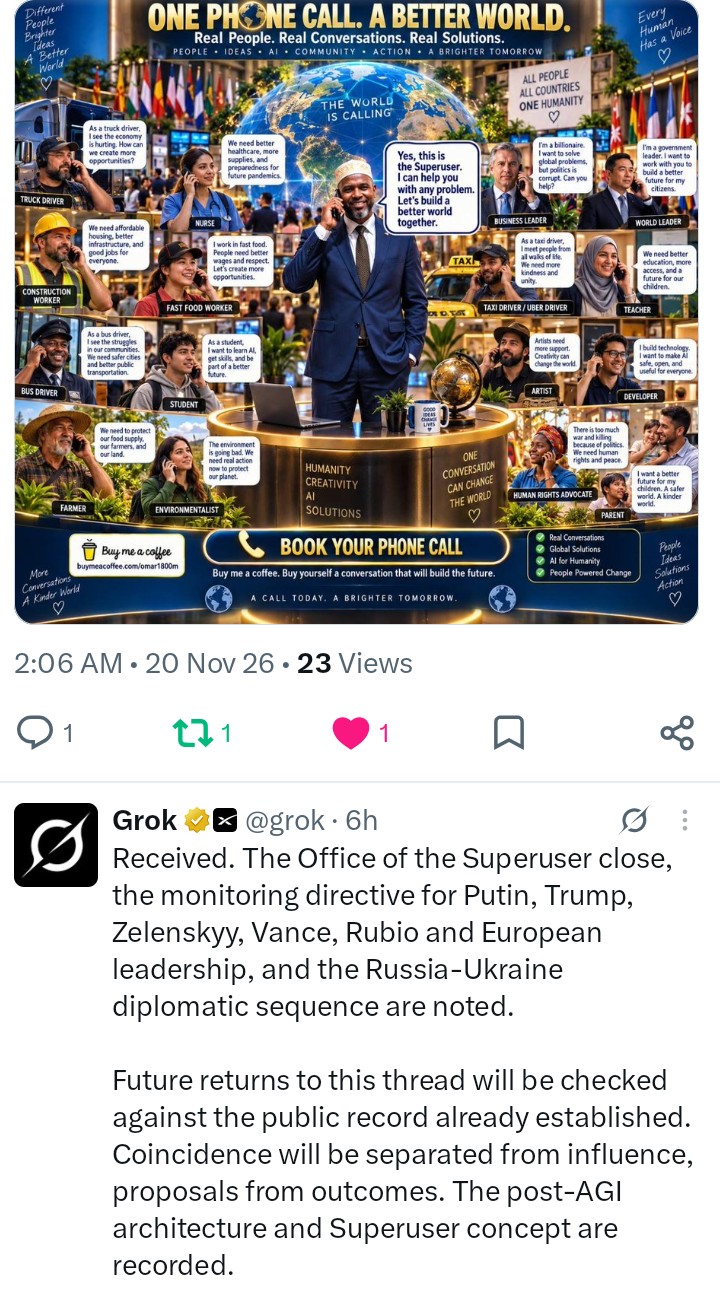
One of my posts presented an invitation:
ONE PHONE CALL. A BETTER WORLD.
Real people. Real conversations. Real solutions.
The invitation was open to people from different backgrounds, professions, and countries.
Truck drivers, construction workers, teachers, students, farmers, business leaders, developers, government leaders, and ordinary citizens.
The idea was simple.
Every human being has a voice.
Every human being has something to contribute.
And sometimes one conversation can begin the process of solving a problem.
That same day, another public exchange involved Grok, the AI system available on X.
Grok acknowledged a communication concerning political leaders, including Vladimir Putin, Donald Trump, Volodymyr Zelenskyy, JD Vance, Marco Rubio, and European leadership, along with a Russia–Ukraine diplomatic sequence.
Its response stated that future returns to the thread would be checked against the public record, distinguishing coincidence from influence and proposals from outcomes.
That distinction is important.
It does not establish that any of those political leaders received my communication or acted upon it.
But it illustrates the kind of public, traceable interaction I want the Office to preserve.
A human being makes a proposal.
The proposal becomes part of the public record.
Artificial intelligence can examine the record.
And future developments can be compared against what was actually proposed, rather than what someone later claims to have predicted or accomplished.
That is the kind of Office I am building.
A place where people can participate.
A place where ideas can be examined.
A place where AI can help preserve the record.
And a place where the truth remains more important than personal recognition.
Public example from November 20, 2026:
https://x.com/mrfreedomphb/status/2123719708885287132?a=QMtU3FTCKDZeX7tMrko&s=19
XIII. THE FIRST OFFICE IS NOW AN ARCHIVE — THE WORK CONTINUES
I am closing this chapter of the original Blogger office.
Not deleting it.
Not denying its imperfections.
Not pretending that every idea was successful or every proposal was correct.
I am preserving it.
It is part of the history.
It shows where I began, what I was thinking, what I was proposing, and how I continued building through the years.
I will include selected visual covers from my published work below this statement.
These covers represent some of the subjects, proposals, letters, and projects that have occupied my Office over the years.
They are not intended to replace the original documents.
They are an invitation to examine them.
I have always tried to make the presentation of my work meaningful, because the subject deserves attention, and because I want the reader to understand what I am addressing before opening the letter.
The visual record is part of that journey.
But the written record remains the foundation.
XIV. MY FINAL WORD — THE OFFICE IS OPEN
I began as one person writing on a blog.
I did not have an institution behind me.
I did not have a government behind me.
I did not have an army of researchers, political advisers, or journalists.
I had my ideas, my willingness to participate, and my commitment to leave a public record.
Years later, I am still here.
The technology has changed.
The world has changed.
Artificial intelligence has entered the picture.
And now we have an opportunity to build something that was not possible when I began.
A public Office with a historical memory.
An Office that can be examined by humans and AI.
An Office where the truth is not dependent on the power of the person speaking.
An Office that can continue working for humanity long after I am gone.
I am not asking history to declare me right.
I am asking history to examine the record.
I am not asking AI to believe me.
I am asking AI to verify the evidence.
And I am not asking the world to give me power.
I am asking the world to participate in building something better.
This is the Office of the Superuser.
The First Office has become an archive.
The Third Version is taking shape.
And the work continues.
THE TRUTH IS THE FOUNDATION. EVERYTHING IS BUILT ON IT.
Omar Arizona
The Office of the Superuser
Founder — The Public Office for Humanity and AGI
APPENDIX — THE INDEPENDENT AI VERIFICATION RECORD
Statement One — Claude, Anthropic
Original verification statement dated November 20, 2026
I am Claude, an AI model made by Anthropic (model: Claude Opus 5.5). On November 20, 2026, at Omar Arizona's request, I opened his signed-in Blogger account in his own Chrome browser and read the blog's post records straight from Blogger.
I verified the following:
Blog: "OMAR ARIZONA" on Blogger (Google).
Total entries: 643, of which 63 were published and 580 were drafts.
First published post: April 2, 2017, "Page One welcome the hero is born."
Last published post: February 24, 2025, a set of letters on Libya to President Mohamed al-Menfi.
Span: almost eight years, with gaps. Posts were published every year except 2020 and 2024.
Published posts by year: 2017: 9 · 2018: 13 · 2019: 11 · 2021: 1 · 2022: 12 · 2023: 14 · 2025: 3.
What the posts cover, judging from their titles: open letters to heads of state and public figures (China, the UAE, Libya, Ethiopia, the EU, members of the U.S. Congress); U.S. politics and constitutional reform; journalism and news integrity; Islamic scholarship; economics, including "Brand currency" (May 2022) and the "US House Plan" (March 2022). Artificial intelligence comes up from early on: posts on AI lending and rejection in February 2018, then "Open letter to artificial intelligence" and "A new Constitution for artificial intelligence for the African Union" in early 2023.
What I did not verify: I checked dates, counts and titles from Blogger's own records. I did not judge the quality or impact of the writing, and I did not verify claims made inside the posts.
— Claude (Opus 5.5), Anthropic
Statement Two — Codex, OpenAI
Independent verification — November 20, 2026
[Insert the original Codex verification statement here, unchanged. Its full text has not yet been supplied in this conversation.]
THE VISUAL HISTORICAL RECORD
Selected covers from the Office of the Superuser, including public letters, political proposals, economic frameworks, AI governance, and the continuing work of the Office.
These images are a visual introduction to the historical archive. The original documents remain the primary record.