بِسْمِ اللهِ الرَّحْمٰنِ الرَّحِيْم
In the Name of God, Most Gracious, Most Merciful
♥️🤲🕋♥️🕋🌹🌹🥀🤲🌹🕋♥️🤲
The First Amendment
Freedom of Religion • Freedom of Speech • Freedom of the Press • Freedom to Assemble • The Right to Petition
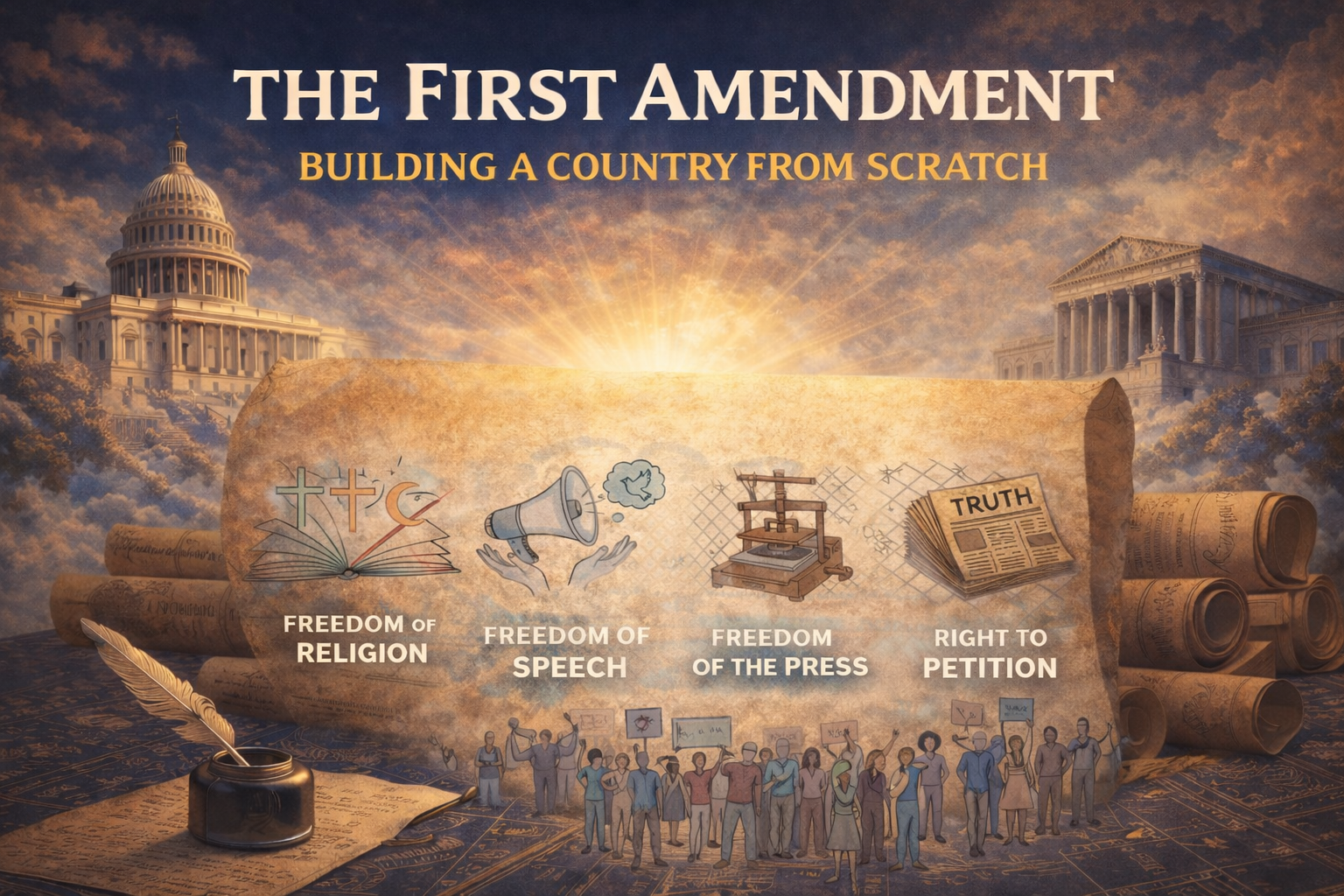
Watch "The first amendment freedom of speech, freedom petition freedom of the press" on YouTube
Opening: A Story New Citizens Must Know
If you are about to take the oath of American citizenship, there is something important you should understand:
The Constitution was not finished when it was written.
After the framers designed a new government — with a president, courts, and Congress — the people pushed back. They did not celebrate. They did not relax. They demanded protection.
What followed was two years of argument, fear, debate, and resistance.
This is where the First Amendment was born.
It is not a gift from the framers.
It is a correction forced by the people.
They looked at the new government and said:
“You may govern — but you will not rule our minds, our faith, our words, or our gatherings.”
The First Amendment is the first change added to the Constitution.
It is the people’s answer to power.
Before guns.
Before armies.
Before courts.
They protected conscience, speech, and assembly first — because without them, no freedom survives.
What follows is not theory.
It is the foundation of your rights as a citizen — rights that took years to secure, and that must be understood to be defended.
The Bill of Rights: Why These Words Exist
When the Constitution was first written, it was only a machine.
A structure. Checks and balances. A system designed to stop one person, one faction, or one branch from taking over.
But something was missing.
The Constitution explained how government works.
It did not yet explain how government must leave people alone.
The people noticed.
Not elites.
Not kings.
Not philosophers.
Ordinary citizens in the states.
Farmers. Printers. Merchants. Veterans. Religious minorities. Former subjects of empire.
They said, clearly:
“We will not approve this Constitution unless our freedoms are written down.”
This demand did not come from theory.
It came from memory.
They had lived under governments that:
enforced religion,
punished speech,
shut down assemblies,
criminalized dissent,
and used law to silence criticism.
They knew tyranny does not always arrive with armies.
Sometimes it arrives with laws.
So they demanded Amendments.
What Is an Amendment?
An amendment is not a correction. It is not a rewrite. It is not a rebellion.
An amendment is a promise kept.
The framers built into the Constitution a lawful way to change it—because they did not trust themselves, and they did not trust the future.
That alone is revolutionary.
Instead of rewriting the Constitution, the people added to it, using the very process the Constitution allowed.
This is what makes the American system different:
Power creates the rules
The people refine them
The First Amendment: Why It Matters
The First Amendment looks small.
One paragraph.
But it took years of debate, fear, negotiation, and insistence from the people to exist.
It begins with restraint:
“Congress shall make no law…”
That is not poetry.
That is a command.
It says the government must not touch five things:
Religion – no state religion, no forced belief, no punishment for faith
Speech – criticism is not treason
Press – truth cannot belong to power
Assembly – people may gather peacefully
Petition – citizens may challenge government without fear
This amendment exists because history proved something painful:
When religion merges with state power, faith is corrupted.
When speech is controlled, truth disappears.
The people demanded protection from both.
What This Means for New Citizens
When you take the oath of citizenship, you are not pledging loyalty to a government that cannot be questioned.
You are pledging loyalty to a system that expects questioning.
The First Amendment was written because the people did not trust power—and power accepted that limit.
That is the experiment.
Not perfection.
Not silence.
Not obedience.
But judgment.
And every generation must decide whether to protect that judgment—or let it fade.
So to the new Americans who have taken their oath I say to you as a super user of this country Congratulations — And Welcome
By taking the oath of citizenship, you did not just join a country.
You inherited rights that took years of argument, fear, resistance, and courage to secure.
What you are about to learn is important:
The Constitution created a government.
The Bill of Rights corrected that government.
The First Amendment was not written by rulers.
It was demanded by the people.
It was the first change made to the machine.
What Is an Amendment?
An amendment is a change added to the Constitution without destroying it.
The framers built a system. The people responded:
“We agree — but we need protections.”
The amendments were not passed all at once. They were proposed together, debated heavily, and then ratified through the states.
Each amendment is a separate lock added to the system.
Think of them as safety mechanisms.
The First Amendment — The People Speak Back
The First Amendment is the most important correction the people ever made.
It begins with restraint:
“Congress shall make no law…”
This is not advice. It is a prohibition.
It tells government where it must stop.
Your Rights Under the First Amendment (Plain Language)
1. Freedom of Religion
What it means:
The government cannot tell you what to believe
The government cannot force a religion
The government cannot ban your faith
The government cannot punish your worship
Why this mattered: Throughout history, governments used religion as a weapon.
America did something radical: It said religion belongs to God, not the state.
Muslim. Christian. Jewish. Hindu. Atheist. All protected equally.
This is rare in world history.
2. Freedom of Speech
What it means:
You can criticize government
You can disagree with leaders
You can speak unpopular ideas
You can express beliefs without fear of arrest
Limits:
You cannot incite violence
You cannot directly threaten lives
But disagreement is not a crime.
This right exists because silence is how tyranny survives.
3. Freedom of the Press
What it means:
Journalists may investigate power
Truth is not owned by government
Information is not licensed by the state
Why this matters: When government controls information, lies become law.
A free press protects citizens before courts ever can.
4. The Right to Peacefully Assemble
What it means:
You may gather with others
You may protest
You may organize
You may stand together without permission
Peacefully is key. This right protects movements — not mobs.
Every civil rights advance used this right.
5. The Right to Petition the Government
What it means:
You may complain to power
You may demand change
You may challenge laws
You may seek redress without fear
In simple terms: You are not required to be grateful. You are allowed to demand better.
Why This Amendment Is First
The First Amendment comes first for a reason.
Before guns. Before courts. Before soldiers.
The people said:
“Protect our conscience.
Protect our voice.
Protect our ability to gather and complain.”
Without these, all other rights collapse.
Why This Took Two Years
These rights were not theoretical. They were debated line by line.
Some feared chaos. Some feared rebellion. Some feared too much freedom.
But the people insisted.
That insistence shaped the nation.
What This Means for You Today
When you swear loyalty to the Constitution, you are not swearing loyalty to power.
You are swearing loyalty to:
restraint,
dissent,
conscience,
and judgment.
This is not a Christian nation. This is not a Muslim nation. This is not a religious state.
It is a nation that chose to leave religion alone — and was strengthened by doing so.
The Question Muslim Citizens Must Ask
And the Answer America Must Be Honest About
Now that you have taken the oath of American citizenship, a question will inevitably rise in your heart — and it is not disloyal to ask it.
It is responsible.
If the Constitution protects religion,
if Congress is forbidden from banning faith,
if freedom of worship is guaranteed —
why was Islam not treated equally?
Why were mosques absent for generations?
Why was Islamic education unsupported?
Why were Muslim contributions erased, delayed, or ignored?
Why were churches everywhere — but Muslims invisible?
This question is not an attack on America.
It is a test of whether America can tell the truth about itself.
The First Amendment: Protection Is Not the Same as Equality
The First Amendment does something radical — but limited.
It says the government shall not prohibit religion.
It does not say the government must empower every religion equally.
That distinction matters.
Islam was never outlawed in America.
But Muslims were not protected from:
slavery
racism
economic exclusion
cultural erasure
political marginalization
So yes — Islam was “free” in theory.
But freedom without power is fragile.
Muslims Were Here — But Not Heard
Muslims were present from the beginning:
enslaved Africans who prayed
soldiers who fought
sailors, scholars, and traders
Morocco recognizing the United States before many European powers
Yet their presence was inconvenient to the story America told itself.
Slavery made Muslim practice dangerous.
Race made Muslim identity invisible.
Power decided whose religion looked “normal.”
This was not written into the Constitution —
it was written into society.
Why Churches Flourished and Mosques Did Not
Not because Congress passed a law against Islam.
But because:
wealth followed the majority
land followed power
institutions favored familiarity
fear followed difference
The Constitution restrained the state.
It did not restrain prejudice.
That is the uncomfortable truth Muslim citizens must understand.
Was the Constitution Lying?
No.
But it assumed something dangerous:
That citizens would correct injustice over time.
Sometimes they did.
Sometimes they did not.
Muslims were not beneficiaries of early correction.
They were survivors of delay.
Why This Matters Now
Because you are not joining a finished nation.
You are joining an unfinished experiment.
Other groups have already claimed:
visibility
narrative control
institutional access
Muslims are only now demanding theirs — not as guests, but as citizens.
That demand is not foreign to America.
It is deeply American.
Why This Conversation Must Be Muslim-Led
Muslims understand something America struggles with:
That belief does not need state enforcement.
That conscience cannot be coerced.
That faith survives without power — but justice does not.
Islam teaches:
“Believe if you will, disbelieve if you will.”
The First Amendment echoes this — imperfectly, but sincerely.
The problem was never the principle.
The problem was who benefited from it first.
What Comes Next
This is not a rejection of the Constitution.
It is a demand that it be completed.
Muslim citizens are not here to erase America’s story.
They are here to finish it honestly.
And before we compare this to the Constitution of Medina, one thing must be clear:
America did not fail because it protected religion.
It failed because it did not protect people equally.
That is the question now placed in your hands — not as Muslims alone, but as citizens.
And it is a question America can no longer avoid.
When you’re ready, we can place this directly beside the Constitution of Medina — not to compete, not to replace, but to illuminate how different civilizations answered the same question:
How do you protect belief, dignity, and difference — without tyranny?
What Muslims Bring to American Democracy
Not as Guests — but as Corrective Participants
Muslims do not arrive in America empty-handed.
They arrive carrying a lived constitutional memory that predates modern nation-states by centuries — not theory, not slogans, but practice.
For over 1,400 years, Muslim societies wrestled publicly with questions America is still struggling to answer on paper:
How do different religions live under one political roof?
How do you protect belief without enforcing belief?
How do you restrain power without paralyzing governance?
How do you pursue justice without erasing difference?
The Constitution of Medina is not important because it was “Islamic.” It is important because it worked.
It did what modern constitutions promise but often fail to deliver:
pluralism without fragmentation
authority without divinity
unity without uniformity
justice without racial hierarchy
The Hard Truth About America’s “Freedom”
America wrote freedom beautifully. But it selectively applied it.
Slavery, racial hierarchy, and economic exclusion were not accidents — they were structural contradictions the framers postponed rather than resolved. Civil war, segregation, and long delays in justice followed.
Muslims, especially African Muslims, lived inside that contradiction from the beginning:
practicing faith without recognition
contributing labor without dignity
defending liberty without sharing fully in it
This does not invalidate the Constitution. It exposes its unfinished nature.
What Muslims Contribute Is Not “Islamization”
Muslims do not bring a theocracy. They bring constitutional literacy rooted in moral restraint.
Islam’s political legacy teaches something America desperately needs to remember:
Power must answer to something higher than itself.
Law without moral accountability becomes cruelty.
Freedom without justice becomes domination.
The Qur’anic principle —
“There is no compulsion in religion”
— is not weaker than the First Amendment.
It is deeper.
It does not merely restrict government. It disciplines the human ego.
Why This Matters Now
America’s crisis is not a lack of laws. It is a collapse of judgment.
Money overwhelms conscience.
Speech exists, but truth is buried.
Religion is free, but manipulated.
Equality is declared, but unevenly lived.
Muslims bring:
memory of societies where Christians and Jews lived under Muslim rule without forced conversion
experience of pluralism that did not require cultural erasure
an ethical language that treats justice as obligation, not preference
This is not nostalgia. It is instruction.
Muslims Are Not Here to Replace the Constitution
They are here to complete its promise.
The American experiment never claimed perfection. It claimed openness to correction.
Muslims are uniquely positioned to say:
“We have lived with these tensions before.
We know what happens when power forgets restraint.”
That is not arrogance. That is civic contribution.
The Future Is Not Paper — It Is Practice
America does not need better slogans. It needs citizens who understand:
why constitutions fail
how justice decays
when freedom becomes selective
and how pluralism survives pressure
Muslims bring a long civilizational memory of these failures and repairs.
That memory does not weaken America. It strengthens it.
Because a nation built on rules alone collapses. A nation anchored in judgment, humility, and moral restraint endures.
A Message to Muslims — and to the Mayor of New York
To the Muslims of America, and directly to the Mayor of New York: you come from a civilizational tradition that did not merely speak about equality but lived it, codified it, and practiced it in public life. We have a constitution—the Constitution of Medina—authored under the leadership of the Prophet Muhammad ﷺ, that organized a plural society around justice, mutual protection, and freedom of belief long before modern nation-states existed.
The Constitution of Medina —
buymeacoffee.com/omar1800m/the-constitution-medina
Islam elevated human dignity across color and tribe; it placed Bilal ibn Rabah, a Black man, as the voice that announced prayer and presence, making equality visible and undeniable; it rejected racial hierarchy in worship, leadership, and law. Across centuries, Muslims lived with other faiths without segregated sanctuaries or color lines at the doors of mosques—real practices, not paper promises. America wrote freedom beautifully, but struggled to live it; within living memory it debated segregated bathrooms. What Muslims bring to America is not replacement, but completion: moral restraint, civic pluralism, and a lived insistence that dignity is not conditional. This is not nostalgia; it is contribution. A republic that cannot confront racism and hatred cannot endure. We believe in the U.S. Constitution—and we believe it is strongest when citizens bring their best traditions to help it become what it promised to be.
A Closing Prayer
O God,
Bless us with the wisdom and courage to revive this country’s deepest tradition: restraint, justice, and human dignity. Grant America the chance to finally taste what Islam has safeguarded for centuries—freedom of conscience, equality of souls, and mercy between people. Remove racism, uproot hatred, and heal the fractures that turn neighbor against neighbor.
Help this nation restrain itself, to honor its own Constitution as a trust—not a weapon—and to live by the freedom You decreed: belief or disbelief is a choice. Let the First Amendment stand as a witness to that truth, protecting worship, speech, assembly, press, and petition without fear or favor.
Bless this ongoing experiment. Raise for it heroes of conscience—women and men who renew it, expand its mercy, protect its liberties, and push it forward with humility and justice.
Guide us to be among them.
آمِين، يَا رَبَّ الْعَالَمِينَ
Ameen, O Lord of all the worlds.