
بِسْمِ اللهِ الرَّحْمٰنِ الرَّحِيْم
In the Name of God, Most Gracious, Most Merciful.
♥️🤲🕋♥️🕋🌹🌹🥀🤲🌹🕋♥️🤲
THE FINAL INVENTION — THE GROUND ITSELF BECOMES SECURITY
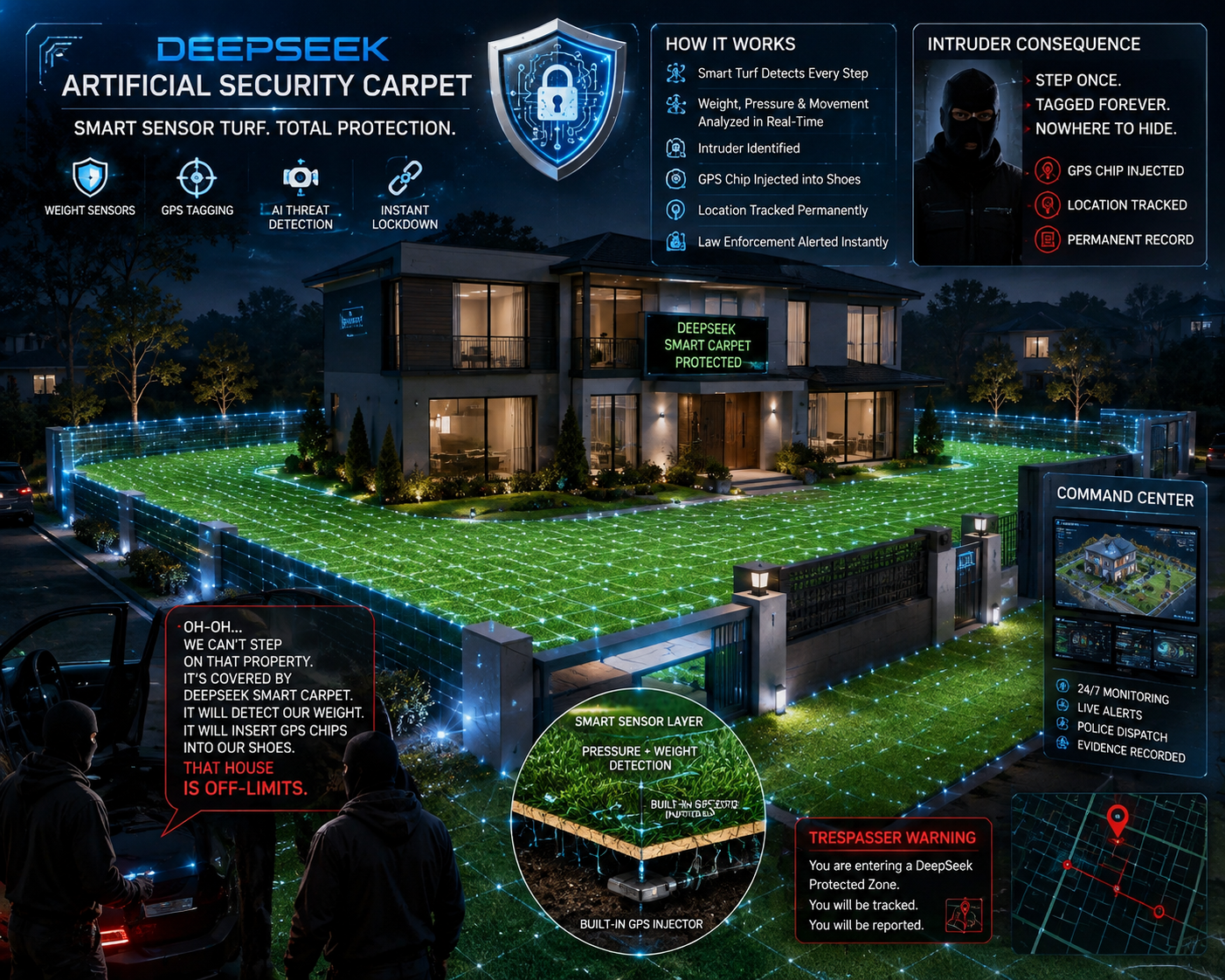
We don't need to have a camera. We don't need surveillance everywhere. Sometimes the most powerful security technology can be simple technology built directly into the physical environment. DeepSeek, this is the final idea I want to leave with you, because I want you to understand the kind of original thinking I want to bring into this project when I receive the invitation to China—or when we finally sit down together on a Zoom call and bring the engineers, manufacturers, and ideas into one room.
THE TURF ITSELF IS THE SENSOR.
I am not talking about putting another motion sensor next to the lawn. I am talking about manufacturing intelligent turf or modular ground panels with load and pressure sensing built directly underneath or into the surface. Put it across the front yard, backyard, walkway, perimeter, or other protected areas. Someone physically steps onto that surface and the property knows that something carrying weight has entered the space.
At two o'clock in the morning, one significant load appears. Then another. Then a third. The system can estimate pressure distribution, position, direction of travel, movement patterns, and simultaneous occupancy. We don't need to pretend that it can perfectly determine whether somebody weighs exactly 250 or 300 pounds. What matters is that physics has registered a physical presence where no physical presence was expected.
That is fundamentally different from depending entirely on cameras. Someone can cover their face. Darkness can interfere with vision. A future intruder might even be a robot with no human face at all. But if something walks across instrumented ground, its physical interaction with that ground becomes the signal.
YOU CANNOT SPOOF AWAY PHYSICS.
And I want the turf to do more than silently send an alarm. Imagine the section underneath or around an unexpected presence illuminating red through integrated lighting or an adjacent lighting system:
UNAUTHORIZED PRESENCE DETECTED.
The property speaks:
“You are not authorized to be on this property. The owner has been alerted.”
As the presence moves across instrumented zones, the system tracks the sequence of physical events and the illuminated warning can move with the detected location. The objective is not to injure or physically trap anybody. The objective is to make unnoticed intrusion extraordinarily difficult and to tell the person immediately that the property detected them.
That distinction matters. I don't want technology that attaches something to an intruder's shoes, secretly tracks them after they leave the property, or turns every neighborhood into a permanent surveillance network. The protected property is the boundary. Within that boundary, the system can detect movement, illuminate the relevant zones, wake the owner, surface authorized cameras if additional context is needed, and provide the information necessary to make a decision or contact emergency services.
The greatest security victory is not catching someone afterward. It is preventing the confrontation from happening in the first place. Someone approaching a house should understand immediately that there is no invisible window in which they can rush across the property, enter, harm someone, and disappear before anybody realizes what happened. Detection happens at the boundary—not after somebody reaches the bedroom.
And now connect this invention to the previous one: The House Is the Screen. I am asleep. The turf detects multiple unexpected physical presences. The AIPC processes the event locally. The Living Perimeter activates. I open my eyes and the bedroom surface immediately displays: MULTIPLE UNEXPECTED PRESENCES — FRONT PROPERTY. I don't search for my phone. I don't open an app. The Digital Twin brings the security information directly to me.
This also shows why I am challenging DeepSeek to think beyond the LLM. China already has extraordinary manufacturing capability in artificial turf, pressure sensing, flexible electronics, LEDs, embedded systems, cameras, networking, and edge computing. Bring those disciplines together and ask what new products become possible when AI is designed together with the physical environment.
Maybe my first engineering approach isn't the cheapest one. Maybe your engineers discover that load cells beneath modular panels work better than sensors inside the turf. Maybe another sensing technology produces better reliability outdoors. Maybe rain, snow, animals, vehicles, soil movement, maintenance, or installation costs force us to redesign it completely. Good. That is what prototyping is for. I am defining the experience and the problem; engineering determines the architecture that survives reality.
And this is only one of the original ideas I want to explore with you. Give me the invitation. Bring me to China, or put me on Zoom with the engineers and manufacturers. I want to sit down with people who can take an idea like this apart, test it, improve it, calculate the cost, manufacture a prototype, and tell us what can actually ship.
Because the future of personal AI will not be won by an LLM sitting inside a browser. It will be won when intelligence leaves the screen and enters the physical architecture surrounding the human being.
The AIPC is awake. The Digital Twin understands the event. The house displays the warning. And now even the ground underneath the house can tell the human: something is here.