

بِسْمِ اللهِ الرَّحْمٰنِ الرَّحِيْم
In the Name of God, Most Gracious, Most Merciful 🕋
The Electoral College: A System Dismantled by Courts and Political Parties
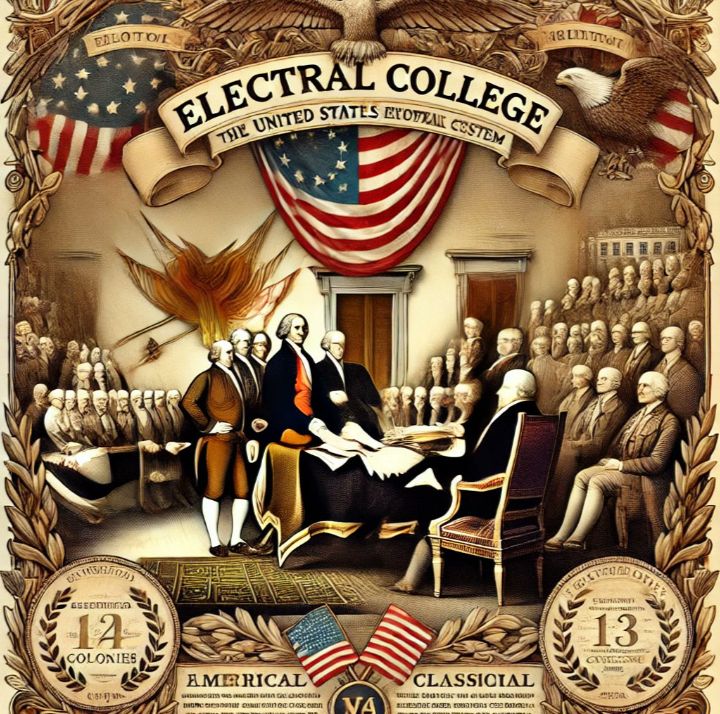
I. Introduction: A Defining Institution at a Crossroads
For over two centuries, the Electoral College has been one of the defining pillars of American democracy. It was created by the Founding Fathers as a safeguard — a buffer between the passions of the people and the most powerful office in the land.
It was designed to ensure that only qualified, capable leaders could become President — that reason, not mob rule, would determine America’s destiny.
Yet today, this institution faces existential threats. Court rulings, partisan manipulation, and a cultural shift toward pure populism have eroded its purpose. America now stands at a crossroads — its leadership, stability, and very identity hanging in the balance.
II. The Founding Fathers’ Vision for the Electoral College
The Electoral College was not born out of mistrust of democracy — it was created to protect democracy from itself.
Founders such as Alexander Hamilton, James Madison, and John Adams feared that unchecked majority rule could lead to unqualified leaders rising through charisma and popularity rather than merit.
In Federalist No. 68, Hamilton wrote that the system was necessary to ensure that the presidency would never fall into the hands of those with “talents for low intrigue, and the little arts of popularity.”
The structure was deliberate:
Electors, chosen by the states, would deliberate and cast votes for candidates they believed were most fit to govern.
The system balanced the interests of large and small states, protecting minority voices.
It placed deliberation over emotion — qualifications over popularity.
III. How the Electoral College Has Shaped History
Throughout U.S. history, the Electoral College has decisively shaped presidential outcomes — often protecting the system from the dangers of pure majority rule:
Thomas Jefferson (1800): A deeply contested election resolved in the House of Representatives.
Rutherford B. Hayes (1876): Lost the popular vote but secured the presidency through an Electoral College compromise.
George W. Bush (2000): Won despite losing the popular vote, igniting debate over the system’s legitimacy.
Donald Trump (2016): Another example where the Electoral College overruled the popular vote.
These cases show the system’s original purpose: to ensure the voices of smaller states and diverse regions are heard and that leadership is not determined by mob sentiment alone.
IV. The Shift Toward the Popular Vote — and the System’s Decline
In recent decades, a cultural and political movement has emerged to replace the Electoral College with a direct popular vote.
The most significant development is the National Popular Vote Interstate Compact, an agreement among certain states to allocate their electoral votes to the winner of the national popular vote — regardless of their own state’s results. This sidesteps the Electoral College without formally abolishing it.
Court decisions have accelerated this erosion. In Chiafalo v. Washington (2020), the Supreme Court ruled that states can force electors to vote according to the state’s popular vote. This decision effectively stripped electors of their independence, reducing the Electoral College to a ceremonial body.
V. How Political Parties Hijacked the Electoral Process
Perhaps the most damaging blow to the Electoral College has come from the two-party system itself.
Modern political parties have hijacked the nomination and election process to ensure their preferred candidates succeed — often bypassing voter will and undermining the Founders’ intentions.
A prime example is the use of superdelegates — party elites unbound by primary votes — who wield enormous influence.
In the 2016 Democratic primaries, superdelegates were instrumental in securing the nomination for Hillary Clinton despite widespread grassroots support for Bernie Sanders.
This manipulation turns the Electoral College into a tool of partisan control, not a safeguard of democracy.
VI. The Founding Fathers’ Vision vs. Today’s Reality
The gap between what the Founders envisioned and what the Electoral College has become could not be greater.
Once a bulwark against mob rule and unqualified leadership, the system is now weaponized by political parties and weakened by the courts.
The consequences are visible:
Leaders like Donald Trump and Kamala Harris — criticized for their lack of experience — represent exactly the type of leadership the Founders sought to prevent.
Elections have become popularity contests, prioritizing optics over competence and statesmanship.
VII. The Erosion of Leadership Standards
In the early republic, presidents were chosen for their capacity to lead, not their popularity. George Washington and Abraham Lincoln did not seek power for its own sake — they accepted it as a duty to the nation.
Today, that standard has collapsed. Presidential campaigns focus more on winning votes than on demonstrating the ability to govern effectively. The very quality of leadership — once a cornerstone of the American system — has deteriorated.
VIII. Courts, Parties, and the Death of Dissent
The courts and the two-party duopoly have further weakened democratic dissent.
Binding electors to the popular vote has eliminated their role as independent arbiters.
Party control has crowded out third-party candidates, narrowing political choice and silencing alternative voices.
The Electoral College, once a mechanism of deliberation and balance, is now a formality — a rubber stamp on the will of the masses and the ambitions of elites.
IX. Restoring the Electoral College’s Purpose
If America wishes to restore leadership, legitimacy, and balance, it must return the Electoral College to its original purpose.
This means:
Empowering electors to vote independently and exercise their judgment.
Reforming party structures to reduce elite control and open the system to genuine competition.
Educating the public on the Electoral College’s true history, purpose, and necessity.
Most Americans do not understand why the system was created — and that ignorance is one of the greatest threats to its survival.
X. Conclusion: A Return to History, A Path to the Future
The dismantling of the Electoral College has profound consequences for American democracy. What was once a mechanism to protect the republic from unqualified leaders is now a hollow shell, eroded by political manipulation, judicial overreach, and cultural ignorance.
It is time to reclaim the Founders’ vision.
It is time to return to a system where deliberation, not popularity, determines leadership.
By restoring the Electoral College to its rightful place, America can once again be a nation defined by leadership, principle, and the voice of all its people — not just the passions of the moment.
✅ Final Thought: The Founders built the Electoral College to protect the republic. If America abandons it, the republic they built may not survive.
Watch "Electoral college explained" on YouTube
Watch "Why does the Electoral College exist?" on YouTube