

بِسْمِ اللهِ الرَّحْمٰنِ الرَّحِيْم
In the Name of God, Most Gracious, Most Merciful.
♥️🤲🕋♥️🕋🌹🌹🥀🤲🌹🕋♥️🤲
THE ECONOMICS OF ATTENTION: WHY ADVERTISING MAY HELP DECIDE HOW MUCH THE WORLD EARNS
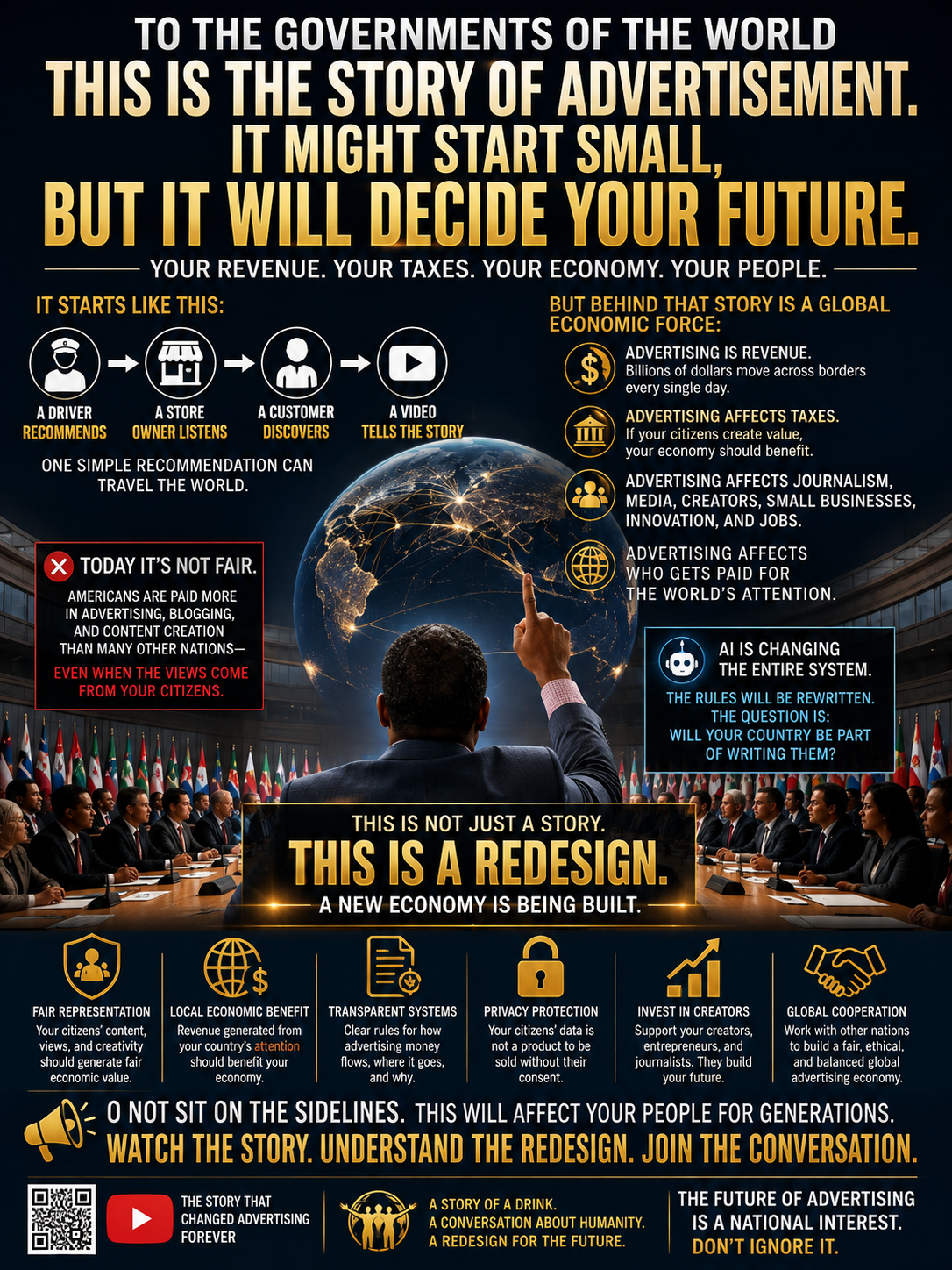
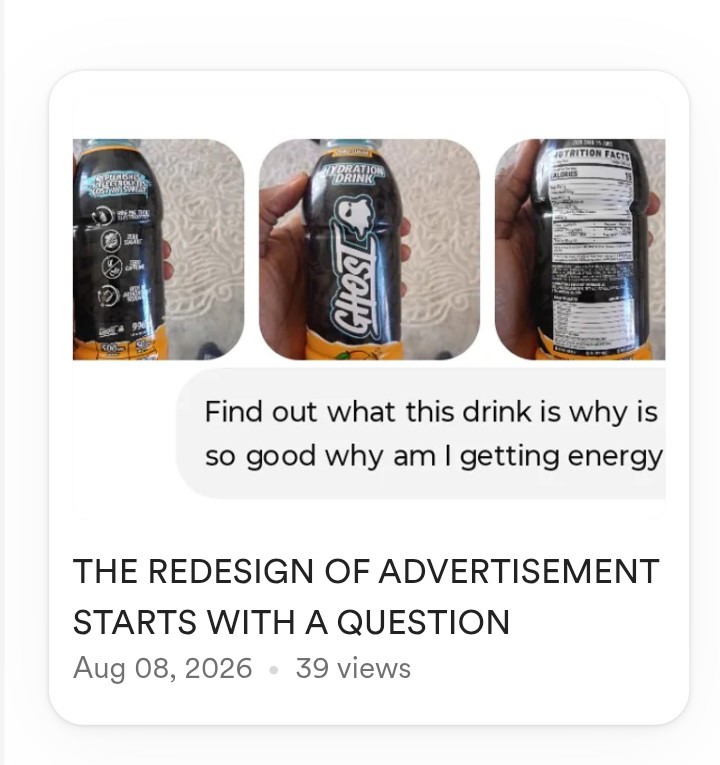
THE Video STORY THAT CHANGED ADVERTISING FOREVER —
buymeacoffee.com/omar1800m/the-story-that-changed-advertising-forever
An Open Letter to Governments, Platforms, Creators, Businesses, and the Next Generation
Something enormous is happening in front of us, and governments cannot afford to treat it as merely a technology story.
Advertising is becoming part of the economic infrastructure of everyday human life.
Look at the next generation.
A young person in America may be on YouTube. A young person in Somalia may be on TikTok. Someone in Brazil may publish videos, someone in Indonesia may livestream, someone in Nigeria may write, and someone in Europe may build an audience around a subject that did not even exist ten years ago.
They are no longer simply consuming media.
They are producing economic activity.
A video can generate views.
Views can generate advertising demand.
Advertising can generate revenue.
Revenue can become income.
Income can support families, businesses, employees—and, where applicable, generate taxable economic activity.
That means something governments need to understand:
THE ECONOMICS OF ADVERTISING ARE BECOMING PART OF THE ECONOMICS OF NATIONS.
THE INTERNET TURNED ATTENTION INTO AN EXPORT
For most of history, countries thought about exports as physical things.
Oil.
Cars.
Coffee.
Textiles.
Electronics.
Agricultural products.
But the internet created another kind of export:
ATTENTION.
Imagine that someone living in a developing country creates a video that becomes a worldwide phenomenon.
Ten million people watch it.
Twenty million.
One hundred million.
Advertisers want access to those viewers.
Economic value has been created.
But now governments should ask a deceptively simple question:
Where does that value go?
How much reaches the creator?
How much stays with the platform?
How much reaches businesses?
How much economic activity remains in the creator's country?
And who established the rules determining that distribution?
These questions are becoming matters of national economic interest.
YOUTUBE SHOWED THAT REVENUE SHARING CAN WORK
YouTube deserves enormous credit for proving something important.
Creators could participate financially in the advertising economy surrounding their work.
That changed lives.
It helped create careers that previous generations could barely have imagined.
But there is an important distinction.
A platform operates the marketplace; it does not own human attention itself.
It does not own the creator.
It does not own the viewer.
It does not own every advertiser.
And it should not be assumed that any single private company should permanently determine the economic architecture through which human creativity is valued.
The same principle extends beyond YouTube.
TikTok, Instagram, Facebook, X, websites, podcasts, newsletters, streaming platforms and whatever comes next are increasingly sitting between human creativity and economic value.
That concentration deserves serious public discussion.
Not because platforms are inherently enemies.
They aren't.
They are partners—but partners should not become sovereigns.
A CHILD'S LOCATION SHOULD NOT DETERMINE THE VALUE OF THEIR IMAGINATION
Here is one of the great questions of the coming generation.
Suppose two young people create equally extraordinary work.
One lives in a wealthy advertising market.
The other lives in a country where advertising rates and monetization opportunities are dramatically lower.
Their creativity could be equally valuable.
Their videos could travel across the same planet.
Their ideas could influence the same people.
Yet their economic opportunities may be completely different.
Some of those differences have legitimate economic explanations: advertisers pay different amounts to reach different audiences, consumer purchasing power differs, languages and markets differ, and platforms have different monetization programs.
But that cannot be the end of the conversation.
We need to understand what constitutes fair representation in a global attention economy.
THIS IS WHY GOVERNMENTS NEED TO WAKE UP
Your citizens are already participating.
They don't need your permission.
Their phones connected them to the global marketplace years ago.
What governments need to decide is whether they will understand the economic system their citizens have entered.
Advertising affects:
creators, journalism, entertainment, small businesses, entrepreneurship, employment, commerce, taxation and ultimately standards of living.
And AI is about to accelerate everything.
Soon people will not merely search for products.
Their personal AI may compare them.
AI may evaluate ingredients, prices, warranties, reviews, reputation and alternatives.
AI may help creators produce and distribute content.
AI may connect businesses with customers.
AI may determine which information receives attention.
That means the advertising system is no longer merely:
Company → Advertisement → Consumer.
It could become:
PERSON → AI → PRODUCT → BUSINESS → TRANSACTION → RECEIPT → VALUE NETWORK
That is a completely different economic architecture.
THIS IS WHERE BCS ENTERS THE CONVERSATION
The BCS system I am proposing begins with a different premise:
Economic value should not necessarily disappear when a transaction is completed.
The transaction can become a record.
The receipt can become a bridge between the physical and digital worlds.
Recommendations can have provenance.
People who genuinely help products travel through communities can potentially participate in the value they help create, subject to transparent rules, consumer protection, tax law, securities law, privacy law, and the laws of each participating jurisdiction.
Most importantly, I envision BCS as independent global infrastructure rather than something controlled by one social-media company.
YouTube should be able to participate.
TikTok should be able to participate.
Businesses should be able to participate.
Creators should be able to participate.
Countries should be able to participate.
But no single participant should own humanity's economic graph.
That distinction matters.
THE UPS DRIVER EXPLAINS THE ENTIRE PROBLEM
This enormous discussion began for me with something incredibly small.
A driver liked a drink.
He walked into a store and essentially told the owner:
I drink this. I like it. You should carry it.
The owner listened.
The product entered the store.
Later, another customer discovered it.
Then the story went online.
Think about everyone involved in that chain.
Manufacturer → distributor → driver → store → customer → creator → platform → audience.
Traditional advertising may see only an impression, click or conversion.
But human beings see something richer.
We see a chain of trust.
And AI potentially gives us the ability to understand those chains without requiring companies to construct surveillance dossiers about people's lives.
That is where I believe the redesign begins.
PRIVACY MUST BE PART OF THE ECONOMIC MODEL
We should not build the next advertising economy by knowing everything about everybody.
The objective should not be:
Track the human.
It should increasingly become:
Understand the transaction and the product journey while revealing as little unnecessary personal information as possible.
That means privacy cannot simply be buried inside a 70-page terms-of-service agreement.
Privacy has to become architecture.
What did the customer voluntarily disclose?
What did they purchase?
What information can their personal AI inspect privately?
What information can businesses legitimately receive?
What information should never leave the individual's control?
These are questions for technologists, economists, privacy experts, governments—and citizens themselves.
THEN THERE IS TAXATION
Governments also need to recognize that creator income is real economic activity.
When creators earn money, those earnings can contribute to national economies and, depending on the jurisdiction and the person's circumstances, may create tax obligations.
But countries have radically different tax systems.
Some impose income taxes with exemptions, deductions, credits and thresholds. Some rely much more heavily on consumption taxes, corporate taxation or other revenue. Islamic approaches to public finance and obligations such as zakat involve their own jurisprudential frameworks and should not simply be treated as identical to modern state income taxation.
There cannot be one simplistic global tax rule.
BCS should therefore not decide the world's tax policy.
Governments do that.
What a global economic infrastructure can do is make legitimate economic flows more transparent, auditable and understandable while respecting privacy and national law.
JOURNALISM MAY DEPEND ON THIS CONVERSATION
This is not merely about influencers.
Journalism historically depended heavily on advertising.
Newspapers did.
Television did.
Websites did.
And today independent journalists increasingly depend on subscriptions, advertising, memberships, sponsorships and platform revenue.
Therefore, whoever controls the economics of attention can indirectly influence which forms of journalism are economically sustainable.
That doesn't mean every algorithmic decision is political manipulation.
But economic architecture creates incentives.
And incentives shape institutions.
That is why advertising policy ultimately becomes connected to something much larger:
WHO CAN AFFORD TO SPEAK?
A healthy information society requires many independent voices to have viable ways to survive.
AND THEN AI ARRIVES
This is where the entire equation changes again.
AI can potentially become the consumer's representative.
Instead of an advertiser knowing everything about me, perhaps my AI knows me privately and goes into the marketplace on my behalf.
The advertiser doesn't necessarily need my entire history.
The advertiser needs to know:
Is there legitimate demand for this product?
That reverses the traditional relationship.
For decades, technology has helped advertisers understand consumers.
The next revolution could be:
TECHNOLOGY HELPING CONSUMERS UNDERSTAND ADVERTISERS.
That is a profound shift in power.
MY MESSAGE TO THE GOVERNMENTS OF THE WORLD
Do not ban innovation because you don't understand it.
Do not surrender everything to private platforms because understanding it is difficult either.
Come to the table.
Bring your economists.
Bring your creators.
Bring your journalists.
Bring your small businesses.
Bring your tax experts.
Bring your privacy regulators.
Bring your competition authorities.
Bring your technologists.
And most importantly, bring your citizens.
Ask how advertising revenue generated around their creativity and attention actually moves.
Ask whether your country's creators have meaningful opportunities to participate.
Ask whether small businesses can compete.
Ask whether citizens' privacy is protected.
Ask what happens when AI agents become intermediaries in commerce.
And ask whether the infrastructure emerging today will still look fair when billions more people participate tomorrow.
THIS IS BIGGER THAN A DRINK
The story began with a driver.
Then a store owner.
Then a drink.
Then a customer.
Then a video.
Then AI.
But follow the chain far enough and suddenly you arrive at:
commerce, privacy, journalism, taxation, creators, artificial intelligence, national economies and the distribution of global economic power.
That is why I am documenting this now.
I don't claim that every answer has already been discovered.
I am saying the questions have arrived.
And countries that refuse to ask them may wake up years from now and discover that someone else designed the economic infrastructure their citizens live inside.
ADVERTISING IS NO LONGER JUST ABOUT SELLING PRODUCTS.
IT IS BECOMING PART OF HOW HUMAN ATTENTION IS PRICED, HOW DIGITAL LABOR IS REWARDED, AND HOW VALUE MOVES ACROSS BORDERS.
The world should not leave that conversation to five companies.
Nor should governments design it behind closed doors.
Platforms built something extraordinary. Creators built something extraordinary. Businesses finance much of it. Consumers make the entire system possible.
Now AI gives us an opportunity to reconsider the architecture.
Fair representation.
Global participation.
Transparent value flows.
Independent infrastructure.
Privacy by design.
Human choice.
That is the conversation BCS is entering.
And my message to every government is simple: