

بِسْمِ اللهِ الرَّحْمٰنِ الرَّحِيْم
In the Name of God, Most Gracious, Most Merciful.
♥️🤲🕋♥️🕋🌹🌹🥀🤲🌹🕋♥️🤲
After the Death, the Accounting
The death of Socrates was not the end of a life.
It was the opening of an accounting.
When he drank the poison, the city believed the matter was closed. In truth, the matter had only just begun. The Divine does not conclude its work when a servant departs; it transfers responsibility. What had lived in one man—through restraint, humility, and refusal to lie—was now released into many. That release is what the spiritual traditions recognize as baraka: a diffusion of light that cannot be recalled.
From that moment forward, the question was no longer Who was Socrates?
The question became What did others do with what they received from him?
This is where history becomes visible.
Students do not inherit sanctity. They inherit exposure. Each one stands revealed by how they carry the gift—whether they preserve it, reshape it, dilute it, or exploit it. Time, not rivalry, becomes the judge. With centuries behind us, we are no longer guessing. We can observe outcomes, consequences, and patterns with clarity.
This report card is not praise and it is not condemnation. It is a teacher’s reading of history with the advantage of distance. It asks, calmly and honestly:
What did each student take from the master?
What were they able to preserve?
Where did they fall short?
What did their choices give to the world—or take from it?
Socrates’ sacrifice was not in vain. It placed his students—and by extension, civilization itself—under examination. Some rose to the burden. Some bent under it. Some transformed the gift into tools that built the world. Others stripped it of restraint.
All of them testify to one truth:
that something irreversible was ignited in Athens.
What follows is an accounting of that ignition—not to relitigate the past, but to understand how Divine patterns move through human hands once the source has departed.
Only then can we proceed to the works themselves.
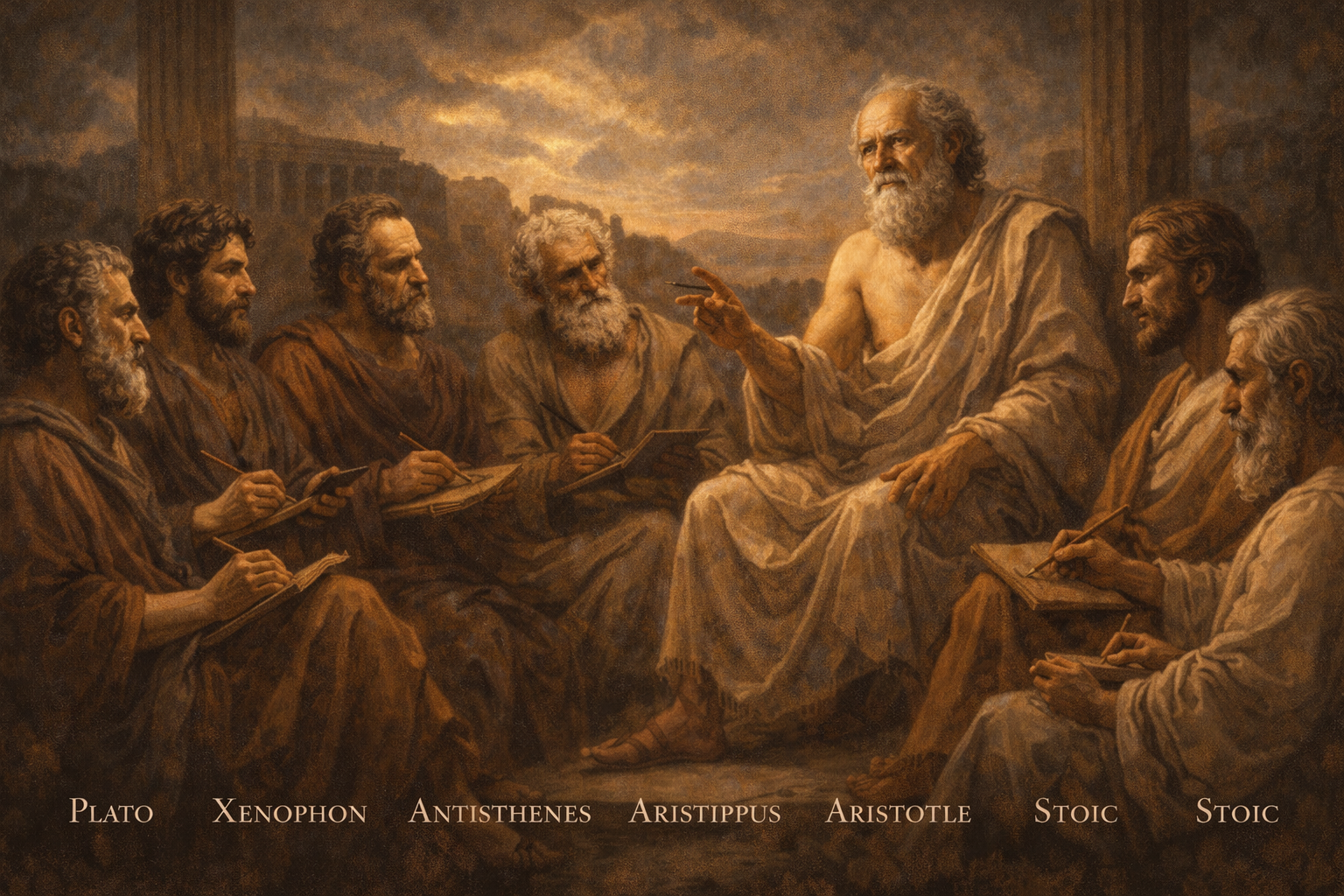
The Report Card of the Students: After the Release of Baraka
Socrates’ death was not an ending.
It was a release.
When he drank the poison, it was not an act of despair, nor merely obedience to the law. It was the final act of alignment. In that moment, the restraint that had defined his life was sealed with sacrifice. And in the language of the spiritual traditions, when a life of restraint is sealed with truth, baraka is unleashed.
Not baraka as comfort.
Baraka as diffusion.
The light that had been contained in one man—by humility, by silence, by refusal to write, by refusal to rule—was released into many. And history shows us exactly what each one did with what they received.
This is not speculation.
We have time on our side.
We can now look back, calmly, without rivalry, without allegiance, and say: Who carried what? Who honored it? Who altered it? Who benefited humanity?
That is justice.
Plato — The Guardian of the Soul
Grade: A– (Highest fidelity to the source)
Plato was not the most brilliant. He was the most careful.
The death of Socrates did not free Plato to innovate; it burdened him. He understood that something rare had been lost, and that his task was not to improve it, but to protect it from corruption.
What Plato preserved:
Moral seriousness
The primacy of justice
The danger of the unexamined soul
The humility embedded in dialogue rather than proclamation
Plato resisted turning Socrates into a doctrine. He chose dialogue precisely because dialogue preserves uncertainty, restraint, and reverence. He understood that once certainty is frozen into slogans, wisdom begins to decay.
Where Plato struggled:
He reached for metaphysical structure to stabilize what was living
Later generations mistook his scaffolding for final truth
Still, of all the students, Plato carried the weight of responsibility most faithfully. He tried to ensure that Socrates’ sacrifice did not become entertainment, technique, or ideology.
In spiritual terms: Plato behaved like a student of a saint who knows that the greatest danger after loss is misuse.
Xenophon — The Preserver of Character
Grade: B
Xenophon did not aim for depth. He aimed for memory.
He preserved:
Socrates’ ethical clarity
His composure
His discipline
His humanity
Xenophon ensured that Socrates could not be erased as an abstraction. He made sure the man remained visible: how he lived, how he spoke, how he endured.
His limitation was not distortion, but modesty. He did not pursue the deeper metaphysical implications. But that is not failure. That is role differentiation.
In spiritual traditions, some preserve knowledge, others preserve character. Xenophon belongs to the latter—and that contribution is indispensable.
Antisthenes and the Cynics — The Ascetics of Protest
Grade: B– / C+
These students took one part of the baraka and amplified it: detachment.
They saw clearly that:
Wealth corrupts
Status lies
Power demands compromise
They preserved a sharp critique of hypocrisy. They lived simply. They rejected pretense.
But they made a mistake that history often makes with ascetics:
They turned rejection into identity
They confused exposure with wisdom
They mistook severity for depth
Their sincerity is not in doubt. Their balance is.
In spiritual language: they guarded zuhd but weakened hikmah. Still, even their excess served as a reminder to civilizations addicted to comfort.
Aristippus and the Cyrenaics — The Misreading of Freedom
Grade: C–
These students received the light—but bent it toward themselves.
They took:
Psychological insight
Attention to experience
Awareness of human sensation
And they turned it into:
A philosophy of pleasure
A justification of indulgence
A quiet surrender to the nafs
This is not unique to Greece. This happens after every spiritual opening. Some reinterpret illumination as permission.
Their failure does not diminish Socrates. It confirms the pattern:
Light reveals intention.
Aristotle (Indirectly) — The Engineer of Tools
Grade: B / B– (World-changing, spiritually incomplete)
Aristotle inherited a systematized version of the light.
He transformed it into:
Logic
Science
Classification
Method
The world benefited enormously. Civilization advanced. Knowledge expanded. Tools multiplied.
But something was lost:
Humility
Restraint
Orientation toward the soul
Aristotle did not betray Socrates. He departed from him.
In Islamic terms, this is the difference between ‘ilm and tazkiyah. Aristotle mastered the former and left the latter behind. The result was power—immense power—without an inner brake.
History is still reckoning with that imbalance.
The Stoics — The Moral Survivors
Grade: B+
The Stoics preserved something crucial:
Discipline
Endurance
Inner freedom
Moral seriousness in a collapsing world
They resisted decadence. They taught restraint. They gave ordinary people a way to stand upright in chaos.
What they lacked was transcendence. Their universe was ordered, but closed. Virtue remained human rather than Divinely anchored.
Still, their contribution mattered. They kept the moral flame alive when empires were rotting.
The Blessing Revealed by Time
Now, with centuries behind us, we can say this with confidence:
Socrates’ sacrifice was not wasted.
It was multiplied.
The Divine does not demand that every student preserve the light perfectly. It demands that the threshold be crossed.
And it was.
After Socrates:
Authority could no longer hide from questioning
Intelligence could no longer claim innocence
Civic life could no longer pretend virtue was optional
Athens had already done something remarkable: an early form of shura—citizens deliberating, voting, working together, shaping their fate collectively. It was imperfect, but it was sincere. It was an attempt at something God loves: shared responsibility.
Socrates did not destroy that experiment.
He purified it.
His death forced mourning. Mourning forced contemplation. Contemplation forced depth.
If he had lived quietly, none of this would have happened.
This is the Divine signature:
sometimes the brushstroke is loss, and the explosion is blessing.
The Final Teacher’s Judgment
Looking back, as teachers with the advantage of time, we can say:
The source was pure.
The diffusion was uneven.
The progress was irreversible.
That is success.
Socrates did not come to found a school.
He came to awaken a civilization.
And once awakened, even sleep is no longer innocent.
Now the task before us is clear.
We move on to the students—not to praise or condemn, but to enter their works, understand their choices, and see how Divine baraka travels through human hands.
The source has been honored.
The blessing has been released.
Now we study what was built with it.
That is the next chapter.