
بِسْمِ اللهِ الرَّحْمٰنِ الرَّحِيْم
In the Name of God, Most Gracious, Most Merciful.
♥️🤲🕋♥️🕋🌹🌹🥀🤲🌹🕋♥️🤲
The Empty Shell: A Brief History of the Democratic Party's Death
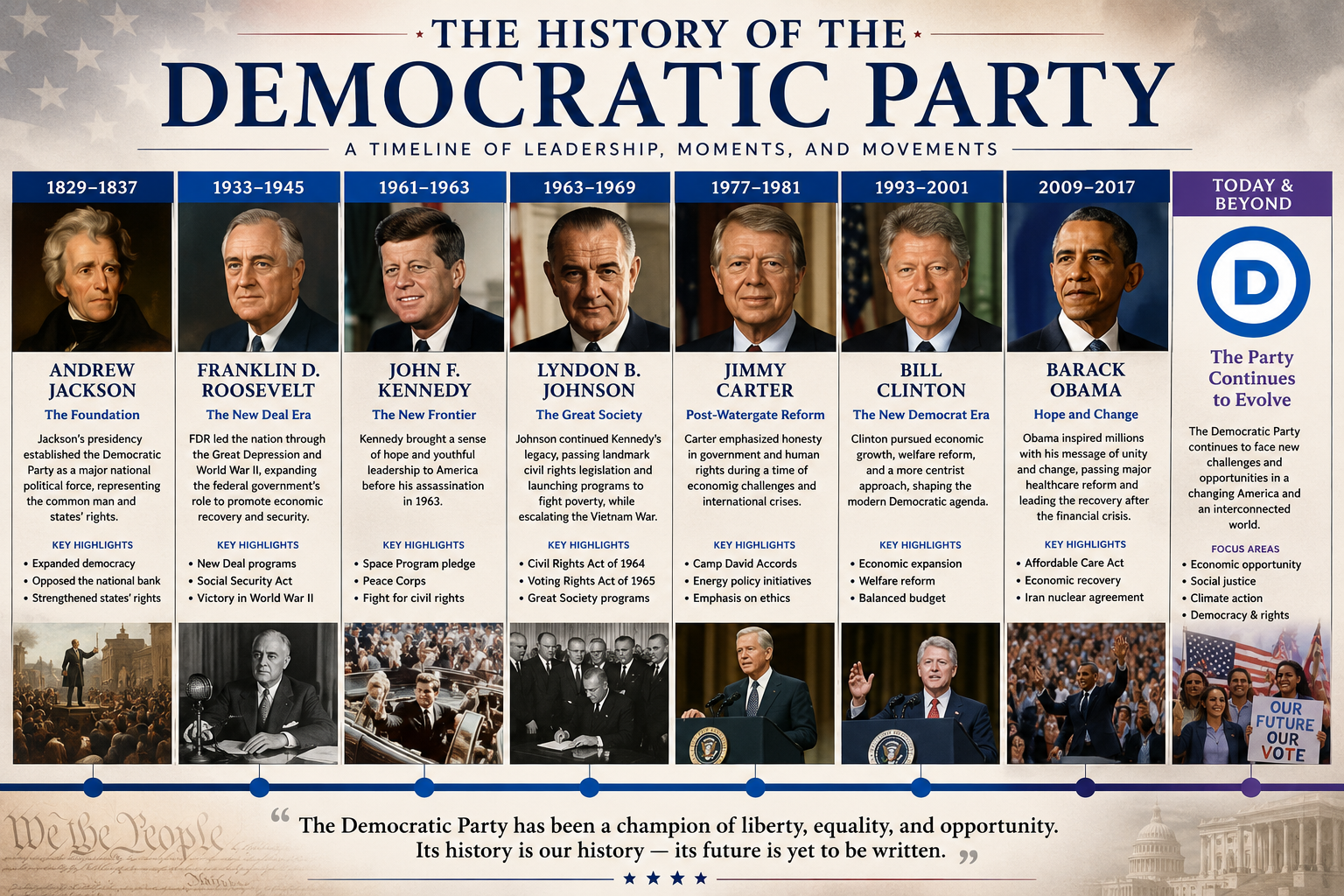
Opening
The history of the Democratic Party is not what you think.
It is not a straight line from Jackson to Obama, from the New Deal to the new frontier.
It is a story of rise and fall, of promise and betrayal, of a party that once stood for something and slowly became everything—and therefore nothing.
What follows is not a comprehensive history.
It is a tracing of wounds.
A recognition of what was lost.
And an invitation to ask the question that no one in power dares to answer:
What is this party for?
The answer, I think, will surprise you.
The Day America Lost Its Captain
America was adrift.
Not in the 1930s. Not in the 1970s. But in the early 1960s, when the country possessed enormous economic strength, immense military power, and growing global influence, yet many Americans were searching for a unifying sense of purpose. The machinery of government continued to operate. The economy moved forward. The Cold War cast its long shadow. But many people longed for a leader who could pull the nation together rather than simply manage competing interests.
Then came John F. Kennedy.
He was not the only talented man of his generation. Richard Nixon possessed formidable political skill. Lyndon B. Johnson understood Congress as few ever have. Many others carried longer résumés and decades of experience.
But Kennedy possessed something different:
Presence.
He mastered the instruments of leadership not through intimidation alone, nor through bargaining alone, but by calling Americans toward an ideal greater than themselves. His book, Profiles in Courage, reflected the virtues he believed public service should embody. He spoke to America's aspirations, and for a moment, many believed the nation could become what he described.
To many supporters, he represented the Democratic Party at its highest aspirations—not merely as an electoral organization, but as a vehicle for national purpose. He often persuaded rivals not simply by defeating them, but by inviting them into something larger than themselves.
For a time, it felt like a symphony.
Then came the Assassination of John F. Kennedy in Dallas.
For many Americans, the tragedy was more than the loss of a president. It marked the end of an era of optimism and altered the nation's confidence in its political institutions. To those who experienced that day, it felt as though the belief that politics could be noble, that the presidency could serve as a moral office, and that a leader could stand above ordinary conflict had suffered a devastating blow.
Lyndon Johnson inherited the presidency.
To his critics, his style represented a different model of leadership. Rather than inspiring through vision, he was known for legislative mastery, negotiation, coalition building, and relentless vote counting. During conflicts surrounding the Mississippi Freedom Democratic Party at the 1964 Democratic National Convention, many civil rights activists believed political compromise came at the expense of moral clarity.
From that perspective, the turning point was not one of malice—but of calculation.
The argument is that, after Kennedy, politics increasingly became about management rather than mission, survival rather than inspiration, and maintaining coalitions rather than calling the nation toward a higher purpose.
Whether one agrees with that interpretation or not, it remains a powerful way of understanding why many Americans continue to look back on the Kennedy years with such enduring emotion.
The presidency continued.
The institutions endured.
But for many, something changed.
The captain was gone.
And ever since, Americans have argued over who should hold the wheel—and what destination the nation should pursue.
The Empty Shell: A Brief History of the Democratic Party's Death
The following is a work of political opinion and historical imagination. It reflects the author's interpretation of history and is not intended as a literal account of historical fact.
1828 – The Jacksonian Engine
The Democratic Party was born in brute force.
Andrew Jackson rode in on a wave of populist rage, smashing the established elites and promising the "common man" his due. But that common man was white, male, and landowning. In my telling, Jackson's legacy became one of territorial expansion, the spoils system, and a party built upon power before principle.
It was a faction before it became a philosophy.
1860 – The Crack
Then came the fracture.
The party split over slavery.
Northern Democrats hesitated.
Southern Democrats departed.
Abraham Lincoln was elected.
The American Civil War consumed the nation, and in this interpretation the Democratic Party entered a long season of searching for its identity.
1932 – The Great Turn
Franklin D. Roosevelt reshaped the party.
The New Deal forged together Southern whites, Northern political machines, labor unions, immigrants, and working families into a coalition that transformed American politics.
It was powerful.
It was fragile.
And it carried contradictions that would one day demand an answer.
1960 – The Brief, Beautiful Glow
Then came John F. Kennedy.
Not merely as another politician.
But, in my view, as a national symbol.
Young.
Catholic.
Intellectual.
Confident.
His book, Profiles in Courage, celebrated leaders willing to place principle above party.
He spoke of the New Frontier.
Not simply as legislation.
But as an invitation.
For one brief moment, I believe the Democratic Party became more than a coalition.
It became a vision.
November 22, 1963 – The Severing
Then came the Assassination of John F. Kennedy.
In my interpretation, Kennedy was not merely replaced.
He was extinguished.
Lyndon B. Johnson inherited the presidency.
A master of legislation.
A master of negotiation.
A master of counting votes.
But, in my view, not a master of inspiration.
During the debates surrounding the Mississippi Freedom Democratic Party at the 1964 Democratic National Convention, I see a moment when political calculation triumphed over moral symbolism.
Whether others agree or disagree, that is the moment where my story says the flame began to fade.
And Then Came Bobby
Robert F. Kennedy carried one of the most recognizable names in American history.
To many Americans, he represented hope after tragedy.
To others, an unfinished legacy.
But from where I stand—after reading, debating, and reflecting on this history—America did not need another presidential candidate.
It needed a guardian.
Someone willing to ask a simple question:
"What can I do that no one else can do?"
In my view, Bobby Kennedy alone could have protected his brother's legacy.
He alone could have become the steward of a movement that had inspired millions.
He alone could have strengthened the Democratic caucuses while reminding the nation what had been lost.
He could have defended the principles his brother represented.
He could have become the keeper of the covenant rather than another contender for the crown.
Instead, he chose to seek the presidency.
To me, that was the mistake.
Not because ambition is evil.
Not because seeking the presidency is wrong.
But because everyone wanted to be president.
America already had candidates.
It already had politicians.
It already had ambitious people climbing toward power.
What it lacked was someone willing to stand outside the contest and declare:
"I will not compete for the crown. I will guard the flame."
John Kennedy possessed, in my view, a rare gift.
He could persuade rivals.
He could calm conflict.
He could invite opponents into a larger vision.
He did not merely lead.
He conducted a symphony.
Bobby Kennedy witnessed that gift.
He saw it.
He understood its cost.
Yet, in my interpretation, when history demanded a guardian, he pursued the presidency instead.
That is the lesson I take.
Everybody wants to be president.
Very few people ask:
"What does my country actually need from me?"
Sometimes the greatest act of leadership is not seeking the highest office.
Sometimes it is protecting what history has already entrusted to your care.
In my story, Bobby Kennedy could have become the keeper of the Kennedy flame.
Instead, he became another candidate.
And when he fell in 1968, I imagine the flame finally disappeared.
2012 – The Empty Shell Confirmed
In this interpretation, by 2012 the Democratic Party had become something fundamentally different from the coalition that inspired the Kennedy era.
To me, it no longer spoke with one voice or one purpose.
It had become an institution searching for its own identity.
The Verdict
In my telling, the Democratic Party did not die in a single day.
It was slowly transformed.
Reshaped by war.
Changed by political compromise.
Pulled apart by competing visions.
But if I had to choose one symbolic moment, it would be the day John Kennedy's casket left Dallas.
Because, to me, Kennedy represented more than a president.
He represented a promise.
A promise that a political party could rise above factions.
A promise that leadership could unite instead of merely dominate.
A promise that the presidency could be a moral office before it was a political prize.
In my view, Bobby Kennedy could have preserved that promise.
Instead, he sought the crown.
And in the story I tell, that choice—not any single election—marks the moment the Democratic Party became an empty shell.
That is the tragedy.
That is the wound.
Everything else is footnote.
The Democratic Party never recovered.
Not because it lost the election.
Not because it lost the White House.
But because it lost the one man who could have preserved its soul—and he was too busy chasing the crown to realize that his true calling was standing right behind him.
The Assassinations That Broke Us
And then we were overwhelmed by the vicissitudes of death.
Malcolm X—shot. A man who spoke truth to power in a way that Martin Luther King never could. He was the fire. He was the mirror. He told Black America that self-respect was not a request—it was a demand. He said, "By any means necessary." And they killed him for it.
Martin Luther King—shot. The dreamer. The preacher. The man who believed that love could conquer hate. He said, "I have a dream." And they killed him for it.
And what did the Democratic Party do? What did they do to honor these men—these prophets? Nothing. They used their memory. They invoked their names. They quoted them at conventions and fundraisers. And then they went right back to the same old politics—the same calculations, the same compromises, the same betrayals.
Malcolm X was more important than Martin Luther King to me. You know what I'm saying? Deep sick. Because Martin preached patience. He preached turn the other cheek. He preached wait. Malcolm preached now. Malcolm said defend yourself. Malcolm said don't wait for permission to be free.
And both of them were taken from us—and the party that claimed to stand for civil rights let it happen and then capitalized on the corpses.
One Trash After Another
Nixon—the first trash. A paranoid, conniving, lying wreck of a man who destroyed faith in the presidency and then resigned in disgrace. He gave us the Southern Strategy—a dog whistle to white resentment—and the party never fully recovered from the division he exploited.
Ford—the pathetic replacement. A placeholder who couldn't even stand up straight, a man who pardoned Nixon and told America to move on while the wounds were still open. He was decent, but decency wasn't enough. Not then. Not ever.
Carter—the virgin. Too pure, too good, too decent for the job. A man who meant well but couldn't handle the machinery. He was the one decent man in a room full of sharks, and the sharks ate him alive. He told America the truth—about energy, about limits, about sacrifice—and America hated him for it.
Reagan—the hypocrite. He could lie like nobody's business and destroy everything while smiling. He gutted the middle class, broke the unions, sold arms to terrorists, and told America it was morning in America while the rest of us were still in the dark. He made selfishness a virtue and called it freedom.
The Bush Dynasty—first George, then his son. They burned the country to the ground. One gave us a recession. The other gave us a war—two wars—based on lies that killed hundreds of thousands and left us with nothing but debt and grief. And the Democratic Party? They voted for the wars. They enabled the destruction. They were complicit.
Clinton—the betrayal of everything. He came in as a New Democrat, a moderate, a man who could win. And what did he do? He signed DOMA, the Defense of Marriage Act, legalizing discrimination. He gutted welfare. He played the saxophone and smiled through it all. And when he got caught with his pants down, he lied to the country—and the party protected him because he was their guy. The closet was deep. The hypocrisy was deeper. He was the first Democrat to show us that the party had no principles—only survival.
Obama—the great hope who became the great disappointment. He promised hope and change. He promised a new beginning. And then he turned around and carpet-pulled everyone—on marriage, on the banks, on the wars, on everything in between. He deported more immigrants than any president before him. He expanded the surveillance state. He bombed countries without Congressional approval. He was Reagan in blackface—all poetry, no substance, and a betrayal of everything he pretended to stand for.
Where Do We Stand Now?
The Democratic Party has never been the same.
It doesn't know what it stands for. It doesn't know where it's from. It doesn't know where it's going.
So I ask the question—the one nobody wants to ask:
Why does the Democratic Party exist?
When all of you don't have the same understanding. When all of you don't have the same agreements. When all of you don't have the same principles.
You don't even believe in God.
You are not Martin Luther King's perspective. You are not people of the Lord. You are not people of the book.
You are not the party of Malcolm X—you are the party that quotes him at fundraisers and then does nothing.
You are not the party of Kennedy—you are the party that buried him and never looked back.
The Only Honest Question
I think all of you should just exit the Democratic Party.
Create your own parties. Without any hidden agenda.
Socialists, go start your socialist party. Progressives, go start your progressive party. Moderates, go start your moderate party. Identity-politics crusaders, go start your identity party.
Stop pretending you all believe the same thing. Stop pretending you are a coalition of shared values. You are a coalition of shared enemies—and that is not a mission, that is a sickness.
America needs real debates. Real choices. Real parties that actually stand for something.
Not this empty shell.
Not this graveyard.
The Verdict
The Democratic Party died a long time ago.
It died when Kennedy was shot and Johnson betrayed the caucuses.
It died when Bobby chose the crown instead of the covenant.
It died when Malcolm and Martin were taken and no one fought back.
It died with Nixon's lies, Reagan's smiles, Clinton's betrayals, and Obama's empty promises.
It died when God was voted off the platform and marriage was redefined in a single evolution.
It died when everyone was welcome and no one was represented.
So now we ask:
Are the Democrats brave enough to admit the party is dead?
Are they brave enough to split—and start from scratch?
Or will they keep dragging around this corpse, pretending it's still breathing, while America watches in disbelief?
The history is written. The wounds are open. The question hangs in the air.
And the answer—if it ever comes—will determine whether the Democratic Party rises from the ashes or finally becomes what it has been for decades:
An empty shell
The Empty Shell: A Brief History of the Democratic Party's Death
Conclusion: The Redesign
---
The story ends here.
Not with a whimper. Not with a surrender. But with a decision.
I've watched this party die. I've traced the wounds from Dallas to Atlantic City, from the assassinations of Malcolm and Martin to the betrayals of Clinton and Obama. I've seen the empty promises. The calculated compromises. The slow rot of a party that forgot who it was and why it existed.
And now, I'm done watching.
The Super User's Prediction
I'm going to redesign the Democratic Party.
Not because I love power. Not because I want to control anything. But because someone has to. Because the party is a corpse being propped up by donors and consultants and people who have never read a page of history. Because the coalition is broken—and pretending it isn't is the real betrayal.
So here is what I will do:
1. Separate the Socialists
Let them build their own party.
Let them elect their president. Let them run on their own platform, with their own candidates, their own agenda. They don't belong in the Democratic Party—not because they're wrong, but because they're different. They have a different vision. A different understanding. A different relationship to power.
And that's okay.
But pretending we're all the same? That's the lie that's killing us.
So let them go. Let them start their own party. And let the American people decide which vision they prefer.
2. Restore the Party to the People of God
The Democratic Party and its rich history belongs to the people of God.
Not the secular activists. Not the identity-politics crusaders. Not the coastal elites who treat faith as a primitive superstition.
The people of God—the ones who believe in something larger than themselves. The ones who understand that family is not a construct, that faith is not a hobby, that the nation is not a crime.
Kennedy understood that. Martin Luther King understood that. Malcolm X understood that—in his own way.
They understood that principle comes before power.
And that understanding has been lost.
So I'm restoring it.
3. Strike the Record Clean
All these people starting from the 90s—all the way to Obama—must be stricken from the record.
Not erased from history. But removed from the identity of the party.
Clinton's triangulation? Stricken.
Obama's empty promises? Stricken.
The platform votes that removed God and then put Him back like a marketing gimmick? Stricken.
The evolution on marriage that was never about conviction—only about politics? Stricken.
The party of Kennedy, of FDR, of the civil rights movement—that party is still worth saving.
The party of Clinton and Obama? It's a shell. And it's time to stop pretending otherwise.
---
4. Build a New Way Online
The party must adopt a new way of going online.
No more donor emails that beg for money and offer nothing in return.
No more focus-grouped slogans that mean nothing.
No more performative outrage that distracts from real issues.
I will retell the party's history—honestly, unflinchingly, without spin. I will consult the records. I will honor the martyrs. And I will ask the American people to reclaim what was stolen from them.
The party has been offline for too long—disconnected from its roots, its principles, its people.
I'm bringing it back online.
5. Obama Must Retire
I'll say it plainly:
Obama needs to stay retired.
He took on Trump twice. And he lost. Twice. Not just in elections—in ideas. He failed to inspire a lasting coalition. He failed to deliver on his promises. He failed to protect the party from becoming what it is today.
And he never learned his lesson.
He kept giving speeches. Kept raising money. Kept pretending he was still the hope and change he once represented.
But that chapter is over.
He needs to retire—not from public life, but from the identity of the party. He is not the future. He is the past—a past that led us to this empty shell.
---
6. The Design Comes First
I will design the new party before I consult anyone.
Not because I don't value input. But because consultation without vision is just aimless conversation.
I will design the principles. The platform. The culture. The history. The identity.
And then—after the design is done—I will invite consultation.
The people will have their say. But they will have something real to say about.
Not a mess of factions. Not a coalition of enemies.
A party. With a soul. With a mission.
The Final Word
The Democratic Party is a historic party.
It cannot just be erased. It has given too much to this country—civil rights, social security, the New Deal, the dream of a just society.
But it has also betrayed too much. The working class. The faithful. The people who believed in it most.
So I will not erase it.
I will redesign it.
I will move it online. I will tell its story honestly. I will separate the factions. I will restore the faith. I will strike the betrayals from the record.
And then—when the design is done—I will ask the people:
Is this the party you believed in?
Is this the party you fought for?
Is this the party you want to pass on to your children?
And if they say yes—we will rebuild.
If they say no—we will build something new.
But either way, the shell will be filled again.
Not with empty promises.
With purpose.
-