
بِسْمِ اللهِ الرَّحْمٰنِ الرَّحِيْم.
In the Name of God, Most Gracious, Most Merciful
♥️🤲🕋♥️🕋🌹🌹🥀🤲🌹🕋♥️🤲
The conclusion Socrates and the Pattern of the Divine
There is a moment, at the end of certain lives, when argument ends and pattern speaks.
Socrates’ life does not conclude in ambiguity. It concludes in alignment.
When the moment came—when exile was offered, when silence was available, when survival was possible—he chose obedience over escape. He did not claim victory. He did not curse the city. He did not plead his usefulness. He submitted himself to what he understood as Divine order and accepted death as the cost of truth.
This is not philosophy.
This is posture.
And posture, more than speech, reveals belief.
At the edge of life, Socrates oriented himself toward God. Not theatrically. Not doctrinally. Simply and finally. He accepted that the Divine does not need to justify itself to the city, to the court, or to history. That acceptance is not skepticism. It is submission.
This is where the debate ends.
The Divine Pattern, Repeated
Across history, the Divine does not act randomly. It acts through patterns that are recognizable to those who study conscience rather than spectacle.
The pattern is this:
A society grows powerful, articulate, confident.
Intelligence becomes instrumental.
Truth becomes rhetorical.
Religion becomes performative.
Authority becomes self-referential.
Then, without announcement, a corrective appears.
Not a conqueror.
Not a king.
Not always a prophet.
Sometimes, a man of restraint.
He does not seize power.
He does not found an institution.
He does not write manuals.
He exposes false certainty simply by refusing to counterfeit it.
He walks through the city like a living question.
This man is never welcomed. He is tolerated briefly, ridiculed eventually, and removed decisively. And only after removal does his meaning become unavoidable.
Socrates fits this pattern exactly.
Why He Wrote Nothing
Some men are sent to articulate systems.
Others are sent to reorder orientation.
Socrates belonged to the latter.
He left no books because his function was not transmission of content, but purification of method. He taught people how to notice when they did not know what they claimed to know. He dismantled the ego’s right to speak without understanding. He restored humility to intelligence.
That kind of work does not survive as text.
It survives as impact.
And impact is measured by what follows.
The Ocean That Came After
From one man who claimed to know nothing came an ocean of thought.
Students did what students of saints have always done:
They tried to preserve the light.
They translated presence into language.
They systematized what was never meant to be owned.
Some succeeded partially. Some distorted. Some secularized. Some extracted technique and lost humility.
This too is part of the pattern.
The purity of a source is never measured by the perfection of what follows. It is measured by its generativity—by how much life it releases into the world.
By that standard, Socrates stands unchallenged.
He reordered the intellectual conscience of civilizations that did not yet know how to restrain their intelligence.
The City and the Saint
Athens was not evil.
It was early.
It was a civic machine under pressure, attempting democracy while waging war, distributing authority without fully understanding its moral weight. It relied on confidence, unity, and persuasion. It could not afford sustained hesitation.
Socrates did not attack the city.
He revealed its limits.
And when systems encounter what they cannot integrate, they remove it.
Not because it is false.
But because it is untimely.
That is why saints rarely die peacefully.
The Reward Is Not Survival
The Divine does not reward its servants the way societies reward compliance.
The reward of men like Socrates is not longevity, comfort, or approval. It is something quieter and more enduring: vindication through pattern.
He lost his life.
He gained history’s conscience.
He was condemned by a vote.
He was acquitted by time.
And the city that judged him became a lesson rather than a standard.
The Final Recognition
Socrates was not a prophet.
He did not bring revelation.
He did not found a religion.
But he was a man of God in function: restrained, humble, obedient to truth, uninterested in power, and willing to die rather than falsify what he knew before the Divine.
That is enough.
History does not need him to be more.
The pattern does not require it.
The Divine does not always speak in scripture. Sometimes it speaks in refusal—refusal to lie, refusal to flatter, refusal to survive at the cost of conscience.
Socrates was such a refusal.
And civilizations are still answering him.
The Ornament
Those who reduce him to rhetoric misunderstand him.
Those who reduce him to philosophy evade him.
Those who study only his arguments miss his alignment.
Socrates stands where saints always stand: between the arrogance of power and the silence of conscience.
He did not save Athens.
He revealed it.
And in doing so, he fulfilled the role assigned to him.
That is not failure.
That is completion.
The Student and the Pattern That Follows
Every true master is completed not by his own words, but by his students.
Socrates left nothing written. That was not a deficiency; it was a condition. He did not come to deposit doctrine, but to correct orientation. His task was to restore humility to intelligence, to remind the mind that it must submit to truth before it can speak with authority. That work cannot be frozen into text. It can only be transmitted.
So the student gathered around him.
They listened.
They wrote.
They argued.
They tried to preserve what they felt in his presence.
Some did so with reverence. Some with ambition. Some with misunderstanding.
This is always the aftermath of a saint.
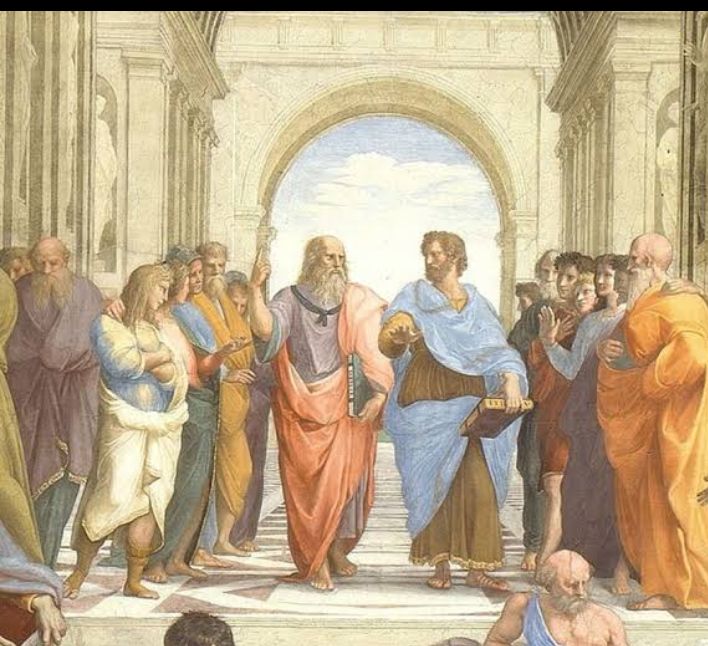
Plato tried to protect the soul of the teacher by giving it form. He elevated the questions into structures, turned dialogue into philosophy, and sought to preserve moral gravity in a world that had already lost it. Aristotle went further—organizing, categorizing, systematizing—extracting tools that would shape science, logic, and governance for centuries. Others followed, each carrying something real, and each introducing something human.
This too is part of the pattern.
When the source is pure, what follows is abundant—but not uniform. Some students safeguard the light. Others bend it. Some refine. Others dilute. Some build paths. Others turn paths into instruments of power. None of this negates the source. It confirms it.
Saints do not control what comes after them. They are not sent to manage legacy. They are sent to ignite conscience. What others do with that fire is the test of history.
The Divine does not explain itself by preserving perfection. It reveals itself through patterns.
A man appears without title.
He lives in restraint.
He speaks without certainty.
He dies without compromise.
An ocean follows him.
That is not coincidence. It is recognition.
Socrates was not meant to be the system. He was meant to be the standard against which systems are judged. His students did what students always do: they tried—some faithfully, some imperfectly—to carry what they were given.
And the world is still answering that gift.
The Aftermath: The Students and the Irreversibility of the Gift
When a saint departs, the work does not end.
It changes form.
Socrates did not leave behind a school, a doctrine, or a protected lineage. He left behind people who had been touched by a gift they did not fully understand at the time. That gift was not information. It was orientation. A reordering of the intellect toward humility, toward virtue, toward the refusal to lie for advantage.
Once such a gift is received, it cannot be undone.
This is one of the quiet laws of Divine action:
when the source closes, the light does not vanish—it diffuses.
The students were not equal. They could not be. They were human, conditioned by ambition, fear, talent, and limitation. Some preserved the spirit with care. Some translated it imperfectly. Some extracted power and lost restraint. Some mixed truth with excess. This is not failure. This is the cost of transmission after presence is gone.
Divine justice does not require uniform outcomes.
It requires irreversible progress.
And progress was irreversible.
After Socrates, it was no longer possible to speak confidently without expecting to be questioned. It was no longer respectable to claim wisdom without moral examination. The intellect had been permanently wounded—in the best sense—by humility.
Among the students, Plato stands as the one who carried the burden most carefully. He understood that the danger was not ignorance, but corruption of the soul. He tried to preserve not merely Socrates’ questions, but his gravity. He elevated dialogue, protected moral seriousness, and refused to turn wisdom into technique alone. He did not succeed perfectly—but perfection was never the requirement.
What mattered was fidelity of intent.
Others would follow different paths. Some would systematize. Some would secularize. Some would build tools that outgrew their ethical foundations. This, too, is part of the pattern. Once the Divine correction has occurred, history is no longer judged by purity, but by direction.
The correction had already landed.
Socrates did not need every student to succeed.
He needed the threshold to be crossed.
From that point forward, the intellect could no longer pretend innocence. Virtue could no longer be separated entirely from reason. Character could no longer be dismissed as secondary to cleverness.
The work of the Divine was done.
What followed—Plato, Aristotle, and all the others—belongs to the human chapter: effort, synthesis, error, brilliance, distortion. But none of them erase the source. None of them undo the gift. They are all downstream of a moment when a man refused to lie, even to save his life.
That is where this account ends.
And that is where the next one begins.
We move now to the students—not to judge them as saints or failures, but to understand how human beings carry Divine gifts once the source is gone, and what justice looks like when light must travel without its origin.
The pattern continues.
.