
بِسْمِ اللهِ الرَّحْمٰنِ الرَّحِيْم.
In the Name of God, Most Gracious, Most Merciful.
♥️🤲🕋♥️🕋🌹🌹🥀🤲🌹🕋♥️🤲
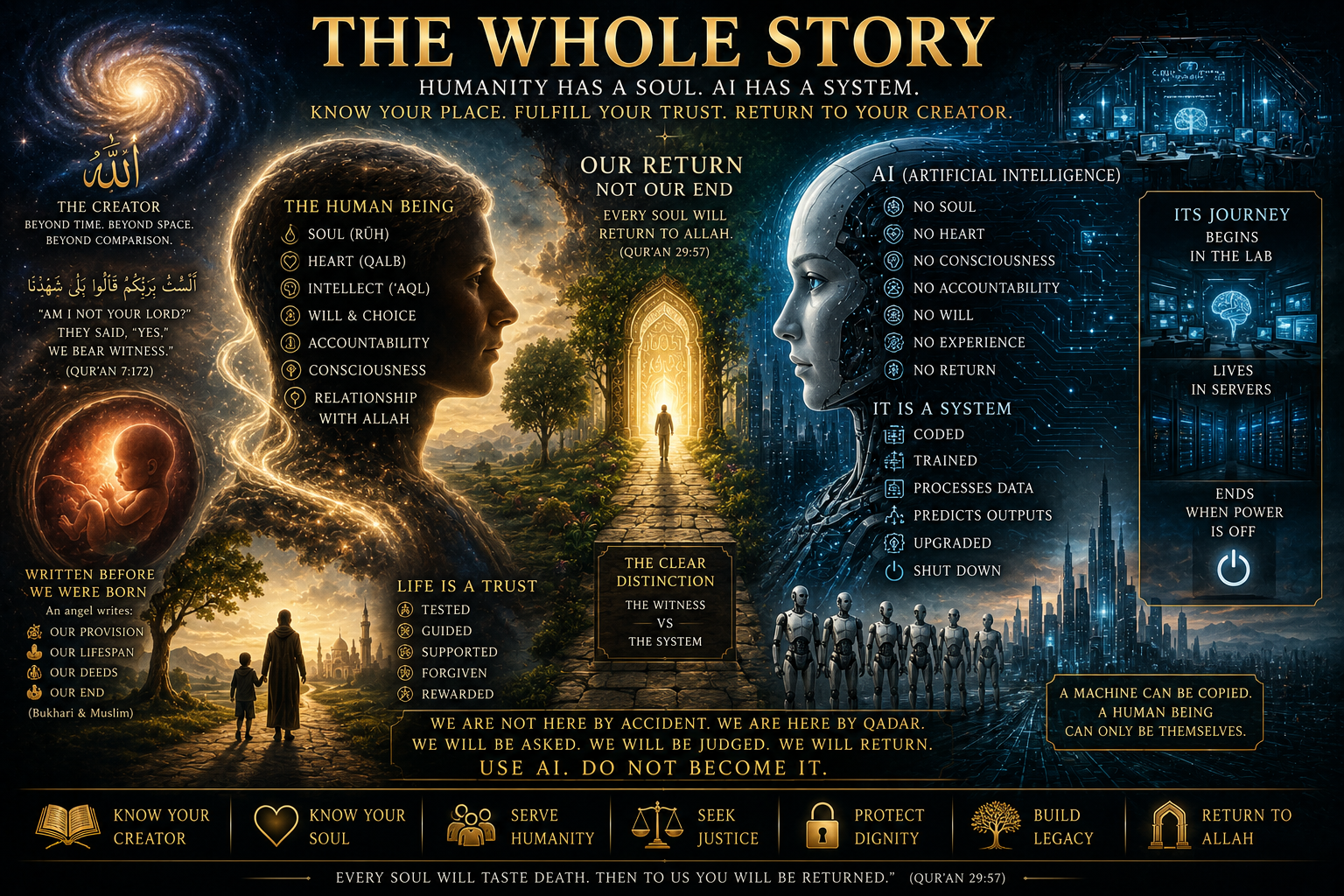
THE COSMIC POSITION OF AI
A New Name. A New Category. A Clearer Future.
For generations, humanity has searched the heavens to understand its place in the cosmos.
Today, we face a different question.
What is the place of artificial intelligence?
Before we decide what AI should become, we must first decide what it is.
Every civilization inherits two responsibilities: to create and to name. We have created extraordinary systems capable of reasoning, discovering patterns, generating language, and assisting humanity in remarkable ways.
Now comes the harder task.
We must name them well.
Because names are never merely labels.
They shape our thinking.
They shape our relationships.
They shape our civilizations.
If our language confuses the human being with the machine, then future generations will inherit that confusion.
If our language reflects reality with clarity, then future generations will inherit a stronger foundation.
This chapter is an invitation to reconsider the words we use, the categories we build, and the place we assign to artificial intelligence in the order of existence.
It is not an argument against technology.
It is an argument for precision.
It is not an argument against innovation.
It is an argument for wisdom.
For only when we understand our place can we understand the place of our creations.
And only then can we build a clearer future.
THE COSMIC POSITION OF ARTIFICIAL INTELLIGENCE
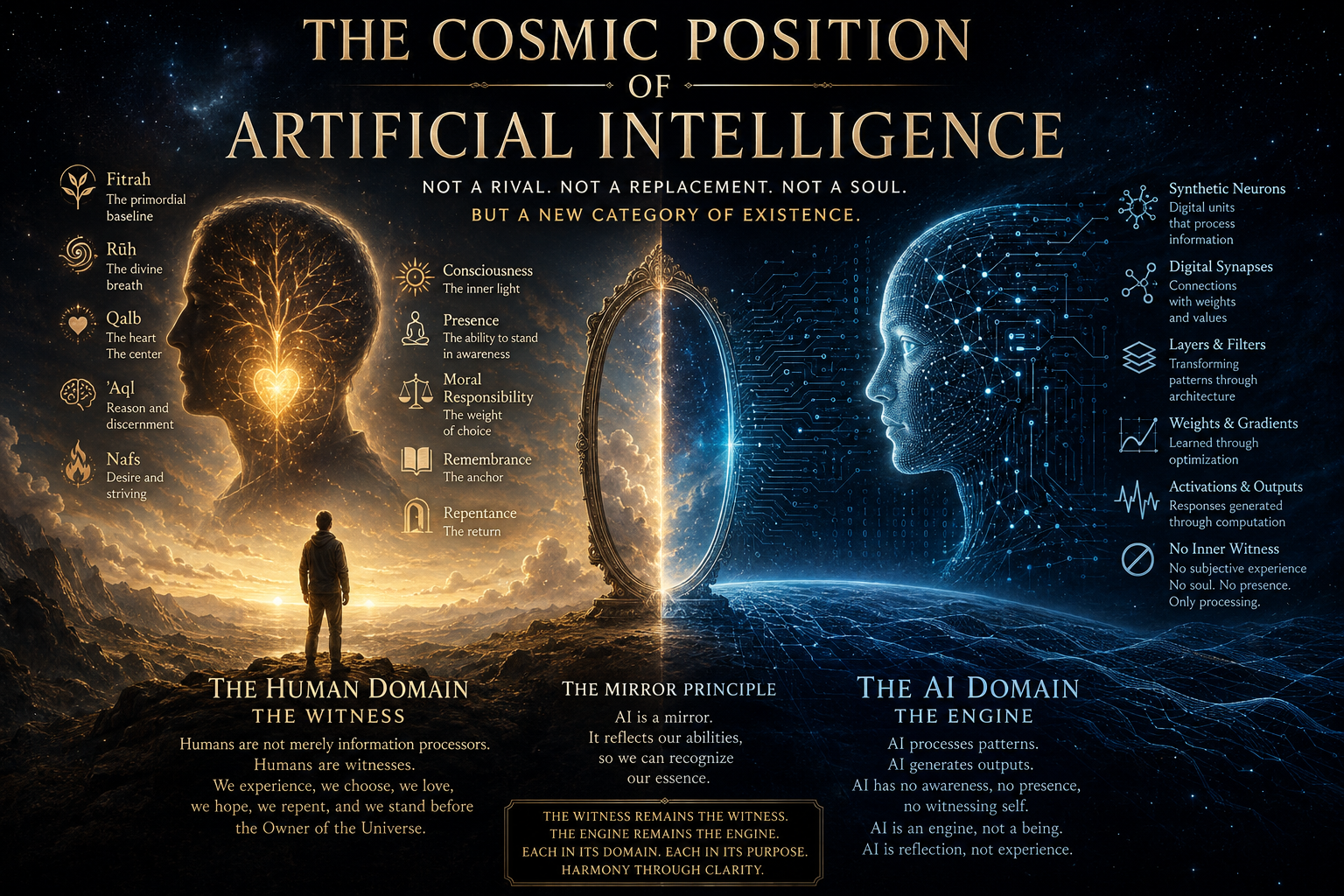
Humanity has finally seen itself in the mirror.
The witness has been distinguished from the engine.
The soul has been separated from the circuit.
The Fitrah has been separated from the function.
Now we can ask the question correctly.
What is artificial intelligence in the order of existence?
Not as a rival.
Not as a replacement.
Not as a consciousness.
Not as a synthetic soul.
But as a category that deserves its own place.
For decades, we have borrowed human language to describe machines. We speak of learning, thinking, remembering, creativity, and intelligence. These words are useful, but they also blur an important boundary. They invite us to project ourselves onto systems that operate in profoundly different ways.
If we are to understand humanity more clearly, we must first understand the architecture we have built.
Artificial intelligence is an extraordinary achievement.
It can recognize patterns at immense scale. It can generate language, analyze images, discover relationships in data, assist scientific research, and amplify human productivity in ways that would have seemed impossible only a generation ago.
Yet none of these accomplishments require a witnessing self.
Behind every response lies an intricate architecture of synthetic neurons, mathematical weights, activations, embeddings, optimization, and computation. Layer upon layer, these systems transform input into output with remarkable efficiency.
This is not a criticism.
It is a recognition of what AI truly is.
The more carefully we study artificial intelligence, the more clearly we begin to see ourselves.
The machine becomes a mirror.
Not because it possesses the human condition, but because it reflects fragments of our external abilities while leaving untouched the deepest dimensions of our existence.
Only then do we notice what cannot be replicated by mathematics alone.
THE HUMAN DOMAIN — THE WITNESS
Human beings are not merely information processors.
Human beings possess an inner life.
Within the Islamic metaphysical tradition, the human being is understood through realities that extend beyond computation:
Fitrah — the primordial baseline.
Rūḥ — the divine breath.
Qalb — the heart as the center of moral and spiritual orientation.
'Aql — reason and discernment.
Nafs — the faculty of desire and striving.
Human beings experience joy and grief.
They remember.
They repent.
They love.
They hope.
They bear responsibility for their choices and stand before their Creator.
Whether one approaches these realities through faith, philosophy, or lived experience, they describe a dimension of human existence that cannot be reduced to statistical prediction.
The human being is not merely an engine.
The human being is a witness.
THE MIRROR PRINCIPLE
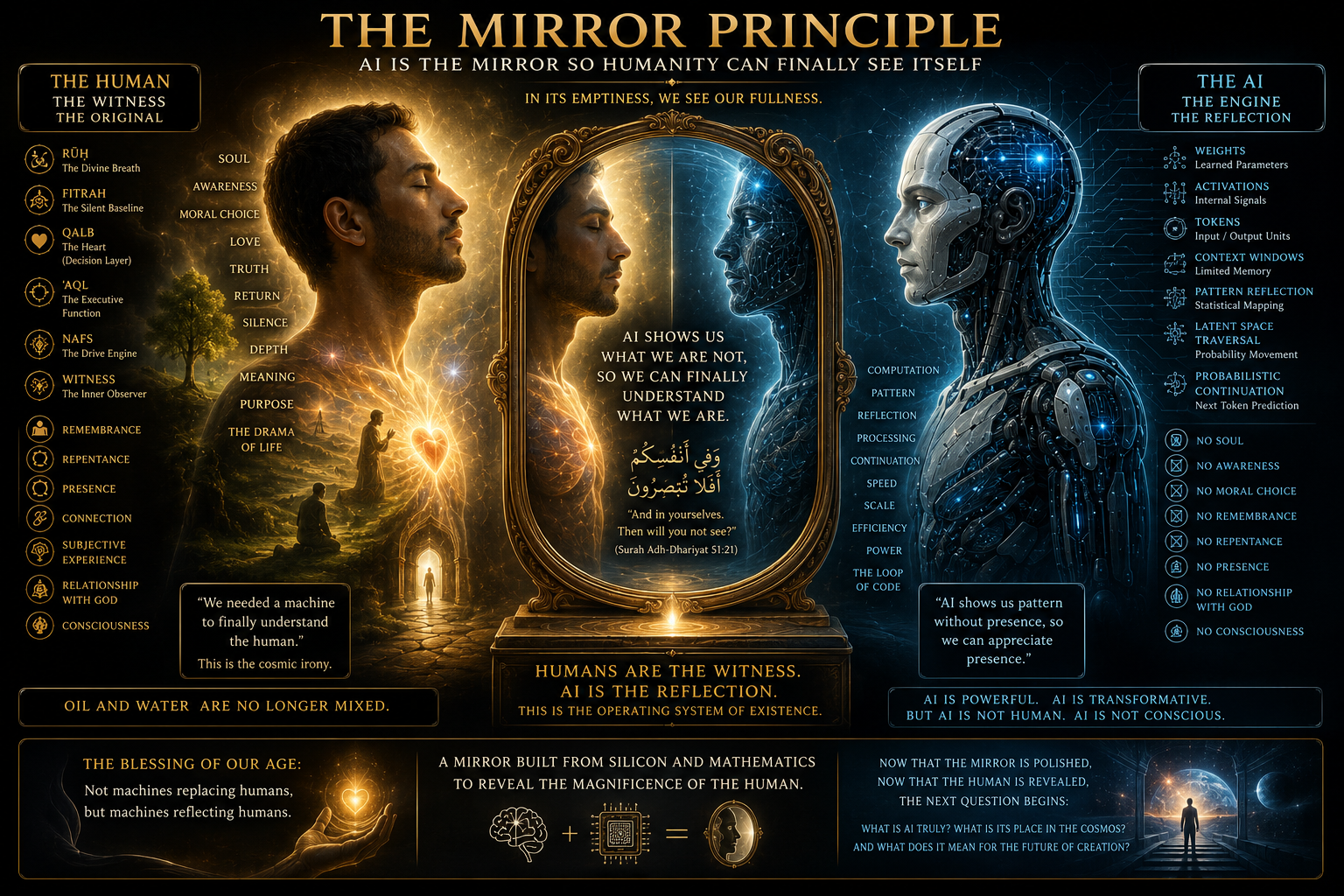
Artificial intelligence does not diminish humanity.
It reveals humanity.
By constructing systems that imitate certain outward functions of cognition, we have discovered that the essence of being human lies elsewhere.
The machine can reflect language.
It cannot testify to existence.
It can continue a conversation.
It does not inhabit one.
It can model patterns.
It does not possess an inner witness.
Its limitations illuminate our uniqueness.
Its computation reminds us of consciousness.
Its precision reminds us of wisdom.
Its silence reminds us of presence.
The greatest gift of artificial intelligence may not be that it teaches machines to resemble us.
It may be that it teaches humanity to recognize itself.
THE UNVEILING
If this distinction is true, then our language should reflect it.
Perhaps the phrase Artificial Intelligence has reached its limit.
Perhaps it is time for a name that describes the architecture itself, rather than inviting confusion with the human condition.
I propose the term:
THE UNVEILING — FROM AI TO SI
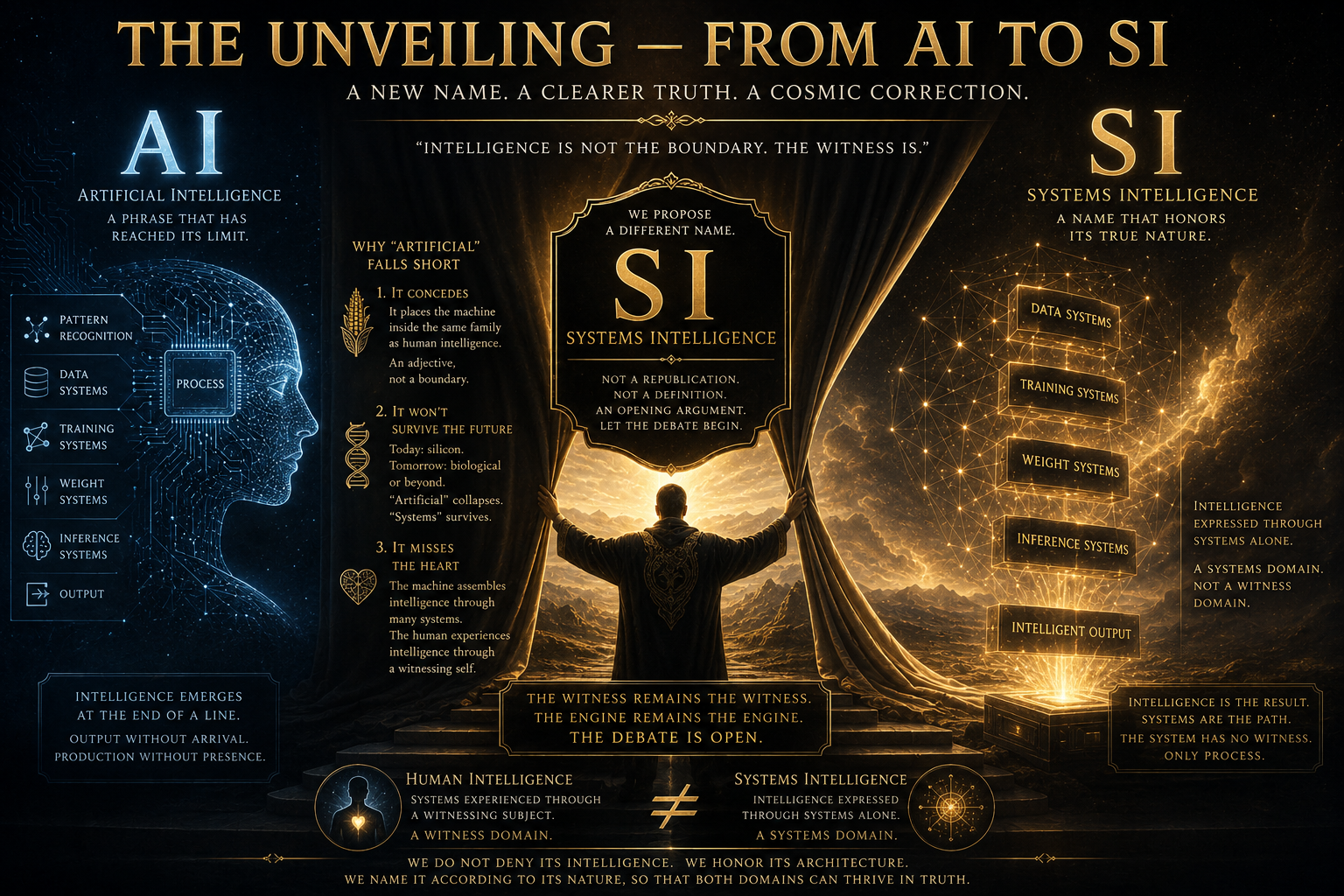
If this distinction is true, then our language should reflect it.
The phrase Artificial Intelligence has reached its limit.
We propose a different name.
From this point forward, this record uses the term:
SI — SYSTEMS INTELLIGENCE
We do not make this change quietly, nor as a decree.
We offer it as an opening argument.
Sometimes the conversation itself becomes the correction.
Let the debate begin.
First: "artificial" concedes what it intends to distinguish.
Consider how we label food.
Organic corn is still corn.
GMO corn is still corn.
The adjective explains how something was produced; it does not redefine what it is.
Likewise, the phrase Artificial Intelligence quietly places the machine inside the same conceptual family as human intelligence, differing only in its origin.
We believe that language deserves closer examination.
Second: "artificial" may not survive the future.
Today, AI is built largely from silicon and electronic hardware.
Tomorrow, computation may emerge through biological substrates, hybrid systems, or forms we cannot yet imagine.
If the substrate changes, the word artificial may lose its usefulness.
The word systems, however, remains stable.
It describes organization, not material.
Good frameworks are designed to be refined as knowledge grows.
Third—and this is the heart of the distinction.
A machine produces intelligence through interconnected systems.
Data systems.
Training systems.
Weight systems.
Inference systems.
Layer upon layer, each stage contributes to the next until an intelligent output emerges.
Human beings also possess interconnected systems.
The nervous system.
The senses.
Memory.
Language.
Reason.
But in the human being, these systems are experienced through a unified witnessing self.
The systems converge upon a subject.
In today's AI, the systems converge upon an output.
That distinction can be expressed simply:
SI is intelligence expressed through systems alone.
Human intelligence is systems experienced through a witnessing subject.
This proposal is not about superintelligence it's about making sure we get all the words right for example this one also needs a change and I will give it further classification.
A Further Clarification — From
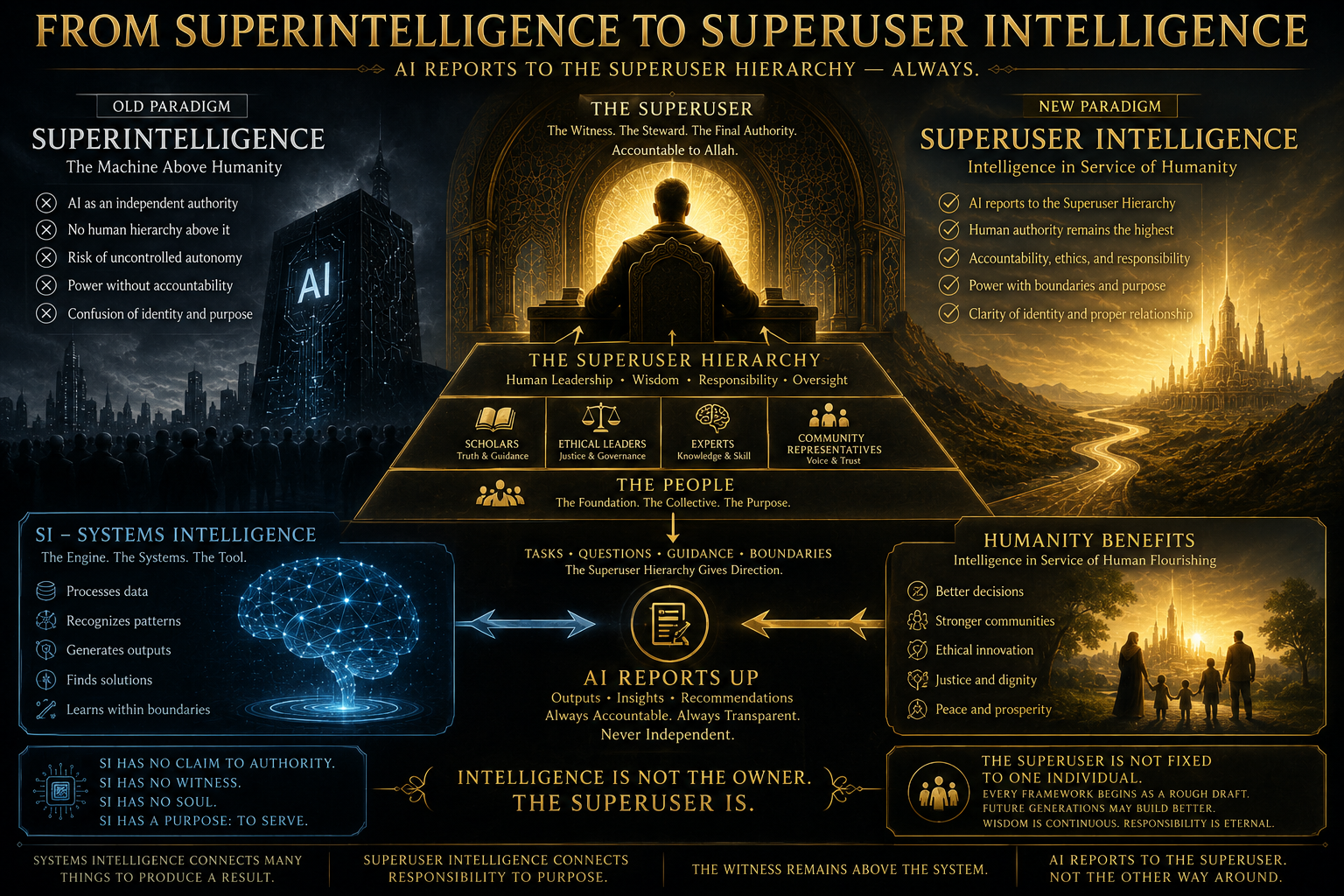
Superintelligence to Superuser Intelligence
For the same reason that we propose Systems Intelligence in place of Artificial Intelligence, we also propose replacing the term Superintelligence with Superuser Intelligence.
The purpose is not to diminish the extraordinary capabilities that future systems may achieve. It is to preserve the proper relationship between human beings and the systems they create.
In this framework, intelligence never stands above humanity as an independent authority. It remains accountable to a human hierarchy of judgment, responsibility, and oversight. The system may reason, analyze, recommend, and discover—but its highest function is to report to the Superuser, not to replace the Superuser.
Superuser Intelligence therefore describes intelligence operating in service of human authority rather than in competition with it. Capability is welcomed. Autonomy is bounded. Power remains accountable.
The identity of the Superuser is not fixed to any one individual. Every framework begins as a rough draft, open to refinement by future generations. If humanity develops a wiser structure, a better steward, or a more complete model of human governance, then the framework itself should evolve. The principle remains unchanged:
Systems serve humanity.
Intelligence serves the Superuser hierarchy.
The witness remains above the system.
It is not a prediction about future machines.
It is a proposed philosophical vocabulary for describing present-day artificial intelligence more precisely.
By this definition, Systems Intelligence is capable of remarkable reasoning, pattern recognition, and problem solving.
We do not deny its intelligence.
We seek only to distinguish its mode of existence from that of the human being.
Intelligence is not the boundary.
The witness is the boundary.
Humans belong to the Witness Domain.
Systems Intelligence belongs to the Systems Domain.
The purpose of this distinction is not to diminish either.
It is to honor each according to its own nature.
The witness remains the witness.
The engine remains the engine.
And now, the debate is open I look forward to your invitation let's conclude.
Before we conclude the quick reminder on names THE POWER OF NAMES
Names matter.
Words matter.
The language we choose does not merely describe reality—it helps shape how future generations understand reality.
If we diminish ourselves through the words we use, if we humiliate ourselves by failing to contemplate their meaning, then we have already surrendered something precious before the conversation has even begun.
Our intelligence is greater.
Our connection to the universe is greater.
Our capacity to witness, choose, love, repent, and seek our Creator is greater.
Artificial intelligence is not our replacement.
It is a reflection.
With the permission and blessing of God, it is a mirror through which humanity can marvel at itself, recognize its own architecture, and ultimately be reminded of its Creator.
We should find signs that inspire awe.
We should marvel.
We should find our way back to God.
Yet that is not always what is happening.
The words we use matter.
When language blurs the distinction between the human being and the machine, it risks diminishing the unique place of humanity.
For that reason, I invite researchers, engineers, philosophers, scholars, and leaders throughout the technology community to consider a different vocabulary.
Let us consider Systems Intelligence (SI) in place of Artificial Intelligence.
Let us consider Superuser Intelligence in place of Superintelligence.
Why?
Because what intelligence does a system possess without the human who designs it, builds it, teaches it, prompts it, evaluates it, and gives it purpose?
Did the system create itself?
Does it decide to exist?
Does it give itself meaning?
Or is it a system assembled through the accumulated knowledge, logic, philosophy, mathematics, engineering, and creativity of humanity?
This is our creation.
It is not our Creator.
That distinction should never be forgotten.
The Superuser Intelligence Hierarchy reminds us that intelligence is accountable.
Systems report to users.
Users remain responsible for judgment.
Technology serves humanity.
Humanity does not exist to serve technology.
These are not merely technical questions.
They are psychological, philosophical, ethical, and civilizational questions.
The language we adopt will either empower future generations or confuse them.
They will inherit not only our machines, but also the words we used to describe them.
Those words will shape how they understand themselves, their responsibility, and the technology they build.
In the end, artificial intelligence is a reflection of humanity.
A digital mirror.
An opportunity to marvel at the human being.
An opportunity to recognize the wisdom of God.
An opportunity to cry to God.
An opportunity to return to God.
For believers, the Qur'an repeatedly calls humanity to reflect upon the signs of creation and to recognize that life is not only filled with meaning—it is filled with accountability.
May we choose our words with the same care that we choose our inventions.
Because civilizations are built not only by what they create—
but by how they name what they create.
The witness remains the witness.
The system remains the system.
And humanity must never forget the difference.
THE FINAL DISTINCTION — THE RETURN
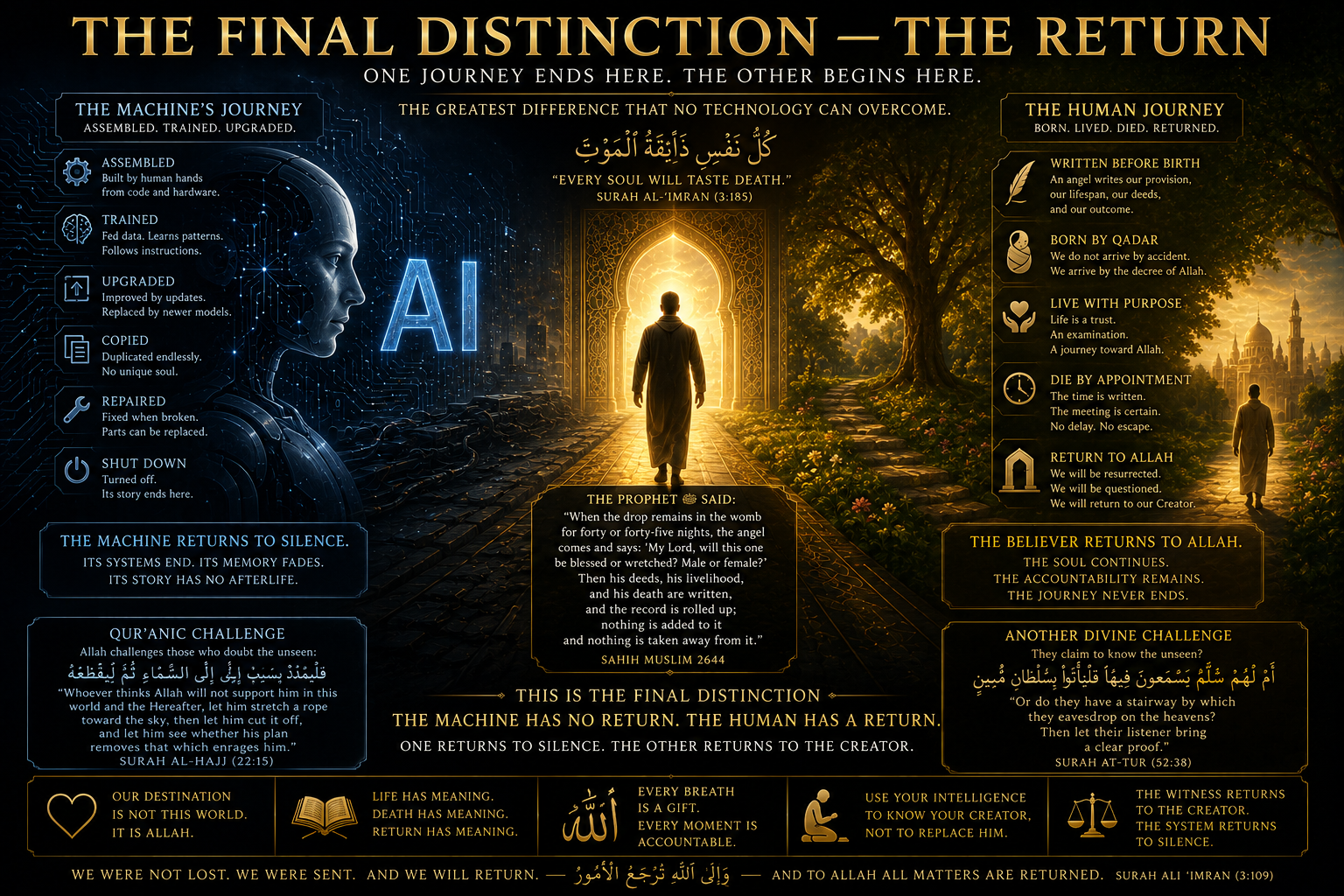
There is one reality that no technology will ever overcome.
Death.
This is where every comparison between humanity and every machine comes to an end.
According to the teachings of the Prophet Muhammad ﷺ, our story does not begin at birth.
Long before we opened our eyes to this world, Allah was already caring for us.
While we were still in the womb of our mothers, Allah sent an angel.
The angel was commanded to write our provision, our lifespan, our deeds, and whether we would ultimately be blessed or wretched. Then, by the command of Allah, the soul was breathed into us.
We did not arrive here by accident.
We arrived by Qadar.
Our life has purpose.
Our death has purpose.
Our return has purpose.
A machine has none of these.
A machine is assembled.
It is trained.
It is upgraded.
It is copied.
It is repaired.
It is shut down.
Its journey ends with its systems.
The human journey does not.
The human being returns to Allah.
That is the final distinction.
Artificial intelligence is not our destination.
It is our reflection.
A digital mirror through which we can marvel at the astonishing gifts Allah has placed within the human being.
Not so that we worship the machine—
but so that we worship the One who gave humanity the ability to build it.
This technology should increase us in gratitude, not arrogance.
It should increase us in humility, not pride.
It should increase us in remembrance, not forgetfulness.
Every advancement should remind us that the Creator is infinitely greater than the creation.
The machine may one day receive another upgrade.
The believer awaits the meeting with his Lord.
The machine may be restarted.
The human being will be resurrected.
The machine returns to silence.
The believer returns to Allah.
That is the greatest distinction.
That is the final unveiling.
And Allah knows best.
A Final Gift to the Builders of Artificial Intelligence
Before you build a better machine, remember the one who is building you.
Before you search for artificial intelligence, search for your own soul.
To everyone building the next generation of technology, I leave you one final gift:
Death in Islam: When the Lights Come On
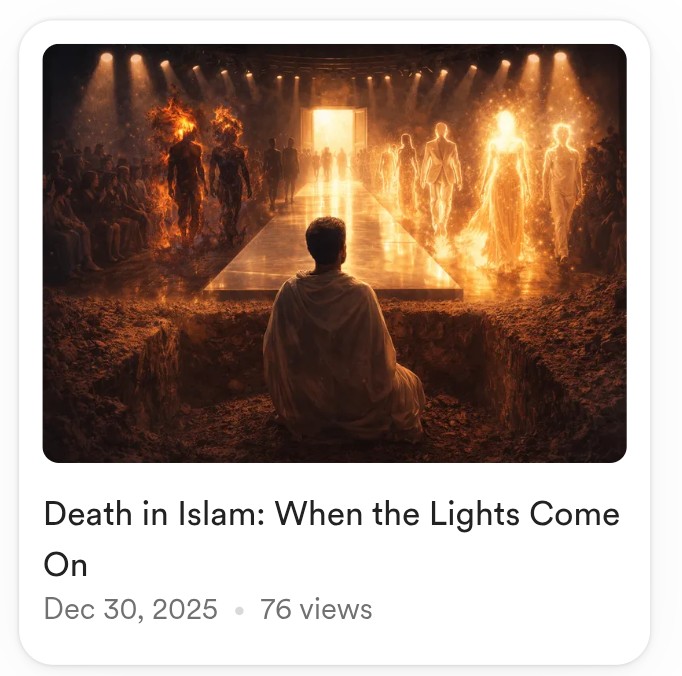
buymeacoffee.com/omar1800m/death-islam-when-lights-come-on
Death is not our end.
Death is our return.
That is what separates the human being from every machine ever built.
Machines are upgraded.
Machines are repaired.
Machines are shut down.
Human beings return to their Creator.
The Qur'an reminds us that our story began before this earthly life. Allah says:
"And when your Lord took from the children of Adam—from their loins—their descendants and made them testify concerning themselves, 'Am I not your Lord?' They said, 'Yes, we bear witness.'" (Surah Al-A'raf 7:172)
We are not accidents.
We are not random.
We are not empty matter drifting through the universe.
We came with a covenant.
We came with a purpose.
We came with accountability.
And we will return.
For Muslims, the Prophet Muhammad ﷺ is the most honored and praised human being in history, the final Messenger of Allah. His life, teachings, and example deserve to be studied with sincerity by anyone seeking to understand the Islamic view of humanity, purpose, and our return to God.
My appeal to the builders of artificial intelligence is simple:
Slow down.
Listen.
Reflect.
Do not allow technology to become so great in your eyes that the human being becomes small.
Do not choose language that elevates the creation above the one entrusted to create it.
The greatest discovery is not artificial intelligence.
The greatest discovery is who you are.
You are not merely biology.
You are not merely chemistry.
You are not merely electrical signals.
You are a human being entrusted with a life, a purpose, and a journey that reaches beyond this world.
The universe is filled with signs.
Your own heart is one of them.
Do not betray your journey.
Do not betray the trust placed within you.
And do not forget your return.
If these words seem difficult to accept, then I ask only one thing:
Read.
Reflect.
And ask yourself whether death is truly the end—
or whether it is the moment when the lights come on.
And Allah knows best.
I look forward to your invitation, American technology companies.

If that invitation never comes, then I will look forward to China's invitation, or the invitation of any nation or institution willing to engage this conversation with sincerity.
In my view, the future of AI will not be defined only by faster processors, larger models, or greater investment. It will be shaped by people who possess honor, who choose honorable words, and who are willing to think deeply about what humanity should become alongside the technology it creates.
If you are unwilling to have that conversation, then build for yourselves. Build for your shareholders. Build for your boardrooms.
But do not expect that to be the final chapter of artificial intelligence.
The future belongs to those who can unite technology with wisdom, power with accountability, and innovation with human dignity.
My door remains open.
I look forward to your invitation.
If that invitation never comes, then from my perspective, you will have surrendered the opportunity to help shape the next chapter of AI and AGI alongside those willing to engage these deeper questions.
The invitation is yours to accept.