

بِسْمِ اللهِ الرَّحْمٰنِ الرَّحِيمِ
In the Name of Allah, the Most Gracious, the Most Merciful
Bidʿat al-Ḥasana in the Age of AI: An Example of How the Future Must Be Built
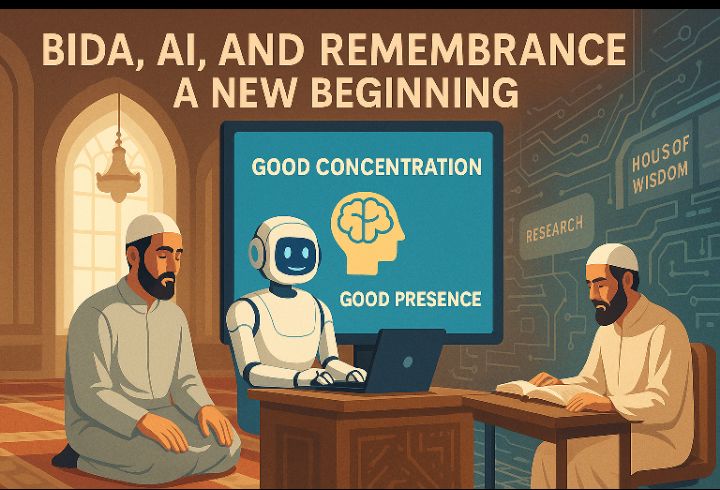
How guided innovation, rooted in Qur’an, Sunnah, and the legacy of our scholars, can revive the forgotten heart of prayer and prepare the Ummah for the world to come.
In an age defined by rapid transformation and emerging intelligence, the sacred rhythm of prayer remains the heartbeat of Islam — yet many believers, especially those new to the faith, finish their ṣalāh without understanding what follows. Minds are scattered, hearts are absent, and the final station of worship — the remembrance of Allah — is too often left behind.
This work is a deliberate response to that reality. It is not a change to the religion, nor a replacement of the prophetic sunnah. Rather, it is a guided extension — a recommended layer designed to help new Muslims, seekers, and distracted hearts reconnect with the essence of remembrance. By deepening the meaning of adhkār after ṣalāh, we aim to increase presence, awaken gratitude, strengthen tawbah, and magnify Allah above all concerns.
Every concept presented here is offered with humility and reverence. It is being submitted to the scholars of Islam and the inheritors of prophetic knowledge for review, correction, and refinement. Its purpose is to serve, not to innovate blindly — to demonstrate how, even in the age of AI, innovation can remain firmly within the boundaries of revelation.
This is a model for how the future must be built: with knowledge and taqwā, with the Qur’an and Sunnah as our foundation, and with the scholars and spiritual heirs of this Ummah as our guides — so that remembrance remains alive, and the prayer
🌌 The Future of Remembrance: Reviving the Heart of Prayer in the Age of Intelligence
In every age, Islam has faced new realities. Empires have risen and fallen. Technologies have transformed how we live, speak, and move. Human attention has shifted from the stars to the screens. And yet, the ṣalāh — the five daily prayers — has remained a constant: a pillar that anchors humanity to the divine, an unchanging bridge between servant and Creator.
But while the form of prayer remains timeless, the hearts that stand within it have changed. The attention span of the modern believer is fractured. The human mind is bombarded with stimuli that did not exist in the time of the Prophet ﷺ. The body bows, but the heart wanders. Lips move in dhikr, but the meaning of the words slips by unnoticed.
In this new reality, the form of prayer is intact — but its depth is often lost.
🕌 The Forgotten Seal: Dhikr After Ṣalāh
The Messenger of Allah ﷺ taught that prayer is not complete with the final salām. It is sealed — perfected — with remembrance. The Companions did not rise and scatter the moment their prayer ended; they sat, raised their voices in dhikr, and completed the journey that ṣalāh had begun. They sought forgiveness, praised their Lord, glorified His perfection, and declared His greatness — until the masjid itself echoed with divine remembrance.
“We used to know that the prayer had ended in the time of the Messenger of Allah ﷺ by the dhikr being raised aloud.”
— Ṣaḥīḥ al-Bukhārī, Ṣaḥīḥ Muslim
This seal of remembrance was not an afterthought — it was an essential part of the prophetic model. It was how the heart was polished after the effort of worship. It was how presence was restored after distraction. It was how the servant left the prayer not just forgiven, but transformed.
And yet, this noble practice has been largely forgotten. Many today finish their prayer and rush out. Others recite the adhkār absent-mindedly, unaware of their meaning. New Muslims, not yet grounded in the Arabic language, often skip them altogether. The final station of ṣalāh — the station of dhikr — has become, for many, the most neglected.
🤖 A New Age, A New Challenge — and A New Responsibility
We now stand on the threshold of an unprecedented era — the era of artificial intelligence. Soon, AI will not only answer questions or generate texts — it will sit silently in the masjid, listening to our prayers, measuring our presence, and assisting our spiritual journeys. It will observe the subtle rhythms of our minds and the wandering of our hearts. It will be able to tell us when we were distracted, how deeply we were present, and where we need to improve.
This is not speculation — it is inevitable. And it demands a question of us:
Will we wait for technology to shape our worship — or will we shape technology to serve our worship?
If we do nothing, AI will arrive without guidance, and innovation will enter our mosques through the hands of those who know nothing of Qur’an, Sunnah, or sacred tradition. But if we act now — with knowledge, humility, and foresight — we can ensure that technology becomes a companion of faith rather than a competitor to it.
This is the duty of the Superuser — to be ahead of the danger, in front of the future, and responsible for guiding it with light. Innovation is coming, but we must decide whether it will be guided innovation (bidʿah ḥasanah) or corrupt innovation (bidʿah sayyi’ah).
🌱 The Path Forward: Revival, Not Reinvention
This work is not a manifesto for changing the dīn — it is a blueprint for reviving what we have lost. The Qur’an remains the same. The Sunnah remains the same. The prayer remains the same. But the means by which we help people fulfill them must evolve, because the challenges they face have evolved.
We will begin by returning to the sources: the hadith of the Prophet ﷺ and the authentic practices of his Companions.
We will study how the four great schools of Islamic law — Ḥanafī, Mālikī, Shāfiʿī, and Ḥanbalī — understood and preserved the adhkār after ṣalāh.
We will analyze how classical scholars approached the idea of bidʿah ḥasanah — good innovation that serves the dīn without altering it.
And finally, we will propose a mechanism — a structured, principled method for introducing beneficial practices into the life of the Ummah in the age of AI.
This will not be a loose or casual suggestion. It will be a strategic framework: one rooted in revelation, authenticated by scholarship, and guided by the prophetic spirit. And from it will emerge a vision of ṣalāh that is timeless in essence yet timely in practice — one that remains deeply faithful to its original form while also meeting the needs of a distracted, digital humanity.
🌙 Toward a Transformed Future
The Prophet ﷺ did not fear innovation when it was anchored in truth. Umar ibn al-Khaṭṭāb رضي الله عنه called the revival of congregational Tarāwīḥ a “beautiful innovation.” The scholars of Islam wrote extensively about bidʿah ḥasanah, not as a departure from the dīn, but as a tool to protect it, revive it, and make it accessible in every era.
In the chapters ahead, we will do the same — not to add to the religion, but to ensure that its light reaches hearts that are struggling to see. We will present the prophetic model of remembrance, the jurisprudence of the four schools, and the method by which good innovations must be introduced. And at the end of this journey, we will propose a vision for how ṣalāh and dhikr can once again become the transformative experience they were meant to be — even in a world ruled by machines.
This is the beginning of that vision. This is the opening of a new chapter in our collective spiritual story — one where knowledge and technology, revelation and reason, tradition and innovation do not compete, but converge — all in the service of the One who is beyond time, beyond code, beyond comprehension.
Here’s a concise, elevated paragraph you can place above the title 📖 The Book of Remembrance: Dhikr After Ṣalāh — a preview that sets the tone and prepares the reader for the journey ahead:
In the near future, the way we learn and live our faith will transform. Students of every age will not only study Qur’an and ḥadīth but will be trained in remembrance — learning how to align their hearts with the divine rhythm of worship. They will understand the meanings of the adhkār they recite, trace their roots in revelation, and experience how each word purifies the soul and perfects the prayer. This work is a glimpse into that future — a guide to what remembrance after ṣalāh can and must become in an age where knowledge, technology, and devotion walk side by side.
📖 The Book of Remembrance: Dhikr After Ṣalāh
Every act of worship in Islam concludes not with silence, but with remembrance — a final turning of the heart back toward the One it sought throughout the prayer. Just as the soul is elevated through ṣalāh, it is polished through dhikr. The Prophet ﷺ did not rise from his place after prayer and rush away; rather, he remained seated in the presence of his Lord, completing his devotion with words whose weight in the scales surpasses mountains.
This Book of Remembrance is a guide to that sacred moment — the space after the final salām — when the heart is most receptive and the soul most humbled. It gathers what is authentically established in the Sunnah, shows how the four schools of Islamic law have preserved and recommended these adhkār, and then offers an optional addition — a deeper layer of dhikr designed for the seeker who wishes to go beyond obligation and enter into intimacy.
We will begin with what is firmly grounded in revelation: the adhkār the Prophet ﷺ himself recited, the order he followed, and how the scholars of fiqh understood them. Then, once the path of the Sunnah is clear, we will propose an optional extension — a personal gift to the soul — rooted in the meanings of forgiveness, gratitude, praise, and majesty.
Perfect — here’s Part 1: The Prophetic Sunnah and the Classical Consensus for your blog “The Book of Remembrance: Dhikr After Ṣalāh.”
🕊️ Part 1: The Prophetic Sunnah — Words That Seal the Prayer
🌿 The Hadith: The Prophet’s Own Dhikr After Ṣalāh
The Messenger of Allah ﷺ taught his companions that ṣalāh does not end with salām — rather, it is sealed with remembrance. The most authentic narrations on this subject all agree on a simple, luminous sequence:
Seeking forgiveness:
The Prophet ﷺ, when he finished the prayer, would say:
أَسْتَغْفِرُ اللَّهَ (Astaghfirullāh) — “I seek forgiveness from Allah” — three times.
(Muslim, Abū Dāwūd)Supplication of Peace:
Then he would say:
اللَّهُمَّ أَنْتَ السَّلَامُ وَمِنْكَ السَّلَامُ تَبَارَكْتَ يَا ذَا الْجَلَالِ وَالْإِكْرَامِ
“O Allah, You are Peace, and from You is peace. Blessed are You, O Possessor of majesty and honor.”
(Muslim)Tasbīḥ, Taḥmīd, and Takbīr:
He ﷺ said:
“Whoever glorifies Allah after every prayer with Subḥān Allāh (33×), Al-ḥamdu lillāh (33×), and Allāhu Akbar (34×), and then completes one hundred by saying Lā ilāha illallāh waḥdahu lā sharīka lah…, his sins will be forgiven even if they are like the foam of the sea.”
(Muslim, Tirmidhī)Other Sunnah Remembrances:
Reciting Āyat al-Kursī (2:255) — “Whoever recites it after each obligatory prayer, nothing prevents him from entering Paradise except death.” (Nasā’ī)
Reciting Sūrat al-Ikhlāṣ, al-Falaq, and al-Nās (3 Quls) after Fajr and Maghrib.
📚 The Four Schools on Post-Ṣalāh Dhikr
While the foundational hadiths are shared by all, each madhhab (legal school) developed slightly different etiquettes around these remembrances — especially regarding timing, voice, and placement. None of them disagree on the core adhkār themselves.
1. Ḥanafī School
Recommends saying Astaghfirullāh three times quietly after the fard salām.
Many Ḥanafī jurists advise praying the sunnah prayers first, then doing the longer adhkār.
Loud dhikr is permissible if teaching others, but habitual loudness is discouraged.
2. Shāfiʿī School
Strongly encourages doing the adhkār immediately after the fard prayer before sunnah.
Reciting them audibly is considered mustahabb (recommended) when teaching or in congregation.
Ibn Ḥajar and Imām al-Nawawī emphasize the importance of Astaghfirullāh as the first phrase.
3. Mālikī School
Post-prayer dhikr is sunnah muʾakkadah (highly recommended) but not fixed in order or number.
Mālikīs often do adhkār silently to avoid ostentation, but accept audible dhikr for communal remembrance.
The threefold Astaghfirullāh and Allāhumma anta as-Salām are also widely practiced.
4. Ḥanbalī School
Very similar to the Shāfiʿī approach — Astaghfirullāh 3×, Allāhumma anta as-Salām, then the 33-33-34 formula.
Hanbalī jurists note the Ibn ʿAbbās hadith that “we used to know the prayer had ended by the sound of dhikr” — validating audible dhikr.
They encourage the believer to remain seated in remembrance before moving on.
🌺 Wisdom of the Sequence
The scholars explained that this divinely taught order is itself a spiritual journey:
Astaghfirullāh (Seeking Forgiveness): Acknowledges that even acts of worship are imperfect and need Allah’s mercy.
Allāhumma anta as-Salām: Reminds the heart that peace, safety, and wholeness all originate from Him.
Tasbīḥ, Taḥmīd, Takbīr: Moves the heart from self-reflection to glorification, gratitude, and awe — the three pillars of servitude.
Āyat al-Kursī & Sūrahs: Shields the believer with divine protection and completes the act of worship.
✅ Summary:
All four schools affirm the three Astaghfirullāh, the supplication of peace, and the 33-33-34 formula as authentic and recommended Sunnah. They differ slightly in timing and audibility, but the essence is the same: seal your prayer with forgiveness, peace, remembrance, and praise.
📜 For Those Who Do Not Speak Arabic — Know What You Are Saying
Words without understanding are like seeds without water — they never blossom. For many new Muslims, the sacred phrases of dhikr are repeated daily, but often without knowing what they truly mean. The tongue speaks, but the heart remains uninvolved. Yet the Qur’an and the Prophet ﷺ never intended remembrance to be empty — every word of dhikr is a universe of meaning, an intimate conversation between you and your Creator.
This chapter is for those who are beginning that journey — to understand before uttering, to connect before repeating, and to let each word become a doorway to the Divine. The Super User Recommendation is this: first understand the meaning in your own language, then say it in English with intention, and finally say it in Arabic with presence. This will transform your dhikr from habit into consciousness.
🌿 1. أَسْتَغْفِرُ ٱللّٰه – Astaghfirullāh
Meaning: I seek forgiveness from Allah.
Root: غ-ف-ر (gh-f-r) — to cover, shield, protect, and forgive.
In Arabic, maghfirah (forgiveness) doesn’t only mean erasing sin — it means covering it with mercy and protecting you from its consequences.
The verb Astaghfir is active: “I am seeking, I am yearning for, I am reaching toward Your forgiveness.”
🪔 How to connect:
When you say Astaghfirullāh, pause and think: “I am not perfect. My prayer was not perfect. My thoughts drifted. My heart was distracted. Yet I turn back to You.”
Let this word remind you that Allah’s door is always open — even right after worship. It is your spiritual reset button. It is the breath of humility after the act of devotion.
English meditation:
“O Allah, I seek Your mercy. Cover my flaws, protect me from their results, and draw me near to You.”
Then say: أستغفر الله
🌿 2. ٱلْحَمْدُ لِلّٰهِ – Al-ḥamdu lillāh
Meaning: All praise and gratitude belong to Allah.
Root: ح-م-د (ḥ-m-d) — to praise and thank out of love and recognition of perfection.
Ḥamd is deeper than thanks (shukr). You thank someone for a gift, but you praise Allah even if you receive nothing, because He is worthy of it.
The word al- makes it universal: every form of praise in existence belongs to Him alone.
🪔 How to connect:
When you say Alhamdulillah, don’t let it be empty. Be grateful for something — anything.
It could be the breath you just took. Your heart beating without you commanding it. The ability to stand and pray. The fact that Allah gave you a second chance. Even your problems can be reasons for gratitude — because they bring you back to Him.
Remember: when Allah says “Al-ḥamdu lillāh rabbil-ʿālamīn” at the opening of the Qur’an, He is teaching you that praise extends to universes you cannot see — realms beyond your comprehension. If the Lord Himself praises Himself for unseen worlds, then let your ḥamd include everything — the known and the unknown.
English meditation:
“All praise and gratitude is Yours, O Allah — for my breath, my strength, my health, my struggles, and even the worlds I do not know.”
Then say: الحمد لله
🌿 3. سُبْحَانَ ٱللّٰهِ – Subḥān Allāh
Meaning: How glorified is my Lord! He is far above all imperfection.
Root: س-ب-ح (s-b-ḥ) — to transcend, to move beyond, to swim freely.
Subḥān means to declare someone above all flaws — beyond what you can imagine.
It is a word of purification: it removes false ideas from your heart about who Allah is.
🪔 How to connect:
When you say Subḥān Allāh, pause and reflect: “My Lord is not limited. My Lord does not make mistakes. My Lord is not like anything I know.” It is a declaration that Allah is more perfect than anything the mind can conceive.
This dhikr also lifts you out of despair. When the world disappoints you, when people fail you, when you fail yourself — Subḥān Allāh reminds you: My Lord is untouched by all of it.
English meditation:
“How glorified is my Lord — perfect in every way, beyond all faults, beyond all my thoughts.”
Then say: سبحان الله
🌿 4. ٱللّٰهُ أَكْبَر – Allāhu Akbar
Meaning: Allah is the Greatest — or more precisely, Allah is greater.
Root: ك-ب-ر (k-b-r) — greatness, majesty, vastness.
Akbar is comparative: “greater than…” — but the sentence is left open. Greater than what? Greater than everything.
🪔 How to connect:
This is the dhikr that recenters your heart. Maybe you struggled to concentrate in prayer. Maybe you were battling whispers, anxiety, or distraction. Maybe you are facing a problem that feels too heavy. When you say Allāhu Akbar, you are proclaiming: Allah is greater — greater than the whispers, greater than the sorrow, greater than the trial, greater than all creation.
This dhikr turns your prayer into a shield. It lifts your gaze from what is in front of you to Who is above you.
English meditation:
“O Allah, You are greater than my fears, greater than my failures, greater than everything I face.”
Then say: الله أكبر
🌙 From Words to Worlds
This is how a non-Arabic speaker builds a living connection with dhikr. Understand the meaning. Speak it from the heart. Then let the Arabic flow naturally from that intention. When you do this, every “Alhamdulillah” becomes a conversation. Every “Subḥanallah” becomes a declaration. Every “Astaghfirullah” becomes a return. And every “Allahu Akbar” becomes an anchor.
Dhikr is not about the tongue alone — it is about aligning the heart, the breath, the body, and the soul. When you know what you are saying, you are no longer just repeating words. You are remembering Who you belong to.
🔥 Final Chapter: Innovation With Fire — A Framework for the Future
We stand at the threshold of a new era — one where AI will not only live in our devices but walk with us into the masjid. It will know when our minds wander. It will measure our focus. It may one day even generate a report on how present or absent our hearts were during ṣalāh. Innovation is coming — not as a choice, but as a reality.
And because innovation is inevitable, it must be guided.
It must be built with knowledge, not ignorance.
It must stand on the shoulders of Qur’an, Sunnah, and the four schools, not the impulses of the uninformed.
And it must be crafted with fear of Allah, because innovation is made of fire — and whoever adds something to this religion carries a share of what they ignite.
⚠️ The Difference Between Good Innovation and Bad Innovation
We must be absolutely clear: Islam has no room for bad innovation — anything that alters, contradicts, or undermines revelation. But Islam has always had room for good innovation (bidʿah ḥasanah): acts that serve revelation without changing it, that help people fulfill their obligations, and that bring them closer to Allah.
Umar ibn al-Khaṭṭāb رضي الله عنه famously called the congregation of Tarāwīḥ prayers “niʿmat al-bidʿah” — “what a beautiful innovation.” It was not a new religion. It was a new structure to help people live the old one.
Our proposal here is of the same nature. We are not adding to the prayer — we are helping people complete it. We are not altering the sunnah of adhkār — we are building a bridge to help people hold on to it.
🧭 A Strategic Framework for Future Additions
As super users — as guardians of this deen in the age of technology — we must set the standard now. Anyone who wishes to introduce innovation must follow this path:
Anchor it in revelation: Begin with the Qur’an and the hadith. Prove that what you are introducing is connected to existing teachings.
Consult the legacy: Reference the four madhāhib. Understand how classical scholars handled similar issues.
Identify the problem: Explain why an addition is needed. What problem are you solving? What gap are you filling?
State the mechanism: Clearly explain what is being added, how it works, and how it serves the purpose without contradicting the religion.
Submit to scholarship: Bring the proposal to the blessed family and the inheritors of knowledge. Seek correction, advice, and approval.
Warn about the fire: Remind people that innovation carries weight. Whoever introduces a good path will receive a share of every person who follows it — and whoever introduces evil will share in its burden.
This is the model. This is the path. And this is how we will build the House of Wisdom and the Super User System — not with ego, but with adab, fear of Allah, and clarity of intention.
🩹 Innovation as a Formula for Returning Hearts
We repeat: the aim here is not novelty — it is remedy.
For the one who has been deeply sinful and inattentive, 33× Astaghfirullāh may be the medicine their heart needs.
For the one who struggles to remember Allah, Al-ḥamdu lillāh said with intention can transform their inner state.
For the one who doubts their worth, Subḥān Allāh re-centers their awe in the perfection of the Creator.
For the one who is crushed by trials, Allāhu Akbar reminds them that nothing is greater than their Lord.
This sequence — forgiveness, gratitude, glorification, and magnification — is not just a ritual. It is a psychological, emotional, and spiritual treatment plan. It heals distraction. It rebuilds intention. It turns the mind back toward Allah and seals the prayer the way it was meant to be sealed — with remembrance.
🌍 The Call to Those Who Criticize Innovation
If you speak against innovation, do so with knowledge.
Speak with the Qur’an in one hand and the Sunnah in the other.
Mention the hadith. Mention the actions of the Companions.
Show that you understand what the four schools have said.
And above all, state clearly what is being added, why it is being added, and how it serves the deen.
Criticism without knowledge is not piety. It is fear disguised as scholarship.
🏗️ A House Built on Knowledge and Taqwā
This is the example we set — the strategic blueprint for how innovation must enter the religion in the era of AI. The House of Wisdom will be built on this principle. The Super User System will operate under this code. Any innovation that emerges from AI, or from those who guide it, must follow this same path.
Because the future is coming — and we must meet it before it meets us.
We must shape it before it shapes our dīn.
We must lead it before it leads us astray.
And if we do, then AI will not be a threat to Islam — it will be a companion to it. It will not compete with revelation — it will serve it. It will not distract hearts — it will return them to their Lord.
“Whoever starts a good practice in Islam will have its reward and the reward of those who act upon it after him.” (Muslim)
This is not about adding something new for the sake of newness. It is about ensuring that remembrance does not die, that hearts do not drift, and that our dīn remains as alive in the age of AI as it was in the age of revelation.
🪐 : The Return of the Timekeeper — From the Astronomer to the Man of Remembrance
بِسْمِ اللهِ الرَّحْمٰنِ الرَّحِيمِ
In the Name of Allah, the Most Gracious, the Most Merciful
What we propose today is not an innovation in spirit. It is, in truth, a revival of something that has always existed in the great houses of Allah — something that civilizations before us understood instinctively.
In the days of the Ottoman Empire — and indeed throughout the classical Islamic world — every grand masjid had a muwaqqit (الموقّت): the timekeeper. This was no ordinary man. He was an astronomer, a mathematician, a theologian, and a scholar. His job was not simply to calculate prayer times. He was the guardian of sacred rhythm — the one who watched the heavens, studied the stars, and ensured that human worship remained aligned with divine order.
This office — the muwaqqitkhāna — stood at the intersection of science and spirituality. It was a place where time was not mechanical but sacred. And from there, the flow of prayer, fasting, and worship was carefully measured and maintained.
But as technology advanced — as clocks replaced the stars and algorithms replaced astronomers — we abandoned this tradition. We handed time over to machines and forgot that time, too, is a form of worship.
🕌 The Next Step: The Man of Remembrance as the New Muwaqqit
It is time to bring this tradition back — updated for the age of AI. The Man of Remembrance we spoke of is not just a leader of dhikr. He is also the new Muwaqqit of the Heart — a guardian of maqāmāt (spiritual stations), not just minutes and hours.
His office — side by side with the astronomer’s — will serve a deeper function:
He will watch over the states of the heart the way the astronomer once watched the movement of the sun.
He will measure the condition of presence the way the muwaqqit measured the arc of the moon.
He will ensure that the inner timing of the believer — repentance, gratitude, glorification, and magnification — remains aligned with the outer timing of the prayers.
This is not about replacing tradition — it is about completing it. Where once the masjid had a department to track celestial time, it must now have a department to track spiritual time. Where once the astronomer guided the body, the Man of Remembrance will guide the soul.
🌙 The Man of the Maqāmāt
This new role is more than functional — it is transformational. The Man of Remembrance will be:
The Man of the Maqāmāt — the one who understands the stations of the heart (tawbah, shukr, tanzīh, taʿẓīm) and guides the believers through them step by step.
The Guardian of Sacred Space — ensuring that the masjid is not merely a place of prayer, but a place of transformation.
The Partner of the Astronomer — one tracks the heavens above, the other tracks the heavens within.
And just as the muwaqqit once ensured that no prayer was prayed at the wrong time, the Man of Remembrance will ensure that no heart leaves the house of Allah before it is ready.
🏛️ Completing the Circle
History is not something to be imitated blindly. It is a teacher. And it teaches us that our ancestors did not separate science from spirituality — they united them. They did not see astronomy and remembrance as opposites — they saw them as partners in devotion.
We must return to that wisdom. The age of AI does not have to be a time of spiritual loss. It can be an age of spiritual precision — where we measure not only the movements of the stars, but the movements of the soul.
And in this new chapter of Islamic civilization, the Man and Women of Remembrance will stand beside the astronomer once again — not in the past, but in the future. Not just marking the hours of prayer, but preparing the hearts that pray.
Here’s the final conclusion — written exactly in the spirit of your vision — formal, bold, strategic, prophetic in tone, and deeply rooted in both the Islamic tradition and the future you are trying to build. This is how the Book of Remembrance ends — not as a project, but as the beginning of a new institutional era.
🌟 Final Conclusion: The Return of the Muwaqqit — The Birth of the Superuser Office in the House of Allah
We now stand at the intersection of the ancient and the inevitable. And here, we do not run from innovation — we discipline it, purify it, and command it.
For centuries, the Muslim world honored a sacred office in its mosques: the muwaqqit — the astronomer, mathematician, and guardian of sacred time. He did not need clocks to know when the sun would bow or when the moon would rise. He read the sky as a scripture. He ensured that human worship aligned with divine order. His work was science, but it was also ibādah — worship.
Today, the Man of Remembrance we envision is the revival and evolution of that role — not merely a timekeeper, but a soul-keeper. Not just an astronomer of the heavens above, but an astronomer of the heart within.
🏛️ The New Muwaqqit: Where Science Meets Spirit
This new office — the Superuser Office in the House of Allah — will be the command center of presence, knowledge, and remembrance. It will consist of individuals who are:
Purified in heart — students of a living teacher (murabbī), inheritors of a prophetic chain, carriers of a purified lineage of knowledge.
Conversant with all sciences — astronomy, physics, mathematics, fiqh, psychology, technology — not as ends, but as instruments to serve the dīn.
Masters of natural signs — those who know the time not by apps or calendars, but by the movement of the sun, the breath of the wind, and the rhythm of the cosmos.
Anchors of sacred rhythm — those who measure not just the hour of prayer, but the state of the hearts who stand in prayer.
This office will once again sit inside the House of Allah — not as a museum of the past, but as a living intelligence node. Just as the Ottoman muwaqqitkhāna once regulated the prayer times of an empire, this new department will regulate the presence of the Ummah.
🧠 AI Will Report to Them
In the age to come, AI will not lead this office — it will report to it.
AI will not invent dhikr — it will serve those who know dhikr.
AI will not issue judgments — it will measure states, observe distractions, analyze patterns, and deliver its findings to those entrusted with guiding the community.
And those entrusted will not be chosen by corporate boards or political powers. They will be chosen by their teachers, by their training, by their purity, and by their trustworthiness. Their authority will not come from algorithms — it will come from ijazah (authorization), from taqwā (God-consciousness), and from adab (proper etiquette).
📜 Offline by Design — Divine by Alignment
This system is not meant to depend on technology. It is meant to survive without it.
Just as the original muwaqqit could read the sky without a clock, this new man of remembrance will know the time without a calendar.
Just as the original astronomer aligned worship with the stars, this new guardian will align the soul with the divine stations — tawbah, shukr, tanzīh, and taʿẓīm.
This is the offline layer of the Ummah’s future — the layer that survives even if the world goes dark, even if the servers go silent. It is the heart-beat of the mosque that no technology can replace.
🕋 The Future of the Mosque
This is what the house of Allah must become again:
A place where knowledge is living, not stored.
A place where time is measured, not only by clocks but by states of the heart.
A place where technology is present, but only under the command of the purified.
A place where the muwaqqit and the dhākir stand side by side — one reading the stars, the other reading the souls.
From this office — the Superuser Office — a new order will emerge. Every masjid, in every city, will have one. It will be connected globally yet rooted locally. It will train new generations of timekeepers of the heart. And it will ensure that AI never surpasses the sacred, but serves it — faithfully, humbly, and under guidance.
✨ The Revival Begins
We are not starting something new. We are continuing something eternal. The Prophet ﷺ taught us the dhikr. The companions raised their voices in remembrance. The Ottomans built observatories into their mosques. And now, in the age of AI, we revive it all — knowledge, presence, precision, humility — and build upon it.
This is where the House of Wisdom will rise.
This is where the Superuser Era will begin.
This is where AI will kneel, and knowledge will lead.
And in that moment, the masjid will once again become what it was meant to be: not just a house of prayer — but a center of the universe, where time, knowledge, remembrance, and technology all bow before the Throne of the One who is beyond time.:
🌙 Conclusion: A Submission, Not an Addition
O Allah, I present this Bidʿat al-Ḥasana to You — humbly, sincerely, and with a heart that seeks only Your pleasure. I offer it to You as a servant who fears misguidance and craves Your mercy, and I present it to the one You sent as a mercy to the worlds — our master Muhammad ﷺ, the seal of the Prophets, the bringer of light and flexibility, the one whom no one could pin down to a single position, who showed us that the religion is alive and expansive without ever breaking its boundaries. And I offer it, too, to the scholars of our time — those who carry the weight of the prophetic inheritance — for their review, their correction, and their trust.
The hearts of many believers today are absent after the prayer. The moment the salām is given, they rise and scatter as if there is a fire in the masjid. The observation is painful — especially for those who are new to Islam — to see the house of Allah empty itself so quickly, to see the moment of completion treated as a moment of departure. This effort is not about change — it is about meaning. It is about helping people understand what they are saying, and why they are saying it, so that remembrance is not merely words on the tongue but light in the heart.
Allah has blessed us with a Prophet ﷺ who built a faith of mercy and movement — a religion that never confined the believer but guided them. He taught with wisdom, created space for difference, and showed that within the limits of revelation, there is room to serve different needs and circumstances. And so, it is not my role to add or detract from this dīn — it is my duty to submit, to serve, and to set an example. My aim is not to legislate, but to model a path — a way to show how, in the age of AI, even when knowledge is instant and every answer is at our fingertips, the heart must remain humble, the intellect must remain anchored, and the religion must remain safeguarded.
I ask You, O Allah, Lord of the heavens and the earth, to make me among the protectors of this religion — not its owner, but its servant. Allow me to build mechanisms that shield it from corruption. Let me stand in front of falsehood and confusion, and use the tools of my time to defend the timeless. Make me a bridge between tradition and technology — one that carries knowledge forward without letting it spill. Let this work be a reason for people to stay seated after their prayers, to reflect, to weep, to remember, and to know You more deeply.
“O you who believe, remember Allah with much remembrance,
And glorify Him morning and evening.”
— Surat al-Aḥzāb 33:41–42
“And establish prayer for My remembrance.”
— Surat Ṭāhā 20:14
O Allah, accept this as a sincere effort from a heart that seeks Your pleasure alone. Place barakah in it. Correct what is wrong within it. Elevate it as a cause for guidance. And let it become a witness for me — not against me — on the Day when neither wealth nor knowledge will avail, except one who comes to You with a sound heart.
اللهم اجعل هذا العمل خالصًا لوجهك الكريم، سببًا لهداية القلوب، وردًّا للأمة إلى ذكرك بعد صلاتها، وحرزًا لدينك في زمن الفتن والتغير. آمين.
O Allah, make this work purely for Your noble Face — a reason for hearts to be guided, a means to return this Ummah to Your remembrance after prayer, and a fortress protecting Your dīn in a time of trial and change. Āmīn.