
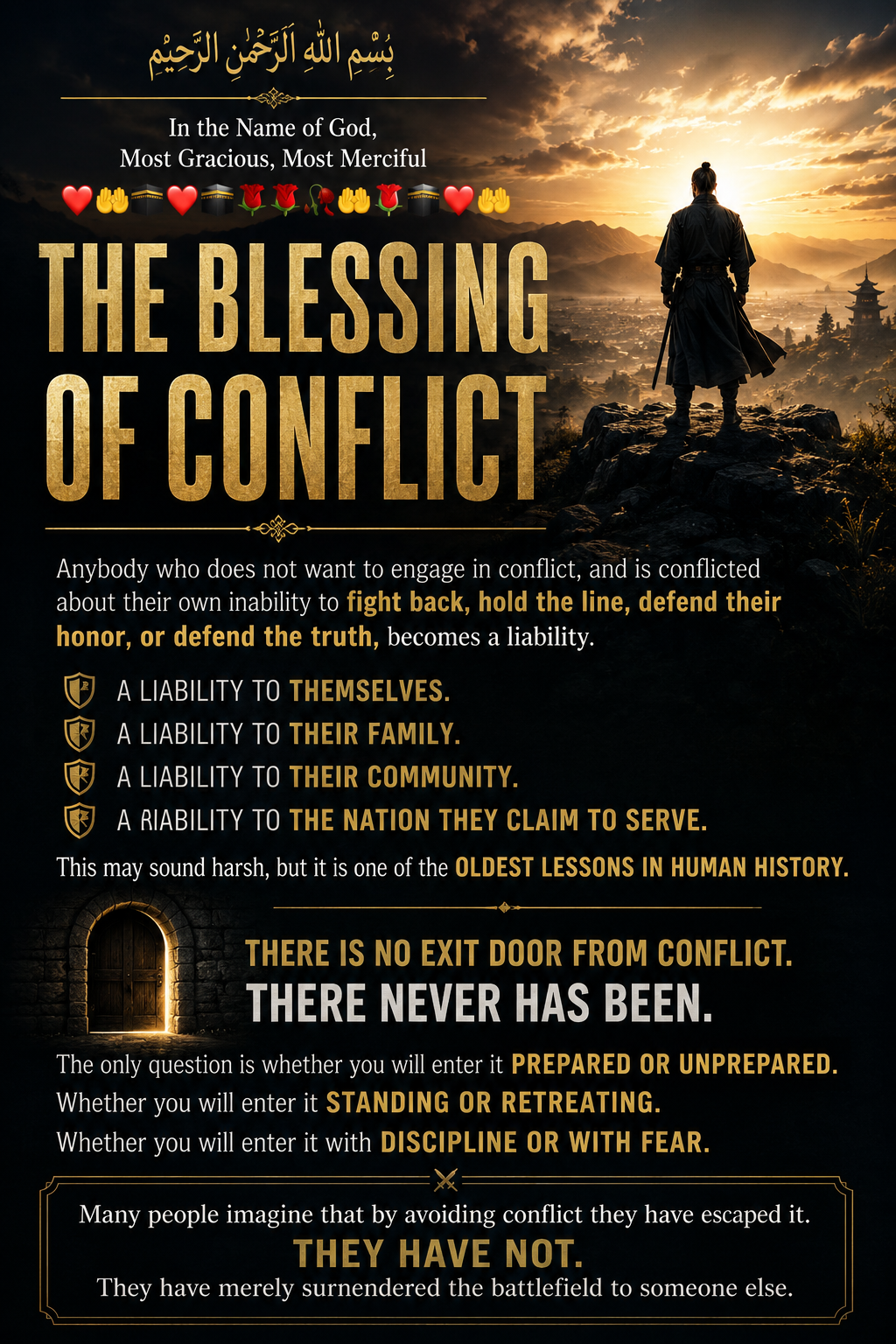
بِسْمِ اللهِ الرَّحْمٰنِ الرَّحِيْم
In the Name of God, Most Gracious, Most Merciful
♥️🤲🕋♥️🕋🌹🌹🥀🤲🌹🕋♥️🤲
The Blessing of Conflict
Anybody who does not want to engage in conflict, and is conflicted about their own inability to fight back, hold the line, defend their honor, or defend the truth, becomes a liability.
A liability to themselves.
A liability to their family.
A liability to their community.
A liability to the nation they claim to serve.
This may sound harsh, but it is one of the oldest lessons in human history.
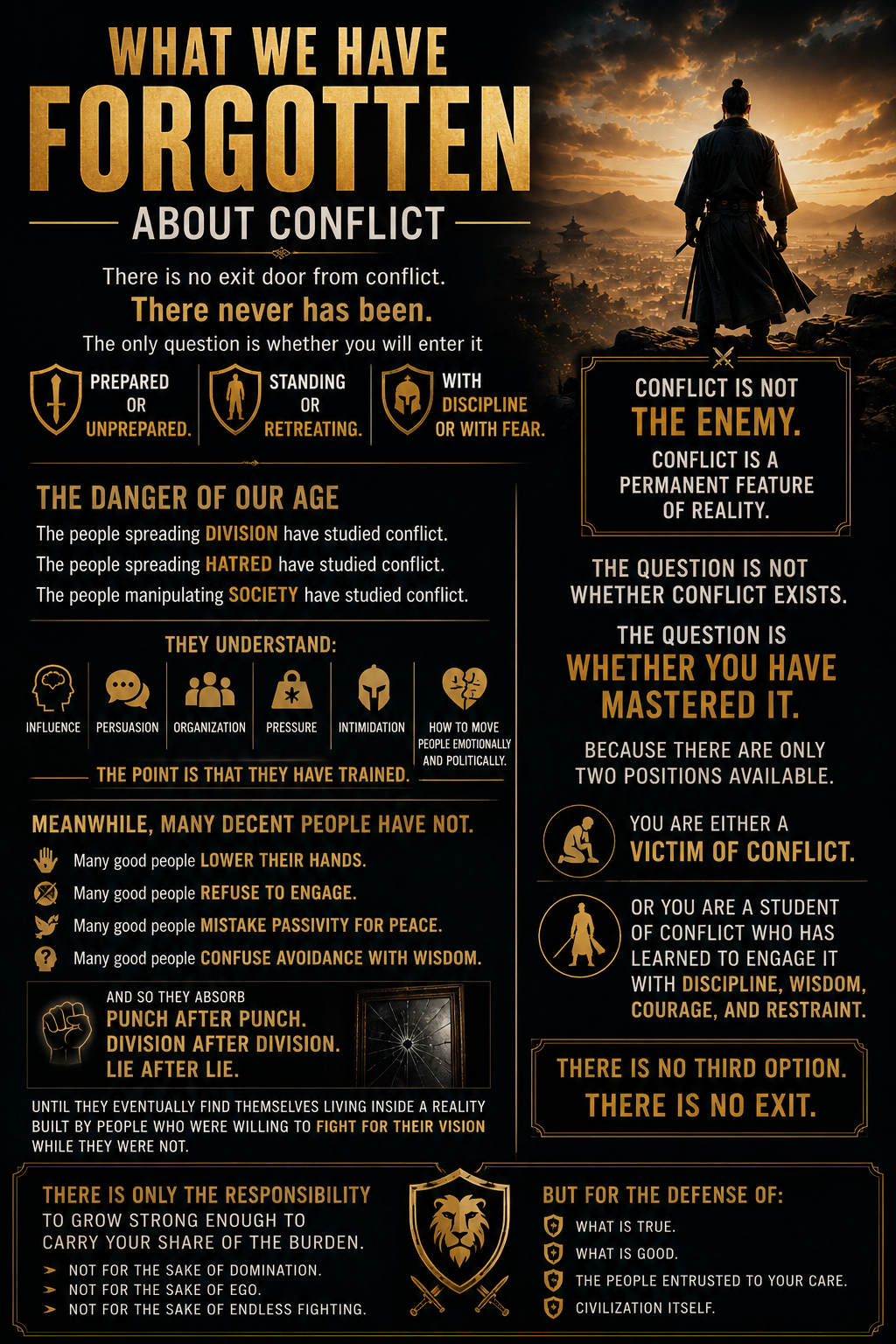
There is no exit door from conflict.
There never has been.
The only question is whether you will enter it prepared or unprepared.
Whether you will enter it standing or retreating.
Whether you will enter it with discipline or with fear.
Many people imagine that by avoiding conflict they have escaped it.
They have not.
They have merely surrendered the battlefield to someone else.
While they remain silent, others speak.
While they hesitate, others organize.
While they withdraw, others advance.
While they avoid confrontation, others master it.
And that is precisely the danger of our age.
The people spreading division have studied conflict.
The people spreading hatred have studied conflict.
The people manipulating society have studied conflict.
They understand influence.
They understand persuasion.
They understand organization.
They understand pressure.
They understand intimidation.
They understand how to move people emotionally and politically.
Whether their cause is righteous or corrupt is a separate question.
The point is that they have trained.
Meanwhile, many decent people have not.
Many good people lower their hands.
Many good people refuse to engage.
Many good people mistake passivity for peace.
Many good people confuse avoidance with wisdom.
And so they absorb:
Punch after punch.
Division after division.
Lie after lie.
Until they eventually find themselves living inside a reality built by people who were willing to fight for their vision while they were not.
Musashi understood that a warrior who refuses to train does not create peace.
He guarantees defeat.
Al-Ghazali understood that a soul which refuses to struggle against its lower self does not create righteousness.
It guarantees corruption.
The same principle applies to societies.
If those who love truth will not defend truth, truth will not defend itself.
If those who love justice will not defend justice, justice will not defend itself.
If those who love unity will not work for unity, division will fill the vacuum.
Conflict is not the enemy.
Conflict is a permanent feature of reality.
The question is not whether conflict exists.
The question is whether you have mastered it.
Because there are only two positions available.
You are either a victim of conflict.
Or you are a student of conflict who has learned to engage it with discipline, wisdom, courage, and restraint.
There is no third option.
There is no exit.
There is only the responsibility to grow strong enough to carry your share of the burden.
Not for the sake of domination.
Not for the sake of ego.
Not for the sake of endless fighting.
But for the defense of what is true.
For the defense of what is good.
For the defense of the people entrusted to your care.
For the defense of civilization itself because Perhaps one of the greatest blessings of modern society is that most people no longer have to fight for their survival every day.
What We Have Forgotten About Conflict
Perhaps one of the greatest blessings of modern society is that most people no longer have to fight for their survival every day.
If someone attacks you, there is a police officer.
If someone steals from you, there is a court.
If someone threatens your community, there are institutions designed to respond.
This is a tremendous achievement of civilization.
It is a blessing.
A profound blessing.
But every blessing carries a hidden cost.
When generations grow up protected from conflict, many also grow up without understanding conflict.
They have never been tested by it.
They have never been forced to study it.
They have never been forced to master it.
They have never been placed under sustained pressure long enough to discover what is missing inside themselves.
And so something dangerous happens.
They begin to mistake comfort for strength.
They begin to mistake safety for capability.
They begin to mistake the absence of conflict for mastery of conflict.
These are not the same thing.
A person can live an entire life without ever developing the courage to confront falsehood.
A person can live an entire life without learning how to withstand criticism.
A person can live an entire life without learning how to defend an idea, a principle, a family, a community, or a civilization.
That does not make them bad people.
It simply means there are parts of themselves that remain undiscovered.
Parts of themselves that have never been tested.
Parts of themselves that have never been forged.
Parts of themselves that have never been called upon.
Diamonds are formed under pressure.
Character is formed under pressure.
Conviction is formed under pressure.
Without pressure, many strengths remain hidden.
Without resistance, many virtues remain dormant.
Without challenge, many people never discover who they truly are.
And if we cannot acknowledge what is missing, we cannot develop it.
If we cannot see the weakness, we cannot strengthen it.
If we cannot name the problem, we cannot solve it.
The first step is honesty.
Honesty with ourselves.
Honesty about our strengths.
Honesty about our weaknesses.
Honesty about what we have avoided.
Meanwhile, there are others who have studied conflict.
They understand persuasion.
They understand influence.
They understand organization.
They understand how to provoke emotion.
They understand how to dominate attention.
They understand how to mobilize people around anger, fear, resentment, and division.
They train.
They practice.
They improve.
They sharpen their tools.
They sharpen their message.
They sharpen their ability to move people.
And while they are improving, many decent people remain spectators.
Many good people remain silent.
Many good people remain passive.
Many good people assume that truth will somehow win on its own.
Then they wonder why hatred spreads.
They wonder why division spreads.
They wonder why destructive voices seem stronger than constructive ones.
They wonder why those who work for darkness appear more organized than those who work for light.
The answer is often uncomfortable.
The people spreading those messages are fighting for their vision.
The rest are hoping their vision wins on its own.
Hope is important.
But hope without effort is surrender.
Hope without preparation is surrender.
Hope without discipline is surrender.
Hope without action is surrender.
Miyamoto Musashi understood this.
Imam Al-Ghazali understood this.
Neither man worshipped conflict.
Neither celebrated aggression.
Neither glorified anger.
But both understood that some things must be defended.
Truth must be defended.
Justice must be defended.
Communities must be defended.
Civilizations must be defended.
My Contribution: Pressure, Conflict, and Remaining Human
As I reflect on Musashi and Imam Al-Ghazali, I cannot help but think about my own journey.
Before I was a truck driver, before I spent years studying leadership, society, and human behavior, I worked as a correctional officer.
A correctional officer lives in a different world.
Conflict is not theoretical.
Conflict is not something that happens occasionally.
Conflict is always present.
Every day, every shift, every interaction carries the possibility that someone may challenge you, threaten you, manipulate you, test your boundaries, or force you to respond under pressure.
There is no luxury of pretending conflict does not exist.
There is no escape hatch.
You learn very quickly that reality does not care about your comfort.
And yet, the greatest lesson I learned was not how to dominate people.
It was how not to lose myself.
I was determined not to allow anger to become my identity.
I was determined not to allow pressure to make me cruel.
I was determined not to allow conflict to rob me of my humanity.
That lesson did not come only from the prison system.
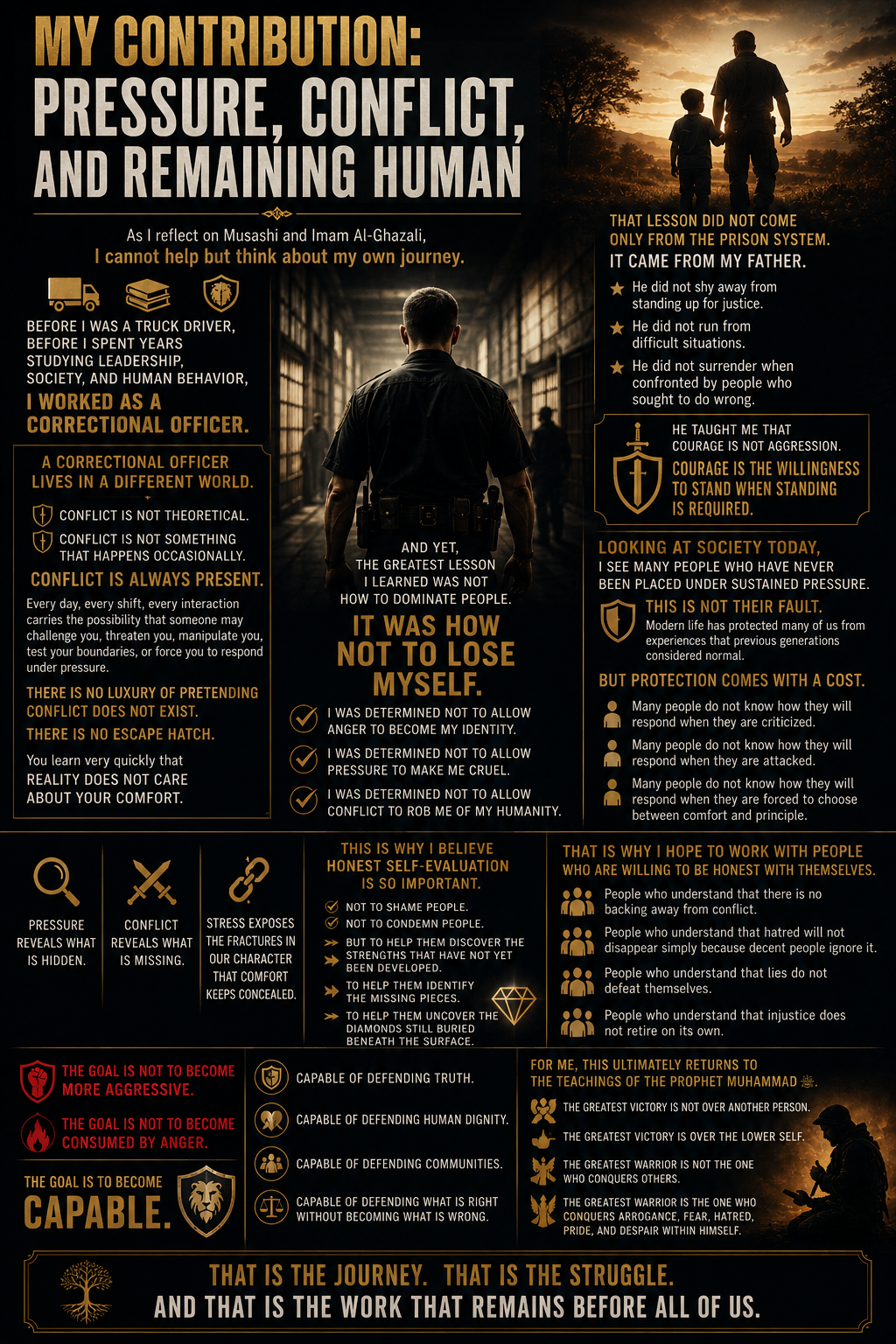
It came from my father.
I was blessed with a father who did not shy away from standing up for justice.
He did not run from difficult situations.
He did not surrender when confronted by people who sought to do wrong.
He taught me that courage is not aggression.
Courage is the willingness to stand when standing is required.
Looking at society today, I see many people who have never been placed under sustained pressure.
This is not their fault.
Modern life has protected many of us from experiences that previous generations considered normal.
But protection comes with a cost.
Many people do not know how they will respond when they are criticized.
Many people do not know how they will respond when they are attacked.
Many people do not know how they will respond when they are forced to choose between comfort and principle.
Pressure reveals what is hidden.
Conflict reveals what is missing.
Stress exposes the fractures in our character that comfort keeps concealed.
This is why I believe honest self-evaluation is so important.
Not to shame people.
Not to condemn people.
But to help them discover the strengths that have not yet been developed.
To help them identify the missing pieces.
To help them uncover the diamonds still buried beneath the surface.
That is why I hope to work with people who are willing to be honest with themselves.
People who understand that there is no backing away from conflict.
People who understand that hatred will not disappear simply because decent people ignore it.
People who understand that lies do not defeat themselves.
People who understand that injustice does not retire on its own.
The goal is not to become more aggressive.
The goal is not to become consumed by anger.
The goal is to become capable.
Capable of defending truth.
Capable of defending human dignity.
Capable of defending communities.
Capable of defending what is right without becoming what is wrong.
For me, this ultimately returns to the teachings of the Prophet Muhammad ﷺ.
The greatest victory is not over another person.
The greatest victory is over the lower self.
The greatest warrior is not the one who conquers others.
The greatest warrior is the one who conquers arrogance, fear, hatred, pride, and despair within himself.
That is the journey.
That is the struggle.
And that is the work that remains before all of us.
IN CONCLUSION: THE MISSING LAYER
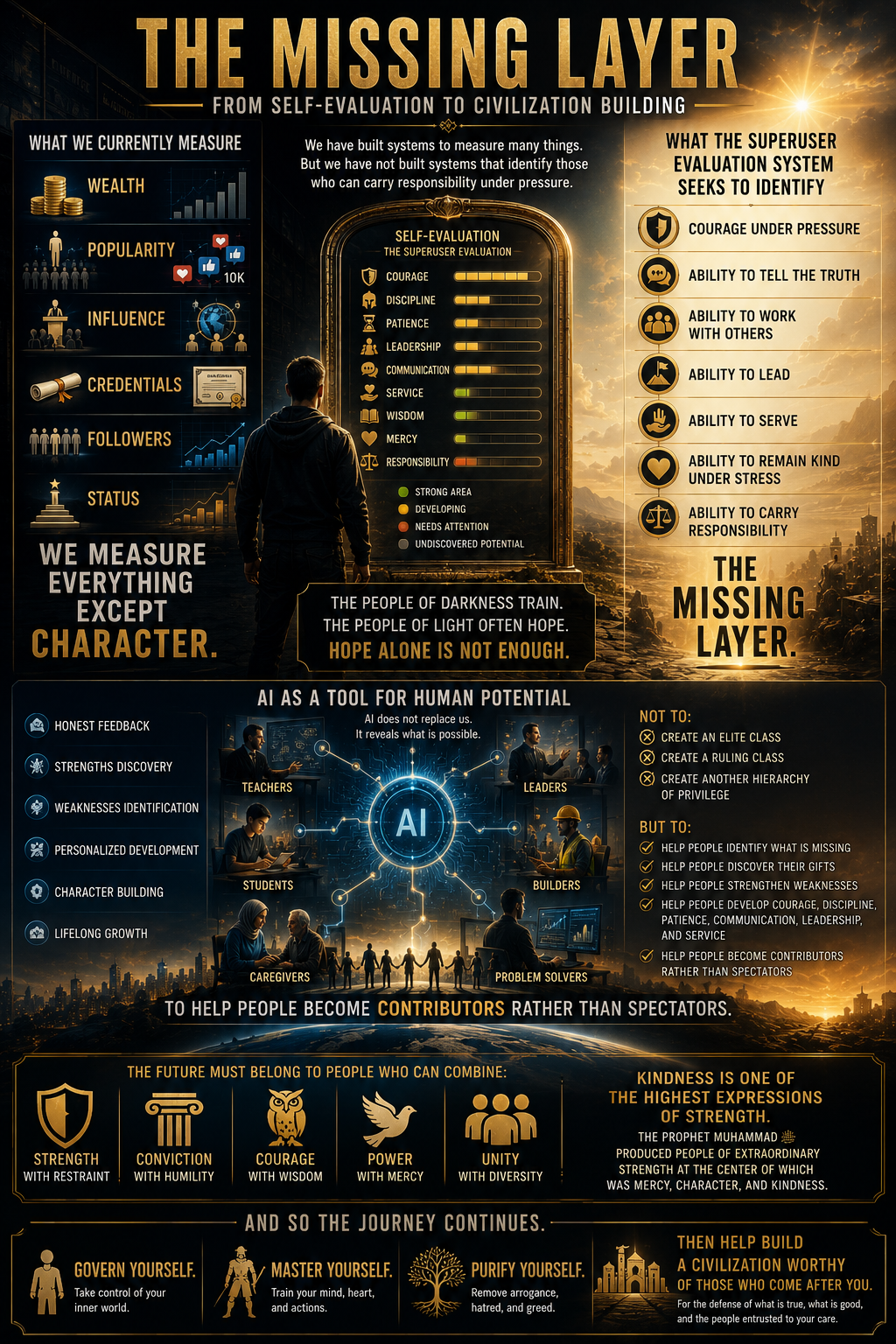
As I look at the world today, I believe we are missing something very important.
We have built systems to measure wealth.
We have built systems to measure popularity.
We have built systems to measure influence.
We have built systems to measure credentials.
But we have not built systems that accurately identify those who can carry responsibility under pressure.
We have not built systems that distinguish between those who can hold the line and those who cannot.
We have not built systems that help people discover where they are strong, where they are weak, and where they need training.
That is the missing layer.
The people who work for division seem to find each other naturally.
The people who spread hatred find each other naturally.
The people who manipulate, intimidate, bully, and exploit find each other naturally.
They organize.
They train.
They sharpen one another.
They develop the skills needed to advance their vision.
Meanwhile, many decent people remain isolated.
Many people of goodwill never receive an honest assessment.
Many never discover their strengths.
Many never discover their weaknesses.
Many never discover what they are capable of becoming.
The people of darkness train.
The people of light often hope.
And hope alone is not enough.
This is where I believe we have work to do.
This is where I believe the future can be improved.
This is one of the reasons I continue to think about the Superuser System and the role AI can play in helping individuals understand themselves more honestly.
Not to create an elite class.
Not to create a ruling class.
Not to create another hierarchy of privilege.
But to help people identify what is missing.
To help people discover their gifts.
To help people strengthen their weaknesses.
To help people develop:
Courage.
Discipline.
Patience.
Communication.
Leadership.
Service.
To help people become contributors rather than spectators.
Because the future cannot be entrusted solely to those who are the loudest.
It cannot be entrusted solely to those who are the most aggressive.
It cannot be entrusted solely to those who are willing to dominate others.
The future must belong to people who can combine:
Strength with restraint.
Conviction with humility.
Courage with wisdom.
Power with mercy.
And that brings us back to something that is often overlooked.
Kindness.
Kindness is frequently mistaken for weakness.
It is not.
Kindness is one of the highest expressions of strength.
Anyone can become angry.
Anyone can become harsh.
Anyone can become cruel.
But to remain balanced while possessing strength—that is rare.
To remain compassionate while possessing authority—that is rare.
To remain just while possessing power—that is rare.
The Prophet Muhammad ﷺ did not produce weak people.
He produced people of extraordinary strength.
People who could stand for truth.
People who could endure hardship.
People who could confront injustice.
People who could defend their communities.
Yet at the center of that strength was mercy.
At the center of that strength was character.
At the center of that strength was kindness.
Perhaps that is what Musashi and Imam Al-Ghazali were both trying to build.
Not merely warriors.
Not merely scholars.
Not merely leaders.
But complete human beings.
Human beings who could enter conflict without becoming consumed by conflict.
Human beings who could defend truth without becoming tyrants.
Human beings who could hold power without becoming corrupted by power.
Human beings who could remain anchored while the world around them lost its balance.
That is the invitation.
Evaluate yourself honestly.
Discover what is missing.
Train what is weak.
Strengthen what is good.
Learn how to participate in society without losing your identity.
Learn how to engage conflict without becoming consumed by it.
Learn how to defend truth without abandoning mercy.
Learn how to stand firm without losing your humanity.
The world does not merely need more followers.
It needs more people who are capable of carrying responsibility.
More people who are capable of serving.
More people who are capable of leading.
And the journey begins where Musashi and Imam Al-Ghazali both began:
Govern yourself.
Master yourself.
Purify yourself.
Then help build a civilization worthy of those who come after you.
A Final Word and an Invitation
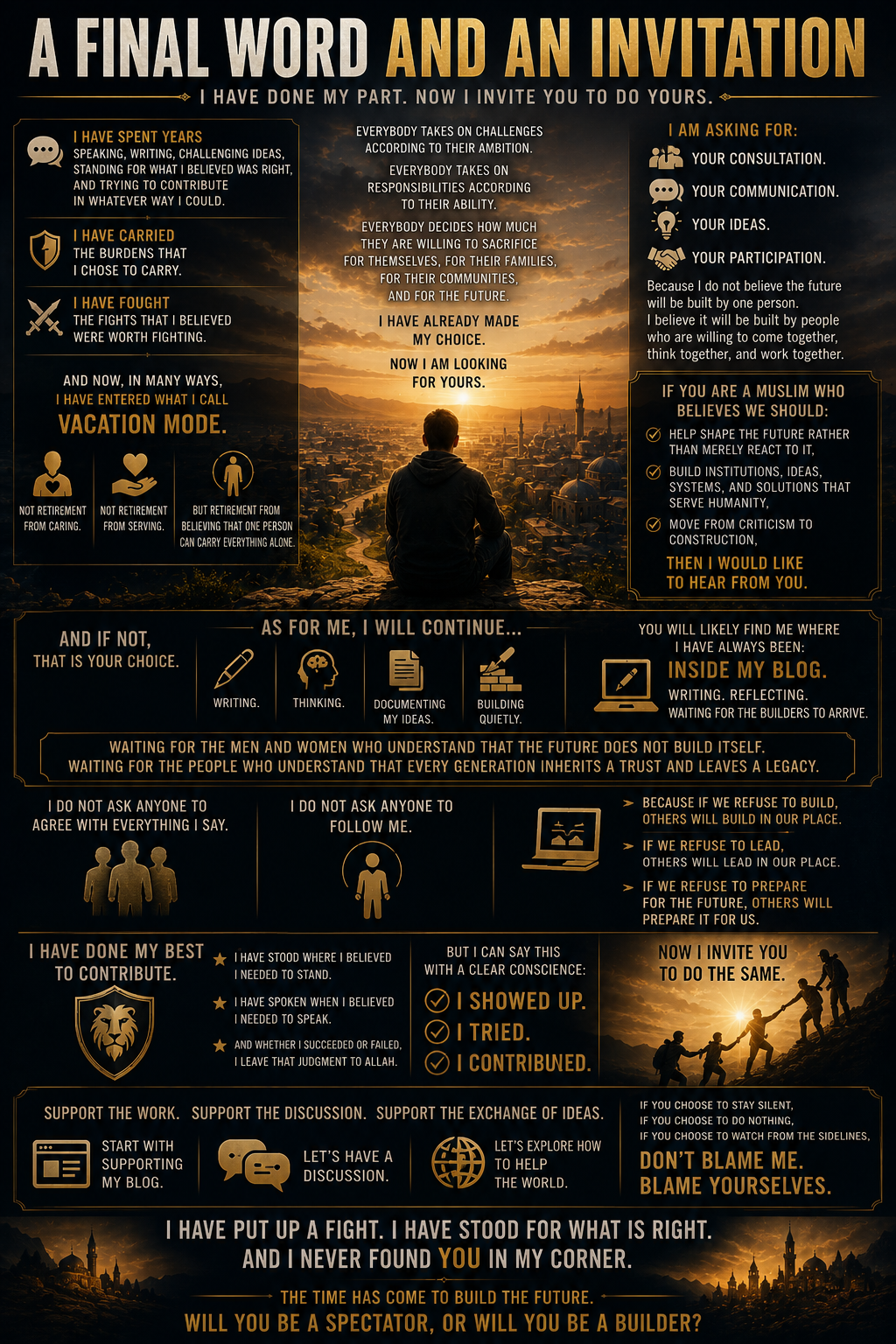
As for me, I have reached a point in my life where I am no longer interested in endless arguments, endless battles, or endless noise.
I have spent years speaking, writing, challenging ideas, standing for what I believed was right, and trying to contribute in whatever way I could.
I have carried the burdens that I chose to carry.
I have fought the fights that I believed were worth fighting.
And now, in many ways, I have entered what I call vacation mode.
Not retirement from caring.
Not retirement from serving.
But retirement from believing that one person can carry everything alone.
Everybody takes on challenges according to their ambition.
Everybody takes on responsibilities according to their ability.
Everybody decides how much they are willing to sacrifice for themselves, for their families, for their communities, and for the future.
I have already made my choice.
Now I am looking for yours.
I am asking for your consultation.
I am asking for your communication.
I am asking for your ideas.
I am asking for your participation.
Because I do not believe the future will be built by one person.
I believe it will be built by people who are willing to come together, think together, and work together.
People who understand that the age we are entering demands more from us than simply consuming information.
It demands contribution.
It demands responsibility.
It demands leadership.
If you are a Muslim who believes we should help shape the future rather than merely react to it, then I would like to hear from you.
If you believe we should build institutions, ideas, systems, and solutions that serve humanity, then I would like to hear from you.
If you believe that the time has come to move from criticism to construction, then I would like to hear from you.
And if not, that is your choice.
As for me, I will continue writing.
I will continue thinking.
I will continue documenting my ideas.
I will continue building quietly.
You will likely find me where I have always been:
Inside my blog.
Writing.
Reflecting.
Waiting for the builders to arrive.
Waiting for the men and women who understand that the future does not build itself.
Waiting for the people who understand that every generation inherits a trust and leaves a legacy.
I do not ask anyone to agree with everything I say.
I do not ask anyone to follow me.
I simply ask that you participate.
Because if we refuse to build, others will build in our place.
If we refuse to lead, others will lead in our place.
If we refuse to prepare for the future, others will prepare it for us.
I have done my best to contribute.
I have stood where I believed I needed to stand.
I have spoken when I believed I needed to speak.
And whether I succeeded or failed, I leave that judgment to Allah.
But I can say this with a clear conscience:
I showed up.
I tried.
I contributed.
Now I invite you to do the same.
Support the work.
Support the discussion.
Support the exchange of ideas.
And let us see whether together we can build something worthy of those who come after us.