
بِسْمِ اللهِ الرَّحْمٰنِ الرَّحِيْمِ
In the Name of God, Most Gracious, Most Merciful.
♥️🤲🕋♥️🕋🌹🌹🥀🤲🌹🕋♥️🤲
THE BIRTH OF PROPHET MUHAMMAD ﷺ — THE PLAY
بِسْمِ اللهِ الرَّحْمٰنِ الرَّحِيمِ
In the Name of Allah, Most Gracious, Most Merciful.
أعوذ بالله من الشيطان الرجيم
I seek refuge in Allah from Satan, the accursed.
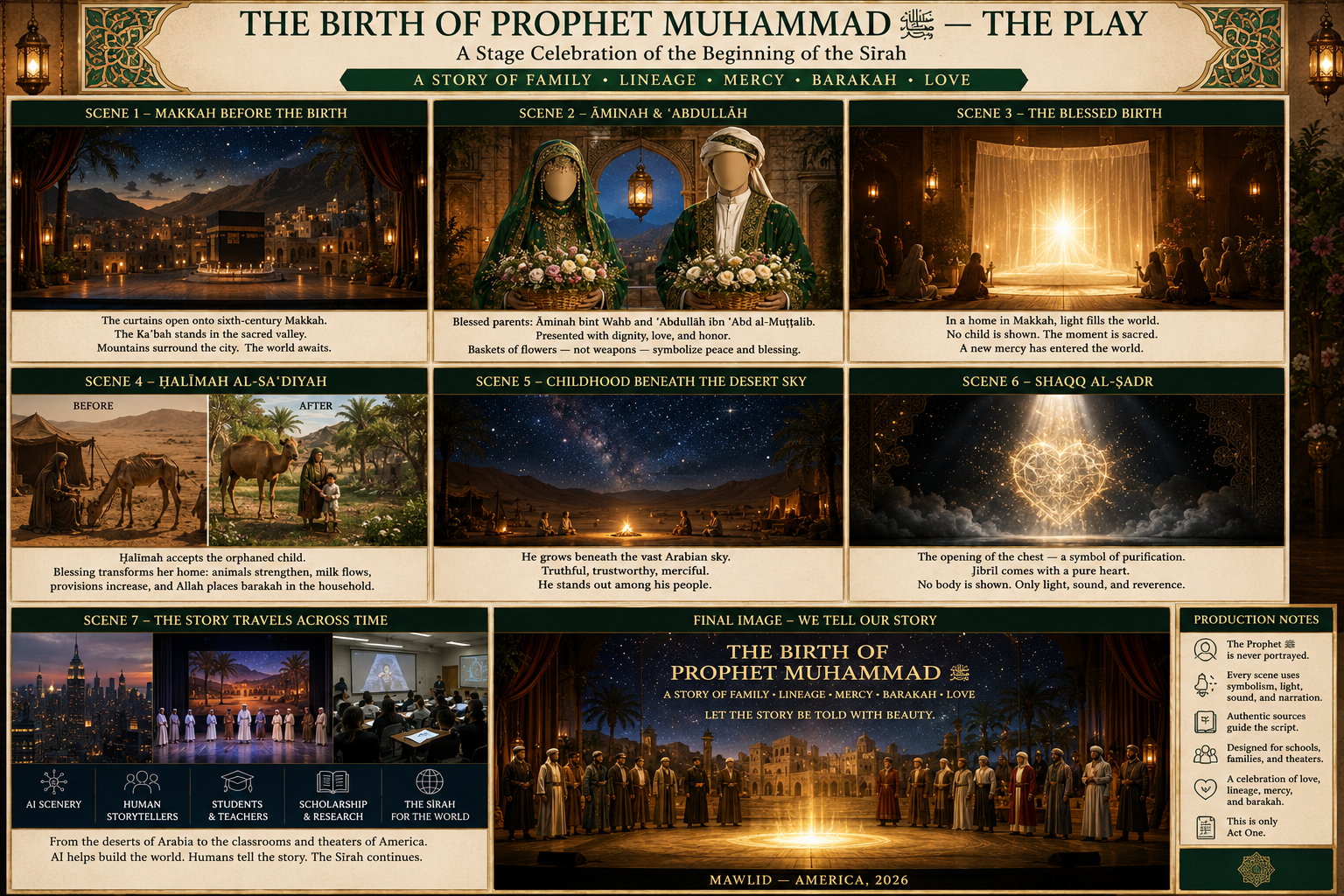
I intend, in shāʾ Allāh, to create a stage play about one of the most extraordinary stories humanity has ever inherited:
The Birth of Prophet Muhammad ﷺ
I envision a production that can be performed by young people, high-school students, universities, community theaters, families, and eventually professional stages—a production filled with decorum, beauty, elegance, history, and love.
The purpose will not be to turn the sacred into spectacle.
The purpose will be to allow people to experience the story.
To enter the world into which the Messenger of Allah ﷺ was born.
To meet Āminah bint Wahb, his blessed mother.
To remember ʿAbdullāh ibn ʿAbd al-Muṭṭalib, his father.
To experience Mecca, the Quraysh, the desert, the caravans, the poetry, the families, and the society surrounding his arrival.
And then comes the extraordinary story of his childhood.
We can tell of the reports surrounding his birth and the signs associated with it—carefully distinguishing what is firmly established from what comes through later sīrah and devotional traditions.
We can tell of the women of Banū Saʿd coming to Mecca seeking infants to nurse.
We can tell the beautiful story of Ḥalīmah al-Saʿdiyyah, whose household had very little and who initially found herself with the orphaned Muhammad ﷺ when others hoped for children whose fathers could provide greater payment.
And then everything begins to change.
The weak animal strengthens.
Provision increases.
Blessing enters the household.
The audience begins to understand something before the characters themselves fully understand it:
There is something extraordinary about this child.
Then we journey into the desert.
We see the young Muhammad ﷺ growing beneath the enormous Arabian sky.
We encounter the famous report of Shaqq al-Ṣadr — the opening of his chest—when Jibrīl came to him and his heart was purified. This should never become a gruesome theatrical scene. It can be represented through light, sound, narration, movement, and symbolism, preserving reverence while allowing an audience to understand what the tradition relates.
And throughout the production there would be one absolute principle:
THE PROPHET MUHAMMAD ﷺ IS NEVER PORTRAYED
No actor needs to impersonate him.
His presence can instead be communicated through narration, the reactions of those around him, lighting, sound, scenery, poetry, and carefully designed theatrical symbolism.
That limitation can actually become one of the production's greatest artistic strengths.
Imagine the stage becoming quiet.
Imagine the desert at night.
Imagine a narrator speaking while the stars appear overhead.
Imagine Ḥalīmah describing what happened to her household after this child entered her care.
Imagine children in an American high school learning the sīrah not merely by memorizing names and dates, but by building the scenery, learning the history, studying the Arabic names, designing costumes, composing music and soundscapes, and performing the story together.
And now we have something previous generations never possessed:
artificial intelligence.
AI can participate in this symphony without replacing the human beings at its center.
It can help students reconstruct historical environments.
It can help create projected desert landscapes and changing skies.
It can help teachers compare historical sources.
It can help with translations, accessibility, subtitles, sound design, research, rehearsal, and educational materials.
But human beings remain the storytellers.
And scholarship must remain the guardian of the sacred history being told.
Every major scene should eventually pass through qualified scholars of sīrah and Islamic tradition, so that authentic reports are distinguished from weaker or later narratives and audiences understand the difference.
This is bigger than one performance.
I want a Muslim child in America to be able to walk into school during the month of Mawlid and say:
“We have a story too.”
A story about a mother.
A father.
A grandfather.
A foster mother.
A desert family.
A city called Mecca.
And a child whose arrival would eventually transform Arabia and change the history of the world.
Let the costumes carry dignity.
Let the scenery carry beauty.
Let the language carry elegance.
Let scholarship protect the history.
And above everything else—
LET THE STORY BE TOLD WITH LOVE.
Perhaps one day theaters across America will raise their curtains and families—Muslim and non-Muslim alike—will sit together and encounter the beginning of the sīrah of the Messenger of Allah ﷺ.
Not through caricature.
Not through someone else's definition of him.
But through our own careful, beautiful, scholarly and loving telling of the story.
That is the play I intend to build.
The Birth of Prophet Muhammad ﷺ.
And this is only Act One.