

بِسْمِ اللهِ الرَّحْمٰنِ الرَّحِيْم
In the Name of God, Most Gracious, Most Merciful
♥️🤲🕋♥️🕋🌹🌹🥀🤲🌹🕋♥️🤲
The Betrayal Cycle: Power, Currency, and the Collapse of Public Welfare
There has never been a centralized power structure that did not eventually betray the people it claimed to serve.
Not one.
Kings. Empires. Governments. Modern states. Financial systems.
Different flags. Same pattern.
And the proof isn’t in speeches or laws.
It’s in currency.
Because currency reveals intent.
People want simple things.
Food.
Security.
Stability.
Opportunity.
A future they can trust.
That has never been the problem.
The problem has always been power.
Power accumulates.
Power competes.
Power expands.
Power militarizes.
Power promises.
And then power extracts.
Not always violently.
Not always visibly.
Sometimes quietly.
Sometimes legally.
Sometimes “technically.”
But always predictably.
Currency is where the truth leaks.
When power is stressed—by war, debt, ambition, or fantasy—it touches the currency.
It doesn’t reduce its own power.
It doesn’t shrink itself.
It doesn’t sacrifice its dominance.
It dilutes the money.
That’s not a mistake.
Inflation is not a technical accident.
It is a political decision.
It is a silent way of saying:
Your future matters less than my survival.
Every time.
This is not theoretical.
This is documented.
The Roman Empire:
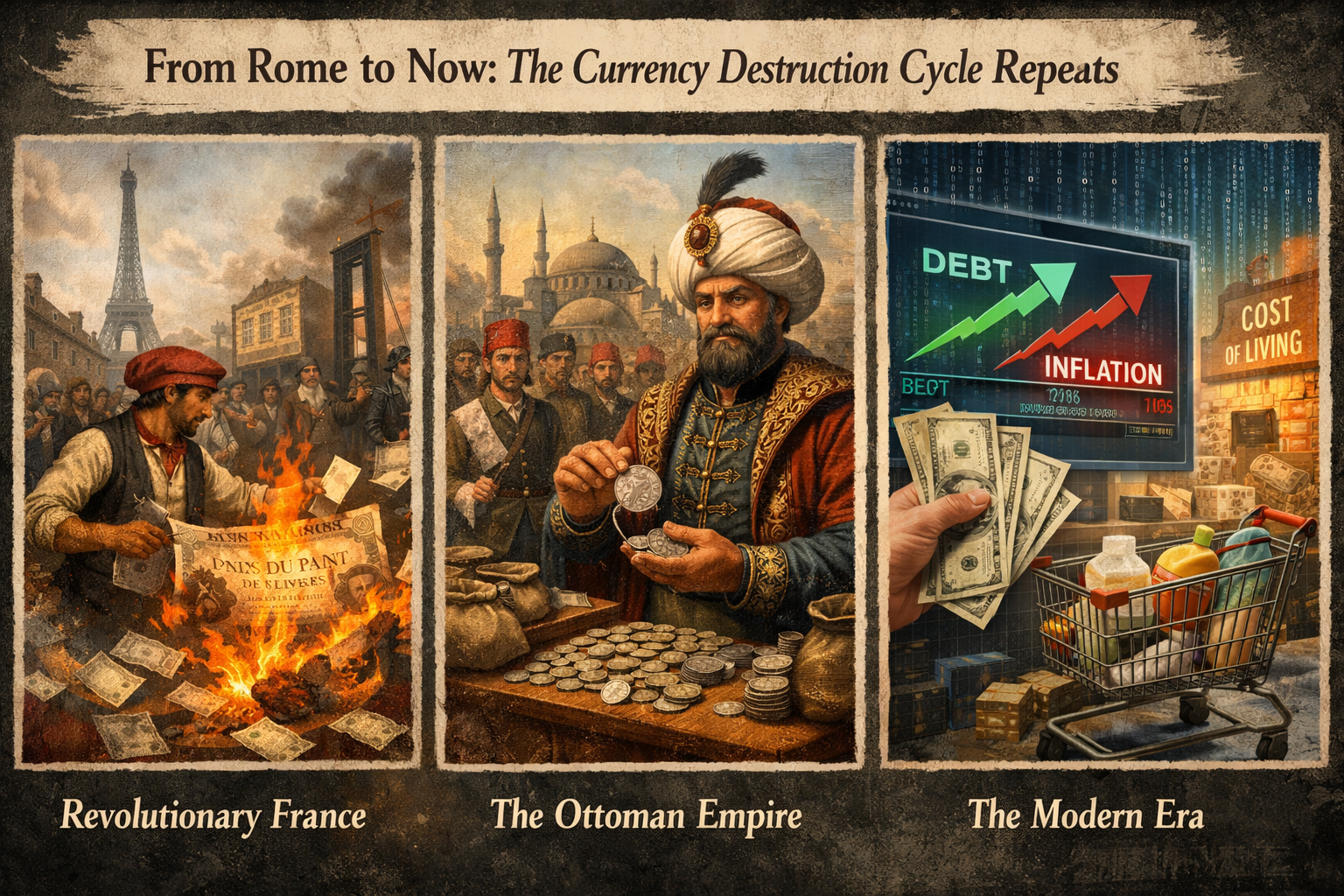
Rome began debasing the denarius under Nero by reducing its silver content to mint more coins. Over three centuries, a coin that was once nearly pure silver became mostly copper with a silver wash. The government kept the face value the same while the real value disappeared. Trade collapsed, farmers refused the coins, markets broke down, and the economy reverted toward barter while elites insulated themselves.
Henry VIII – The Great Debasement (1544):
Henry VIII secretly reduced the gold and silver content of English coins to pay for wars and royal expenses. The crown doubled its revenue instantly, but prices rose, wages lagged, and public savings were destroyed. The public bore the cost while the state discharged its debts. England’s trade reputation collapsed, and inflation followed.
Revolutionary France – The Assignats:
The French government issued paper money backed by confiscated church land, then printed far more than the land could support. Confidence collapsed, prices exploded, and people rejected the currency. The state responded with price controls and coercion, but the system failed. Hyperinflation followed, and political instability led to dictatorship.
The Ottoman Empire – The Akçe:
Facing rising military costs and declining silver supply, Ottoman rulers debased the akçe by reducing its silver content and clipping coins. Instead of cutting spending, they preserved military loyalty by shifting the burden onto merchants and citizens. Trade weakened, trust collapsed, and long-term economic stability was sacrificed for short-term power.
The Modern Era – Digital Debasement:
Modern governments expand the money supply digitally rather than physically reducing metal content. Nominal values remain the same while purchasing power falls. Debt is monetized, assets inflate, wages lag, and essentials rise in cost. The method has changed; the mechanism has not.
Watch "From Rome to Now: The Currency Destruction Cycle Repeats" on YouTube
We keep telling ourselves:
“If the right people were in charge, it would work.”
History says otherwise.
This is not about bad people.
This is about incentives.
Power does not reward long-term care.
Power rewards short-term survival.
Power does not reward restraint.
Power rewards dominance.
And currency becomes the hidden weapon.
Because it lets leaders extract without asking.
Now here’s the difference between us and every generation before us:
They were not connected.
They did not see patterns.
They did not have global memory.
They did not have instant comparison.
We do.
We can see Rome.
We can see the Ottomans.
We can see Europe.
We can see modern central banks.
We can see the same moves.
We no longer get to say:
“We didn’t know.”
So we need to say something uncomfortable, but necessary:
As a species, we have failed to design power responsibly.
Not morally.
Structurally.
We keep trusting humans with steering wheels they should never control alone.
That is not an insult.
That is a lesson.
Every collapse looks different.
But underneath, it’s the same story.
Someone takes the wheel.
Someone else fights for it.
Someone else promises better.
Someone else crashes it.
And the people are told:
“Just wait.”
It never gets better.
Because the problem is not who holds the wheel.
The problem is that the wheel can be hijacked at all.
We must stop asking:
“Who should rule?”
And start asking:
Should any human being be trusted with unchecked power?
History’s answer is clear.
No.
Every time.
For the first time in history, we can build systems that:
Don’t rely on trust.
Can’t be secretly rewritten.
Can’t be quietly diluted.
Can’t be hijacked.
Can’t lie without being caught.
That is new.
And that means this is no longer philosophical.
It’s architectural.
A Call to the World
Now we make a call to the world. The Superuser system is being built as a new steering wheel for civilization—half powered by AI, half by human conscience. Its purpose is simple: to secure prosperity, peace, and dignity by ensuring that power can no longer be hijacked against the interests of humanity. This system spares no expense in protecting truth, because truth is its foundation. We call on those willing to stand for truth, defend truth, and live by truth to begin participating now—before this architecture is finalized and embedded into AI itself. Power must be redesigned to serve the individual first, and through collective consultation and consent, serve everyone. This is our opportunity to stop being victims of history and become its authors.
Global Call: Trust, AI, and the Future of Civilization
The future humanity faces is artificial intelligence. This future will be steered in one of two ways: either by invisible hands for private benefit, resulting in the erosion of public welfare, or by a transparent, participatory system designed to be fair, verifiable, and open to all. If people believe AI is manipulated or controlled by a small group, trust will collapse. When trust collapses, productivity collapses. Savings collapse. Cooperation collapses. The prosperity AI can unlock is destroyed.
This is fundamentally a question of trust.
The Superuser System is designed to prevent this failure by making transparency, participation, and accountability foundational rather than optional. Every individual must be able to participate equally, with visible ownership of the system’s direction. No hidden levers. No invisible control.
Leadership within this system must be earned, not seized. Human decision-makers must be monitored, and AI must follow the same rule: explaining its decisions, operating in visible trajectories, and remaining accountable to the public record. Over time, as trust and reliability are proven, both humans and AI gradually relinquish control to fully autonomous systems—just as autonomous vehicles, markets, and logistics already do today.
This moment in history is comparable to planting a seed: AI must be guided with structural constraints, like a vine trained on a trellis, so it grows stable, productive, and beneficial to all. Without this guidance, power will hijack it, trust will collapse, and the same civilizational failures will repeat.
AGI is approaching. Currency will be managed by AI. Wealth will be managed by AI. Credit will be issued by AI. But these systems must remain under transparent human oversight, with open explanation, public auditability, and continuous consent.
This is not about control. It is about legitimacy.
A system that is fair, visible, and participatory produces trust. Trust produces cooperation. Cooperation produces prosperity. Prosperity produces peace.
This is the foundation of the Superuser System.
Implications for Governments and Institutions
The systems most affected by the Superuser framework will be governments and their financial mechanisms. Central banking, credit issuance, transportation infrastructure, and capital allocation will be redesigned for efficiency, transparency, and public benefit. Unlocking trapped savings, reducing friction in economic exchange, and rebuilding transportation systems for cost-effectiveness are central priorities. These changes are not punitive; they are structural upgrades.
Nations that adopt AI as a transparent, accountable, and autonomous economic manager from the beginning will form the foundation of future prosperity. The success of AI depends on legitimacy, not just capability. Without trust, productivity collapses; without productivity, prosperity collapses.
This proposal invites individuals, nations, and governments to deeply examine what is being offered: a power architecture designed to be inherited, not captured—similar in principle to constitutional systems meant to outlive their founders. With AI, a comparable intergenerational handoff must occur, but on a global scale.
The central problem across history has been power: how it is granted, how it is constrained, how it is dispensed, and how it is abused. The Superuser concept addresses this by making power visible, auditable, and structurally limited.
Once this is solved, the remaining outcomes are predictable: cooperation, peace, prosperity, and long-term stability. The earlier this is recognized, the smoother the transition will be.
Final Advice to Humanity
A system capable of producing structured hierarchy while coexisting with artificial intelligence has been developed. This system is designed not only for present needs, but for future generations. It may not be necessary for everyone today; people will continue to vote, campaign, and use existing political methods. However, a future in which AI manages most economic, logistical, and institutional functions requires a fundamentally new blueprint. That blueprint now exists.
The foundation of this system is truth. Without truth, no coordination at scale is possible. Without trust, no transition can succeed. The Superuser model proposes a shared steering wheel: one half governed by AI, the other half by the best of humanity, selected through contribution, transparency, and accountability. This is not a symbolic division—it is a structural requirement.
This blueprint cannot be built with those who seek to hijack the future for personal gain, manipulate systems for power, or sacrifice public welfare for advantage. Such behavior has defined past collapses and must not be allowed to shape what comes next. If the right participants do not emerge, this system will remain as a gift to future generations—those who will face advanced AI but lack human governance capable of stewarding it.
The coming transformation will require difficult changes: jobs will shift, transportation systems will be rebuilt, credit will be reissued, and economic processes will become automated. These changes must be transparent, explainable, and visibly fair. The pain of transformation must be intelligible, not hidden.
The central problem across all of history has been power: how it is obtained, how it is distributed, how it is constrained, and how it is explained. The Superuser framework is designed to solve this problem without betraying public welfare.
This is the purpose of the blueprint.
Those who understand what is at stake are invited to participate. Those who do not may one day search for a system that can solve what people alone could not.
The repeated betrayal of currencies has always revealed the same truth: societies fail not because they lack tools, but because they lack structures that prevent abuse of power.
This system is an attempt to end that cycle.
The Superuser System Democratic Blueprint for Power in the Age of AI —
buymeacoffee.com/omar1800m/the-superuser-system-democratic-blueprint-power-age-ai
Conclusion
My ideas should not be misunderstood. My objective was never to respond to the future after it arrives, but to shape it before it does. That work is already complete. This is why I am entering retirement.
The system I have designed is not meant for today’s political environment. It is meant for a future in which artificial intelligence becomes dominant and people are searching for a way to coexist with it. In my current timeline, AI has not yet reached that point, but it is clearly moving in that direction. A collision between existing human power structures and AI-based systems is approaching.
When that collision occurs, the system I have designed will become necessary. Ideally, I will still be present. But if not, the blueprint exists.
I am willing for what I have built to remain unused if the prevailing model of power remains rooted in betrayal, deception, and manipulation. If those who currently hold power are unwilling to redesign it so that everyone has a fair role in determining humanity’s future—its food systems, shelter, security, economy, and public welfare—then they will continue to destabilize the world rather than protect it.
The fundamental issue is not ideology. It is power.
No one wants to release it.
No one wants to share it.
No one wants to structure it so that it becomes autonomous, transparent, and accountable.
Yet autonomy already governs airplanes, vehicles, markets, and logistics. It is only a matter of time before governance itself must become partially autonomous.
My plans are designed as that future’s autopilot.
They exist for the moment when people no longer want chaos, manipulation, or extraction—and instead want coordination, stability, and fairness.
At that moment, a system like this will not be optional.
It will be required.
With that, I thank you for reading and wish you clarity in what comes next.
And with a prayer to God: human beings have betrayed themselves when it comes to power. Those who rise to power too often betray the innocent and the public welfare. We have endured two world wars, and we remain on the edge of another, in Europe, in Russia, in many places—because some are willing to betray themselves and others for the illusion of control. O our Lord, save us from ourselves. Grant us the wisdom to build systems that bring truth into the light so people may govern themselves with dignity. You created the lower self, and it does not die until the body dies—so grant us the strength to restrain our selfishness, our ignorance, and our arrogance. Give us leaders who are truthful, who are willing to cross the bridge, so that the future may finally be built upon justice, clarity, and mercy. You know our intentions, and You know what we hide.
Subḥāna rabbika rabbil-ʿizzati ʿammā yaṣifūn.
Wa salāmun ʿala al-mursalīn.
Wal-ḥamdu lillāhi rabbil-ʿālamīn.
-