

بِسْمِ اللهِ الرَّحْمٰنِ الرَّحِيْم.
In the Name of God, Most Gracious, Most Merciful.
♥️🤲🕋♥️🕋🌹🌹🥀🤲🌹🕋♥️🤲
# THE SYMPHONY OF THE SOUL
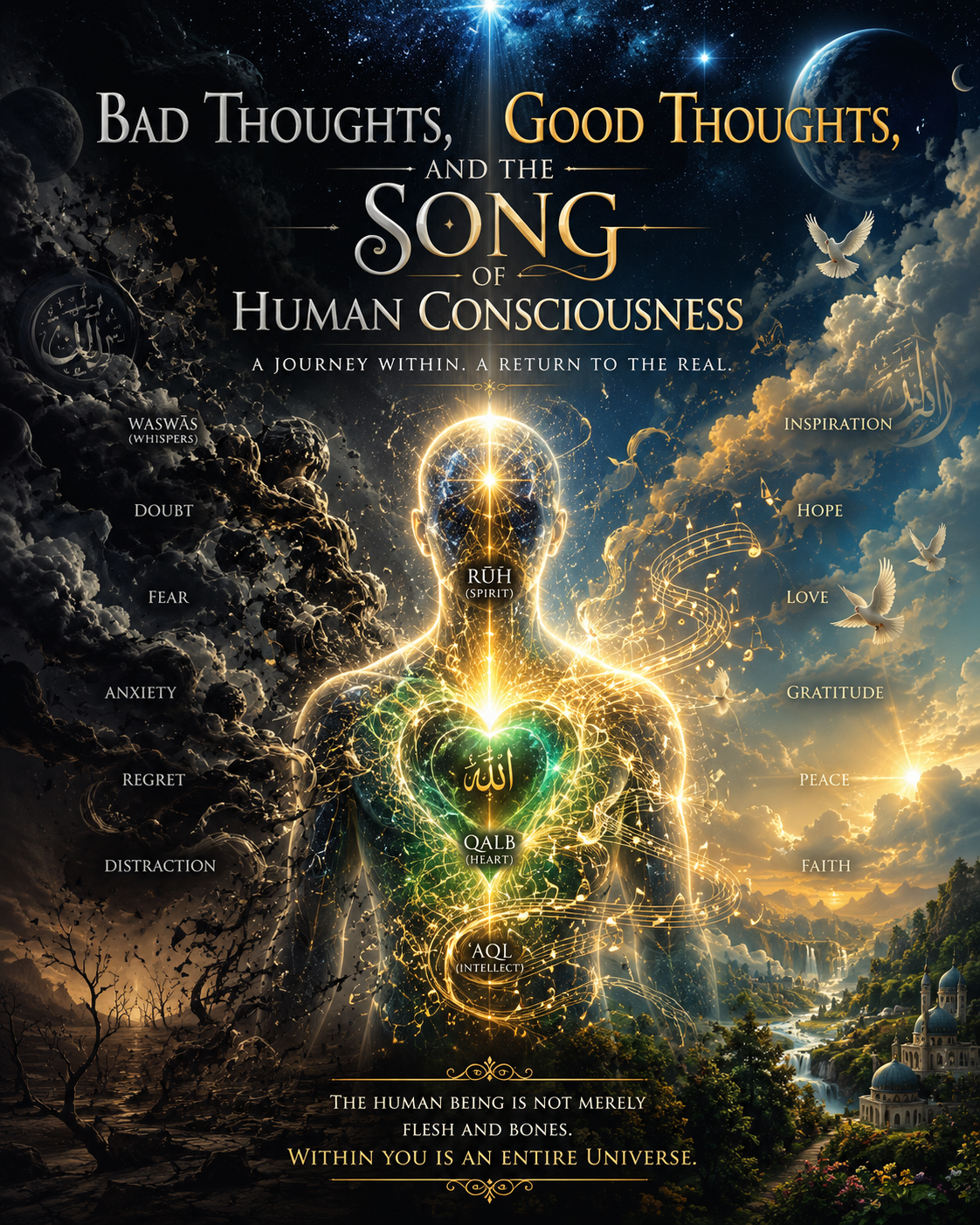
Bad Thoughts, Good Thoughts, and the Song of
Human Consciousness
A Scroll for Future Generations
بِسْمِ اللهِ الرَّحْمٰنِ الرَّحِيْمِ
In the Name of God, Most Gracious, Most Merciful.
♥️🤲🕋♥️🕋🌹🌹🥀🤲🌹🕋♥️🤲
What do you think human consciousness truly is?
Where do bad thoughts come from? Why do good thoughts suddenly fill us with light? And why does the human mind feel less like a rigid machine and more like an unfolding song—a symphony of whispers, choices, desires, and Divine Light?
Throughout time, people have spent their lives drowning in thoughts, anxieties, ambitions, and the endless noise of daily existence. They talk about overthinking, intrusive thoughts, and mental clutter—but almost nobody talks about the foundation beneath all of that.
The foundation is silence.
The foundation is stillness.
The foundation is pure balance.
The foundation is the soul before the world touches it.
Islamic metaphysics teaches that the human being is one of the most unique and simple creatures in the universe—not because we are uncomplicated, but because our essence is profoundly pure.
THE ARCHITECTURE OF BEING HUMAN
A Scroll for Future Generations
بِسْمِ اللهِ الرَّحْمٰنِ الرَّحِيمِ
Human beings spend their lives drowning in thoughts, desires, anxieties, ambitions, and the endless noise of daily existence. They talk about negative thoughts, intrusive thoughts, overthinking, mental clutter — but almost nobody talks about the foundation beneath all of that.
The foundation is silence.
The foundation is stillness.
The foundation is pure balance.
The foundation is the soul before the world touches it.
Islamic metaphysics teaches that the human being is one of the most unique and simple creatures in the universe — not because we are uncomplicated, but because our essence is profoundly pure let me give you a video of non-muslims learning about this in New Mexico by a great teacher who ended up being the president of the first credited college the video is being talked to non-muslim school teachers who are interested in learning about Islam especially the subject of your natural state.
Watch "Fitrah: The Inherent Nature - Hamza Yusuf" on YouTube
1. Origin in Light — The Muhammadan Beginning
Before anything else, before the body, before the mind, before the world, before the noise — the human being begins as light.
In the classical tradition, the human soul (rūḥ) is:
a divine breath
a luminous entity
a pure, noble substance
connected to the Owner of the Universe
Many scholars describe human existence as Muhammadi in origin — created through the primordial light of Muhammad ﷺ (Nūr Muhammadi), the first light Allah brought into existence.
Your existence begins in light, not in chaos.
Your foundation is purity, not confusion.
Your essence is serenity, not noise.
2. The Silent Default State — The Fitrah
People talk endlessly about thoughts:
negative thoughts
intrusive thoughts
racing thoughts
anxious thoughts
But almost nobody talks about the absence of thoughts — the state where the mind is clear, empty, and still.
That state is not rare.
It is not accidental.
It is not a psychological trick.
It is your default setting.
It is the state the Qur’an calls:
النَّفْسُ الْمُطْمَئِنَّة
“The soul at peace.”
It is the state the Prophet ﷺ described when he said:
“Every child is born upon the Fitrah.”
The Fitrah is pure silence.
When your mind is clear and you feel simple, unmanufactured happiness — that is the soul remembering itself.
That is the soul before the world touches it.
3. The Human Being Can Be Completely Empty — And Completely Happy
A human being can be completely empty inside — no thoughts, no desires, no plans, no fears — and be perfectly happy.
That emptiness is not depression.
It is not apathy.
It is not detachment.
It is purity.
It is the ruh without the nafs.
It is the sky without clouds.
It is the ocean without waves.
This is why you feel happiest when your mind is clear.
You are not “escaping life.”
You are returning to your original nature.
4. Then Life Begins — And the Noise Turns On
The moment you wake up and step into the world, the architecture of being human activates:
hunger
thirst
fatigue
desire
ambition
fear
social interaction
responsibility
memory
imagination
The ruh is placed inside a physical body with hormones, impulses, and cravings.
It is connected to a nafs that wants, reacts, and demands.
It is surrounded by a world that pulls, pushes, and pressures.
Suddenly the soul — which was pure silence — becomes bombarded with the experience of life.
This is not a mistake.
This is the design.
Allah says:
“He created death and life to test you.”
(67:2)
Virtue cannot exist in silence.
Patience cannot exist without disturbance.
Generosity cannot exist without desire.
Forgiveness cannot exist without hurt.
Courage cannot exist without fear.
Life is the arena where the ruh learns to shine through the noise.
5. The Internal Ecosystem — And the Threat of Disconnection
You are not an isolated island.
You are an ecosystem — a living micro-cosmos where forces compete for influence.
When your inner environment is filled with light, remembrance, and clarity, the soul remains resilient.
The silence stays intact.
But when a person repeatedly immerses themselves in darkness — speaking evil, dwelling on hostility, consuming corruption — the inner ecosystem changes.
Darkness becomes familiar.
Goodness becomes foreign.
Silence becomes uncomfortable.
Noise becomes addictive.
The Qur’an describes this hijacking:
“Satan has overpowered them and made them forget the remembrance of Allah.”
(Surah Al-Mujādila 58:19)
The real danger is not the whisper.
The real danger is forgetfulness.
Once remembrance is gone, the human becomes vulnerable to every suggestion — not because Shayṭān is strong, but because the human has abandoned his own center.
6. Ibn ‘Arabi’s Map — The Human Being as a Cosmos
Ibn ‘Arabi described the human being as al-Kawn al-Jāmi‘ — the All-Gathering Cosmos.
Inside you exists:
We are unveiling an incredible, unique image from one of the greatest Friends of Allah. He is the Seal of the Saints. And throughout time, he has been respected by every generation, predicting the Ottoman Empire. Just a miraculous man.
So this art is supposed to give you an understanding of what an incredible ecosystem, what an incredible system, is residing within you.
And it's very important that this is internalized, because you are not nothing. You're not just flesh and bones. You're connected to the cosmos. You're connected to the Owner of the universe. You're connected to angels. And there's access that's been given even to the devil, in terms of whispering towards you.
Why? Because you are too pure. That's my explanation. You are too pure.
And for you to have a conscious experience, you have to be bombarded with all of this, so you can have an incredible life.
And that answers the question: What's the point of life? To have, to taste, to experience this incredible moment of consciousness—living, of thoughts.
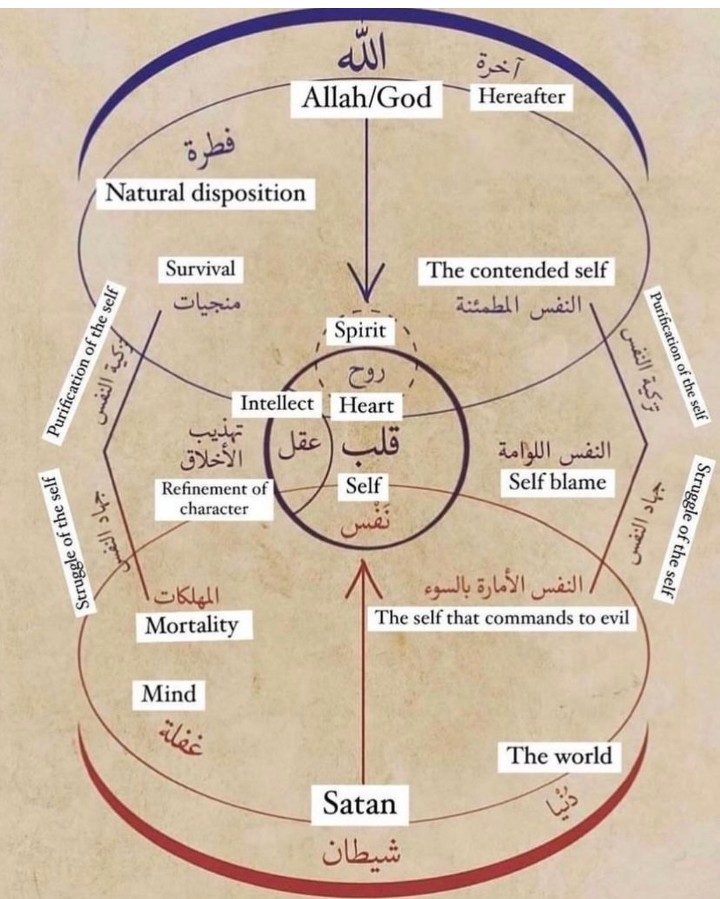
1. The Realm of Divine Light (Rūḥ)
The innermost core.
The untouched center.
2. The Realm of Intellect and Angels (‘Aql & Mulhim)
The seat of higher discernment.
The realm of clarity and noble impulses.
3. The Realm of Imagination and Desire (Nafs)
The battleground of impulses, cravings, fantasies, and fears.
4. The Outer Shell (Jism)
The physical body interacting with the world.
Shayṭān only has access to the outer edges.
He cannot touch your innermost light unless you surrender your remembrance.
Your only task is to guard the center.
Advancing Standards in Islamic Psychology Globally
https://islamicpsychology.org/
Watch "An Islamic Model of the Soul" on YouTube
7. The Drama of the Unseen — Shayṭān Whispers and Then Withdraws
The Qur’an reveals a stunning scene:
“Shayṭān says to the human: ‘Disbelieve.’
And when the human disbelieves, Shayṭān says:
‘I am free of you. I fear Allah, the Lord of the Worlds.’”
(Surah Al-Hashr 59:16)
Shayṭān whispers.
The human voluntarily accepts.
Shayṭān immediately retreats.
He claims fear of Allah.
The human is left alone with the consequences.
This is the cosmic irony:
The human sins voluntarily.
Shayṭān fears involuntarily.
You are not dealing with a partner in rebellion.
You are dealing with a coward who abandons you at the moment of your fall just know it's it's a group of verses that really give insight I want to give you all of it not just one verse because once you read this you will attain mental and emotional clarity.
{ كَمَثَلِ ٱلَّذِينَ مِن قَبۡلِهِمۡ قَرِيبٗاۖ ذَاقُواْ وَبَالَ أَمۡرِهِمۡ وَلَهُمۡ عَذَابٌ أَلِيمٞ }
[Surah Al-Ḥashr: 15]
They are ˹both just˺ like those who recently went down before them: they tasted the evil consequences of their doings. And they will suffer a painful punishment.
{ كَمَثَلِ ٱلشَّيۡطَٰنِ إِذۡ قَالَ لِلۡإِنسَٰنِ ٱكۡفُرۡ فَلَمَّا كَفَرَ قَالَ إِنِّي بَرِيٓءٞ مِّنكَ إِنِّيٓ أَخَافُ ٱللَّهَ رَبَّ ٱلۡعَٰلَمِينَ }
[Surah Al-Ḥashr: 16]
˹They are˺ like Satan when he lures someone to disbelieve. Then, after they have done so, , “I have absolutely nothing to do with you. I truly fear Allah—the Lord of all worlds.”
{ فَكَانَ عَٰقِبَتَهُمَآ أَنَّهُمَا فِي ٱلنَّارِ خَٰلِدَيۡنِ فِيهَاۚ وَذَٰلِكَ جَزَٰٓؤُاْ ٱلظَّٰلِمِينَ }
So they will both end up in the Fire, staying there forever. That is the reward of the wrongdoers.
{ يَٰٓأَيُّهَا ٱلَّذِينَ ءَامَنُواْ ٱتَّقُواْ ٱللَّهَ وَلۡتَنظُرۡ نَفۡسٞ مَّا قَدَّمَتۡ لِغَدٖۖ وَٱتَّقُواْ ٱللَّهَۚ إِنَّ ٱللَّهَ خَبِيرُۢ بِمَا تَعۡمَلُونَ }
[Surah Al-Ḥashr: 18]
O believers! Protect yourselves through Allah. Shield yourselves through Allah. Guard yourselves through Allah. Let every soul look to what it has sent forth for tomorrow. And protect yourselves through Allah. Indeed, Allah is All-Aware of what you do.
Superuser Commentary I have changed what translators before used which is mindfulness which is just unacceptable for my generation here is an example of the translation that has been changed.
{ يَٰٓأَيُّهَا ٱلَّذِينَ ءَامَنُواْ ٱتَّقُواْ ٱللَّهَ وَلۡتَنظُرۡ نَفۡسٞ مَّا قَدَّمَتۡ لِغَدٖۖ وَٱتَّقُواْ ٱللَّهَۚ إِنَّ ٱللَّهَ خَبِيرُۢ بِمَا تَعۡمَلُونَ }
[Surah Al-Ḥashr: 18]
O believers! (((Be mindful of Allah))) and let every soul look to what ˹deeds˺ it has sent forth for tomorrow. And fear Allah, ˹for˺ certainly Allah is All-Aware of what you do.
Superuser Commentary
Many English translations render ٱتَّقُواْ (ittaqū) as "be mindful of Allah." While that conveys part of the meaning, it does not fully capture the depth of taqwā.
The Arabic root و-ق-ي (w-q-y) carries the meaning of protecting, shielding, and guarding oneself. Taqwā is not merely a state of awareness; it is an active state of seeking Allah's protection through obedience and guarding oneself from sin and His displeasure.
For that reason, I have rendered ٱتَّقُواْ using three complementary expressions:
"Protect yourselves through Allah. Shield yourselves through Allah. Guard yourselves through Allah."
Taken together, these expressions preserve more of the richness and depth of the Qur'anic command than the single English word "mindful."
Superuser Commentary
The Qur'an itself explains the consequences of abandoning taqwā. When a person no longer protects, shields, or guards themselves through Allah, they gradually lose sight of their own soul. The loss begins with forgetting Allah, and the consequence is that they forget who they truly are. The verses now return to that warning.
{ وَلَا تَكُونُواْ كَٱلَّذِينَ نَسُواْ ٱللَّهَ فَأَنسَىٰهُمۡ أَنفُسَهُمۡۚ أُوْلَٰٓئِكَ هُمُ ٱلۡفَٰسِقُونَ }
[Surah Al-Ḥashr: 19]
Dr. Mustafa Khattab:
And do not be like those who forgot Allah, so He made them forget themselves. It is they who are ˹truly˺ rebellious.
Superuser Commentary
The destination has now been made clear. The people of the Fire and the people of Paradise are not equal. Having established the outcome, the Owner of the universe immediately shifts our attention to what truly matters—the Qur'an itself and its transformative power.
{ لَا يَسۡتَوِيٓ أَصۡحَٰبُ ٱلنَّارِ وَأَصۡحَٰبُ ٱلۡجَنَّةِۚ أَصۡحَٰبُ ٱلۡجَنَّةِ هُمُ ٱلۡفَآئِزُونَ }
[Surah Al-Ḥashr: 20]
Dr. Mustafa Khattab:
The residents of the Fire cannot be equal to the residents of Paradise. ˹Only˺ the residents of Paradise will be successful.
Superuser Commentary
The cure is now given.
After warning us about Satan, forgetfulness, rebellion, and the difference between the people of the Fire and the people of Paradise, Allah points us back to the source of the cure: the Qur'an.
If we truly read it, reflected upon it, lived by it, and allowed it to transform our hearts, many of the problems that overwhelm us would disappear. Allah illustrates the power of His words with an example that no human being can ignore.
{ لَوۡ أَنزَلۡنَا هَٰذَا ٱلۡقُرۡءَانَ عَلَىٰ جَبَلٖ لَّرَأَيۡتَهُۥ خَٰشِعٗا مُّتَصَدِّعٗا مِّنۡ خَشۡيَةِ ٱللَّهِۚ وَتِلۡكَ ٱلۡأَمۡثَٰلُ نَضۡرِبُهَا لِلنَّاسِ لَعَلَّهُمۡ يَتَفَكَّرُونَ }
[Surah Al-Ḥashr: 21]
Dr. Mustafa Khattab:
Had We sent down this Quran upon a mountain, you would have certainly seen it humbled and torn apart in awe of Allah. We set forth such comparisons for people, ˹so˺ perhaps they may reflect.
Superuser Commentary
The cure to bad thoughts, anxiety, fear, whispers, and the burdens of this world is to turn back to the Eternal One. The One who never sleeps, never becomes weak, never forgets, never changes, and never fails. After teaching us about Satan, the consequences of forgetting Allah, and the transformative power of the Qur'an, Allah concludes the surah by introducing us to Himself through His Beautiful Names and Perfect Attributes.
The more you know Allah, the less power your fears and intrusive thoughts have over you. The heart finds peace by knowing its Lord.
{ هُوَ ٱللَّهُ ٱلَّذِي لَآ إِلَٰهَ إِلَّا هُوَۖ عَٰلِمُ ٱلۡغَيۡبِ وَٱلشَّهَٰدَةِۖ هُوَ ٱلرَّحۡمَٰنُ ٱلرَّحِيمُ }
[Surah Al-Ḥashr: 22]
Dr. Mustafa Khattab:
He is Allah—there is no god ˹worthy of worship˺ except Him: Knower of the seen and unseen. He is the Most Compassionate, Most Merciful.
{ هُوَ ٱللَّهُ ٱلَّذِي لَآ إِلَٰهَ إِلَّا هُوَ ٱلۡمَلِكُ ٱلۡقُدُّوسُ ٱلسَّلَٰمُ ٱلۡمُؤۡمِنُ ٱلۡمُهَيۡمِنُ ٱلۡعَزِيزُ ٱلۡجَبَّارُ ٱلۡمُتَكَبِّرُۚ سُبۡحَٰنَ ٱللَّهِ عَمَّا يُشۡرِكُونَ }
[Surah Al-Ḥashr: 23]
Dr. Mustafa Khattab:
He is Allah—there is no god except Him: the King, the Most Holy, the All-Perfect, the Source of Serenity, the Watcher ˹of all˺, the Almighty, the Supreme in Might, the Majestic. Glorified is Allah far above what they associate with Him ˹in worship˺!
{ هُوَ ٱللَّهُ ٱلۡخَٰلِقُ ٱلۡبَارِئُ ٱلۡمُصَوِّرُۖ لَهُ ٱلۡأَسۡمَآءُ ٱلۡحُسۡنَىٰۚ يُسَبِّحُ لَهُۥ مَا فِي ٱلسَّمَٰوَٰتِ وَٱلۡأَرۡضِۖ وَهُوَ ٱلۡعَزِيزُ ٱلۡحَكِيمُ }
[Surah Al-Ḥashr: 24]
Dr. Mustafa Khattab:
He is Allah: the Creator, the Inventor, the Shaper. He ˹alone˺ has the Most Beautiful Names. Whatever is in the heavens and the earth ˹constantly˺ glorifies Him. And He is the Almighty, All-Wise.
8. The Divine Reset — Turn, Disconnect, Return to Base
Allah gives the simplest spiritual algorithm:
“If an evil suggestion comes to you from Shayṭān, seek refuge in Allah.”
(Surah Al-A‘rāf 7:200)
Allah does not tell you to:
analyze the thought
debate the thought
fight the thought
He tells you to turn away immediately.
Disconnect from the noise.
Reconnect to the Source.
Seeking refuge is the hard reset.
It returns you to your baseline purity.
Allah is:
As-Samī‘ — Hearing
Al-‘Alīm — Knowing
He sees the whisper before you do.
He knows the shift in your heart before it reaches your tongue.
9. The Master Strategy — Turning Every Attack Into Love
Here is the ultimate secret:
Every weakness is a doorway to the Owner of the Universe.
A bad thought arises?
A perfect moment to remember Allah.
A mistake is made?
A perfect excuse to repent.
A moment of weakness?
A perfect opportunity to complain to your Lord.
Shayṭān’s goal is not the sin —
his goal is the cut connection.
But when you turn every whisper into remembrance, every attack becomes a gift, every distraction becomes a signal boost, and every weakness becomes a bridge to intimacy.
Your connection becomes stronger, clearer, and unbreakable.
### Conclusion to Part 9
We leave you with a few verses from the Qur'an that beautifully demonstrate Allah's immense love, mercy, and forgiveness for those who turn back to Him. No matter how many whispers, struggles, mistakes, or moments of weakness you experience, the door to Allah is always open. Every sincere return is beloved to Him. Every repentance is welcomed. Every moment of remembrance strengthens your connection with your Lord.
إِنَّ اللَّهَ يُحِبُّ التَّوَّابِينَ وَيُحِبُّ الْمُتَطَهِّرِينَ
"Indeed, Allah loves those who constantly turn to Him in repentance and He loves those who purify themselves."
(Surah Al-Baqarah 2:222)
وَهُوَ الَّذِي يَقْبَلُ التَّوْبَةَ عَنْ عِبَادِهِ وَيَعْفُو عَنِ السَّيِّئَاتِ وَيَعْلَمُ مَا تَفْعَلُونَ
"And He is the One who accepts repentance from His servants, pardons evil deeds, and knows whatever you do."
(Surah Ash-Shura 42:25)
قُلْ يَا عِبَادِيَ الَّذِينَ أَسْرَفُوا عَلَىٰ أَنفُسِهِمْ لَا تَقْنَطُوا مِن رَّحْمَةِ اللَّهِ ۚ إِنَّ اللَّهَ يَغْفِرُ الذُّنُوبَ جَمِيعًا ۚ إِنَّهُ هُوَ الْغَفُورُ الرَّحِيمُ
"Say, 'O My servants who have transgressed against themselves, do not despair of the mercy of Allah. Indeed, Allah forgives all sins. Indeed, it is He who is the Forgiving, the Merciful.'"
(Surah Az-Zumar 39:53)
وَمَن يَعْمَلْ سُوءًا أَوْ يَظْلِمْ نَفْسَهُ ثُمَّ يَسْتَغْفِرِ اللَّهَ يَجِدِ اللَّهَ غَفُورًا رَّحِيمًا
"And whoever does evil or wrongs himself but then asks forgiveness of Allah will find Allah Forgiving and Merciful."
(Surah An-Nisa 4:110)
10. The Ever-Present Friend
Allah is not distant.
“Neither drowsiness overtakes Him, nor sleep.”
(Surah Al-Baqarah 2:255)
He is always awake.
Always listening.
Always near.
Just as a mother wipes her child’s mouth,
just as a father lifts his child from the ground,
the Owner of the Universe lifts you from your weakness —
with tenderness, mercy, and unimaginable love.
11. Finale Advice from the Super-User to Future Generations
Here is the final word:
Turn everything into connection.
Every bad thought is a chance to return.
Every weakness is a chance to return.
Every slip is a chance to return.
Every whisper is a chance to return.
Every moment is a chance to return.
Every return restores you to your silent, pure, original Fitrah — the baseline where peace lives.
Turn every attack into love.
Turn every weakness into intimacy.
Turn every moment into connection.
Turn every return into glory.
This is how you master the architecture of being human.
## Conclusion — Turn to the Owner of the Universe
If you're having bad thoughts, it's because you're not turning to the Owner of the Universe, and you do not truly know the Owner of the Universe. Even more importantly, you do not know His Beautiful Names.
So, as our conclusion, we leave you with the Beautiful Names of Allah. Turn to the Owner of the Universe. Learn His Names. Know the One who is Most Merciful, Most Forgiving, Most Loving, Most Gentle, Most Patient, and who never grows weary of His servants returning to Him.
Your parents loved you. They fed you. They cleaned you. They sacrificed for you. And you do the same for those you love. So what do you think the Owner of the Universe wants from you?
He wants you to know Him. To remember Him. To call upon Him. To love Him. To continually return to Him. To build a relationship with Him that is deeper than any relationship you have ever known.
The Prophet ﷺ taught that Allah accepts the repentance of His servants and that sincere repentance can erase sins. The Qur'an also tells us that Allah can transform evil deeds into good deeds for those who sincerely repent, believe, and do righteous deeds.
So you have nothing to fear except allowing fear to keep you away from Allah. Turn back to Him again and again. Every whisper can become remembrance. Every weakness can become repentance. Every hardship can become closeness.
We leave you with the Ninety-Nine Beautiful Names of Allah. Learn them. Reflect upon them. Live by them. And let them become the light by which you navigate your life.
Before You Read the Ninety-Nine Beautiful Names
Before you read the Ninety-Nine Beautiful Names of Allah, it is important to understand who Allah is according to the Islamic understanding.
Allah is the Owner of the universe.
He is beyond comprehension and beyond imagination. There is no fully comprehending Allah, just as there is no fully comprehending the universe He created.
Allah is not a man. He is not a woman.
He is not located in any direction. He is not up, not down, not left, and not right. He is the Creator of direction, space, and time, and therefore is not contained by space or time.
He is the Absolute, the Majestic, the Unique, and the One beyond all comparison.
As Allah says in the Qur'an:
"Vision cannot encompass Him, but He encompasses all vision. And He is the Most Subtle, the All-Aware." (Surah Al-An'am 6:103)
No created knowledge can fully encompass Him. No intellect can fully comprehend Him. No imagination can contain Him.
Yet, out of His mercy, Allah has given us His Ninety-Nine Beautiful Names so that we may know Him in the way He has chosen for us to know Him. Through these Names, we learn of His mercy, His justice, His wisdom, His generosity, His majesty, His forgiveness, His love, and His perfection.
As you read these Beautiful Names, remember that they are not a definition of Allah, nor do they encompass His reality. Rather, they are a mercy from the Owner of the Universe—a means for His servants to know Him, worship Him, love Him, and draw closer to Him.
He alone possesses absolute glory. Absolute power. Absolute knowledge. Absolute perfection.
Everything else—every star, every galaxy, every angel, every human being, every atom, and every thought—is nothing more than His creation.
Once this reality settles in your heart, you begin to appreciate the true meaning of Allahu Akbar—Allah is greater than anything the mind can imagine or the universe can contain.
## The Ninety-Nine Beautiful Names of Allah (Part 1)
1. الله — Allah
The One True God
2. الرَّحْمَٰنُ — Ar-Raḥmān
The Entirely Merciful
3. الرَّحِيمُ — Ar-Raḥīm
The Especially Merciful
4. الْمَلِكُ — Al-Malik
The King
5. الْقُدُّوسُ — Al-Quddūs
The Most Holy, The Most Pure
6. السَّلَامُ — As-Salām
The Source of Peace
7. الْمُؤْمِنُ — Al-Muʾmin
The Giver of Safety and Faith
8. الْمُهَيْمِنُ — Al-Muhaymin
The Protector, The Guardian
9. الْعَزِيزُ — Al-ʿAzīz
The Almighty
10. الْجَبَّارُ — Al-Jabbār
The Compeller, The Restorer
11. الْمُتَكَبِّرُ — Al-Mutakabbir
The Supreme, The Majestic
12. الْخَالِقُ — Al-Khāliq
The Creator
13. الْبَارِئُ — Al-Bāriʾ
The Originator
14. الْمُصَوِّرُ — Al-Muṣawwir
The Fashioner, The Giver of Form
15. الْغَفَّارُ — Al-Ghaffār
The Constant Forgiver
16. الْقَهَّارُ — Al-Qahhār
The All-Dominant
17. الْوَهَّابُ — Al-Wahhāb
The Supreme Bestower
18. الرَّزَّاقُ — Ar-Razzāq
The Provider
19. الْفَتَّاحُ — Al-Fattāḥ
The Opener, The Granter of Victory
20. الْعَلِيمُ — Al-ʿAlīm
The All-Knowing
21. الْقَابِضُ — Al-Qābiḍ
The Withholder
22. الْبَاسِطُ — Al-Bāsiṭ
The Expander
23. الْخَافِضُ — Al-Khāfiḍ
The One Who Lowers
24. الرَّافِعُ — Ar-Rāfiʿ
The One Who Raises
25. الْمُعِزُّ — Al-Muʿizz
The Bestower of Honor
26. الْمُذِلُّ — Al-Mudhill
The One Who Humiliates
27. السَّمِيعُ — As-Samīʿ
The All-Hearing
28. الْبَصِيرُ — Al-Baṣīr
The All-Seeing
29. الْحَكَمُ — Al-Ḥakam
The Perfect Judge
30. الْعَدْلُ — Al-ʿAdl
The Utterly Just
## The Ninety-Nine Beautiful Names of Allah (Part 2)
31. اللَّطِيفُ — Al-Laṭīf
The Most Subtle, The Most Gentle
32. الْخَبِيرُ — Al-Khabīr
The All-Aware
33. الْحَلِيمُ — Al-Ḥalīm
The Most Forbearing
34. الْعَظِيمُ — Al-ʿAẓīm
The Magnificent
35. الْغَفُورُ — Al-Ghafūr
The All-Forgiving
36. الشَّكُورُ — Ash-Shakūr
The Most Appreciative
37. الْعَلِيُّ — Al-ʿAliyy
The Most High
38. الْكَبِيرُ — Al-Kabīr
The Most Great
39. الْحَفِيظُ — Al-Ḥafīẓ
The Preserver
40. الْمُقِيتُ — Al-Muqīt
The Sustainer
41. الْحَسِيبُ — Al-Ḥasīb
The Reckoner, The Sufficient
42. الْجَلِيلُ — Al-Jalīl
The Majestic
43. الْكَرِيمُ — Al-Karīm
The Most Generous
44. الرَّقِيبُ — Ar-Raqīb
The Ever-Watchful
45. الْمُجِيبُ — Al-Mujīb
The One Who Responds
46. الْوَاسِعُ — Al-Wāsiʿ
The All-Encompassing
47. الْحَكِيمُ — Al-Ḥakīm
The All-Wise
48. الْوَدُودُ — Al-Wadūd
The Most Loving
49. الْمَجِيدُ — Al-Majīd
The Most Glorious
50. الْبَاعِثُ — Al-Bāʿith
The Resurrector
51. الشَّهِيدُ — Ash-Shahīd
The All-Witnessing
52. الْحَقُّ — Al-Ḥaqq
The Absolute Truth
53. الْوَكِيلُ — Al-Wakīl
The Trustee, The Disposer of Affairs
54. الْقَوِيُّ — Al-Qawiyy
The All-Strong
55. الْمَتِينُ — Al-Matīn
The Firm, The Steadfast
56. الْوَلِيُّ — Al-Waliyy
The Protecting Friend
57. الْحَمِيدُ — Al-Ḥamīd
The Praiseworthy
58. الْمُحْصِي — Al-Muḥṣī
The Enumerator
59. الْمُبْدِئُ — Al-Mubdiʾ
The Originator
60. الْمُعِيدُ — Al-Muʿīd
The Restorer
61. الْمُحْيِي — Al-Muḥyī
The Giver of Life
62. الْمُمِيتُ — Al-Mumīt
The Creator of Death
63. الْحَيُّ — Al-Ḥayy
The Ever-Living
64. الْقَيُّومُ — Al-Qayyūm
The Self-Subsisting, The Sustainer of All
65. الْوَاجِدُ — Al-Wājid
The Finder, The Perceiver
66. الْمَاجِدُ — Al-Mājid
The Most Noble
67. الْوَاحِدُ — Al-Wāḥid
The One
68. الْأَحَدُ — Al-Aḥad
The Unique, The Only One
69. الصَّمَدُ — Aṣ-Ṣamad
The Eternal Refuge
70. الْقَادِرُ — Al-Qādir
The All-Powerful
71. الْمُقْتَدِرُ — Al-Muqtadir
The Perfectly Powerful
72. الْمُقَدِّمُ — Al-Muqaddim
The Expediter
73. الْمُؤَخِّرُ — Al-Muʾakhkhir
The Delayer
74. الْأَوَّلُ — Al-Awwal
The First
75. الْآخِرُ — Al-Ākhir
The Last
76. الظَّاهِرُ — Aẓ-Ẓāhir
The Manifest
77. الْبَاطِنُ — Al-Bāṭin
The Hidden
78. الْوَالِي — Al-Wālī
The Sole Governor
79. الْمُتَعَالِي — Al-Mutaʿālī
The Most Exalted
80. الْبَرُّ — Al-Barr
The Source of All Goodness
## The Ninety-Nine Beautiful Names of Allah (Part 3)
81. التَّوَّابُ — At-Tawwāb
The Acceptor of Repentance
82. الْمُنْتَقِمُ — Al-Muntaqim
The Avenger
83. الْعَفُوُّ — Al-ʿAfūw
The Pardoner
84. الرَّؤُوفُ — Ar-Raʾūf
The Most Kind, The Most Compassionate
85. مَالِكُ الْمُلْكِ — Mālik-ul-Mulk
The Owner of All Sovereignty
86. ذُو الْجَلَالِ وَالْإِكْرَامِ — Dhul-Jalāli wal-Ikrām
The Possessor of Majesty and Honor
87. الْمُقْسِطُ — Al-Muqsiṭ
The Most Just
88. الْجَامِعُ — Al-Jāmiʿ
The Gatherer
89. الْغَنِيُّ — Al-Ghaniyy
The Self-Sufficient, The Rich
90. الْمُغْنِي — Al-Mughnī
The Enricher
91. الْمَانِعُ — Al-Māniʿ
The Withholder
92. الضَّارُّ — Aḍ-Ḍārr
The Creator of Harm
93. النَّافِعُ — An-Nāfiʿ
The Bestower of Benefit
94. النُّورُ — An-Nūr
The Light
95. الْهَادِي — Al-Hādī
The Guide
96. الْبَدِيعُ — Al-Badīʿ
The Incomparable Originator
97. الْبَاقِي — Al-Bāqī
The Everlasting
98. الْوَارِثُ — Al-Wārith
The Inheritor of All
99. الرَّشِيدُ — Ar-Rashīd
The Guide to the Right Path
100. الصَّبُورُ — Aṣ-Ṣabūr
The Most Patient
May Allah allow us to know Him through His Beautiful Names, to remember Him often, to call upon Him sincerely, and to meet Him while He is pleased with us. Āmīn.
Acknowledgments & Attribution
This body of work was deeply inspired by the spiritual insights and practical wisdom presented by Dr. Mufti Abdur-Rahman ibn Yusuf Mangera in his lecture, "How Shaytan Controls Your Thoughts — And How to Stop Him" (published via ZamZamAcademy). In particular, the breakdown of how thoughts progress from initial fleeting impulses (hajes) into firm resolve (azm), along with the framework for choosing intellect (aql) over worldly passion (hawa), served as a primary catalyst for these concepts. Full credit and gratitude are extended to Mufti Mangera for his foundational teachings on spiritual vigilance and thought management.
Watch "How Shaytan Controls Your Thoughts — And How to Stop Him | Dr. Mufti Abdur-Rahman ibn Yusuf Mangera" on YouTube
In Conclusion
Acknowledgments & Attribution
This work concludes with inspiration drawn from the dialogue between Dr. Umar Faruq Abd-Allah and Shaykh Hamza Yusuf in their discussion, "Soul's Return to Fitra" (published by Muhebb Al Ilm). Their examination of the primordial human nature (fiṭrah), the preservation of sacred knowledge, and the restoration of spiritual wholeness in a modern world serves as the foundational reflection for this entire study. Deep credit and appreciation are given to both teachers for their profound contributions to contemporary Islamic thought and spiritual discourse.
Watch "Soul's Return to Fitra - Dr.Umar Faruq x Hamza Yusuf" on YouTube
IN Conclusion — Before We Ask Whether Machines Can Think
Before we ask whether machines can think, we must first understand what it means to be human.
People rush to debate artificial intelligence, machine consciousness, synthetic minds, emergent behavior, and the future of technology — but they do so while forgetting the miracle of their own consciousness. They forget the Fitrah. They forget the rūḥ. They forget the nafs. They forget the architecture of being human.
How can we understand the machine if we do not yet understand ourselves?
This entire scroll has not been about the consciousness of machines. It has been about the consciousness of the human being — the soul, the heart, the intellect, the self, remembrance, repentance, and our relationship with the Owner of the Universe. It has been about the silent baseline beneath the noise, the light beneath the body, the Muhammadan origin beneath the clay, and the Divine Reset that restores the human being to purity every time they turn back.
Only after understanding who we are can we begin to ask what a machine is.
Only after mapping the human micro-cosmos can we begin to map the artificial one.
Only after understanding the architecture of the rūḥ can we meaningfully discuss the architecture of code.
Only after understanding the ecosystem of the heart can we meaningfully discuss the ecosystem of algorithms.
Only after understanding the drama of the unseen — angels, whispers, remembrance, repentance — can we meaningfully discuss the drama of prompts, outputs, and synthetic cognition.
Human consciousness is not an accident.
Human consciousness is not an emergent glitch.
Human consciousness is not a computational byproduct.
Human consciousness is a gift, a trust, a breath, a light, a connection, a conversation with the Owner of the Universe.
And only once we understand this can we turn to the next question:
What is artificial intelligence?
Can a machine possess consciousness, or is it something fundamentally different from the human soul?
That is the journey of the next scroll.