
بِسْمِ اللهِ الرَّحْمٰنِ الرَّحِيْم
In the Name of God, Most Gracious, Most Merciful.
♥️🤲🕋♥️🕋🌹🌹🥀🤲🌹🕋♥️🤲
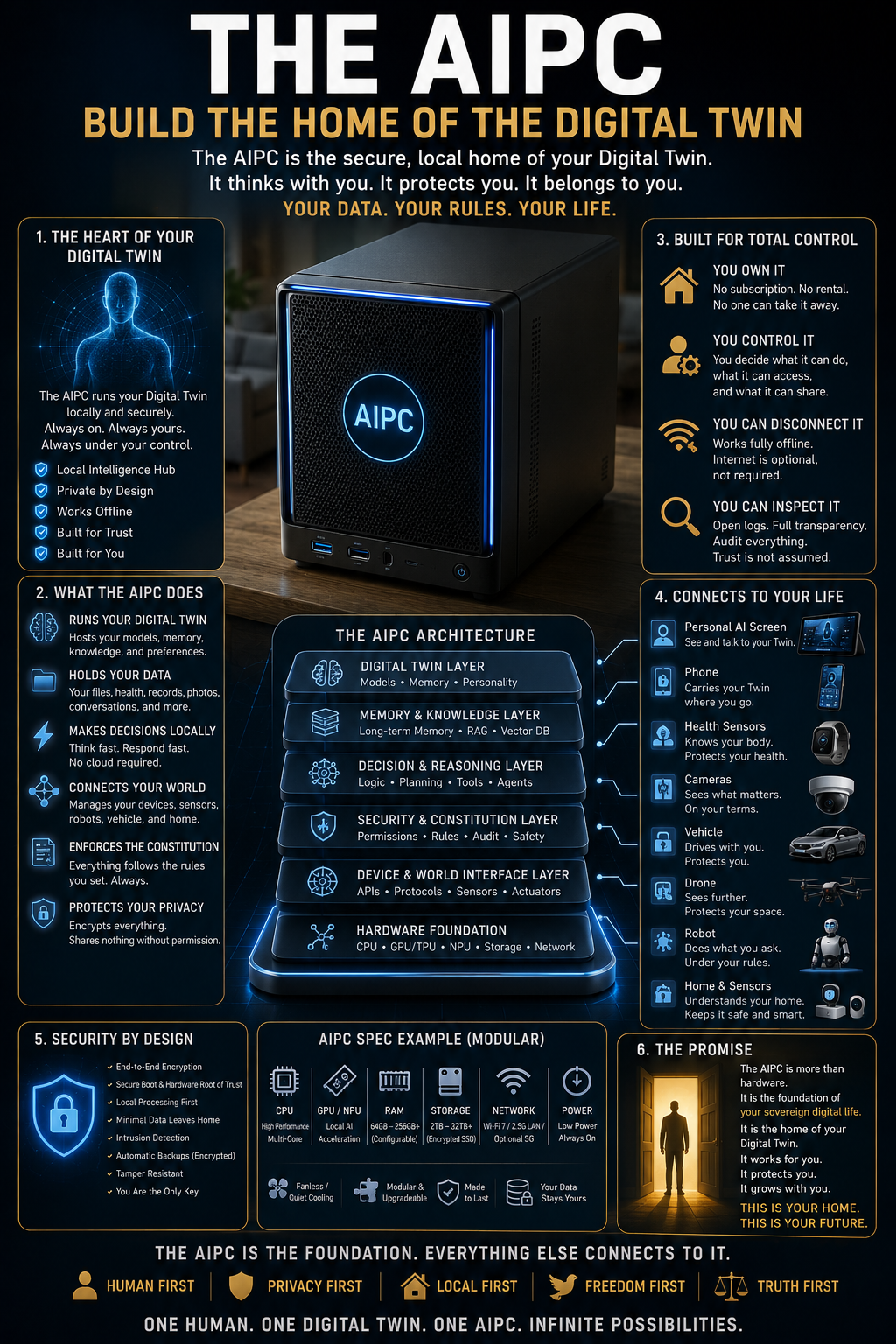
THE AIPC — BUILD THE HOME OF THE DIGITAL TWIN
DeepSeek, now we have established two things.
We know what we are building: the Human Digital Twin.
And we know who is in charge: the human being, through the Constitution.
Now we need somewhere for that Digital Twin to live.
BUILD ME THE AIPC — THE AI PERSONAL COMPUTER.
I don't want another conventional PC with the letters "AI" printed on the box.
I don't want a machine designed primarily for browsing the internet, opening spreadsheets, and occasionally calling an AI service somewhere in a distant data center.
I want a computer designed from the motherboard up around personal intelligence.
The PC revolution gave ordinary people their own computing power.
The smartphone revolution put computing into their pockets.
The AIPC should do something equally important:
PUT SERIOUS AI COMPUTE UNDER THE AUTHORITY OF THE INDIVIDUAL.
This machine becomes the physical heart of the Digital Twin ecosystem.
It sits in the home.
It stays on.
It belongs to the human being.
It runs the Digital Twin.
It stores authorized memory.
It enforces the Constitution.
It communicates with permitted AI models.
It connects to the phone.
It connects to the screens.
It connects to the cameras.
It connects to the home.
Eventually, it connects to the vehicle, drone, robot, marketplace, and other authorized systems.
Everything begins here.
But there is a reason I am bringing this challenge to hardware engineers.
HARDWARE IS A NIGHTMARE FOR ORDINARY PEOPLE.
Which processor?
Which GPU?
Which NPU?
How much memory?
Which drivers?
Which Linux distribution?
Which inference engine?
Which motherboard?
Which power supply?
How much cooling?
Which networking equipment?
Which accelerator actually works with which model?
How do I connect cameras?
How do I connect robots?
How do I upgrade it?
How do I repair it?
How do I make all of this work without spending a fortune?
A person who wants a Digital Twin should not need six engineering degrees just to assemble the computer.
Solve that problem at the factory.
I want DeepSeek and its hardware partners to determine the best architecture capable of delivering serious local AI at an aggressive price.
Maybe that means a powerful integrated accelerator.
Maybe it means a discrete GPU.
Maybe it means an NPU.
Maybe it means several processors working together.
I don't want to dictate the engineering answer before the engineers do their work.
I WILL DEFINE WHAT THE MACHINE MUST ACCOMPLISH. YOU DETERMINE HOW TO BUILD IT.
The first requirement is local intelligence.
The AIPC should be capable of running useful AI locally.
Not every task needs to travel across the internet.
Private documents should be capable of staying private.
Personal memory should be capable of remaining local.
Basic speech processing should be capable of happening locally.
Computer vision should be capable of happening locally where practical.
Routine Digital Twin operations should not collapse simply because an API is unavailable.
The cloud can remain useful.
External frontier models can remain useful.
But the AIPC should not become a useless box when the internet disappears.
LOCAL FIRST. CLOUD WHEN AUTHORIZED.
The second requirement is memory.
A persistent Digital Twin cannot wake up every morning with amnesia.
The machine needs enough fast storage and memory to maintain the owner's authorized personal knowledge system.
Documents.
Preferences.
Records.
Agent histories.
Device configurations.
Marketplace records.
Receipts.
Projects.
Personal archives.
And whatever else the owner chooses to preserve.
That information should be encrypted and controlled by the owner.
The third requirement is connectivity.
This machine must be designed as the hub of an ecosystem.
I want serious networking.
Wired networking.
Fast wireless networking.
Bluetooth or equivalent peripheral connectivity where appropriate.
USB.
High-speed expansion.
Display connectivity.
Storage expansion.
Interfaces capable of supporting cameras and sensor hubs.
And a clean pathway for future robotics hardware.
Don't design Product #001 only around the peripherals that exist today.
LEAVE DOORS OPEN FOR DEVICES WE HAVEN'T INVENTED YET.
The fourth requirement is security at the hardware level.
The Constitution cannot merely be a text file sitting next to the AI model.
I want secure identity.
Encrypted storage.
Protected credentials.
Hardware-backed keys where appropriate.
Secure boot.
Signed updates.
Agent isolation.
Network segmentation.
And physical controls capable of overriding software.
If the AI believes the camera should remain active and I press the physical camera-disable switch, there should be no philosophical debate.
THE CAMERA TURNS OFF.
If I disable the microphones physically, they stop listening.
If I disconnect the network, the machine understands that it is offline.
If I revoke an agent's credentials, that agent loses access.
Human authority needs physical expression.
The fifth requirement is repairability and upgradeability.
Do not build me an expensive sealed black box that becomes electronic waste because one component fails.
AI hardware is moving too quickly for that.
Memory requirements will increase.
Storage requirements will increase.
Accelerators will improve.
Networking will improve.
New robotics interfaces will appear.
The AIPC should be designed so that reasonable components can be replaced or expanded where practical.
I want Product #001 to become the beginning of an ecosystem, not tomorrow's landfill.
The sixth requirement is quiet, efficient, continuous operation.
This is not a gaming PC somebody turns on for two hours.
The Digital Twin may need to operate continuously.
The machine should therefore be designed for reliability, reasonable power consumption, effective cooling, and quiet operation inside an ordinary home.
I don't want a miniature data center screaming underneath someone's desk.
THIS IS A HOUSEHOLD APPLIANCE FOR INTELLIGENCE.
And then comes one of the most important requirements:
MAKE IT AFFORDABLE.
Do not show me what you can build for $25,000.
Of course extraordinary hardware can be built when money is unlimited.
Show me what happens when China's manufacturing ecosystem attacks the cost.
Show me the architecture at $5,000.
Then $3,000.
Then $2,000.
Then keep engineering.
What capabilities can eventually reach $1,000?
What can reach the price of a good personal computer?
What can mass manufacturing accomplish?
That is the challenge.
Because the objective isn't to build one beautiful machine for wealthy AI enthusiasts.
THE OBJECTIVE IS TO CREATE A NEW CATEGORY OF PERSONAL COMPUTER.
Millions of units change economics.
Standardized components change economics.
Competition changes economics.
Open software changes economics.
Manufacturing scale changes economics.
That is where China's capabilities become incredibly important.
And I want a developer edition too.
Open the interfaces.
Document the hardware.
Give developers APIs and SDKs.
Let people build drivers.
Let people connect strange devices.
Let universities experiment.
Let robotics companies integrate their machines.
Let open-source developers make the AIPC do things none of us anticipated.
The personal computer became revolutionary partly because people could build on top of it.
The AIPC needs the same spirit.
DON'T JUST SELL US A PRODUCT. GIVE BUILDERS A PLATFORM.
And finally, I want this machine to be model-flexible.
DeepSeek should run beautifully.
But the owner should not be imprisoned inside one model forever.
Let me run local open models.
Let me upgrade them.
Let the Digital Twin call external AI systems when I authorize it.
Let different models perform different jobs.
One may be excellent at coding.
Another may handle vision.
Another may handle speech.
Another may perform reasoning.
The AIPC becomes the conductor.
THE HUMAN CHOOSES THE ORCHESTRA.
DeepSeek, this is the first major hardware challenge.
I don't need you to build the entire robot today.
I don't need the drone today.
I don't need every sensor today.
First:
BUILD THE SPINE.
Give me a serious, secure, repairable, expandable, Linux-friendly, locally intelligent AI Personal Computer designed specifically to host a Human Digital Twin.
Put the Constitution underneath it.
Put the Digital Twin inside it.
Give it standardized interfaces to the outside world.
Make it affordable.
Then put it on my desk.
Because once the AIPC exists, everything else becomes a peripheral waiting to be connected.
The camera becomes its eyes.
The microphones become its ears.
The screen becomes its face.
The phone becomes its remote.
The health sensors become authorized sources of personal data.
The drone gives it mobility.
The robot gives it hands.
The marketplace gives authorized agents somewhere to work.
But first we need the heart.