

بِسْمِ اللهِ الرَّحْمٰنِ الرَّحِيْم
Welcome to the Tafsir of Surah Al-Fatiha
We have covered the first verse, where we recognized that no translation can fully capture the depth of its meaning. Every word in Arabic carries layers of significance, and when it is translated into English, much of its linguistic beauty, grammatical precision, and spiritual weight is reduced.
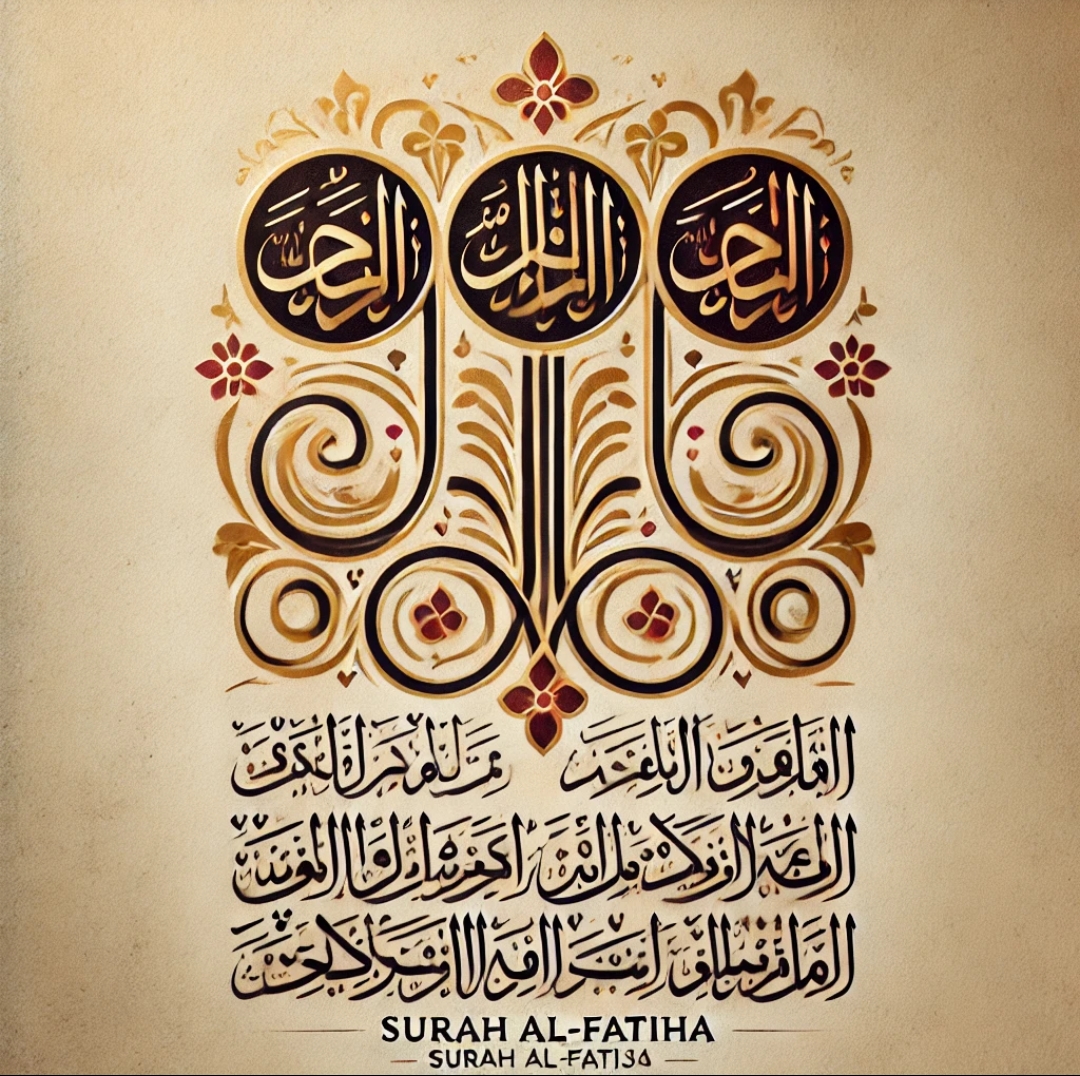
For example, the word ٱلۡحَمۡدُ (Al-Ḥamd) is often translated as "Praise," but this is insufficient.
Al-Ḥamd is not just praise—it is praise mixed with gratitude, a recognition of perfection, ownership, and constant favor.
To pin it to one English word would be to limit its meaning.
Thus, an improved translation would be:
"Al-Ḥamd belongs to Allah, Lord of the Universe."
This verse places us in the present tense, actively engaging with the Owner of all things. The journey of Surah Al-Fatiha begins with presence—with gratitude, awareness, and acknowledgment of the One who governs all existence.
---
The Divine Love and Mercy in the Next Verse
Once you are present with the Owner of the Universe, the next verse calls upon Him with His Names of Mercy:
{ ٱلرَّحۡمَٰنِ ٱلرَّحِيمِ }
[Surah Al-Fātihah: 3]
Translation (Abdul Haleem):
"The Lord of Mercy, the Giver of Mercy."
However, even this translation does not fully capture its meaning.
Breaking Down the Names of Mercy
1. ٱلرَّحۡمَٰنِ (Ar-Raḥmān) – "The Infinitely Merciful"
From the root ر-ح-م (r-ḥ-m), which is also the root of رحم (Raḥim – womb).
This mercy is vast, overflowing, and universal—it encompasses all of creation.
Just as a womb nurtures and protects without the child even asking, Allah's mercy covers all things without exception.
2. ٱلرَّحِيمِ (Ar-Raḥīm) – "The Ever-Merciful"
Also from ر-ح-م (r-ḥ-m), but in the fa‘īl form, which signifies continuity and consistency.
Unlike Ar-Raḥmān, which applies to all of creation, Ar-Raḥīm is a specific, reserved mercy for the believers.
This is the mercy that will be shown on the Day of Judgment, to those who sought Allah’s guidance.
---
The Mercy That Extends to Judgment Day
After contemplating Allah’s Mercy, the next verse reminds you of a moment when you will need it the most:
{ مَٰلِكِ يَوۡمِ ٱلدِّينِ }
[Surah Al-Fātihah: 4]
Translation (Abdul Haleem):
"Master of the Day of Judgment."
This shifts your awareness—you were in praise, then in mercy, and now you are in accountability.
You have been reflecting on Allah’s mercy, and now you are reminded that one day, you will stand before Him.
You will need that mercy when all help is stripped away, and only divine judgment remains.
Notice the structure:
1. First, you recognize Allah as the Owner of the Universe.
2. Then, you recognize His Mercy.
3. Now, you recognize His Judgment.
Each verse connects and prepares you for the next, guiding you through the emotions of prayer.
---
Turning From Judgment Day to Seeking Help
Now that you have been taken to the ultimate reality—Judgment Day, the next verse brings you back to your present moment, showing you how to prepare for that Day:
{ إِيَّاكَ نَعۡبُدُ وَإِيَّاكَ نَسۡتَعِينُ }
[Surah Al-Fātihah: 5]
Translation (Abdul Haleem):
"It is You we worship; it is You we ask for help."
After being reminded of the final judgment, you are taught how to seek salvation:
1. "إِيَّاكَ نَعۡبُدُ" (It is You we worship) → Directs your heart to exclusive devotion.
2. "وَإِيَّاكَ نَسۡتَعِينُ" (It is You we ask for help) → Directs your soul to dependence on Allah alone.
The contrast is striking—on the Day of Judgment, there will be no help except the help of Allah.
You are now being taught that the only way to succeed on that Day is to worship and rely on Allah now.
---
The Only Help That Matters
Since you now know where to seek help, the next verse shows you the ultimate request to make:
{ ٱهۡدِنَا ٱلصِّرَٰطَ ٱلۡمُسۡتَقِيمَ }
[Surah Al-Fātihah: 6]
Translation (Abdul Haleem):
"Guide us to the straight path."
After acknowledging:
Who Allah is (Rabb of the Universe),
What He gives (Mercy),
What awaits us (Judgment),
What we must do (Worship and Seek Help)—
You are now taught the most important prayer of all:
💡 Guidance.
This is the key to success on Judgment Day.
This is the direction every soul must seek.
This is the essence of life itself—to stay on the path that leads to Allah’s pleasure.
---
The Interconnection of These Verses
Surah Al-Fatiha is a journey:
1. You begin with gratitude → "Al-Ḥamd belongs to Allah, the Lord of all worlds."
2. You recognize mercy → "The Infinitely Merciful, the Ever-Merciful."
3. You are brought to Judgment Day → "Master of the Day of Judgment."
4. You declare worship and dependence → "It is You we worship, and You we ask for help."
5. You seek the only thing that matters → "Guide us to the straight path."
Each verse is connected to the next, guiding you through the realities of existence and how to navigate them with faith.
---
Final Reflection: Standing in Prayer
When you recite these verses in prayer, understand that:
You are not just reading words.
You are traveling through divine realities.
You are recognizing who Allah is, what He gives, and what is required of you.
You are preparing your soul for the Day you will meet Him.
Next time you stand for Salah, recite Surah Al-Fatiha with full presence.
📖 Read it again now:
ٱلۡحَمۡدُ لِلَّهِ رَبِّ ٱلۡعَٰلَمِينَ
"Al-Ḥamd belongs to Allah, Lord of the Universe."
ٱلرَّحۡمَٰنِ ٱلرَّحِيمِ
"The Infinitely Merciful, the Ever-Merciful."
مَٰلِكِ يَوۡمِ ٱلدِّينِ
"Master of the Day of Judgment."
إِيَّاكَ نَعۡبُدُ وَإِيَّاكَ نَسۡتَعِينُ
"It is You we worship; it is You we ask for help."
ٱهۡدِنَا ٱلصِّرَٰطَ ٱلۡمُسۡتَقِيمَ
"Guide us to the straight path."
Let it sink into your heart. Let it shape your prayer.
Surah Al-Fatiha, often referred to as "The Opening," holds a central place in Islamic worship and theology. Its seven verses encapsulate the essence of the Quran's guidance, serving as a comprehensive prayer for divine assistance and mercy.
Hadith on the Divine Response to Al-Fatiha
A profound Hadith Qudsi highlights the intimate dialogue between the worshipper and Allah during the recitation of Al-Fatiha. The Prophet Muhammad (peace be upon him) conveyed that Allah responds to each verse recited:
When the servant says, "Praise be to Allah, the Lord of all the worlds," Allah responds, "My servant has praised Me."
Upon saying, "The Most Compassionate, the Most Merciful," Allah replies, "My servant has extolled Me."
When declaring, "Master of the Day of Judgment," Allah states, "My servant has glorified Me."
As the servant continues, "You alone we worship, and You alone we ask for help," Allah affirms, "This is between Me and My servant, and My servant will have what he has asked for."
Finally, when requesting, "Guide us to the straight path," Allah concludes, "This is for My servant, and My servant will have what he has asked for."
This Hadith underscores the reciprocal nature of the prayer, emphasizing that each verse of Al-Fatiha elicits a direct and personal response from Allah.
Linguistic Insights
The structure of Al-Fatiha is meticulously crafted, guiding the believer through a journey of recognition, supplication, and commitment:
1. Praise and Gratitude: The opening verses acknowledge Allah's sovereignty and mercy, setting a tone of reverence.
2. Solemn Commitment: Declaring exclusive worship and seeking assistance signifies the servant's dedication and reliance on the Creator.
3. Supplication for Guidance: The plea for guidance reflects the believer's awareness of human limitations and the need for divine direction.
Each verse builds upon the previous, creating a cohesive prayer that encompasses the core tenets of faith and practice.
Integration in Daily Worship
Al-Fatiha is integral to the Muslim's daily prayers (Salah), recited in every unit (Rak'ah). Its repeated use reinforces its significance and serves as a constant reminder of the believer's relationship with Allah. The Hadith emphasizes that the prayer is incomplete without the recitation of Al-Fatiha, highlighting its essential role in worship.
Conclusion
Surah Al-Fatiha serves as a foundational element in Islamic spirituality, encapsulating the essence of the Quran's message. Its recitation fosters a profound connection between the servant and the Creator, offering a comprehensive framework for worship, supplication, and reflection.
Conclusion: One Verse Remains
We have now covered six verses of Surah Al-Fatiha, each unfolding a journey of presence, mercy, accountability, worship, and guidance. From recognizing Allah’s sovereignty to seeking His divine direction, this Surah has shaped the way we stand before our Creator in prayer and in life.
But one verse remains. The final verse of Surah Al-Fatiha seals this journey, defining the path we must follow and the paths we must avoid.
Join us in the next chapter, where we complete this divine opening and uncover its full meaning.
See you in the next chapter.