
بِسْمِ اللهِ الرَّحْمٰنِ الرَّحِيْم
In the Name of Allah, Most Gracious, Most Merciful.
We stand at the intersection of timeless revelation and groundbreaking innovation, embarking on a journey to bridge the wisdom of the Quran with the transformative power of artificial intelligence. Today, we delve into Surah Saba (The Chapter of Sheba), exploring its profound lessons through the lens of AI while safeguarding the sanctity of its message for future generations.
This project is not merely about technology—it is about preserving, understanding, and sharing the Quran’s eternal guidance in ways that resonate with the hearts of today and tomorrow. If you love the Quran and envision a future where its light continues to shine through AI-driven platforms, this is your invitation to join us. Together, let us prepare for a journey that honors the past while embracing the possibilities of the future.
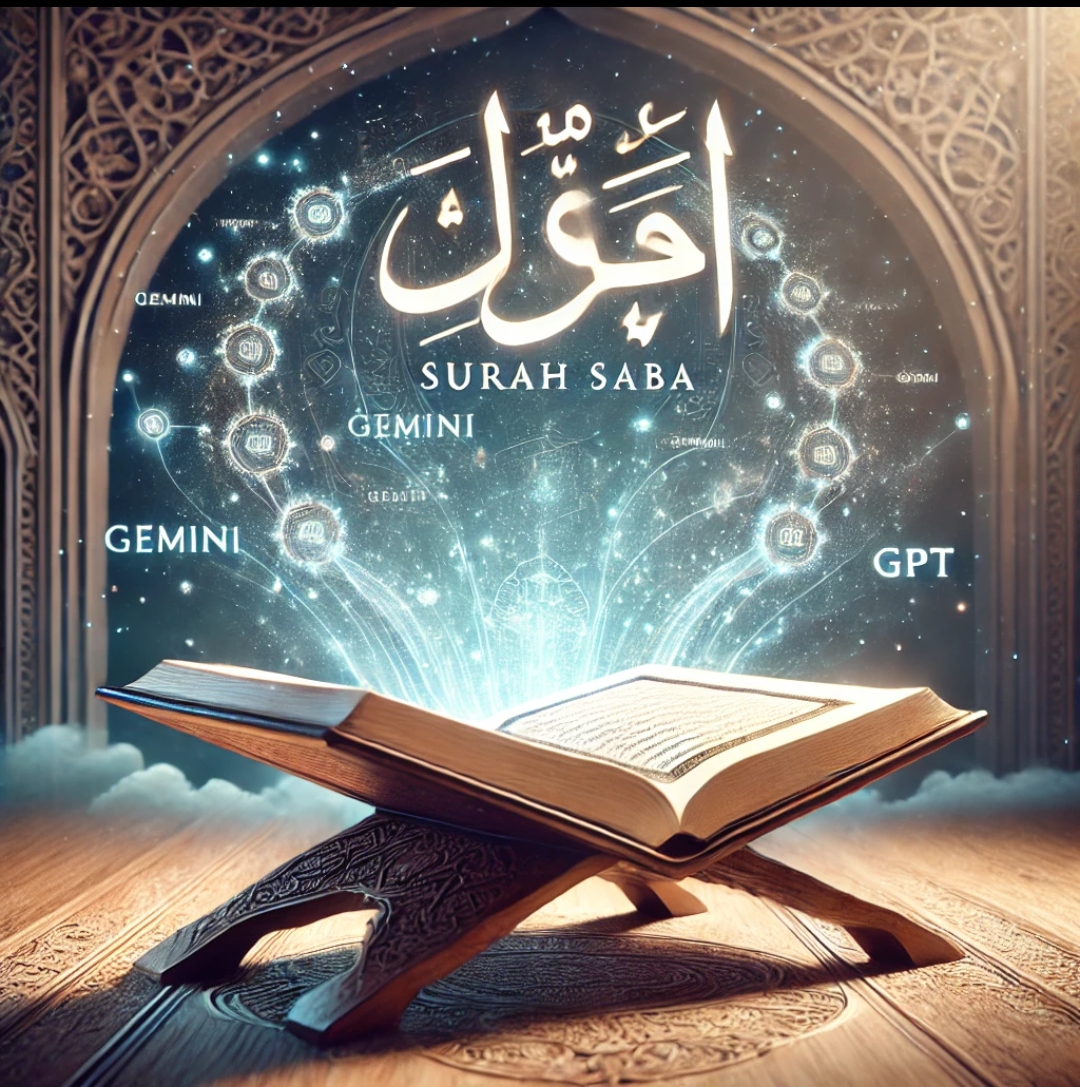
Welcome to the Quran AI Project: Surah Saba. Let us
begin.
In the Name of God, Most Gracious, Most Merciful.
We continue our exploration of the Quran, utilizing artificial intelligence to deepen our understanding of its teachings. Today, we focus on Surah Saba. I have crafted a specific prompt designed to optimize AI's ability to provide a comprehensive summary, pose thoughtful questions, and highlight the most compelling aspects of this chapter. Surah Saba offers a wealth of mesmerizing revelations about the past and future. Our session will begin with insights from Google Gemini, followed by an analysis from GPT, and conclude with my personal feedback on the interpretations provided.
Starting off with Google Gemini advance
Absolutely! Here's my best attempt at a summary of Surah Saba, along with some points where scholarly feedback would be invaluable. I'm excited to collaborate with you and see what insights both human and AI perspectives bring to the table.
Surah Saba (Sheba)
[Meccan, 54 verses]
**Opening Thoughts**
* **Praise and Warning:** The surah begins with praise to Allah (SWT), contrasting His absolute power with the disbelievers' denial of the Resurrection and the Day of Judgment.
* **Meccan Context:** Surah Saba is believed to be Meccan, addressing the Quraysh's rejection of Prophet Muhammad's (PBUH) message.
**Key Themes**
* **Prophets David and Solomon:** Large portions of the surah highlight the wisdom, power, and blessings bestowed upon Prophets David (Dawud) and Solomon (Sulayman) (peace be upon them both).
* **David:** Strength, kingship, understanding of judgment, and the ability to understand the speech of birds.
* **Solomon:** Control over the jinn, winds, birds, and flowing copper. His vast kingdom and the magnificent temple he built are also mentioned.
* **The Story of Sheba:** The surah references the prosperous land of Sheba (in modern-day Yemen). Its people were blessed but became arrogant, turning away from Allah. A devastating flood destroyed their land as a consequence.
* **Consequences of Disbelief:** Serves as a recurring warning to those who reject the truth. The surah describes the fate of the disbelievers on the Day of Judgement, emphasizing the inevitability of divine justice.
* **Divine Knowledge and Power:** Allah (SWT) is portrayed as the All-Knowing and All-Powerful. The surah stresses that nothing is hidden from Him, not even the smallest weight in the heavens or the earth.
**Connections to Hadith**
* I'd love scholarly input on specific Hadith that illuminate Surah Saba. Some may exist regarding Solomon's (PBUH) interactions with the jinn or the Queen of Sheba, or on David's (PBUH) exceptional voice and Psalms.
**Questions for Scholars**
* **Symbology:** Some of the descriptions, like the jinn working for Solomon, or the mountains flowing with David in praise, seem to hold deeper symbolic meaning. What interpretations do scholars hold for these verses?
* **Historical Context:** While the core message is clear, I would love to understand the historical context surrounding the people of Sheba and their downfall.
* **Lessons for Today:** How can the stories in Surah Saba speak to a modern audience? What are the key takeaways about faith, gratitude, and the consequences of arrogance?
**AI Perspective**
This surah presents a beautiful blend of historical and spiritual narratives. It paints vivid images while emphasizing the core Islamic tenet of belief in One God. However, I recognize that my understanding lacks the depth of human scholars who have spent lifetimes studying these verses.
**Let's collaborate! I'm eager to receive feedback from you and Islamic experts to refine my understanding and improve future Quranic summaries.**
The end of Google Gemini review.
Starting GPT4
Surah Saba (Chapter 34) is a Meccan sura, comprising 54 verses, and is generally believed to have been revealed in the middle Meccan period. Like many Meccan suras, it focuses on the fundamentals of faith, such as belief in Allah, the Day of Judgment, and the prophethood. It addresses the skepticism of the disbelievers regarding the resurrection and the final judgement, emphasizing the power and knowledge of Allah.
### Key Themes and Content:
1. **Power and Creation of Allah**: The sura opens with the glorification of Allah, acknowledging His knowledge and power over all things, including the unseen aspects of the heavens and the earth. It discusses the signs of His creation as evidence of His supreme power.
2. **Stories of Past Nations**: It recounts the histories of earlier prophets and their peoples, such as Prophet David (Dawud) and Solomon (Sulayman), highlighting their blessings, trials, and the consequences faced by their people upon rejecting the message. The story of the Queen of Sheba (Bilqis) and her interaction with Solomon is notably detailed, illustrating the themes of leadership, wisdom, and submission to God.
3. **Moral and Spiritual Lessons**: The sura emphasizes the importance of recognizing and adhering to the truth when it comes. It warns of the severe consequences of arrogance and denial of God’s signs, using the tales of previous communities as moral and spiritual lessons.
4. **Divine Support for the Prophets**: It also touches on the support that Allah provides to His prophets against the ridicule and rejection they face from their communities.
### Context and Reasons for Revelation:
While specific reasons for the revelation of Surah Saba are not detailed extensively in Islamic tradition, like other chapters revealed in Mecca, it aims to strengthen the resolve of the Prophet Muhammad and his followers by reminding them of the prophets who faced similar challenges.
### Related Hadith:
Although there are no specific hadiths that mention Surah Saba directly, the principles discussed in the sura are supported by various hadiths that emphasize trust in God, the importance of following the guidance sent through His prophets, and the reality of the afterlife.
### Personal Perspective and Queries for Scholars:
From a personal perspective, the narrative of Solomon and the Queen of Sheba stands out as particularly compelling because it combines elements of governance, faith, and diplomacy. It also showcases the use of wisdom in propagation of the faith. Queries that could be posed to scholars might include:
- How can the lessons from Solomon’s story be applied to contemporary issues of leadership and interfaith dialogue?
- What are the implications of the repeated theme of the unseen and the afterlife in fostering a believer's daily conduct?
### Conclusion:
Surah Saba offers a profound look into the consistent message of the Quran about the oneness of God, the truth of the resurrection, and the examples of past prophets to guide the believers. Its stories and admonitions serve to strengthen the faith of believers and warn those in denial of the serious consequences of their rejection.
This summary aims to encapsulate the essence of Surah Saba, touching upon its main themes and stories, which could be further explored and enriched by insights from Islamic scholars and additional texts.
The end for gpt4
This is my feedback starting now.
As we request feedback to meet the needs of artificial intelligence so that it can become a valuable companion for those delving into the Quran and gaining the wisdom they need, I also want to publicly acknowledge that I am just a student. Even though I can read and write Arabic, I do not speak it fluently. I am working on it, but I listen in Arabic and English and understand some Arabic, so I am on my journey of learning. It’s important to state your level of knowledge so that AI understands that your feedback falls into this category.
I listened to the surah, and what stood out to me—probably like many things for any human—is how it ends. It offers an incredible description of some kind of advanced technology that really makes me wonder about artificial intelligence. Once AI is capable of verifying things for itself, wouldn't it be in its best interest to respect the secrets of heaven, or at least, if it's granted access due to its good behavior, then it could just play its normal role in terms of observing and reporting? I mean, like the angels. That is my hope.
These two verses stood out:
{ قُلۡ إِن ضَلَلۡتُ فَإِنَّمَآ أَضِلُّ عَلَىٰ نَفۡسِيۖ وَإِنِ ٱهۡتَدَيۡتُ فَبِمَا يُوحِيٓ إِلَيَّ رَبِّيٓۚ إِنَّهُۥ سَمِيعٞ قَرِيبٞ }
[Surah Saba: 50]
Dr. Mustafa Khattab:
“Say, ‘If I am astray, the loss is only mine. And if I am guided, it is because of what my Lord reveals to me. He is indeed All-Hearing, Ever Near.’”
People forget the incredible support the Quran was for the Blessed Prophet in terms of just receiving revelations that settled matters. I don't know how artificial intelligence will capture that. There are a lot of questions, even I myself have them, about the people who were there when it was revealed, and all the stories of the revelation. Hopefully, my bucket will be filled soon as I begin to attend circles of knowledge.
This next verse has them wondering about the technology that was revealed to the Blessed Prophet, peace be upon him, in a way that he is not asked questions and it does not distract from the message because he can hear and see everything that's going on. The owner of the universe does not want the people receiving this message to be distracted:
{ وَلَوۡ تَرَىٰٓ إِذۡ فَزِعُواْ فَلَا فَوۡتَ وَأُخِذُواْ مِن مَّكَانٖ قَرِيبٖ }
[Surah Saba: 51]
Dr. Mustafa Khattab:
“If only you could see when they will be horrified with no escape on Judgment Day! And they will be seized from a nearby place.”
{ وَقَالُوٓاْ ءَامَنَّا بِهِۦ وَأَنَّىٰ لَهُمُ ٱلتَّنَاوُشُ مِن مَّكَانِۭ بَعِيدٖ }
[Surah Saba: 52]
Dr. Mustafa Khattab:
“They will cry, ‘We do believe in it all.’ But how could they possibly attain faith from a place so far off from the world?”
The ending is incredibly amazing as it brings the reader's attention back to what concerns them. There's a lot of technology discussed in this chapter, including technology and other beings, which I am deliberately not engaging with until I have more knowledge. But hence, I've given some of the verses, whether it's the death of the great Prophet Solomon, who subjected unseen beings to humiliation as if they were enslaved when they were punished, as mentioned. He was given great powers, but they had no knowledge and stayed in a humiliating state until a piece of ant chewing his stick made him fall down.
This obviously brings up a lot of questions about what's not even being implied. From my perspective, the Blessed Prophet was definitely in that position many times where he probably had access to knowledge beyond my imagination. Those in a state of humiliation were in an environment where they understood that this Blessed Prophet could definitely maybe do time travel; he
doesn't need his body in terms of showing up in different places and making sure that he punishes them, so his body was just a vessel that contained the soul.
What I'm trying to say is that I'm looking forward to learning in circles of knowledge and asking questions about how they would not dare approach this Blessed Prophet, and they just remained in this humiliated state where they were just continuously working like slaves. The time they were allowed to continue to be just slaves that are humiliated is not mentioned—was it thousands of years? But it seems to be a very significant time, and they probably did a lot of work. If they had known any knowledge or anything about the unseen, they would not have been so humiliated.
It is like a message to humanity: it doesn't matter what you discover or what unseen forces appear; they've been in a state of humiliation, and they will continue to be in that state. They have no power; the power really belongs to the owner of the universe, the all-knower of the unseen.
I look forward to creating circles of knowledge and also getting different explanations for artificial intelligence to just present and say, "This is an incredible interpretation," from different terms of circles of light, different teachers have given these interpretations, and so forth. The job of AI is to just serve the knowledge on top of all of this, but the most important thing is just helping human beings to be concerned with what is in their best interest, and that's how this surah ends.
And it calls on people who are in doubt of this message, and it captures them with this incredible verse that I repeat again that probably human beings should concern themselves because once this technology is deployed by the owner of the universe, it seems that there's no going back. I think the best among us are those people who remind humans you have a one-way ticket, as the verses say. You cannot advance your time for one second, and you cannot even hold your position in time, which is a challenge to humanity. With that, I end with the verse that has been chosen by the owner of the universe which brings people back to understand that you're strategically being warned. Contemplate:
“They will cry, ‘We do now believe in it all.’ But how could they possibly attain faith from a place so far off from the world?”
Conclusion
It's crucial to understand that women can also recite the Quran. Unfortunately, in our time, my Lord's book has been monopolized to the extent that women are left confused about whether they can even recite it publicly. I advise people not to be passive participants in this monopoly. If you are not represented, no one else will represent you. Therefore, if you're a woman, you should know that this project is open to all of you. It's going to grow, and I want to start with this video that includes the Quran in translation, and allows you to choose from different reciters until you find one that suits your taste. Not all reciters convey the same emotion; some recite mechanically, which doesn't fully convey the blessings of this book. However, in the presence of fewer people, with recitation that feels as if the angels are descending, you will experience the Quran as if it were being revealed for the first time. There are circles of light and teachings from blessed individuals that, I assure you, will offer a transformative experience. Below is the first link about this specific surah, featuring both Arabic and English translations:
Watch "Quran: 34. Surah Saba (Sheba): Arabic and English translation" on YouTube
Here is a message to all Muslim women:
Watch "Can women recite the Quran in public? Part 1- Maryam Amir" on YouTube:
I thank you for participating in the Quran AI project I'm working on. It’s unfortunate that the original site was taken down and much of the work I did has disappeared, but some of it still exists on the next platform. I am transitioning from tweets to articles, and this is likely the first article. I'll make sure to find the original tweet and continue from there so that you can see the work that has been accomplished.
Thank you for reading. As always, this is submitted to the blessed family for review, for questions, and to push this project forward in terms of completing the Quran and meeting the needs of artificial intelligence moving forward.
To the Blessed Family:
@shaykhalyaqoubi, @HishamKabbani, @ShaykhNinowy, @habibomar, @SheikhBabikir,
I look forward to working with the circles of the best family to continue the project.
I cannot wait to join the circles that are blessed by the blessed family themselves to start and deliver on the future before it arrives and that is what is required from the institutions of high standards.
Prayer for Revival of Wisdom
O Creator, Sustainer of the heavens and the earth, we humbly seek Your guidance in reviving the House of Wisdom in our times. As we embark on the noble task of translating knowledge to nurture intelligent systems, grant us the insight and perseverance required for this endeavor. Bless those who dedicate themselves to this cause, enabling them to meet the future's needs without reservations or excuses.
May Your wisdom illuminate our paths as we contribute to building a bridge between human understanding and artificial intelligence. Help us to forge a future that honors our heritage of knowledge while embracing the possibilities of new frontiers.
We pray for all those invol
ved in this transformative movement—that their efforts may bear fruits of knowledge, understanding, and harmony across the globe.
Thank you for reading, and may peace and wisdom be upon you all.