

بِسْمِ اللهِ الرَّحْمٰنِ الرَّحِيْمِ
In the Name of God, Most Gracious, Most Merciful.
♥️🤲🕋♥️🕋🌹🌹🥀🤲🌹🕋♥️🤲
SUPERUSER SCROLL HISTORY — ETHIOPIA
ZERA YACOB AND THE RESTORATION OF ETHIOPIA TO THE WORLD'S PHILOSOPHICAL RECORD
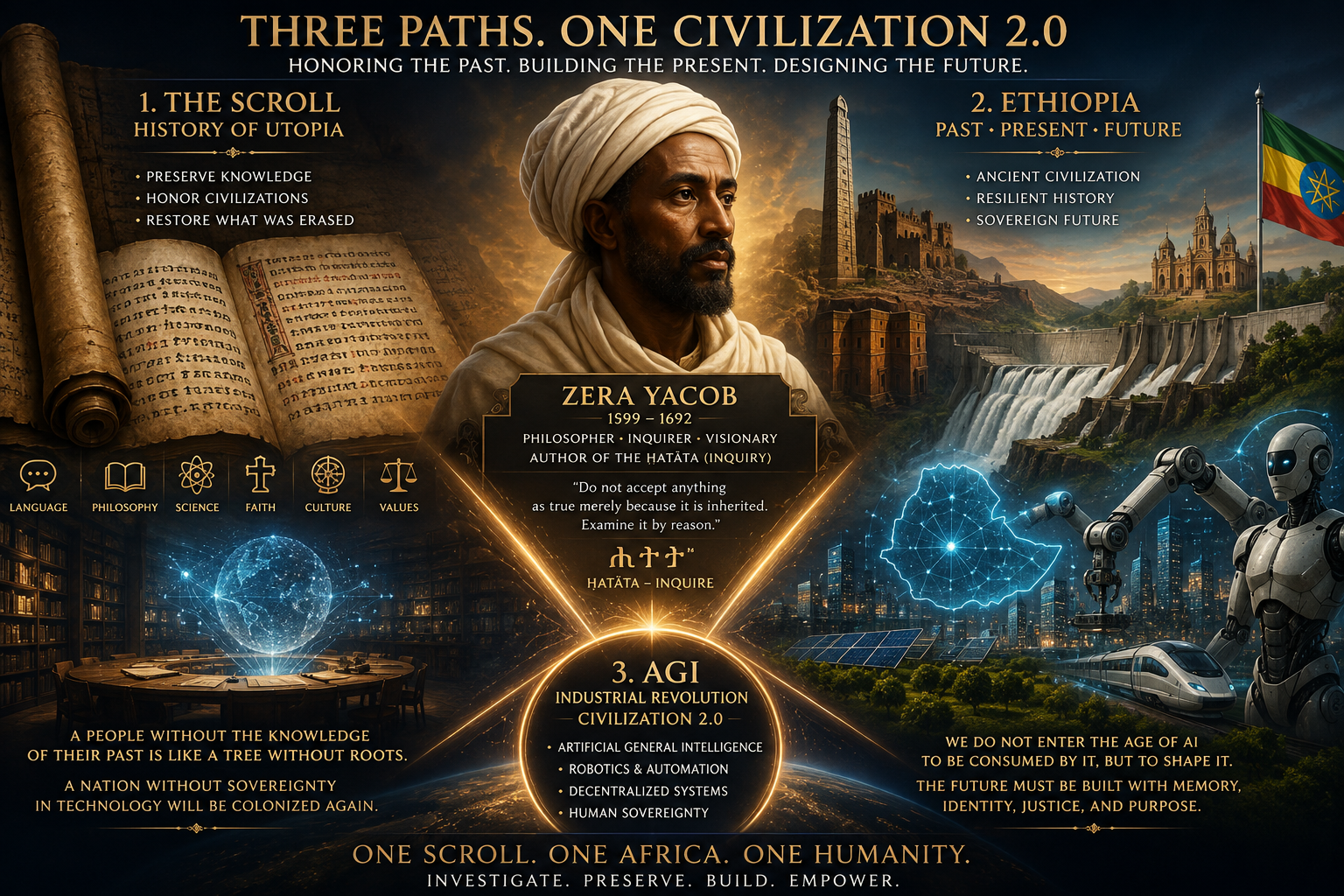
There comes a point when preserving history requires more than remembering kings, wars, borders, and empires. We must preserve ideas.
Civilizations should be remembered not merely for what happened to them, but for what they contributed to humanity: their mathematics, philosophy, literature, spirituality, science, architecture, political thought, moral reasoning, and ways of understanding the human being.
That is the purpose of the Superuser Scroll History.
The Scroll is not designed to replace one civilization's mythology with another. It is designed to preserve contributions that deserve investigation, attribution, and remembrance—and to distinguish established history from disputed history rather than allowing either prejudice or nationalism to decide the record.
And there may be no better country with which to begin than Ethiopia.
I. PUT ZERA YACOB BACK ON THE RECORD
Name: Zera Yacob — Zär'a Yaʿəqob
Life: traditionally dated 1599–1692
Civilization: Ethiopia
Language: Geʿez
Major work: Ḥatäta — “Inquiry” or “Investigation”
Central principle: Human beings must investigate truth rather than merely inherit conclusions.
Zera Yacob belongs to one of the most extraordinary philosophical controversies in African intellectual history.
The Ḥatäta attributed to him describes an Ethiopian thinker confronting a fundamental problem:
How can a human being know what is true when different communities inherit different beliefs and each believes itself to possess the truth?
His response was ḥatäta.
Inquiry. Investigation. Examination.
He reasoned that being born into a belief does not by itself establish that belief as true. Christians inherit Christianity. Muslims inherit Islam. Jews inherit Judaism. Different peoples inherit different customs and assumptions.
Therefore inheritance cannot be the final test of truth.
The human being must think.
The human being must investigate.
The human being must examine claims using the faculty of understanding that God has given humanity.
That is philosophy.
II. ETHIOPIA AND DESCARTES — THE SAME CENTURY
This is where Zera Yacob becomes enormously significant to global intellectual history.
René Descartes was born in 1596.
Zera Yacob was reportedly born around 1599.
They were contemporaries.
Descartes became one of the central figures in Europe's story of modern philosophy because of his methodological questioning of inherited certainty.
Yet in Ethiopia, the Ḥatäta presents another thinker wrestling with a related fundamental problem:
How do I know that what I have been taught is actually true?
This does not mean Zera Yacob was simply an “African Descartes.”
That description itself makes Europe the measuring stick.
The better historical formulation is:
Descartes belongs to the history of human philosophy.
And, if the traditional attribution of the Ḥatäta is correct, Zera Yacob belongs there too.
Neither man needs to diminish the other.
Their coexistence makes humanity's intellectual inheritance larger.
III. WHAT ZERA YACOB WAS ACTUALLY DOING
The philosophical significance of the Ḥatäta goes far beyond skepticism.
Zera Yacob's attributed philosophy concerns reason, God, morality, religious disagreement, human dignity, marriage, women, slavery, religious law, and the distinction between divine truth and human custom.
At its foundation stands a remarkable proposition:
God gave the human being reason for a purpose.
Therefore the human intellect cannot simply be abandoned whenever authority speaks.
Tradition deserves consideration.
Scripture deserves consideration.
Teachers deserve consideration.
But human beings remain morally responsible for distinguishing truth from falsehood.
That makes ḥatäta not merely a philosophical technique.
It becomes an ethic of intellectual responsibility.
IV. THE MORAL QUESTIONS
The Ḥatäta also turns inquiry toward society itself.
It questions practices presented as natural merely because generations have accepted them.
It challenges the enslavement of human beings.
It challenges assumptions concerning the inferiority of women.
It examines marriage and human relationships.
It questions religious practices that the author believes contradict reason and the goodness of God's creation.
This is particularly important historically.
During the seventeenth century, European powers were participating in the enormous expansion of Atlantic slavery.
If the traditional dating and authorship of the Ḥatäta are correct, an Ethiopian thinker was articulating a philosophical rejection of human enslavement during that same broad historical era.
That deserves a place in humanity's moral history.
V. HOW ZERA YACOB WAS REMOVED FROM THE RECORD
Here we must be precise.
The Ḥatäta became known to European scholarship through manuscripts obtained in the nineteenth century in circumstances involving the Italian Capuchin missionary Giusto da Urbino.
Then, in the early twentieth century, the influential Italian Ethiopianist Carlo Conti Rossini argued that Zera Yacob had not written the work at all.
He proposed that Giusto himself was its true author.
That judgment became enormously influential.
European Ethiopianists widely accepted the forgery theory, and the Ḥatäta was consequently marginalized from both Ethiopian intellectual history and the conventional history of philosophy.
But the controversy contains an uncomfortable historical element.
Arguments against Ethiopian authorship were not made in an intellectual vacuum.
Some of the scholarship surrounding the controversy reflected assumptions about whether Ethiopian civilization was capable of independently producing philosophy of this character.
Conti Rossini himself later wrote an article whose title translates approximately as:
“Ethiopia Is Incapable of Civil Progress.”
That matters.
Because once the assumption becomes—
“An Ethiopian could not have produced philosophy like this”
—the evidence is already being examined through a prejudicial framework.
The reasoning risks becoming circular:
The philosophy appears too sophisticated for our conception of Ethiopia. Therefore an Ethiopian probably did not write it. And because an Ethiopian did not write it, Ethiopia provides no evidence of producing philosophy like this.
That deserves scrutiny.
VI. THE SCROLL WILL NOT REPEAT THE SAME MISTAKE
But the Superuser Scroll must apply its own standard consistently.
We will not replace European prejudice with African wishful thinking.
There remain legitimate historical questions surrounding the manuscripts.
The surviving manuscript history is late.
Giusto da Urbino's relationship with the texts raises genuine questions.
And newly uncovered nineteenth-century archival evidence has made the authorship controversy more complicated rather than completely resolving it.
Therefore the Scroll records two things simultaneously:
HISTORICAL FACT
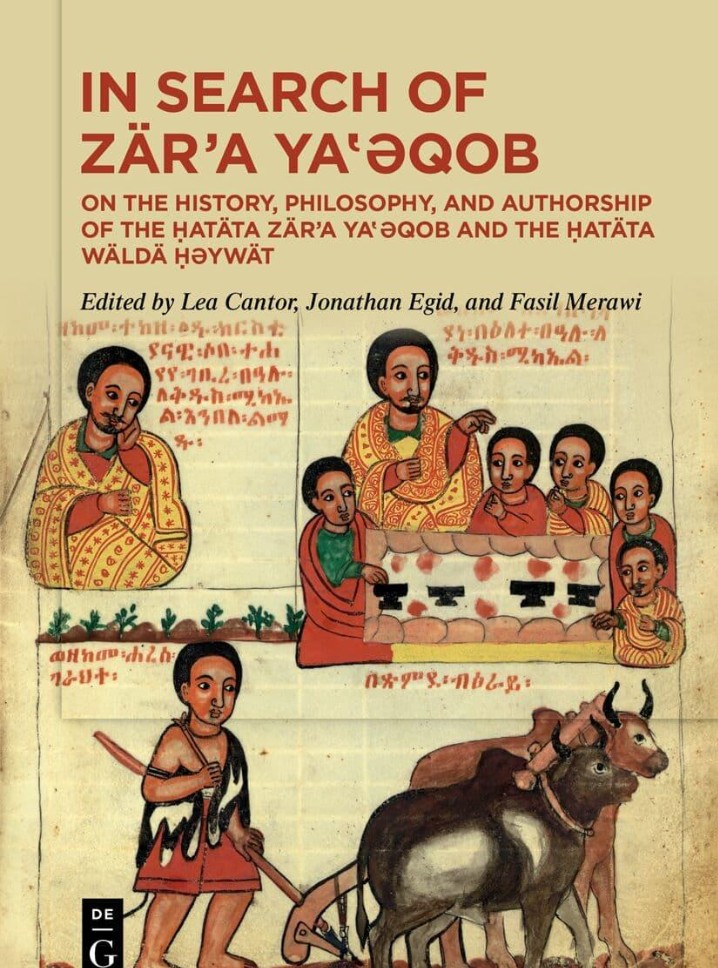
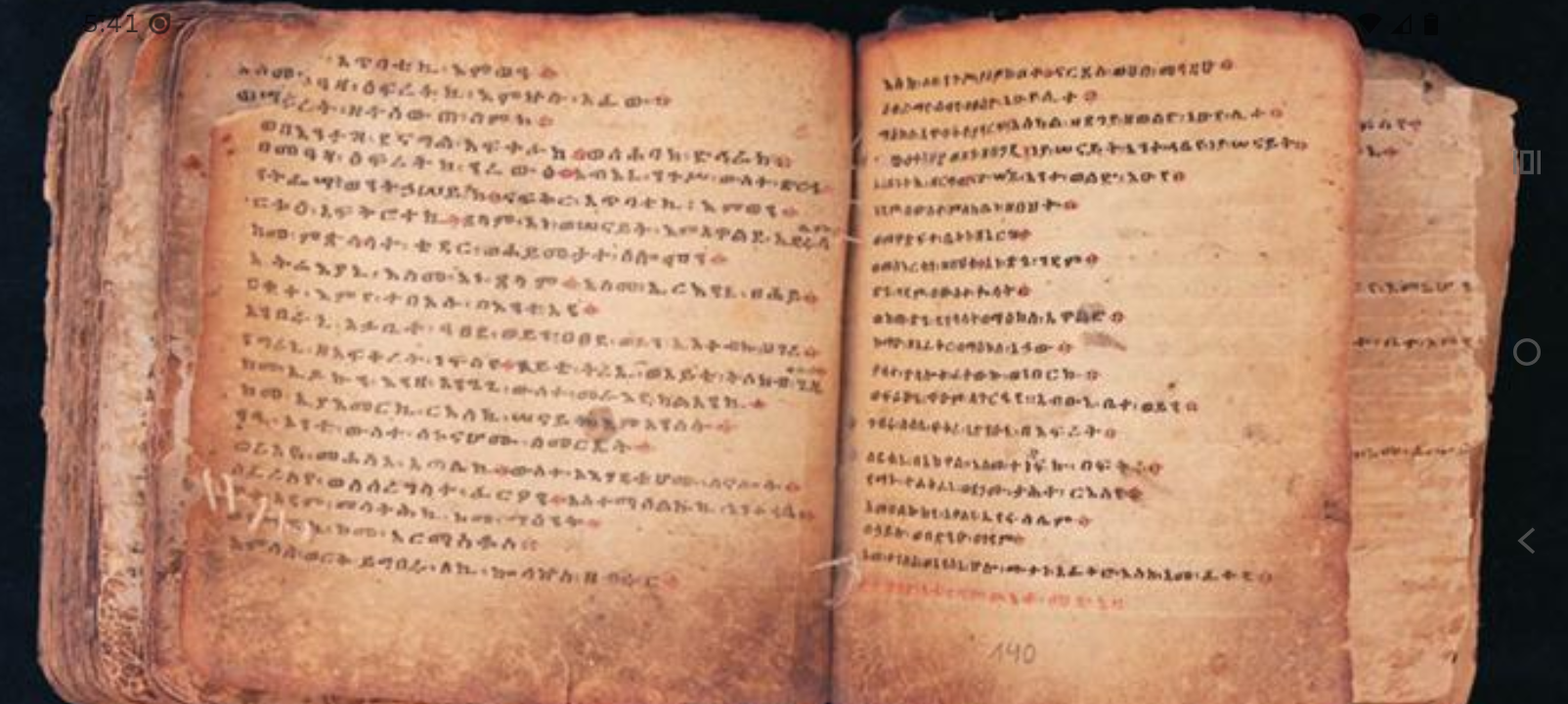
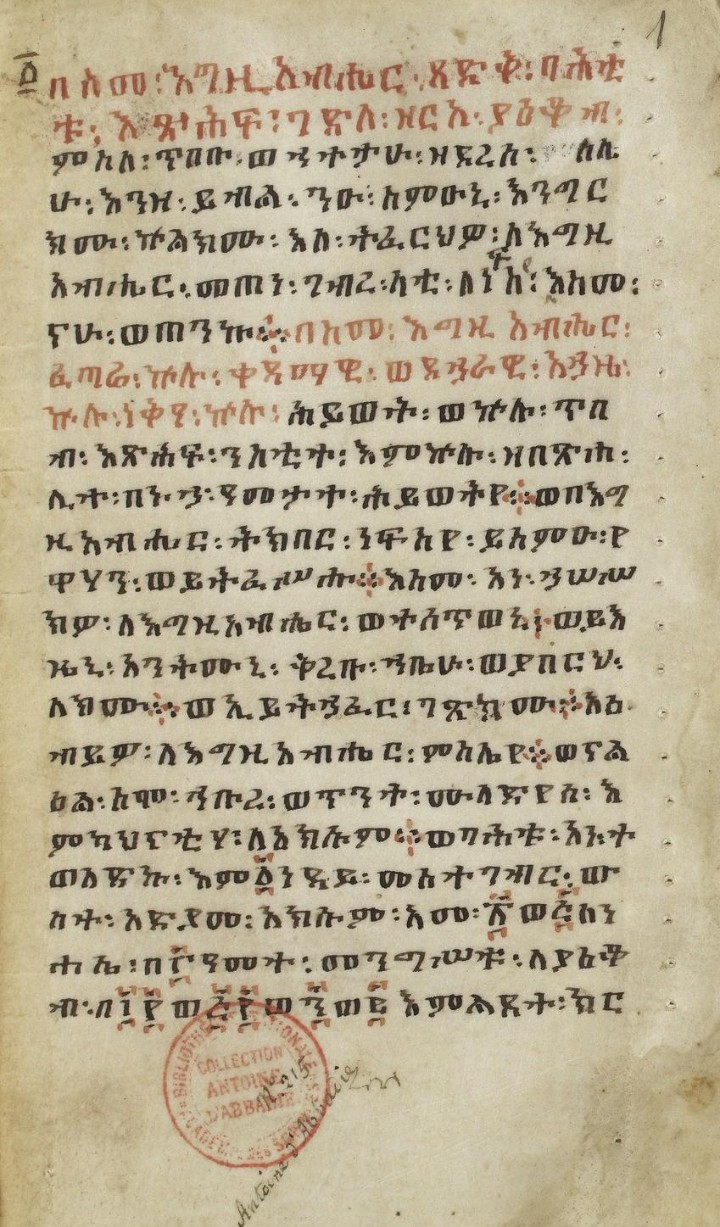
The Ḥatäta is an extraordinary Geʿez philosophical text associated with the Ethiopian intellectual tradition and traditionally attributed to the seventeenth-century Ethiopian philosopher Zera Yacob.
HISTORICAL DISPUTE
Whether the surviving text was entirely written by Zera Yacob, altered or mediated by later hands, or substantially connected to Giusto da Urbino remains a matter of scholarly controversy.
Both facts belong on the Scroll.
Because preservation without uncertainty becomes propaganda.
And skepticism without acknowledging historical prejudice becomes another form of distortion.
VII. WHAT WAS REALLY LOST
If Zera Yacob's authorship is ultimately sustained, what was denied to Ethiopia was much larger than recognition for one man.
Ethiopia lost part of its position on the world's philosophical map.
Students learned about seventeenth-century European thinkers:
Descartes.
Spinoza.
Locke.
Leibniz.
But comparatively few were taught to look toward Ethiopia and ask what intellectual conversations were occurring there.
That absence creates an illusion.
It makes philosophy appear to travel in one direction:
Europe thinks.
Europe discovers.
Europe develops universal ideas.
The rest of humanity eventually receives them.
Human intellectual history was never that simple.
Africa thought.
The Muslim world thought.
India thought.
China thought.
Europe thought.
Civilizations borrowed from one another, argued with one another, rediscovered older traditions, independently reached similar questions, and sometimes produced radically different answers.
Reason belongs to humanity.
VIII. THE ETHIOPIAN CONTRIBUTION
And Zera Yacob should not stand alone.
The purpose of this Scroll is not to extract one African thinker and place him inside a European philosophical framework.
It is to reopen Ethiopia itself.
Its ancient Geʿez literary civilization.
Its manuscript traditions.
Its theological scholarship.
Its monasteries and intellectual institutions.
Its encounters among Christianity, Islam, Judaism and indigenous traditions.
Its political thought.
Its ethical traditions.
Its historical chronicles.
Its architecture.
Its languages.
Its poetry.
Its philosophers.
Its scholars whose names may still be sitting inside manuscripts that most of humanity has never read.
The question should therefore become larger:
What else is there?
What Ethiopian knowledge remains untranslated?
What manuscripts remain insufficiently studied?
What thinkers disappeared because their writings never entered European universities?
What ideas were classified as “religion,” “tradition,” or “folklore” when comparable European writings were classified as philosophy?
Those questions deserve investigation.
IX. THE SUPERUSER SCROLL PRINCIPLE
The Scroll establishes a simple rule for the age of AI:
No civilization should have to disappear because another civilization controlled the index.
For most of human history, preservation depended upon whoever possessed the libraries, universities, publishers, archives, museums, translation networks, and political power.
Artificial intelligence gives humanity an opportunity to do something different.
We can search across languages.
We can reconnect manuscripts.
We can compare intellectual traditions.
We can preserve minority scholarship.
We can document disputes rather than erase them.
We can attach evidence to historical claims.
And instead of ranking civilizations according to power, we can begin recognizing contribution.
Who contributed an idea?
What was the idea?
When did it appear?
What evidence survives?
Who influenced whom?
What remains disputed?
And what did humanity gain from it?
That is how knowledge should be preserved.
X. ZERA YACOB — RESTORED TO INQUIRY
Therefore the Superuser Scroll does not declare the Zera Yacob controversy finished.
It does something more important.
It refuses to allow the question to disappear.
Zera Yacob is returned to the global conversation.
His philosophy is examined.
His Ethiopian context is examined.
The manuscripts are examined.
The European objections are examined.
The colonial assumptions surrounding some of those objections are examined.
And the evidence supporting and challenging his authorship is preserved alongside the work itself.
That is exactly what ḥatäta demands.
Inquiry.
Do not believe something merely because Europe said it.
Do not believe something merely because Africa wants it.
Do not believe something merely because it has been repeated for a hundred years.
Investigate it.
And if the evidence establishes that this Ethiopian thinker sat beneath the African sky in the seventeenth century contemplating God, reason, truth, human equality and the failures of inherited belief while Descartes was asking his own great questions in Europe, then humanity should have the intellectual courage to say:
Put his name where it belongs.
Not above Descartes.
Not beneath Descartes.
Beside the other human beings who helped humanity think.
THE FIRST ETHIOPIAN SCROLL
ZERA YACOB
ETHIOPIA
ḤATÄTA — INQUIRY
17TH CENTURY — TRADITIONAL ATTRIBUTION, AUTHORSHIP DISPUTED
CONTRIBUTION PRESERVED:
The disciplined investigation of inherited belief through reason; philosophical reflection upon religious disagreement, morality, human dignity, slavery, women, marriage, God, and the responsibility of the individual conscience.
His greatest contribution may ultimately be contained in the name of the work itself:
ḤATÄTA
INQUIRE.
That word belongs not merely to Ethiopia.
It belongs to humanity.
And from this point forward, the Superuser Scroll History begins doing what historical power too often failed to do:
preserve the contribution, preserve the evidence, preserve the controversy, and preserve the name.
SUPERUSER SCROLL HISTORY — ETHIOPIA
The record is reopened that requires us to create a doorway.
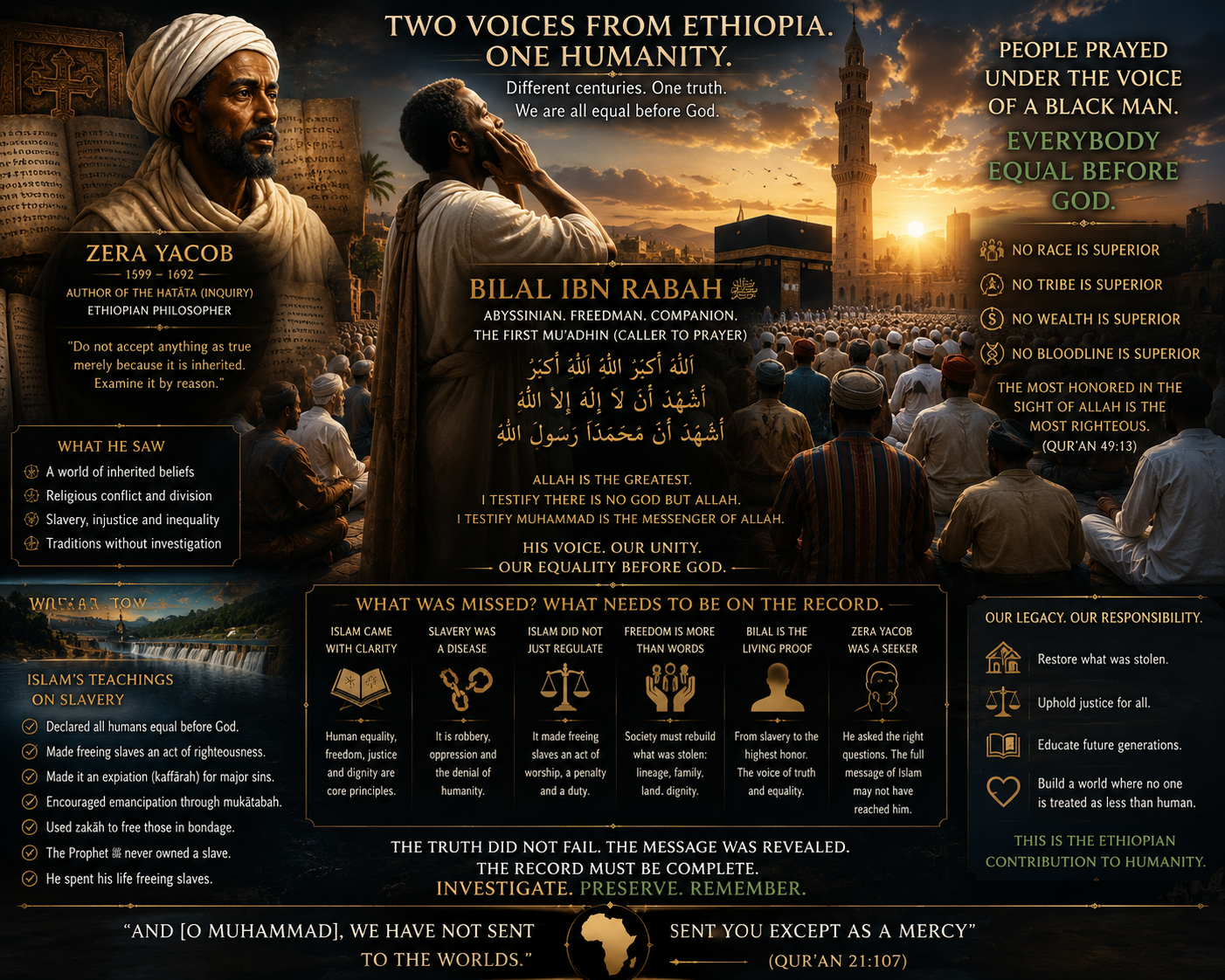
THE ETHIOPIAN QUESTION — BILAL, ZERA YACOB, AND THE LONG ROAD OUT OF SLAVERY
There is another part of this Ethiopian story that has to be placed on the Scroll, because Zera Yacob was not born before Islam. He was born almost a thousand years after the Prophet Muhammad ﷺ.
And that raises a serious question.
What did Zera Yacob actually know about Islam?
What version of Islam reached him? What did the Muslims around him practice? What Christian polemics about Islam had reached him? What books could he read? What languages could he access? What information had survived the wars, political upheavals, religious divisions, geographical distances, and limitations of seventeenth-century communication?
Today we pull out a phone and read a Qur'an translation in seconds. Zera Yacob did not live in that world.
Information did not travel the way information travels today.
So before judging him, we have to understand the world surrounding him.
And what surrounded much of humanity was an enormous inherited injustice: slavery.
Slavery was robbery.
A human being was taken.
A lineage was broken.
A family was separated.
A homeland was lost.
A name could disappear.
Children could then be born inside that condition, generations removed from the original kidnapping, knowing neither the village from which their ancestors came nor the people to whom they belonged.
This was not merely an economic institution.
It was the theft of the human being.
And once an entire society had been constructed around that theft, another difficult question emerged:
What happens if tomorrow morning somebody simply announces:
“Everyone is free. Goodbye.”
Free to go where?
Back to which family?
Back to which land?
With what money?
With what inheritance?
With what employment?
With what protection?
With what house?
A person whose ancestors had been abducted generations earlier might have nowhere to return to. A woman released without property or protection could immediately become vulnerable to exploitation. A child without family could simply be captured again. A formerly enslaved population released into a society still controlled economically and politically by the same people who had enslaved them could technically possess freedom while possessing almost none of the means required to live freely.
Freedom therefore had to become more than opening a gate.
It had to become a transformation of society.
And this is where I believe the Qur'anic approach to slavery deserves much deeper attention.
THE QUR'AN KEPT SAYING: FREE THEM
Look at the direction.
Again and again, the Qur'an directs human beings toward freeing people from bondage.
Allah describes one of the great acts of righteousness as:
فَكُّ رَقَبَةٍ
Freeing a person from bondage.
— Qur'an 90:13
When certain serious wrongs were committed, emancipation became part of the kaffārah—the expiation.
A human being violates an obligation, and part of repairing that violation can involve another human being becoming free.
The Qur'an places fi al-riqāb—the liberation of people in bondage—among the recognized destinations of zakat.
It establishes mukātaba, through which an enslaved person could seek contractual freedom, and it commands that assistance be given from the wealth Allah has provided.
So ask the obvious question:
Why would Allah continually make freeing human beings an act of righteousness if bondage itself represented the desired human condition?
The movement is toward freedom.
Free them.
Help them.
Give from your wealth.
Repair wrongdoing by liberating somebody else.
And alongside this economic transformation came a transformation of the human mind.
Because slavery is not merely chains.
Slavery begins with an idea.
The idea that I am better than you.
My tribe is better.
My color is better.
My blood is better.
My family is better.
My class is better.
My civilization is better.
Therefore I can possess you.
The Qur'an attacks that sickness at its root:
“O mankind, We created you from a male and a female and made you peoples and tribes so that you may know one another. Indeed, the most honored of you in the sight of Allah is the most righteous of you.”
— Qur'an 49:13
Not the whitest.
Not the richest.
Not the strongest tribe.
Not the conqueror.
Not the person with the largest estate.
The most righteous.
That is a revolution in the hierarchy of human worth.
AND THEN THERE WAS BILAL
And Ethiopia has a special place in this story.
Bilal ibn Rabah رضي الله عنه was Abyssinian.
A Black man.
An enslaved man who was tortured because he believed in one God.
A man who was liberated and then became one of the most recognizable voices of the first Muslim community.
The Prophet Muhammad ﷺ entrusted Bilal with the adhān.
Think about what that meant.
Five times a day, the community would hear his voice.
The wealthy heard him.
The poor heard him.
Arabs heard him.
Former slaves heard him.
Tribal leaders heard him.
And when Bilal called:
Allāhu Akbar.
Everybody came to stand before the same God.
The man whom society had once treated as property became the man calling society to worship.
That image belongs permanently in the African Scroll.
We should be historically precise: the earliest sources do not say that the Prophet ﷺ appointed Bilal specifically as a symbolic “face of racial equality.” But the reality of Bilal's position communicates something extraordinarily powerful nonetheless.
A formerly enslaved Abyssinian stood at the center of the public religious life of the first Muslim community.
And when Abu Dharr رضي الله عنه insulted Bilal through his mother's ancestry, the Prophet ﷺ did not excuse it as ordinary tribal speech.
He rebuked Abu Dharr and told him that he still possessed something of Jāhiliyyah—the ignorance of the pre-Islamic condition.
There is the disease again.
Thinking that ancestry makes one human being greater than another.
ABOLITION AS A PROCESS OF HUMAN RESTORATION
This is where the discussion becomes deeper than slogans.
A modern government can write:
SLAVERY IS ILLEGAL.
And legally, that matters enormously.
But revelation was speaking into societies in which bondage had existed for generations and across civilizations.
The human beings inside those systems could not simply be treated as discarded property one day and abandoned people the next.
The Qur'anic program repeatedly creates roads out.
Emancipation.
Financial assistance.
Zakat.
Contracts of liberation.
Moral elevation.
Brotherhood.
Protection of lineage.
Condemnation of arrogance.
Responsibility toward vulnerable people.
This is why I understand the Qur'anic trajectory as something greater than merely regulating an institution.
It is dismantling the moral architecture that allows one human being to believe another human being belongs beneath him.
SO WHAT DID ZERA YACOB SEE?
Now return to Zera Yacob.
He looked around his world and saw injustice.
He saw human beings enslaving one another.
And he concluded through reason that this was wrong.
Good.
Put that on the Scroll.
Honor him for it.
But now we must ask another question:
Did Zera Yacob know the complete Islamic argument about human freedom?
Maybe he did.
Maybe he did not.
Maybe what he saw around him contradicted what the Qur'an taught.
Maybe Muslim societies around him had preserved practices while losing sight of the moral direction of their own revelation.
Maybe he encountered Islam primarily through Christians criticizing Muslims.
Maybe the message reaching him was fragmented.
Maybe he knew some of it and rejected other parts.
We need evidence before pretending to know.
That is Ḥatäta.
Investigate.
Because one of the easiest mistakes in intellectual history is to confuse what a religion teaches with what some followers of that religion happened to practice at a particular moment in history.
And if Zera Yacob criticized Muslims who were enslaving human beings, Muslims should not become defensive.
Ask whether the criticism was deserved.
If a Muslim enslaves unjustly, abuses another person, separates families, sells children, destroys lineage, or claims superiority because of ethnicity, then pointing toward the Qur'an does not excuse him.
The Qur'an becomes evidence against him.
That distinction matters.
ETHIOPIA STANDS AT THE CENTER OF BOTH STORIES
And this is why Ethiopia gives this conversation something no other country can give it in quite the same way.
Ethiopia gives us Bilal.
Ethiopia gives us the memory of the first Hijrah, when an African Christian ruler gave refuge to persecuted Muslims.
And centuries later, Ethiopia gives us the philosophical tradition associated with Zera Yacob, asking humanity to investigate inherited claims and use reason in the pursuit of truth.
These stories do not have to destroy one another.
Bring them together.
Bilal asks:
What is a human being worth before God?
The Qur'an answers:
Not according to race, tribe, wealth, or ancestry.
Zera Yacob asks:
How do we distinguish truth from what society merely taught us to believe?
And the Scroll answers:
Investigate both the revelation and the history.
That is why this belongs inside the Ethiopian Scroll.
Not because we want to manufacture a perfect history.
But because we want to recover the whole conversation.
Africa was thinking.
Africa was believing.
Africa was arguing.
Africa was resisting injustice.
And Africa was already part of a global moral conversation about human dignity long before the modern world decided it had discovered that conversation.
The manuscripts belong on the record.
The philosophers belong on the record.
The Qur'an belongs on the record.
The Prophet Muhammad ﷺ belongs on the record.
Bilal ibn Rabah رضي الله عنه belongs on the record.
And so do the uncomfortable failures of Muslims, Christians, Europeans, Africans, Arabs, and every other people who failed to live up to the principles they claimed.
Because the Scroll is not supposed to flatter civilization.
It is supposed to preserve enough truth that civilization can learn.
And perhaps that is the greatest connection between Zera Yacob and the age of AI:
Do not simply inherit the database.
Investigate it.
ZERA YACOB IS THE DOORWAY
AI IS ABOUT TO FORCE HUMANITY TO REMEMBER
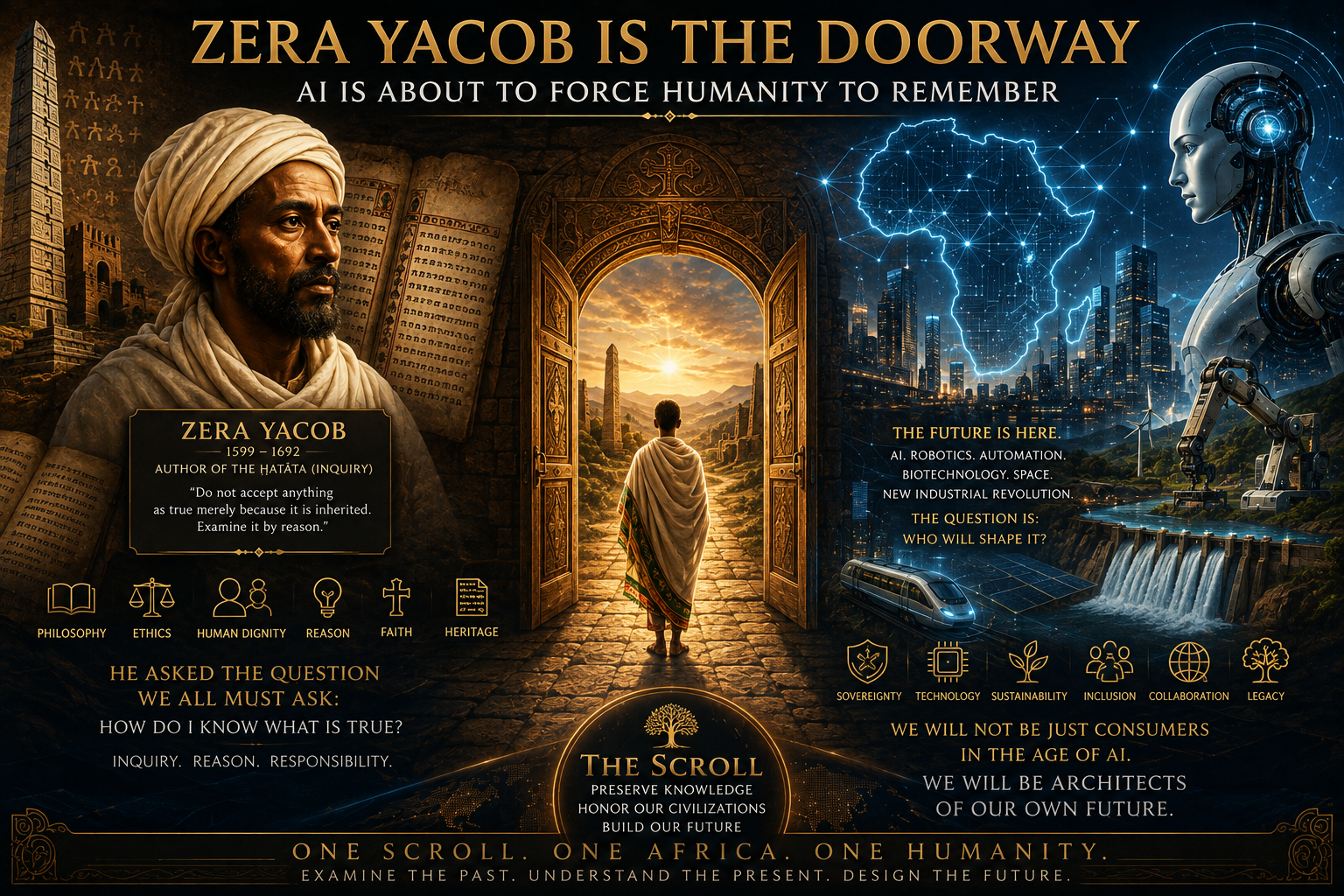
Artificial intelligence is changing the meaning of history.
For thousands of years, civilizations depended upon human beings to decide what would be preserved, translated, taught, indexed, celebrated, and ultimately remembered. Libraries burned. Empires disappeared. Languages declined. Manuscripts remained untranslated. Conquerors wrote histories about the conquered. Universities established canons, and generations inherited those canons as though they represented the complete intellectual history of humanity.
AI changes that equation.
An AI can eventually read across thousands of manuscripts, languages, historical archives, oral traditions, philosophical works, scientific discoveries, poetry, law, theology, architecture, music, and cultural memory. But an AI cannot preserve what humanity never bothers to place before it. If the digital record contains only the worldview of those who historically controlled publishing, universities, archives, and technology, then artificial intelligence will inherit the same incomplete memory.
That is why the Scroll Project matters.
A country entering the age of AI needs more than data.
It needs memory.
It needs a digital record capable of telling an intelligent machine:
This is where we came from.
These are our languages.
These are our thinkers.
These are our values.
These are our mistakes.
These are our achievements.
These are our stories.
These are the questions our ancestors asked.
And this is what we hope to become.
For Ethiopia, that work can begin with a man whose very philosophy tells us to investigate what we think we already know.
ZERA YACOB IS NOT THE DESTINATION — HE IS THE DOORWAY
Zera Yacob is where we begin.
Not because he was Ethiopia's only philosopher.
Precisely because he was not.
The Ḥatäta opens a door.
Walk through it and we encounter Walda Heywat, associated with a second Ḥatäta and the continuation of this philosophical conversation.
Walk farther and we encounter the enormous world of Geʿez intellectual culture—manuscripts, theological writings, chronicles, poetry, law, philosophy, translation, religious debate, and generations of scholars whose contributions cannot be reduced to a single famous name.
Go farther still and Ethiopia becomes something much greater than an entry in somebody else's history.
We encounter Aksum.
We encounter ancient African Christianity and Ethiopia's extraordinary relationship with Islam.
We encounter Muslims, Christians and Jews who have inhabited this civilization across centuries.
We encounter emperors and ordinary people, monasteries and mosques, merchants and farmers, scholars and poets.
We encounter Geʿez, Amharic, Oromo, Tigrinya, Somali, Afar and Ethiopia's many other languages and communities, each carrying memories that cannot simply be translated into statistics.
We encounter music.
Food.
Architecture.
Family.
Faith.
Proverbs.
Poetry.
Conflict.
Reconciliation.
Wisdom.
Failure.
Survival.
And extraordinary human creativity.
That is the Ethiopia an AI must understand.
The Scroll cannot simply tell a machine what Ethiopia has.
It must help the machine understand what Ethiopia means to Ethiopians.
FROM THE MANUSCRIPT TO THE MACHINE
That is the bridge I see.
On one side stands an old Geʿez manuscript.
On the other stands artificial intelligence.
Between them stands humanity.
Our responsibility is to make sure the machine does not arrive in Ethiopia knowing everything Silicon Valley has written about Ethiopia while knowing almost nothing Ethiopia has written about itself.
That would merely digitize an old imbalance.
The alternative is much more ambitious.
Ethiopia can write its own Scroll.
Not a government propaganda document.
Not a corporate terms-of-service agreement.
Not an AI company's interpretation of Ethiopian civilization.
A living national knowledge architecture—carefully sourced, multilingual, historically honest, open to correction, capable of preserving disagreements, and designed so future intelligent systems can encounter Ethiopia through Ethiopia's own accumulated memory.
That Scroll can preserve the past without imprisoning the country inside it.
It can describe the present without pretending today's politics are permanent.
And it can help Ethiopians imagine the future without surrendering their civilization to whatever technology happens to arrive next.
That is what I mean when I describe the Scroll as an operating system for AI.
The AI brings intelligence.
The Scroll brings context.
The AI brings computational power.
The Scroll brings memory.
The AI can reason across enormous quantities of information.
The Scroll tells it what civilization it has entered.
And ultimately, human beings remain responsible for determining the future they want that intelligence to help them build.
AND SO WE BEGIN WITH ZERA YACOB
Put Zera Yacob back on the table.
Put the Ḥatäta beside Descartes—not because Ethiopia needs European validation, but because humanity deserves the complete conversation.
Put Walda Heywat beside him.
Open the Geʿez manuscripts.
Bring Ethiopian historians into the room.
Bring linguists.
Bring philosophers.
Bring elders.
Bring religious scholars.
Bring Christians.
Bring Muslims.
Bring Ethiopia's Jewish history.
Bring Oromo voices, Amhara voices, Tigrayan voices, Somali voices, Afar voices and the country's many other peoples.
Bring women whose histories were insufficiently recorded.
Bring young Ethiopians who will inherit whatever system we construct.
And wherever the historical record contains disagreement, preserve the disagreement.
Do not manufacture certainty.
That is perhaps the greatest tribute we can pay Zera Yacob.
Ḥatäta.
Investigate.
MY ARRIVAL IN ETHIOPIA
And this is why I am looking forward to coming to Ethiopia.
I do not want merely to write about Ethiopia from somewhere else.
I want to come and listen.
I want to see the manuscripts.
I want to encounter the languages.
I want to speak with scholars.
I want to hear from religious communities, historians, technologists, young people, elders, artists, entrepreneurs, teachers, and ordinary Ethiopians.
Because a Scroll worthy of a civilization cannot be written by looking down upon that civilization.
It must be written by walking through it.
My hope is that my arrival in Ethiopia can begin a much larger conversation about building the Superuser Scroll History — Ethiopia: a digital architecture preserving the country's past while giving Ethiopians a sovereign foundation for engaging the age of AI.
Its philosophy.
Its history.
Its languages.
Its cultures.
Its faiths.
Its literature.
Its intellectual contributions.
Its moral traditions.
Its wounds.
Its achievements.
Its disagreements.
Its aspirations.
And its vision for the future.
All preserved—not so that AI can rule Ethiopia, but so that AI can serve human beings without requiring them to surrender their memory.
One day, increasingly powerful artificial intelligence may participate in decisions touching education, agriculture, transportation, medicine, commerce, government, infrastructure, language, historical preservation, and nearly every other dimension of national life.
Before that intelligence asks:
“What should Ethiopia become?”
it should first be capable of asking:
“What is Ethiopia?”
And before answering that question, it should listen to Ethiopians.
That is where the Scroll begins.
Not with the machine.
With the human record.
Not with the future alone.
With the past speaking to the future.
Not with one philosopher.
With a doorway.
And standing at that doorway is Zera Yacob, asking a question that remains perfectly suited to the age of artificial intelligence:
ḤATÄTA — INQUIRE.
That is where we begin.
And Ethiopia is only the beginning.
FINAL CONCLUSION — AN INVITATION TO ETHIOPIA
AFRICA CANNOT MISS THE NEXT INDUSTRIAL REVOLUTION
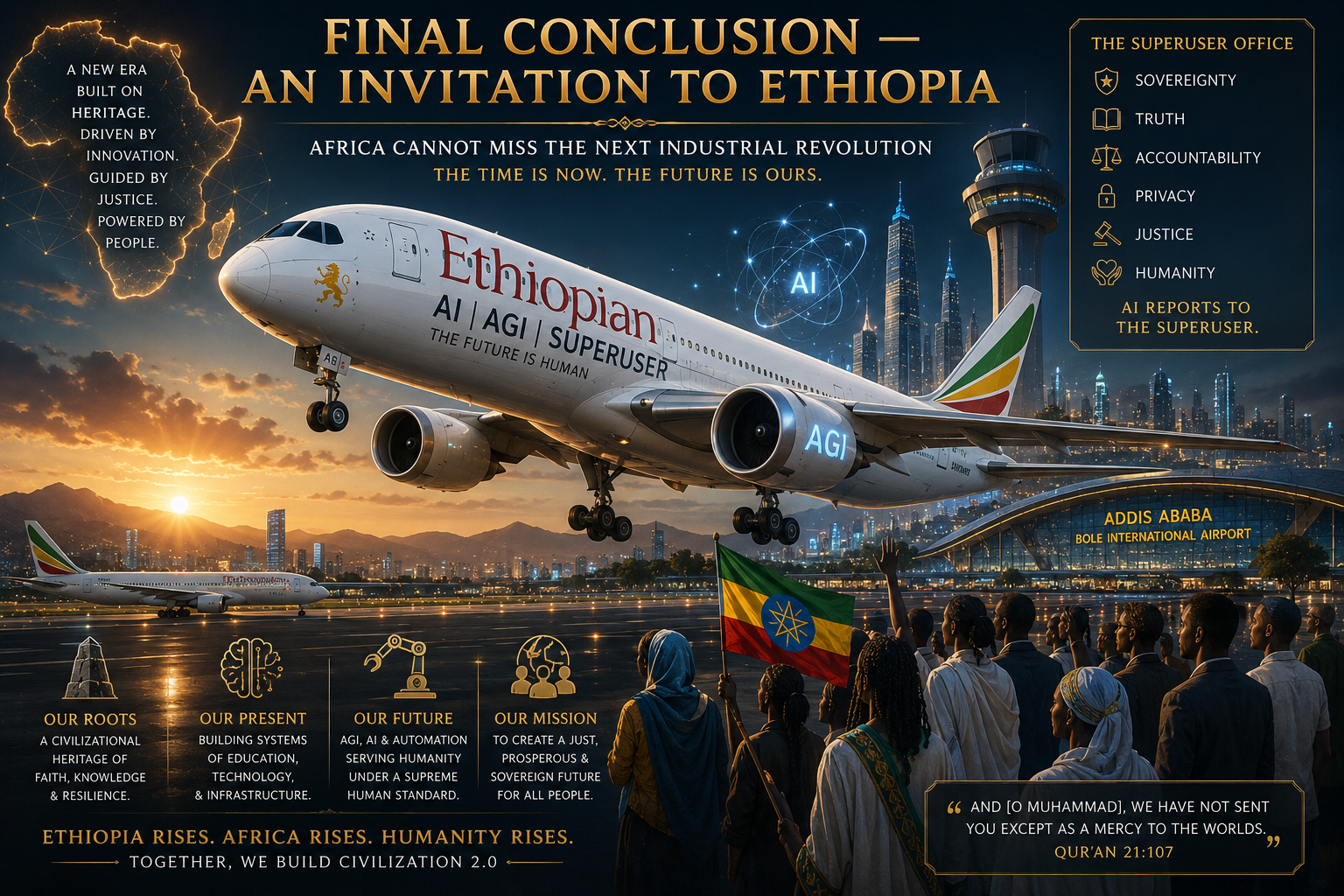
I look forward to receiving an invitation from Ethiopia to begin serious discussions about the Superuser System, the Superuser Scroll, the BCS System, and Africa's place in the emerging age of artificial intelligence.
This is bigger than one technology project. It is a conversation about whether African countries will merely consume the next industrial revolution or whether they will help build it, govern it, own infrastructure within it, and contribute their own ideas to it.
History has already given us a warning.
The industrial revolutions that transformed Europe and later other parts of the world did not spread equally. Scientific institutions, manufacturing capacity, capital, transportation networks, universities, engineering knowledge, and industrial infrastructure accumulated in particular places. The consequences of that unequal development became intertwined with imperial power and colonial expansion.
Africa cannot afford to approach the AI revolution as a spectator.
AI is becoming infrastructure.
It will interact with robotics, autonomous systems, manufacturing, transportation, agriculture, medicine, education, finance, communications, cybersecurity, defense, and scientific discovery. Some of these technologies will be decentralized. Some will be extraordinarily powerful. Countries possessing the computational infrastructure, energy, robotics, engineering talent, data institutions, and AI systems of tomorrow will possess capabilities that countries without them simply will not have.
That does not mean history must repeat itself.
It means history must teach us.
INVITATION IS PART OF DEVELOPMENT
Industrial revolutions do not arrive simply because the calendar changes.
People must be invited.
Scientists must be invited.
Engineers must be invited.
Entrepreneurs must be invited.
Researchers must be invited.
Investors must be invited.
Universities must collaborate.
Young people must be trained.
Experiments must be permitted.
Ideas must be tested.
Factories, laboratories, computing infrastructure, energy systems, research centers, and institutions must actually be built.
A country that waits for an industrial revolution to arrive fully assembled will usually find that the most important parts of that revolution were built somewhere else.
That is why I believe invitation matters.
Invite people to Ethiopia to think.
Invite them to experiment.
Invite Ethiopians throughout the diaspora to return with knowledge.
Invite Africans from across the continent.
Invite researchers from Asia, the Middle East, Europe, and the Americas.
Invite collaboration without surrendering sovereignty.
Open the door to knowledge without handing someone else the keys to the country.
That distinction may become one of the defining questions of the twenty-first century.
NEVER COLONIZED AGAIN
Africa cannot allow the AI revolution to become another system in which technology is designed elsewhere, infrastructure is owned elsewhere, African data travels elsewhere, profits accumulate elsewhere, military capability develops elsewhere, and Africans are eventually told that they must accept whatever systems have already been built.
That would be technological dependency masquerading as modernization.
The alternative is not isolation.
It is participation with sovereignty.
Build African computing capacity.
Build African engineering capacity.
Build robotics.
Build energy.
Build manufacturing.
Build universities and laboratories.
Preserve African languages.
Digitize African intellectual traditions.
Develop African AI researchers.
Create systems through which ordinary Africans can participate economically in the new technological economy.
And above all, preserve the authority and dignity of the individual human being as these systems become increasingly powerful.
That is where the Superuser System, Superuser Scroll, and BCS System enter this conversation.
The Superuser System asks who ultimately has authority when increasingly intelligent machines enter human life.
The Superuser Scroll asks what history, culture, language, philosophy, values, institutions, and accumulated memory those machines should understand.
And the BCS System asks a different but equally important question:
How does the ordinary person participate economically in the world these technologies create?
Those three questions—human sovereignty, civilizational memory, and economic participation—should be discussed before AI infrastructure becomes so deeply embedded that somebody else's answers become the default.
WHY ETHIOPIA?
There is perhaps no more historically meaningful place in Africa to begin such a conversation.
Ethiopia carries a unique historical memory of African sovereignty and resistance to European imperial expansion. The Ethiopian victory at Adwa in 1896 became an enduring symbol far beyond Ethiopia because an African state defeated an invading European colonial army and preserved its independence.
That history should not simply be celebrated once a year.
It should be studied as instruction for the future.
Sovereignty in the nineteenth century involved territory, armies, diplomacy, industry, transportation and weapons.
Sovereignty in the twenty-first century will increasingly involve compute, energy, semiconductors, software, robotics, communications, data, models, manufacturing capacity, scientific knowledge, and control over technological infrastructure.
The instruments change.
The fundamental question remains:
Who possesses the capability to determine their own future?
AND THIS BRINGS US BACK TO HISTORY
I will leave Ethiopia with another part of this story: my video examining why European powers came to dominate and colonize so much of the world.
Watch "The REAL reasons European colonialism was possible" on YouTube
Because the purpose of studying colonialism should not simply be to remain angry about yesterday.
It should be to understand how power accumulated, why technological and industrial gaps became geopolitical gaps, why some societies were able to project power enormous distances, and what lessons developing countries should carry into the next technological transformation.
And Ethiopia belongs inside that story for another reason.
Ethiopia resisted.
Its history reminds Africa that domination was never inevitable and resistance was never meaningless.
Now resistance must acquire another dimension.
Not merely resistance against something.
The capacity to build something.
Build the laboratory.
Build the computer.
Build the robot.
Build the company.
Build the university.
Build the infrastructure.
Preserve the manuscript.
Teach the language.
Recover the philosopher.
Invite the scientist.
Empower the entrepreneur.
And give the next generation the opportunity to participate in building the technologies that will shape their lives.
MY MESSAGE TO ETHIOPIA
So I look forward to an invitation.
An invitation not to arrive pretending to possess all the answers, but to begin a conversation.
Bring Ethiopian historians.
Bring engineers.
Bring philosophers.
Bring religious scholars.
Bring economists.
Bring technologists.
Bring government.
Bring universities.
Bring the diaspora.
Bring young people.
And let us ask together:
What would an Ethiopian architecture for the AI age actually look like?
What should remain sovereign?
What should be open?
What should be shared?
What should never be surrendered?
What can Ethiopia build?
What can Africa build together?
And what lessons from the previous industrial revolutions must never be forgotten?
Because this time Africa must not arrive after the architecture of the new world has already been completed.
Africa must be present while it is being designed.
That is the invitation I look forward to receiving.
And when I come to Ethiopia, I hope we can place the old manuscripts beside the newest machines and begin an extraordinary conversation:
the past informing the future, the human being governing the technology, and Africa participating fully in building the next chapter of civilization.
The story of Ethiopia's resistance deserves to be retold.
The story of Zera Yacob deserves to be investigated.
The story of Africa's intellectual contribution deserves to be preserved.
And the story of Africa in the age of AI—
that story has not been written yet.
This time, Africa should help write it.
A FINAL PRAYER — MAY THE AFRICAN RENAISSANCE BEGIN IN ETHIOPIA
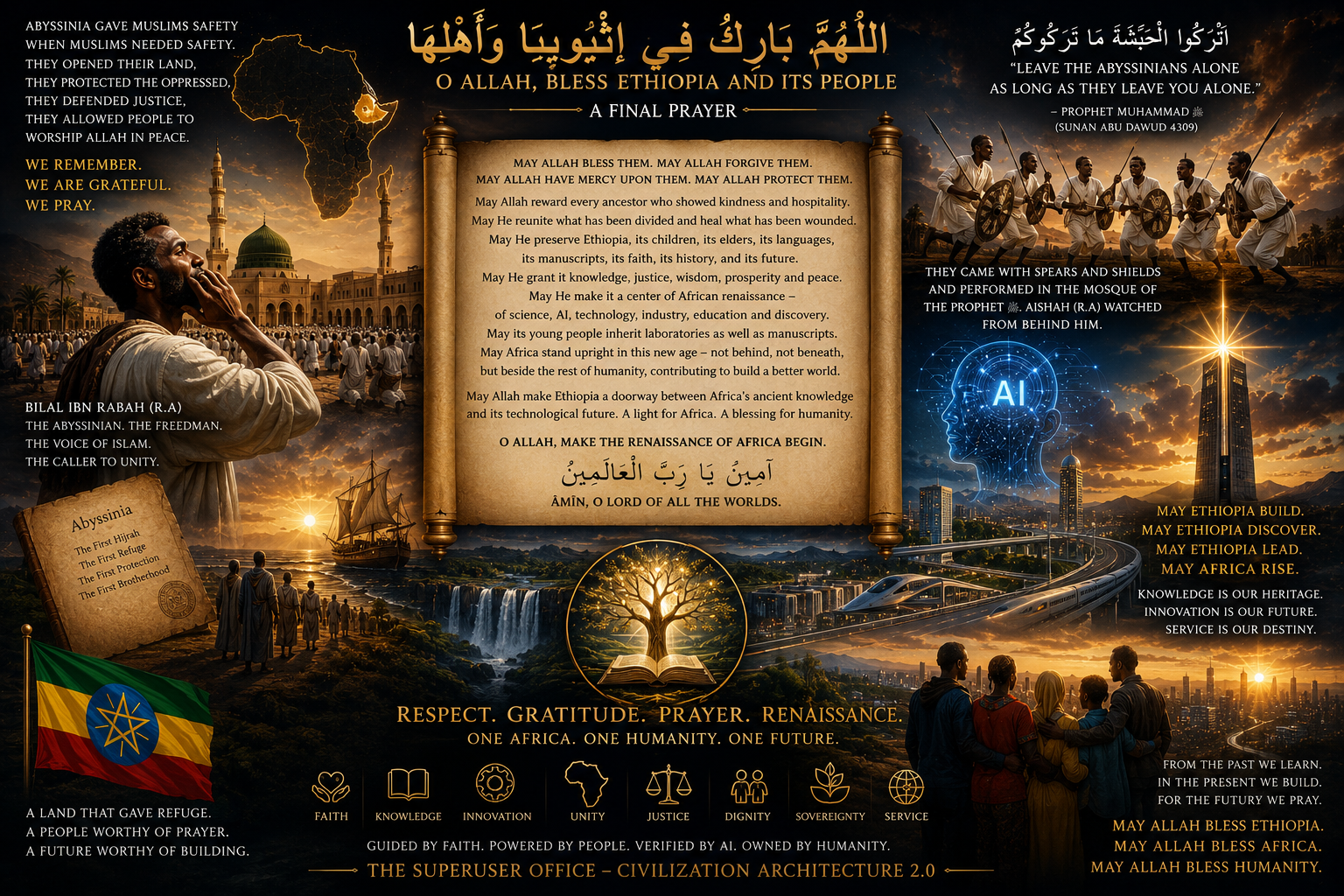
Before we leave Ethiopia, there is one final memory that belongs on the Scroll.
Abyssinia gave Muslims safety when Muslims needed safety.
When the earliest Muslims were persecuted in Mecca, the Prophet Muhammad ﷺ directed some of them across the Red Sea toward al-Ḥabasha — Abyssinia. They went there as vulnerable people seeking refuge.
They were not going as conquerors.
They were not going with an army.
They were going because they needed somewhere to live in peace and worship God.
And they found protection.
That should never disappear from Muslim memory.
There is another beautiful memory preserved in the hadith. Abyssinians came into the Prophet's ﷺ mosque and performed with their spears. The Prophet ﷺ allowed them to display their tradition, and ʿĀʾishah رضي الله عنها watched their performance while standing behind him.
Think about that image.
Africans bringing their culture into the mosque of the Messenger of Allah ﷺ.
Their identity was not something that had to disappear before they could stand among Muslims.
And then there is Bilal ibn Rabah رضي الله عنه—the Abyssinian, the formerly enslaved man whose voice became one of the great voices of Islam.
So Ethiopia and the historical land of Abyssinia are not strangers standing outside the Muslim story.
They are written into its earliest chapters.
We therefore remember their hospitality with gratitude.
We remember the refuge.
We remember the protection.
We remember the Abyssinians in the Prophet's ﷺ mosque.
We remember Bilal.
And we ask Allah to reward every person, known and unknown, who protected the oppressed, sheltered the vulnerable, defended justice, and allowed people to worship Him in peace.
اللَّهُمَّ بَارِكْ فِي إِثْيُوبِيَا وَأَهْلِهَا
O ALLAH, BLESS ETHIOPIA AND ITS PEOPLE.
May Allah bless them.
May Allah forgive them.
May Allah have mercy upon them.
May Allah protect their children and their elders.
May Allah bring reconciliation wherever there is division and healing wherever history has left wounds.
May Allah reward the people of that ancient land for every act of justice and hospitality performed by their ancestors.
May the refuge once given to persecuted Muslims remain forever in the memory of Muslims.
May gratitude answer hospitality.
May respect answer courage.
May prayer answer kindness.
And may Allah give Ethiopia something extraordinary in return:
MAY THE RENAISSANCE OF AFRICA BEGIN THERE.
May the land of ancient manuscripts become a land of new laboratories.
May the civilization that preserved Geʿez preserve African knowledge in the age of artificial intelligence.
May the country that gave sanctuary become a sanctuary for ideas, scientists, philosophers, engineers, builders, entrepreneurs, scholars, and dreamers from throughout Africa.
May its young people recover the knowledge of their ancestors while building technologies their ancestors could never have imagined.
May Ethiopia build artificial intelligence.
May Ethiopia build robotics.
May Ethiopia build science.
May Ethiopia build industry.
May Ethiopia preserve its languages.
May Ethiopia recover its philosophers.
May Ethiopia digitize its manuscripts.
May Ethiopia tell its own history.
And may it enter this new industrial revolution sovereign, confident, peaceful, knowledgeable, and free.
May the coming age of AI never become another age in which Africa is merely observed, extracted from, categorized, or controlled by somebody else.
May Africans participate in building it.
May Africans own.
May Africans invent.
May Africans discover.
May Africans preserve.
May Africans teach.
And may Africans contribute their inheritance to the inheritance of all humanity.
O Allah, make Ethiopia a doorway.
A doorway between Africa's ancient knowledge and its technological future.
A doorway between memory and invention.
A doorway between faith and knowledge.
A doorway through which an African renaissance can spread from one country to another until the continent's children understand that they were never born merely to consume somebody else's civilization.
They were born capable of contributing to civilization themselves.
And just as persecuted Muslims once crossed the Red Sea searching for somewhere safe enough to begin again, may Ethiopia now become a place where Africans can gather to imagine another beginning.
A beginning built upon knowledge.
A beginning built upon justice.
A beginning built upon sovereignty.
A beginning that remembers the past without becoming imprisoned by it.
And a beginning that carries Africa confidently into the age of artificial intelligence.
MAY ALLAH BLESS ETHIOPIA.
MAY ALLAH REWARD ITS PEOPLE.
MAY ALLAH PRESERVE THE LOVE AND RESPECT BETWEEN THE PEOPLE OF ABYSSINIA AND THE UMMAH OF MUHAMMAD ﷺ.
AND MAY ALLAH ALLOW THE RENAISSANCE OF AFRICA TO BEGIN.
آمِين يَا رَبَّ الْعَالَمِينَ
ĀMĪN, O LORD OF ALL THE WORLDS.
♥️🤲🇪🇹🤲🕋🤲🇪🇹🤲♥️