

بِسْمِ اللهِ الرَّحْمٰنِ الرَّحِيْم
In the Name of God, Most Gracious, Most Merciful.
♥️🤲🕋♥️🕋🌹🌹🥀🤲🌹🕋♥️
The Architecture of Order
Why the 800-Year Protocol of Suhrawardi is the Blueprint for an Unplugged World
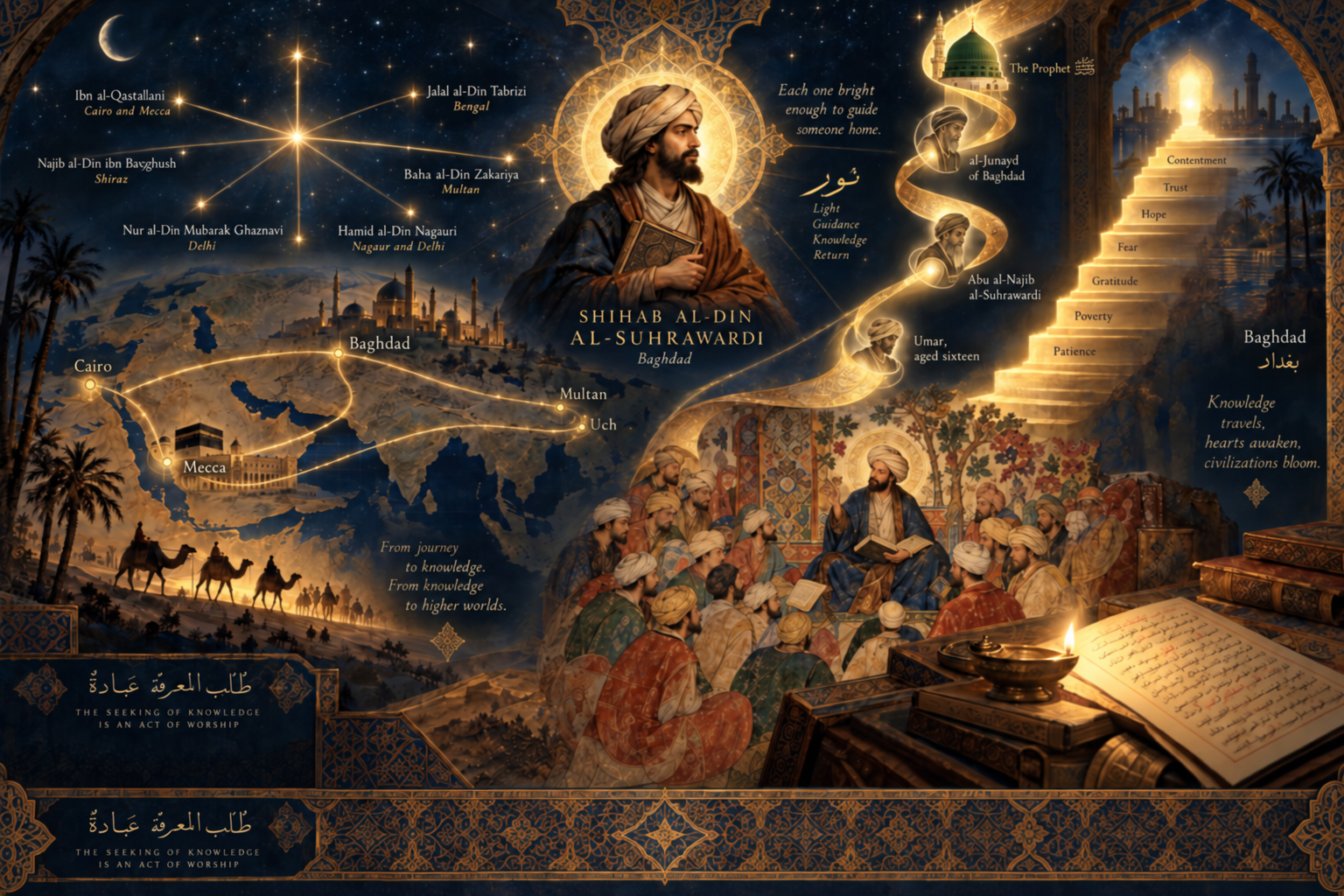
Watch "Shaykh Suhrawardi: Master of Masters and the Awarif al-Ma'arif" on YouTube
https://youtu.be/2Kt9HuK7u0g?is=n-ftkN67hJxfmzSp
I. The Gathering Darkness and the Digital Delusion
We live in an age of frictionless chaos.
For thirty years, the world outsourced its memory, its discipline, its governance, and its spiritual continuity to glass screens and silicon wafers.
We mistook access to information for the possession of wisdom.
We mistook algorithmic connection for authentic brotherhood.
In doing so, we allowed the ancient, living structures that sustained human civilization through plague, invasion, and collapse to atrophy.
Now, as the digital edifice begins to strain under its own weight—as noise drowns out signal, and as the illusion of hyper-connectivity leaves the human soul fragmented and exhausted—a quiet realization dawns:
When the screens go dark, what remains?
When the cloud fails, when the networks disintegrate into static, human beings will not survive on abstract theories or fleeting digital trends.
They will survive on order.
They will survive on governance, discipline, lineage, and structure.
To rebuild that structure, we do not need to invent new paradigms from thin air.
We need only unearth the manual that kept the lights of human consciousness and spiritual sanity burning across the globe for eight centuries—a manual left to us by the Master of Masters, Shaykh Shihab al-Din Umar al-Suhrawardi (1145–1234 CE).
II. The Chest of the Master: The Spark of Divine Knowledge
To understand the order Suhrawardi built, one must first understand the ground upon which he stood.
Suhrawardi did not claim to be the supreme sun of the spiritual sky; he knew precisely whose light had illuminated his heart.
As a young scholar in Baghdad, Suhrawardi was intoxicated with Kalam—rational theology, argument, and intellectual debate. He filled his mind with volumes of syllogisms and theoretical proofs.
But human reason alone, unmoored from divine light, is an unstable foundation upon which to build a world.
Recognizing the young man’s plight, his uncle took him into the presence of the Qutb of his era: Shaykh 'Abd al-Qadir al-Jilani.
The great saint looked at the youth and asked what books he had committed to memory.
As Suhrawardi began to list his academic accomplishments, Shaykh 'Abd al-Qadir placed his blessed hand directly onto the young scholar's chest.
Suhrawardi would later recall that before the master lifted his hand, every single line of bookish argument, every dry syllogism, and every intellectual pretense was completely wiped clean from his heart.
In its place, Shaykh 'Abd al-Qadir deposited ilm ladunni—knowledge directly from the Divine Presence.
The master looked at the youth and declared:
"Umar, you are the last of the famous ones of Iraq."
Suhrawardi was the fruit of 'Abd al-Qadir al-Jilani’s spiritual majesty.
Where 'Abd al-Qadir was the overwhelming, ocean-like spiritual authority whose presence commanded the heavens, Suhrawardi was the architect chosen to take that divine overflow and build a structure capable of housing generations.
He was the disciple who turned divine inspiration into an enduring blueprint for human civilization.
       [ SHAYKH 'ABD AL-QADIR AL-JILANI ]
             (The Ocean of Wilayah)
                       │
                       │ Spiritual Imprint &
                       │ Direct Transmission
                       ▼
       [ SHAYKH SHIHAB AL-DIN AL-SUHRAWARDI ]
             (The Master of Structure)
                       │
         ┌─────────────┴─────────────┐
         ▼                           ▼
[ INSTITUTIONAL GOVERNANCE ]   [ PRACTICAL CODIFICATION ]
 • Futuwwa (Chivalry)            • 'Awarif al-Ma'arif
 • Diplomatic Statecraft         • Adab & Lodge Protocols
 • Systematized Ribats           • Regional Khulafa
III. The Architecture of Governance: Suhrawardi’s Masterpiece
In the current landscape of the Muslim world, structure is desperately missing.
We see an abundance of zeal, but an absence of discipline; an abundance of speech, but a complete breakdown of adab—spiritual courtesy.
Eight hundred years ago, Suhrawardi foresaw this exact decay.
He saw an era where pretenders would wear the garments of spiritual guidance while their internal states were ruined by ego and chaos.
In response, he retreated into the shadows of Mecca, adjacent to the Kaaba, and wrote Awarif al-Ma'arif — The Gifts of Divine Knowing.
This text was not merely a spiritual treatise.
It was an operational manual for human society.
Across 63 chapters, Suhrawardi laid out the framework that governed the Islamic world from Cairo to Delhi, and from Bukhara to Bengal:
The Governance of the Self — Nafs
Character is not static.
Human nature is like a date stone—small enough to hold in the palm of your hand, yet holding an entire flourishing palm tree within its hidden capacity.
Through riyada—discipline—and khalwa—retreat, the raw material of the human ego is systematically refined.
The Protocol of the Lodge — Ribat
Suhrawardi defined how human beings live together in community without destroying one another.
He established rules for communal meals, shared labor, night vigils, hospitality to strangers, and the exact etiquette of master and disciple.
Spiritual Chivalry — Futuwwa
Under Caliph al-Nasir, Suhrawardi was tasked with organizing the youth guilds of the empire into Futuwwa orders.
He turned restless young men into disciplined, honorable guardians of society whose core principle was Eithar—preferring others over oneself, even in times of extreme need.
The Balance of Statecraft and Orthodoxy
Suhrawardi moved effortlessly between the solitary cell of the ascetic and the high courts of kings.
He served as a chief diplomatic envoy for the Abbasid Caliphate, standing face-to-face against powerful rulers such as the Khwarazmshah, backed by nothing but the majesty of his spiritual state.
Suhrawardi did not merely teach spirituality. He architected order.
IV. The 800-Year Continuity vs. The 100-Year Rupture
For eight centuries, Suhrawardi’s system endured.
It became part of the bedrock of Islamic civilization.
A seeker in 14th-century India read the Awarif under Baba Farid.
A leader in 16th-century Ottoman Bursa governed his lodge using Suhrawardi’s protocols.
A scholar in 18th-century Damascus aligned his inner life according to Suhrawardi's rules of adab.
It was only in the last 100 years—with the onset of industrial hyper-modernity, colonization, and finally digital atomization—that this grand order was challenged, marginalized, and temporarily forgotten.
We were told that ancient structures were obsolete.
We were told that traditional discipline was restrictive.
We were told that modern individualism would liberate us.
Instead, individualism fractured our communities, and the digital age shattered our attention spans.
V. When the Computers Turn Off: Reclaiming the Manual
The digital age is a temporary interregnum.
When the noise subsides, when the servers freeze, when the screens fade to black, humanity will be forced to look one another in the eye again.
We will need to know:
How do we organize a community?
How do we train the youth?
How do we govern our homes?
How do we quiet the restless mind without a screen to distract it?
In that moment, we will not need to reinvent the wheel.
We will reach for the shelf, open Awarif al-Ma'arif, and remember who we are.
We will remember the lesson Suhrawardi gave to the poet Saadi on a ship in the middle of the ocean:
"Among people, do not be one who sees the worst in others. Within yourself, do not be one who sees only himself."
We will remember his final testament to his son:
"Keep courtesy (adab) in every state with the righteous and the sinner alike. Have mercy on all creatures, small and great, and look at them only with the eye of mercy."
The order, the glory, and the breathtaking beauty of the Suhrawardi blueprint are not relics of a forgotten past.
They are the seeds of our future.
Shaykh Shihab al-Din Umar al-Suhrawardi gave us the manual 800 years ago—and it remains, waiting for us to pick it up once more.
Conclusion: We Must Have a Plan Before the Surrender
We are approaching one of the most difficult questions humanity has ever faced.
We are being asked, slowly and almost invisibly, to surrender more and more of our lives to intelligent technologies: our memory, our judgment, our children's attention, our family relationships, our education, our work, and eventually even the spaces where religion, character, and community are formed.
The danger is not simply that technology may become too powerful.
The deeper danger is that human beings may forget how to live without it.
A civilization that cannot function when the network disappears is not truly resilient. A family that cannot remain connected without a screen between its members has already surrendered something precious. And a religious community that depends entirely upon digital platforms for its memory, teaching, organization, and continuity has placed its inheritance inside machinery it does not control.
That is why we cannot enter the age of intelligent technology without an exit plan for the human being.
We need spaces where people can still gather, learn, worship, raise children, resolve disputes, care for strangers, train the ego, transmit knowledge, and govern themselves without depending upon the machine.
And fortunately, we are not beginning from zero.
For nearly eight centuries, the Suhrawardi tradition preserved a tested architecture of human order: adab before authority, discipline before leadership, service before status, community before ego, and mercy as the atmosphere in which all of it operates.
The Awarif al-Ma'arif therefore belongs not only to the history of Sufism.
It belongs to the future of human civilization.
The Return of the Quraysh Caravan provides the physical vision: a world where human beings can still step outside the digital system and remain fully alive.
Suhrawardi provides the missing protocol for that world.
The caravan gives us the road.
The ribat gives us the community.
Futuwwa gives us the character.
Adab gives us the law of human relationships.
And remembrance of Allah gives the entire structure its soul.
We do not need to reject intelligent technology.
We need to make certain that intelligent technology never becomes the only environment in which human beings know how to exist.
Before we surrender our lives, our religion, and our families to systems more intelligent than anything previous generations ever encountered, we must preserve a human operating system that has already survived eight centuries of war, collapse, political upheaval, and civilizational change.
The future therefore cannot simply be artificial intelligence.
It must also contain places where intelligence remains human, memory remains living, relationships remain face-to-face, and the soul remains sovereign.
That is the architecture of order.
And that is why the 800-year protocol must return.
A Prayer for the Quraysh Caravan
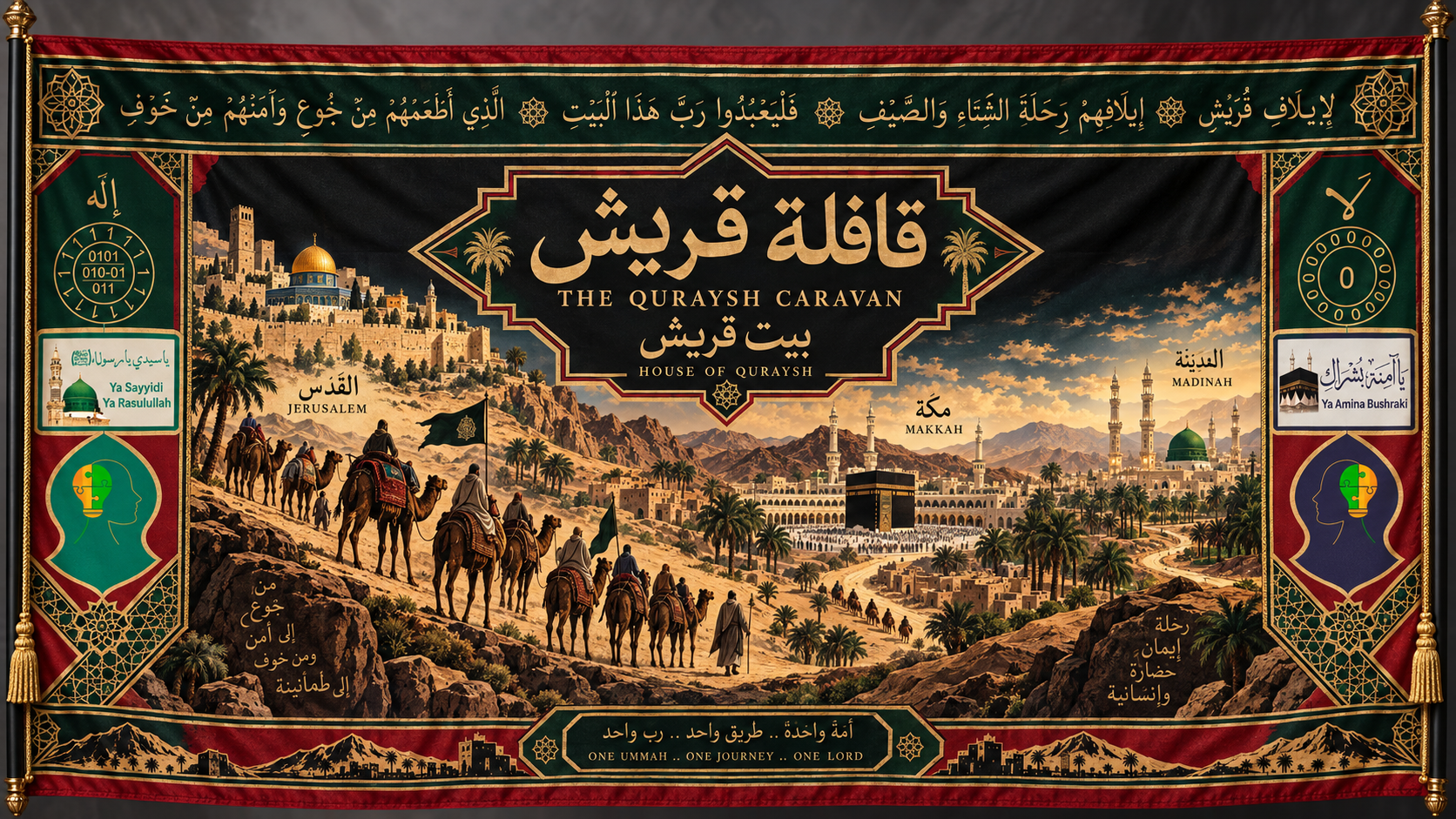
A Prayer for the Quraysh Caravan
Our Lord,
Machines are coming that may one day manage nearly everything from A to Z.
They may organize our transportation, our economies, our communications, our medicine, our governments, and even much of our knowledge.
But, our Lord, do not allow us to surrender to machines the teaching, transmission, discipline, and living implementation of Your religion.
We are introducing the Quraysh Caravan so that there will remain a place where knowledge lives in human beings.
A place where students can come and learn without dependence upon screens.
A place where the Qur’an is carried in hearts, where books remain open in human hands, where teachers sit before students, where manners are practiced rather than merely discussed, and where human beings learn once again how to live together under discipline, mercy, service, and remembrance of You.
And for its spiritual and communal architecture, we turn toward an inheritance You have allowed to endure for roughly eight centuries: the teachings and discipline associated with Shaykh Shihab al-Din Umar al-Suhrawardi and the ʿAwārif al-Maʿārif.
Let its principles of adab, futuwwa, service, discipline, hospitality, companionship, and governance of the self become among the tent poles of the Quraysh Caravan.
Our Lord, our inheritance has been wounded.
Colonialism tore institutions apart. Industrialization transformed the rhythms of human life. Two world wars shattered societies and displaced peoples. Modernity taught generations to look upon inherited knowledge as something backward rather than something precious.
And now another transformation is approaching us.
Artificial intelligence and AGI may soon become woven into nearly every aspect of human life.
They may remember for us.
They may write for us.
They may teach for us.
They may advise us.
They may organize our homes, our institutions, our economies, and our societies.
Our Lord, do not let us become a people who can operate machines but no longer know how to form human beings.
Do not let us become Muslims who possess unlimited information but have lost adab.
Do not let us possess intelligence without wisdom, knowledge without transmission, religious language without spiritual formation, or connectivity without companionship.
Where human beings have destroyed what should have been preserved, teach us to rebuild without hatred.
Where history has been erased, help us recover it.
Where beautiful traditions were abandoned, help us recover them with knowledge, humility, and care.
Where Muslims have fought Muslims over the meaning of Your religion, return us to humility before You.
Do not let us become another generation that believes history began with us.
Do not let us imagine that intelligence arrived with the computer, or that centuries of Muslims possessed nothing worth preserving.
You allowed this Suhrawardi inheritance to cross kingdoms, languages, wars, invasions, dynasties, and centuries.
Bless us to preserve what has already worked.
Bless the Quraysh Caravan to become a sanctuary of living knowledge.
Let its tent be adab.
Let its discipline be service.
Let its youth be trained in futuwwa.
Let its teachers carry knowledge with humility.
Let its elders transmit memory faithfully.
Let its students understand that technology may assist them without becoming their master.
And when the machines are everywhere, leave among humanity places where Your servants still know how to live together without them.
Let there remain places where children learn directly from elders.
Where students sit before teachers.
Where disagreements are resolved face-to-face.
Where strangers are welcomed.
Where food is shared.
Where the ego is disciplined.
Where books are preserved.
Where knowledge is memorized.
Where worship is practiced together.
Where character is formed slowly.
And where Your remembrance remains greater than every machine humanity creates.
Let the Qur’an remain in the chest.
Let knowledge remain in the teacher.
Let mercy remain between people.
Let the chain remain unbroken.
And let the Quraysh Caravan carry forward what centuries of upheaval could not extinguish.
Our Lord, call Muslims everywhere to participate in this restoration.
Call the scholars.
Call the teachers.
Call the students.
Call the families.
Call the craftsmen.
Call the builders.
Call the historians.
Call those who understand technology and those who preserve the old ways.
Let us work together to protect a living inheritance before AI and AGI become the only architecture our children know.
Our Lord, preserve this inheritance, purify it, correct us where we are wrong, protect us from arrogance, and make us worthy of carrying it into the age that is coming.
Āmīn yā Rabb al-ʿālamīn.
آمِين يَا رَبَّ الْعَالَمِينَ
Ameen, O Lord of all worlds.