
بِسْمِ اللهِ الرَّحْمٰنِ الرَّحِيْم
In the Name of God, Most Gracious, Most Merciful
♥️🤲🕋♥️🕋🌹🌹🥀🤲🌹🕋♥️🤲
Somalia at a Crossroads: A Superuser Response to Israel’s Recognition of Somaliland
Date: December 26, 2025
Category: Somalia • Somaliland • Sovereignty • Conscience • The Power of Rhetoric
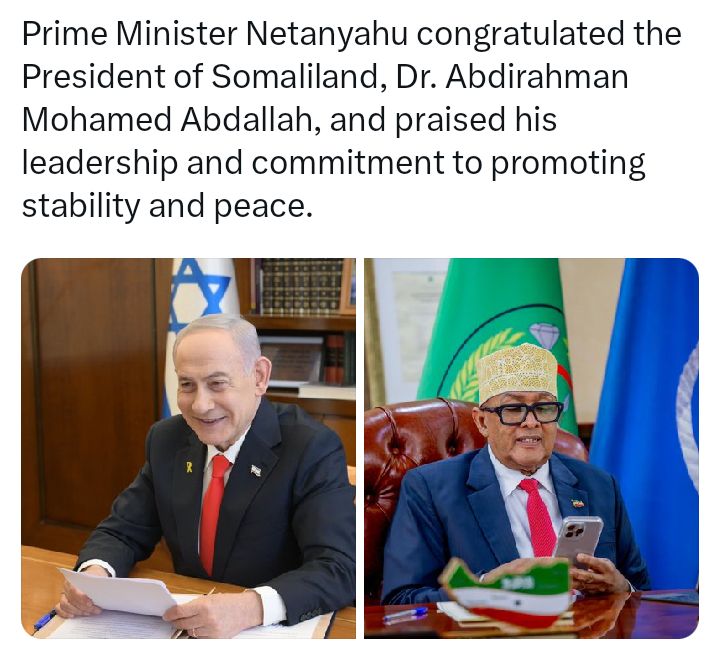
Today, Israel announced formal recognition of Somaliland as an “independent and sovereign state,” and Somaliland’s leadership welcomed it—an unprecedented diplomatic move with immediate regional consequences.
I’m writing this with a heavy heart, because Somalia is not a theory to me. It is blood, family, memory, and a future we have been trying—painfully—to repair after decades of fragmentation and war that began with the collapse of central authority in 1991.
And I’m writing because this moment is not “just diplomacy.” It is an alarm bell: an event that tests the conscience of leaders, the maturity of our political culture, and the unity of the Somali people—wherever they live.
1) What happened today
Israel’s Prime Minister Benjamin Netanyahu formalized Israel’s recognition of Somaliland and spoke of immediate cooperation and diplomatic ties.
Reports also describe regional opposition and concerns that recognizing a breakaway region undermines Somalia’s territorial integrity.
Whatever one thinks of Somaliland’s long-running quest for recognition, the identity of the recognizer matters, the timing matters, and the symbolism matters.
2) Why this is spiritually and nationally explosive
Let’s speak plainly: Somalis are a Muslim people, and our moral compass cannot be rented out for a stamp of recognition.
When recognition is celebrated without accounting for the moral weight of the moment, it communicates something dangerous to the wider Somali public:
that national questions can be outsourced,
that Somali blood and Somali unity are secondary,
and that principle can be traded for paperwork.
If you want a future built on hospitals, roads, security, education, and investment, you do not pour gasoline into an already fragile political environment and call it “progress.”
3) Somalia is finally taking steps forward—and this tries to drag us back
Mogadishu’s recent municipal vote has been widely reported as a step—however imperfect and contested—toward restoring “one-person, one-vote” civic life after decades of indirect, clan-mediated political arrangements.
That matters. It represents a direction: accountability, civic participation, and a modern state trying to stand upright.
And then, on the other side, we see a decision that signals:
“Recognition is the goal, no matter the cost.”
Not consultation. Not joint planning. Not Somali-led resolution.
4) My doctrine here is nonviolence: rhetoric over blood
I will not call for war. I will not romanticize bloodshed. Somalia has buried enough sons and daughters.
But I will say this clearly: decisions like this raise the risk temperature. And when the risk temperature rises, miscalculation becomes easier, extremists gain oxygen, and ordinary civilians pay the bill.
So my response is strategy through speech—rhetoric as a shield, not as a sword.
PART A — A Preparatory Message to the President of Somalia (short, direct)
Mr. President: I am going to give you a victory—a victory that will make people cry, not because we celebrate pain, but because we remember what we almost lost. This is the power of rhetoric: the power of a leader who masters the instrument of leadership at the highest level. I am giving you a gift. Use it. Do not be arrogant. Do not be reactive. Unite the country. Speak to the heart of Somalia—because the heart is where nations live or die.
PART B — A second short paragraph before he reads the speech (Hadith + intention)
The Prophet ﷺ taught us that wisdom is the property of the believer—wherever he finds it, he has the most right to it. I am placing wisdom in your hands in the form of words designed to unify—not to provoke. Read this with a good heart. Read it with humility. Read it with tears if tears come. Let the people’s emotions decide—because when the people’s hearts return to Somalia, Somalia returns to itself.
PART C — The Speech: “A Somali Moment of Truth” (for the President of Somalia)
My fellow Somalis—my people in Mogadishu, in Hargeisa, in Borama, in Burao, in Berbera, in Kismayo, in Baidoa, in Beledweyne, in Garowe, and across the diaspora—
Tonight, I am not speaking to you as a politician.
I am speaking to you as a Somali who has carried this flag in his heart through storms.
For too long, Somalia has been wounded by decisions made without the people—decisions made in rooms where the nation was treated like property, and the future was treated like a private business deal.
We know our history.
We know what happens when ambition outruns conscience.
We know what happens when power outruns consultation.
Somalia has lived through collapse since 1991—through civil war, fragmentation, displacement, and the long struggle to restore statehood and dignity.
And yet, we are still here. Still Somali. Still one people.
And now a new test has arrived.
Today, Israel announced recognition of Somaliland as an independent state, and Somaliland’s leadership welcomed it.
That is the fact. That is what happened.
So I ask, with calm and clarity:
Who decides the future of Somali land—foreign governments, or Somalis?
Who owns this land—politicians, or the people?
We have just taken steps—steps toward civic life and democratic practice that our parents were denied for decades.
We are not perfect, but we are moving. We are rebuilding the logic of a nation: elections, accountability, institutions, and law.
And at this exact moment, we are presented with a decision that threatens to pull our story back into the language of provocation.
So I will not answer provocation with provocation.
I will answer it with the highest Somali weapon:
the word.
The tear.
The poem.
The appeal to conscience.
To my people in Somaliland:
I am not your enemy. I am your brother.
I am not coming to threaten you. I am coming to ask you:
What do you want your children to inherit?
A passport of pride—or a battlefield of regret?
If you believe separation is your destiny, then let it be done with Somali consultation, with dignity, with law, with agreements, with guarantees, with mutual respect—not by importing a recognition that sets fire to the room and asks innocent people to breathe the smoke.
So tonight, I place the question directly into the hands of the people:
If you accept this path, then make it public.
If you reject this path, then make it visible.
Lift the Somali flag.
Lift it in Somaliland—not as surrender, but as a declaration that the Somali people still own the Somali decision.
Raise it to say:
“We will decide our fate ourselves.”
“We will not outsource our dignity.”
“We will not trade the future of our towns for the applause of strangers.”
And to those who say: “We want recognition at any cost,” I say:
Recognition is not bread.
Recognition is not a hospital.
Recognition is not clean water.
Recognition is not security.
A nation is built by roads, schools, ports, investment, and law—by honest work and moral credibility.
And yes—I will speak from moral gravity:
If you celebrate recognition while the Muslim world bleeds, do not be surprised when the Somali street asks what you celebrated—and what you ignored.
So I am calling for a national moment of conscience.
Let every Somali official speak.
Let them speak with humility.
Let them speak with tears if tears come—because tears are not weakness. Tears are proof that the heart is alive.
And let us answer this moment not with bullets, but with unity.
To the world: Somalia is not a prize to be divided.
Somalia is a people.
To Somaliland politicians: the Somali people are not chess pieces.
They are human beings with graves behind them and children ahead of them.
And to my people everywhere:
If you want one Somalia—raise the flag.
If you want the Somali decision to remain Somali—raise the flag.
If you want peace—raise the flag.
And if anyone chooses a different identity, a different alliance, a different moral story—then at least be honest about it, so history can record what was chosen, and who chose it.
May Allah guide us.
May Allah protect Somalia.
May Allah keep our hearts together when politics tries to tear them apart.
PART D — The closing rhetorical “choice” passage (powerful conclusion)
To the people of Somaliland: this is your moment. If you believe your recognition must come through Israel, then say it openly. But understand what you are saying—not only politically, but morally. If you refuse to raise the Somali flag now, you are telling the Somali nation that this decision was made over your heads—or with your approval. So choose with clarity. Choose with courage. Choose with the fear of Allah. Because nations are not destroyed only by armies—nations are destroyed when the heart of the people breaks in half and refuses to heal.
PART E — Open Letter to Moussa Abdi (former Prime Minister of Somaliland)
In the Name of Allah, Most Merciful, Most Compassionate,
Mr. Moussa Abdi,
I am writing to you because you are known as a religious man—someone who speaks of Allah and reveres the Messenger of Allah ﷺ. In moments like this, silence becomes a language. And history listens carefully to the language of silence.
Today, Israel announced recognition of Somaliland, and Somaliland’s leadership welcomed it.
This is not a small headline. It is a moral and national earthquake.
If Somaliland seeks recognition, let it seek recognition through Somali consultation, Somali dignity, and Somali-led process—not through a decision that inflames the region and deepens distrust. A nation is not built by applause. A nation is built by hospitals, roads, schools, ports, and a shared security future.
I ask you—fear Allah regarding Somali blood. Fear Allah regarding Somali unity. Fear Allah regarding the Day when leaders will answer for what they encouraged, and what they allowed.
You have influence. Use it.
Go to Mogadishu if you must. Speak to the Somali public. Speak to Somaliland’s people. Tell them: we can compete in development, in governance, in infrastructure, in clean administration—without importing alliances that turn Somalia into a battlefield of international agendas.
And speak plainly: if this move is celebrated while the Muslim conscience is wounded, then the wound will not stay in Palestine—it will travel into our streets, our politics, and our future.
This is a time to tell the truth, even if it is costly.
May Allah make you a voice of wisdom when wisdom is rare.
PART F — Final letter to the President of Somaliland (your “resignation from the chaos” message, but firm)
Mr. President,
You were given an opportunity—an opportunity to reflect, to build, to steady your society, and to move forward with wisdom. But by embracing recognition in a way that pours fuel on Somalia’s unresolved national wound, you have dragged danger to your own doorstep.
Let me be clear: I will not call for violence. I am a man of peaceful ideas. I believe rhetoric can prevent bloodshed—and if calm voices had not spoken, we both know how quickly reckless forces can spiral.
But I must tell you the truth: this decision signals that your administration chose recognition over long-term prosperity, recognition over consultation, recognition over the patient work of building a shared future in the Horn of Africa.
Somaliland’s story—whatever its final constitutional destination—should be decided by Somalis through consultation, agreements, law, and guarantees. Not through foreign declarations that intensify polarization and make negotiations harder, not easier.
I am stepping back from this political arena because I will not be part of anything that leads to blood. But I will not step back from truth.
You have made a choice that will follow you for the rest of your public life.
A leader is remembered less for what he achieved in paperwork and more for what he protected in people.
May Allah guide you to repentance where repentance is needed, and to wisdom where wisdom has been abandoned.
Final note to readers of my blog
I wrote this to move Somalia away from war, not toward it. I wrote it to force a national conversation that returns the Somali decision to Somali hands.
If you are Somali—anywhere in the world—this is your duty now:
Choose unity or choose division, but choose consciously.
And if you choose unity, make it visible: raise the Somali flag in your heart, in your home, and in your speech—because nations live first in the heart, and only then in the map.