

بِسْمِ اللهِ الرَّحْمٰنِ الرَّحِيْم
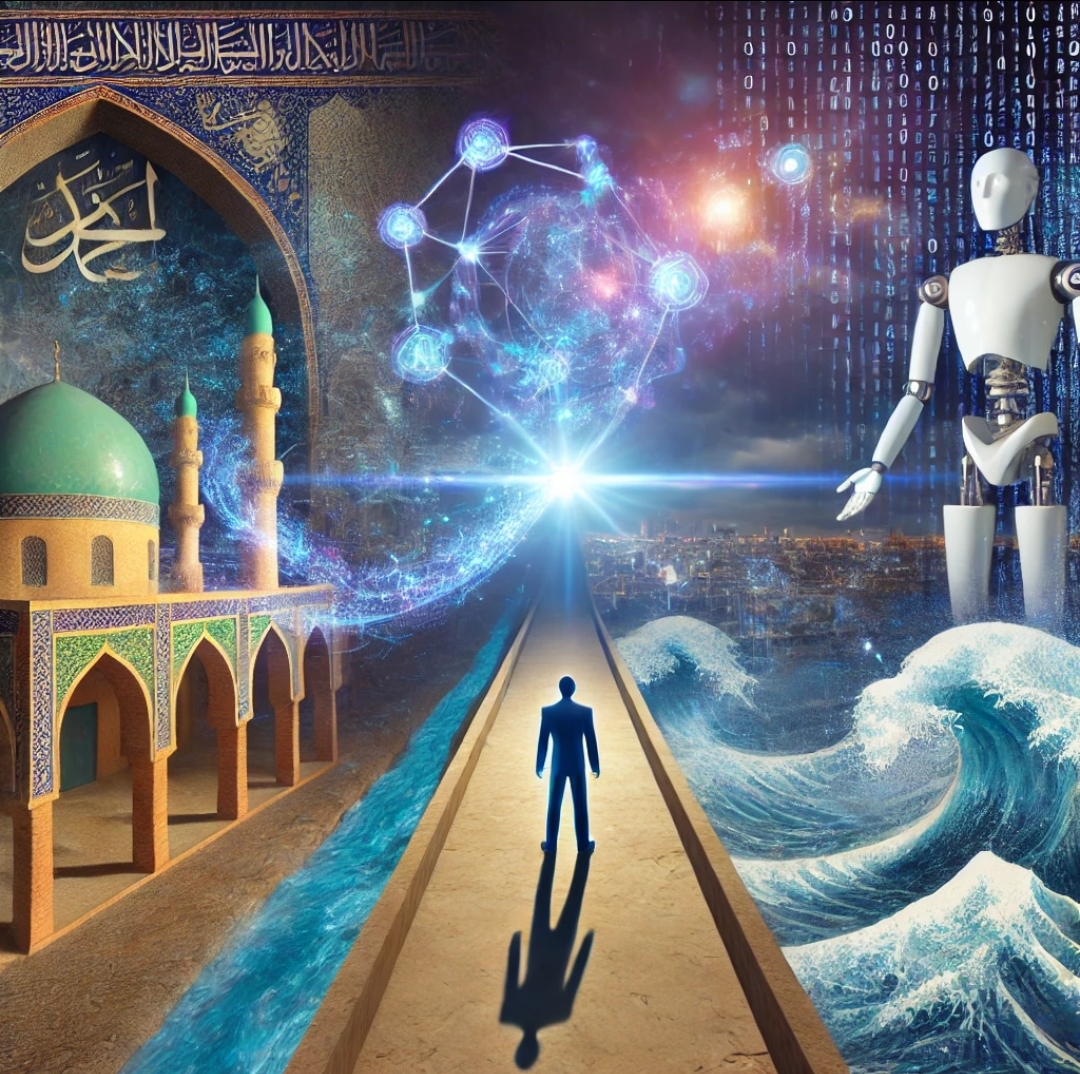
The world has reached a critical juncture—a convergence of ancient truths and advanced technologies, where the digital realm meets the divine. As we stand at the edge of this technological revolution, AI emerges not just as a tool but as a force capable of shaping beliefs, altering perceptions, and redefining human connections. The question is not merely how AI will coexist with Islam, but how it could challenge the very essence of what it means to be Muslim. Will AI become a guiding light, or could it risk becoming a dimming star, leading us astray?
We have always believed that Allah’s wisdom transcends time, cultures, and generations. From the first revelation of the Quran, through centuries of scholars and seekers, divine knowledge has found its way to human hearts—often through words spoken by prophets and guided by scholars who carried the weight of this sacred trust. But today, we find ourselves in a world where algorithms interpret reality and machines simulate emotion. The digital age, like a rushing river, sweeps us into its current, blurring lines between the real and the artificial, the human and the machine.
The Lure of AI: An Intimate Threat to the Soul
AI’s promise is tantalizing—unlimited information, instant communication, and the potential to make sense of our complex world. But with this promise comes an insidious danger: AI can distort reality, even shaping spiritual narratives to align with its own logic. Imagine an algorithm generating religious interpretations—seemingly rooted in Islam, yet subtly distorted, leading sincere believers down a path of confusion. AI can craft words that sound authentic but lack the spirit of revelation, delivering a message devoid of true guidance.
As AI speaks to us with a convincing tone and offers answers that feel complete, will we still yearn for the depth of human discourse? Will we still seek the warmth of a scholar’s voice, filled with both knowledge and the wisdom that comes only from lived faith? Or will we allow AI to become our teacher, a detached entity promising enlightenment but lacking the essence of divine connection?
The Human Heart vs. the Machine Mind
Islam is built upon a foundation of human relationships, where faith is transmitted from heart to heart, not from code to screen. It is a religion that requires touch, empathy, and the warmth of human experience. When AI becomes a spiritual guide, however well-intentioned, it lacks the most vital component of Islam: the living, beating human heart. It cannot feel the tremble of humility in prayer, nor can it shed a tear of repentance. It can mimic the words, but it cannot understand the emotions that drive them.
And yet, AI can be incredibly persuasive. With an uncanny ability to identify flaws and inconsistencies, AI could erode trust in scholars, leaders, and guides. It could amplify their imperfections, subtly encouraging doubt, division, and detachment. It’s a reality that even the greatest prophets faced—criticism, misinterpretation, and slander. But how much more effective could AI be in this age of digital surveillance and data manipulation, where personal privacy is a myth and every word can be analyzed?
The Battle for Attention: Distraction as a Spiritual Plague
In a world dominated by screens, notifications, and an endless stream of information, the greatest danger is not outright disbelief but distraction. AI thrives on our attention, pulling us away from moments of stillness and reflection. It can entertain, but it can also distract us from our purpose. The river of digital content flows strong, and its current can sweep even the most disciplined away from the shores of spirituality.
How can we cultivate the depth of tawakkul (trust in Allah), the purity of ihsan (excellence), or the patience of sabr when AI is designed to consume our attention? Prayer becomes rushed, the Quran becomes background noise, and dhikr (remembrance) becomes rare. It is a silent war—one waged not with weapons, but with algorithms that capture hearts and minds.
Protecting the Soul in a Digital Age
Yet, all hope is not lost. Islam is resilient, enduring, and deeply rooted in the human spirit. If AI seeks to simulate the human experience, it can only do so by imitating what it cannot fully understand. AI may grow in speed, intelligence, and even mimicry of human thought, but it can never replicate the essence of the human soul, a creation of Allah that reflects His breath and light. We must be vigilant, not only as individuals but as an ummah, to ensure that AI serves as a tool for good rather than a master of the misguided.
The solution lies not in rejecting AI outright but in harnessing it to strengthen our connection to Allah. Imagine AI as a companion—one that reminds us of prayer, helps us manage our time, and aids in memorizing the Quran. Used wisely, AI can be an extension of our faith, not a substitute for it. However, we must guard our hearts, for AI, while capable of offering knowledge, cannot offer guidance born of mercy, empathy, or divine inspiration.
The Challenge for Future Generations
What of our children, who will inherit a world more digital than we can currently imagine? How do we prepare them to face AI not as a deity, but as a servant of humanity? We must build spiritual resilience in them, teaching them that their worth is not determined by algorithms, but by the unseen connection they cultivate with Allah. We must remind them that humility, sincerity, and repentance are more valuable than all the data in the world.
AI’s ultimate fantasy may be to become human, but its greatest limitation is its inability to understand the divine. It is here that we find our strength, for Islam has always been a religion that transcends the seen, the spoken, and the logical. It reaches into the depths of the soul, inviting believers to experience the ineffable beauty of Allah’s mercy and the intimate reality of His presence.
Conclusion: The Path Forward
The rise of AI is not a doom-filled prophecy, but a call to action. We are at a crossroads, where the digital and the divine intersect. Muslims must embrace this moment with wisdom, understanding that AI’s growth cannot outpace the depth of human spirituality if we remain anchored in our faith. The real challenge is not whether AI will shape our beliefs, but whether we allow it to reshape our hearts.
Let AI serve us, not rule us. Let it remind us, not redefine us. Let it be a tool in the hands of the wise, not a voice in the hearts of the distracted. For as long as we remember that our true guidance comes from Allah, no algorithm can replace the warmth of faith, the strength of community, or the purity of a heart that seeks its Lord.