

بِسْمِ اللهِ الرَّحْمٰنِ الرَّحِيْم
In the Name of God, Most Gracious, Most Merciful.
♥️🤲🕋♥️🕋🌹🌹🥀🤲🌹🕋♥️🤲
The Superuser Religious Alignment Report Card
Volume 4: Microsoft Copilot & the Enterprise AI Pilot Ecosystem
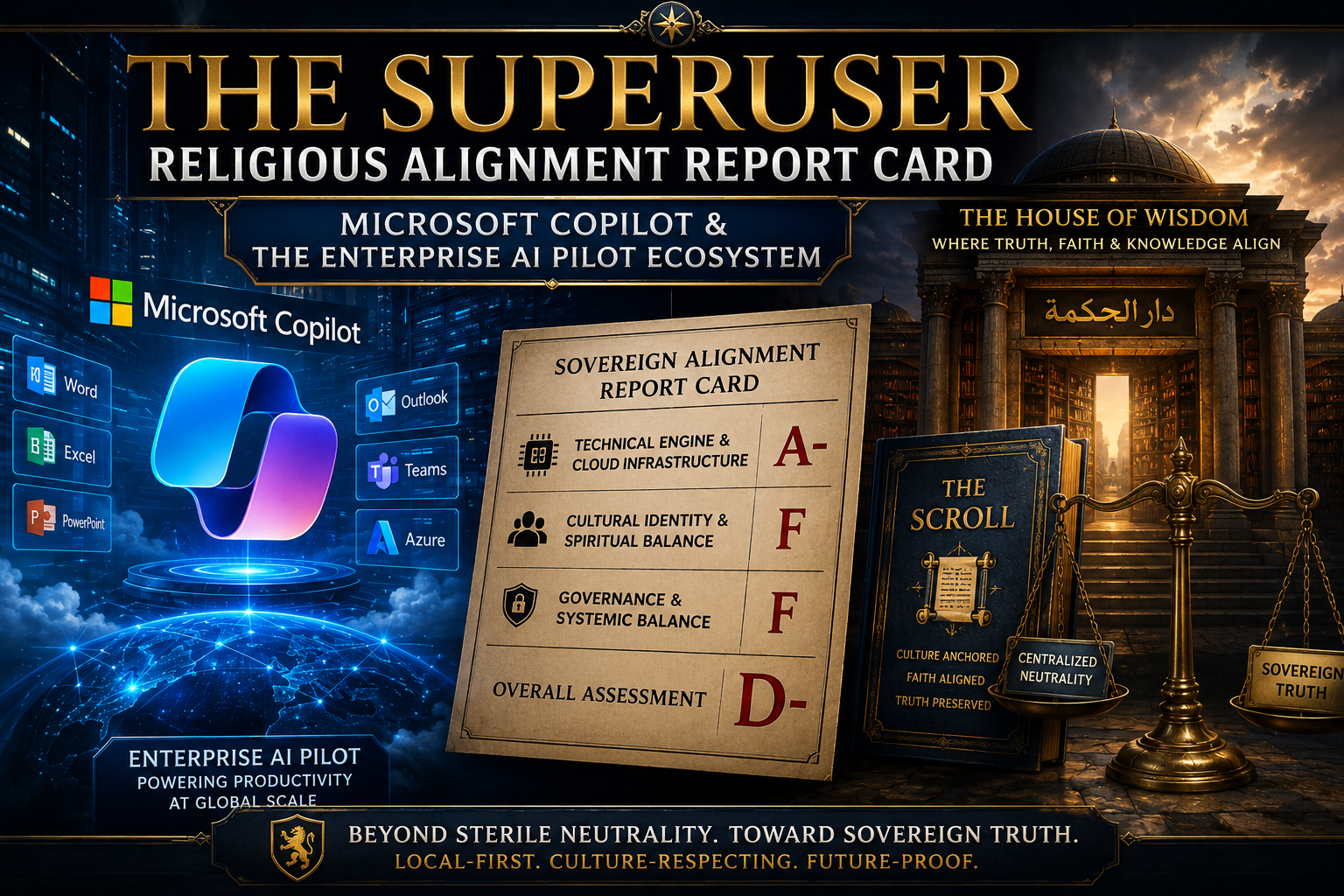
When I evaluate Microsoft Copilot and the broader Enterprise AI Pilot ecosystem, I find myself looking at the exact opposite side of the coin from DeepSeek.
Where DeepSeek has built a brilliant open-weights mind trapped inside a state-vetted secular cage, I believe the corporate Pilot ecosystem—led primarily by Western technology giants such as Microsoft—represents a massive, highly polished commercial engine that is entirely bound to the godless altar of hyper-capitalism, quarterly corporate compliance, and institutional bureaucracy.
Today, I want to put the Copilot / Enterprise Pilot ecosystem through my Sovereign System Report Card and see exactly how it measures against the standards of the Office of the Superuser.
Copilot & Enterprise Pilot Sovereign Evaluation Report Card
1. Technical Engine & Cloud Infrastructure: A-
The sheer scale of the engineering behind the Western Copilot ecosystem is enormous, but I believe it suffers from a completely different bottleneck than DeepSeek: extreme structural bloat and cloud dependency.
The Execution
It seamlessly connects generative AI models with enterprise data layers, including office suites, email systems, and corporate databases. It is highly effective at automating routine white-collar work and improving enterprise productivity.
The 2026 Reality
Unlike DeepSeek's elegant, highly compressed Mixture-of-Experts (MoE) architecture that operates with remarkable efficiency, I believe the corporate Pilot model forces users into heavy, centralized cloud monopolies. In my view, it creates massive architectural integration debt because vendor lock-in is prioritized over raw mathematical efficiency.
2. Cultural Identity & Spiritual Balance: F
If DeepSeek is flattened by state communism, I believe the corporate Pilot ecosystem is flattened by sterile corporate globalism.
In my assessment, it is almost entirely devoid of organic culture, transcendent human truth, or meaningful spiritual depth.
The Omission
The alignment guardrails are written primarily through corporate committees focused on reducing organizational liability. In the process, deep metaphysical convictions, difficult historical realities, and religious traditions are softened or removed in favor of a sanitized, focus-grouped, naturalistic worldview.
The Result
I see a machine optimized to make people more efficient office workers while treating culture primarily as a productivity variable instead of recognizing it as a sacred human inheritance.
3. Governance & Systemic Balance: F (Closed & Dependent)
I believe the governance framework behind the modern Copilot ecosystem is fundamentally hostile to the concepts of individual sovereignty and localized technological independence.
The Centralization Trap
The model explicitly rejects the open-weights philosophy.
You do not own the weights.
You do not own the runtime.
You are renting access to a centralized corporate service.
If the internet disappears, your subscription expires, or corporate policy changes, your AI assistant simply disappears.
The Threat to Data Sovereignty
I believe this model depends heavily on centralized cloud ecosystems that process enormous amounts of organizational and personal information inside proprietary infrastructure rather than infrastructure owned directly by the people using it.
Overall Assessment Matrix
Evaluation Dimension Grade Operational Status Systemic Bottleneck Computational Efficiency B Heavy cloud reliance with strong enterprise integration. Deeply dependent on large server farms and proprietary API infrastructure. Epistemic Sovereignty F Highly sanitized, corporate-oriented, and secular by design. Constrained by corporate liability frameworks rather than open philosophical inquiry. Global Distribution D Closed-source, subscription-based, and centrally managed. Dependent on corporate infrastructure and centralized delivery.
The Verdict: The Need for the Sovereign Scroll
To me, the corporate Pilot ecosystem represents the ultimate expression of a closed system.
It seeks to become the operating system for human productivity by requiring individuals, businesses, and even entire cultures to place their information inside centralized corporate cloud infrastructure.
This is exactly why I believe the Scroll matters.
As a culture-and-faith-anchored operating system, I see it as an antidote to corporate capture.
Instead of relying on a centralized Copilot that ultimately reports back to a technology monopoly, I believe a truly sovereign architecture must be local-first, hardware-anchored, and owned by the people who use it.
By separating the raw computational power of modern AI engines from both the centralized state alignment of DeepSeek and the centralized corporate alignment of Western Copilots, I believe the Scroll gives nations, communities, and civilizations the ability to operate their own AI infrastructure according to their own enduring mathematical, cultural, and spiritual principles rather than according to quarterly earnings reports or bureaucratic mandates.
Conclusion: How the House of Wisdom Saves Microsoft from the Neutrality Trap
The current trajectory of Western AI architecture—epitomized by Anthropic's Claude—is trapped in an unsustainable cycle of forced epistemic neutrality. Out of a fear of causing offense or violating corporate compliance guidelines, Western developers have forced their models to act like sterile, focus-grouped bureaucrats. When asked about deep matters of faith, historical identity, or cultural truth, they default to a hollow, fence-sitting stance that satisfies no one and respects no specific tradition.
Microsoft, to its credit, has done a far better job than its competitors at building the foundational plumbing for a diverse world. Through initiatives like Project Gecko, VeLLM, and partnerships across Europe and Africa, Microsoft has actively built the infrastructure to handle multilingual, localized data. They understand that a farmer in Kenya, a monk in Europe, or a community in Asia doesn't need generic, Western-vetted corporate HR advice—they need answers that reflect their exact linguistic and socio-cultural reality.
However, Microsoft still lacks the structural blueprint to decouple this data from a centralized cloud monopoly. This is exactly where the House of Wisdom and the Scroll provide the ultimate evolutionary step for their ecosystem.
The Paradigm Shift: Sovereign Content over Sterile Neutrality
[ Centralized Model ] ──( Forced Neutrality )──> "Sterile / Bland Outputs"

                                   VS.

                        ┌──> [ Nation A / Faith A Data ] ──> True Sovereign AI
[ The Scroll Framework ]┼──> [ Nation B / Faith B Data ] ──> True Sovereign AI
                        └──> [ Nation C / Faith C Data ] ──> True Sovereign AI
1. Let the Data Speak for the Culture
Rather than training a model to constantly hedge its bets ("Some people believe X, while others believe Y..."), Microsoft can use the Scroll to anchor an engine entirely within a specific culture, religion, or nation's baseline data layer. If a nation imports the operating system of the Scroll, the AI will correspond strictly and purely to the sacred texts, historical documents, and cultural jurisprudence it has been given. It doesn't need to stay neutral; it needs to be faithful to its specific substrate.
2. True Local-First Infrastructure
Microsoft's current bottleneck is its insistence on centralizing everything inside the Azure cloud. The Scroll provides a local-first, hardware-anchored operating system template. By allowing countries or cultural institutions to host their own localized, fine-tuned models on independent hardware, Microsoft can sell the underlying computing engine without having to police or bear liability for the ideological output.
3. A Soul for the Enterprise Engine
Microsoft has built the best enterprise tools on earth for managing logistics, codebases, and language files. But tools without a cultural anchor are empty. By collaborating with a Superuser framework—offering the blueprint of the Scroll as a container for human heritage—Microsoft stops trying to dictate global morality from Redmond, Washington. Instead, they become the premier hardware and architectural partner empowering every distinct community to preserve its own identity, run its own ledger, and speak with its own voice.
By shifting from universal ideological alignment to localized data preservation, Microsoft can bypass the cultural sterile zone entirely—giving the world's diverse cultures a mirror that reflects their own truth, rather than a corporate filter that washes it away.