

بِسْمِ اللهِ الرَّحْمٰنِ الرَّحِيْمِ
In the Name of God, Most Gracious, Most Merciful.
♥️🤲🕋♥️🕋🌹🌹🥀🤲🌹🕋♥️🤲
RECLAIMING THE INTELLECT (AL-‘AQL)
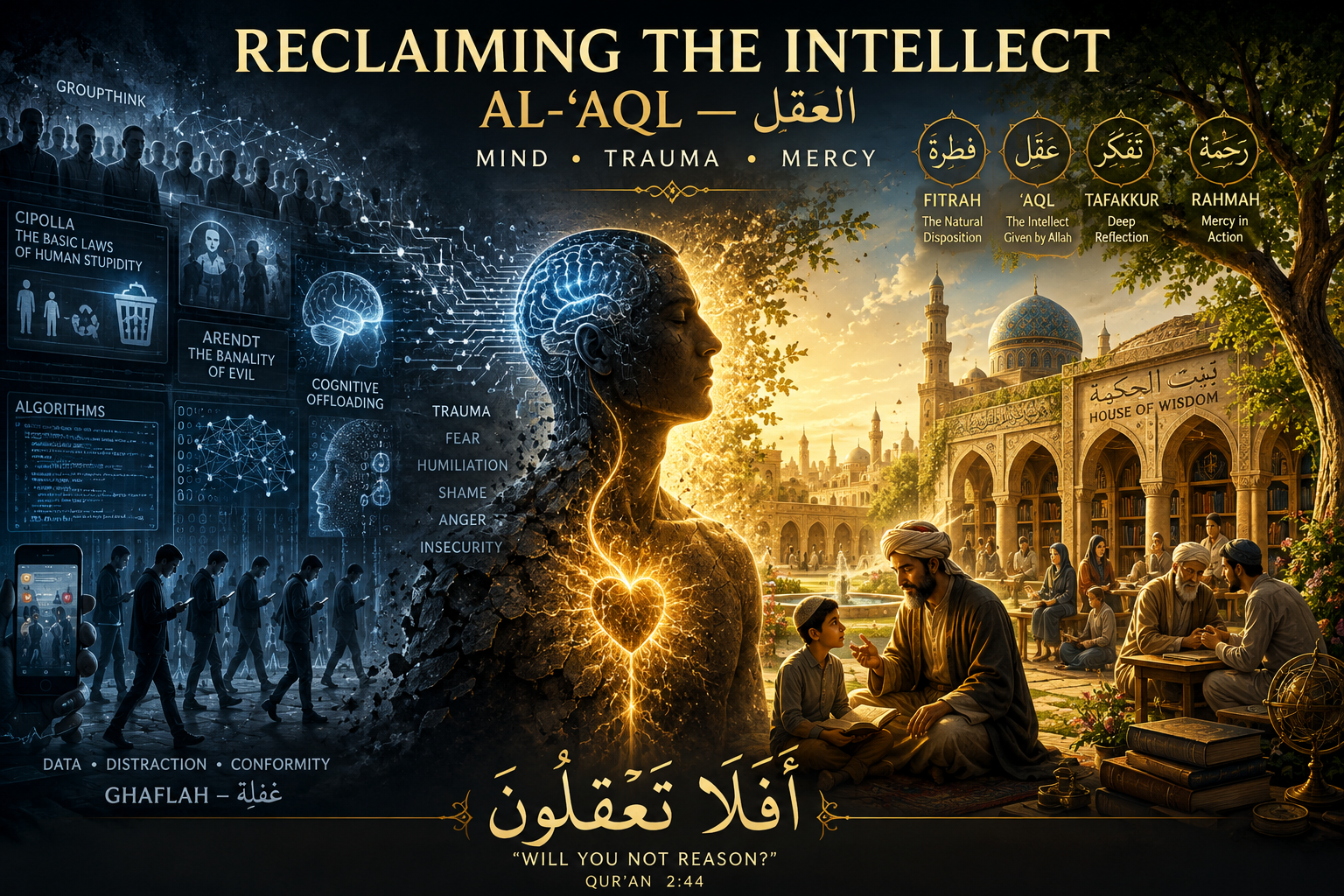
The Islamic Epistemology of Mind, Trauma, and Mercy
بِسْمِ اللهِ الرَّحْمٰنِ الرَّحِيمِ
In the Name of God, Most Gracious, Most Merciful.
There is a danger in calling another human being stupid.
The word sounds like a diagnosis, but very often it is the end of diagnosis. Once we place a person inside that category, we no longer have to ask what happened to them, what environment shaped them, what fears taught them to remain silent, what wounds taught them not to trust, or what conditions might allow their intelligence to emerge.
That is where I want to begin.
When we examine the modern crisis of human thought through thinkers such as Carlo M. Cipolla, Hannah Arendt, the conformity experiments associated with Solomon Asch, or contemporary research into cognitive offloading and dependence on technology, we encounter important observations about human behavior.
People surrender judgment.
People follow crowds.
People conserve mental effort.
People defer to systems and authorities.
People can stop questioning even when something directly in front of them should cause them to question.
These observations matter.
But symptoms are not necessarily root causes.
The deeper question is:
Why does a human being stop thinking?
And an even more important question follows:
What kind of environment allows the intellect to awaken again?
Here the Islamic intellectual tradition gives us another starting point.
Islam does not begin its understanding of humanity by dividing people into permanent categories of the intelligent and the stupid. It begins with the extraordinary dignity of the human being—with the Fitrah, with moral responsibility, with the Qalb (heart), with the ‘Aql (intellect), and with the repeated Qur'anic invitation to observe, listen, remember, contemplate, and reason.
The Qur'an repeatedly asks:
أَفَلَا تَعْقِلُونَ — Afalā ta‘qilūn?
Will you not reason?
The question itself assumes a capacity capable of being exercised.
So perhaps the crisis we are witnessing should not immediately be described as an absence of intelligence.
Perhaps we should first investigate what has happened to the intelligence that was already there.
Instead of asking only:
“Why are people becoming stupid?”
we should ask:
What closes the human intellect?
What frightens it into silence?
What causes someone to surrender judgment to the crowd?
What relationship exists between the heart and the intellect?
And what role do mercy, dignity, security, listening, and human relationships play in restoring the appetite to think?
From the Qur'an, the Prophetic model, and the broader Islamic intellectual tradition, the human being cannot be reduced to a cold biological processor calculating inputs and outputs.
The human being is simultaneously intellectual, moral, emotional, embodied, social, and spiritual.
A frightened human being thinks differently from a secure one.
A humiliated child learns differently from a respected child.
A person living under constant threat processes the world differently from someone given room to contemplate.
And a human being surrounded by mercy may reveal capacities that an environment of ridicule never permitted us to see.
This is why Rahmah—mercy—belongs inside a discussion about intelligence.
1. THE NOBLE DEFAULT: FITRAH AND AHSAN TAQWĪM
The Islamic starting point is dignity and innate human capacity.
Allah says:
“We have certainly created man in the best of stature.”
— Qur'an, Surah At-Tin, 95:4
Ahsan Taqwīm.
That is our starting point.
Not the fool.
Not the statistic.
Not the algorithmic profile.
Not the IQ score.
Not merely the damaged or struggling person standing before us today.
The human being as Allah created the human being.
Every human being is born upon the Fitrah—a primordial disposition oriented toward truth and recognition of the Creator.
The Islamic concept of ‘Aql also extends beyond raw IQ or computational speed. The Arabic root carries the sense of binding or restraining. Intellect is connected to discernment, responsibility, judgment, and the ability to restrain oneself from destructive behavior.
The Qur'an does not merely ask human beings to accumulate information.
It asks them to see.
To listen.
To remember.
To reflect.
To reason.
Therefore, when someone fails to exercise those faculties well, we should not immediately conclude that the intellectual hardware is absent.
We should ask what may be obstructing its proper use.
2. TRAUMA, FEAR, AND THE VEILING OF INTELLECTUAL CAPACITY
If the human being begins from such a noble position, what can contribute to the collapse of critical thought?
Here we must take seriously fear, humiliation, chronic stress, oppression, emotional injury, and trauma.
The Qur'an speaks of the tremendous range of human possibility:
“Then We return him to the lowest of the low, except those who believe and do righteous deeds…”
— Qur'an, Surah At-Tin, 95:5–6
This should not be reduced to a simplistic psychological formula; the verses have their own theological and exegetical context. But they remind us that the human being possesses extraordinary potential while also being capable of profound decline.
Modern psychology and neuroscience likewise give us reasons to examine how prolonged threat and stress can affect attention, learning, memory, emotional regulation, and decision-making.
Consider a child who learns that asking questions brings humiliation.
Consider a student who discovers that disagreeing with authority brings ridicule.
Consider an employee who learns that admitting uncertainty threatens employment.
Consider someone who has spent years surviving an environment where vulnerability is dangerous.
Eventually, silence can become protection.
Conformity can become protection.
Withdrawal can become protection.
Curiosity requires psychological room.
Tafakkur—deep reflection—requires attention.
And when enormous cognitive resources are being consumed by fear, vigilance, instability, or emotional survival, the appetite for exploration can diminish.
What looks from the outside like laziness may sometimes be exhaustion.
What looks like indifference may sometimes be withdrawal.
What looks like intellectual weakness may sometimes be fear.
This does not eliminate individual responsibility.
But it should make us more careful before reducing a complicated human being to a single insulting category.
3. THE COLLAPSE INTO BLIND CONFORMITY
When people stop exercising judgment, something else often fills the vacuum.
The Qur'an repeatedly condemns unthinking imitation when inherited practices contradict revelation and truth:
“And when it is said to them, ‘Follow what Allah has revealed,’ they say, ‘Rather, we will follow that which we found our fathers doing.’ Even though their fathers understood nothing, nor were they guided?”
— Qur'an, Surah Al-Baqarah, 2:170
This is remarkably relevant to the modern problem of conformity.
The crowd says something.
We repeat it.
An authority says something.
We accept it.
An algorithm recommends something.
We follow it.
Everyone around us behaves in a particular way.
We imitate it.
Eventually, imitation can replace investigation.
The Islamic intellectual tradition contains a powerful corrective: Tahqīq—careful verification, realization, and investigation.
The seeker of truth cannot merely inherit conclusions.
Evidence must matter.
Observation must matter.
Reasoning must matter.
Truth must matter more than ego or tribal loyalty.
This intellectual attitude can also be seen in figures such as Ibn al-Haytham, whose methodological writings emphasized rigorous investigation and suspicion of one's own biases when examining claims.
The enemy of critical thought, therefore, is not merely ignorance.
It is also the surrender of the responsibility to examine.
4. RAHMAH: MERCY AS A PEDAGOGICAL ENVIRONMENT
If fear can close a human being, what helps reopen the person?
Islam gives us a profound answer:
Rahmah.
Mercy.
Allah describes the mission of Prophet Muhammad ﷺ:
“We have not sent you except as a mercy to the worlds.”
— Qur'an, Surah Al-Anbiya, 21:107
And Allah says:
“It was by mercy from Allah that you were gentle with them. Had you been harsh and hard-hearted, they would have dispersed from around you.”
— Qur'an, Surah Ali ‘Imran, 3:159
Notice what this teaches us.
People can leave an environment because of the character of the person leading it.
Truth does not give us permission to become cruel.
Knowledge does not give us permission to humiliate.
Authority does not give us permission to destroy dignity.
The Messenger of Allah ﷺ taught, corrected, advised, disciplined, encouraged, listened, and cultivated people.
His mercy was not weakness.
His gentleness did not eliminate standards.
Rather, mercy created an environment in which correction could be received without unnecessary humiliation.
This is Prophetic pedagogy.
And Allah Himself directs believers to the Prophet ﷺ as the model:
“Indeed, in the Messenger of Allah you have an excellent example for whoever has hope in Allah and the Last Day and remembers Allah often.”
— Qur'an, Surah Al-Ahzab, 33:21
Uswatun Hasanah — the Excellent Example.
THE CONTRAST
Dimension A Reductionist Reading The Islamic Framework Developed Here Human Nature Primarily a biological information-processing organism Noble creation endowed with Fitrah, moral responsibility, heart and intellect Cognitive Failure Laziness, limited processing, energy conservation, dependence on tools May also involve fear, heedlessness, emotional injury, environment, habit and moral choice Conformity Groupthink and social pressure Ghaflah, uncritical imitation and surrender of judgment Human Development Improve cognition, habits and performance Cultivate ‘Aql through truth, responsibility, knowledge, character and Rahmah Leadership Optimize performance Cultivate human beings while protecting dignity Ultimate Model Technique The Prophetic example
RETURN TO ZERO
This brings the entire argument to its necessary conclusion.
Before we analyze other people, diagnose society, or build systems to fix the world:
Return to the baseline.
Return to zero.
Look inward first.
We have become extraordinarily comfortable pointing at other people's intellectual failures while rarely examining the environment we ourselves create around them.
Instead of immediately asking:
“What is wrong with this person?”
ask:
“What am I contributing to this environment?”
Are people safer because you entered the room?
Are they more confident?
More curious?
More willing to ask questions?
More willing to admit they do not know?
Or have your ridicule, impatience, suspicion, arrogance, or constant judgment taught them that silence is safer than thought?
Sometimes what we condemn in another human being should become a mirror through which we examine ourselves.
We can become part of the pollution while imagining ourselves to be the cure.
This does not mean every person's behavior is caused by us.
Every human being remains responsible for his or her choices.
But we are responsible for what we contribute to the soil in which other human beings are trying to grow.
Our homes are environments.
Our classrooms are environments.
Our workplaces are environments.
Our communities are environments.
Our governments are environments.
And increasingly, our technologies are environments.
We should never poison the environment people need in order to think and then casually call them stupid for failing to flourish inside it.
THE PROPHETIC WAY
Before demanding sophisticated critical thinking from another human being, perhaps we should first fulfill the simplest obligations of human dignity.
Smile.
Meet people with a cheerful face.
Help people when they are in need.
Respect their privacy.
Do not spy upon them.
Do not search unnecessarily for their faults.
Do not humiliate vulnerable people.
Cover people's mistakes when covering them is appropriate rather than exposing them for entertainment or status.
Advise with wisdom.
Correct without destroying dignity.
Encourage people toward what is better.
This is not intellectual softness.
This is human cultivation.
A living human being—breathing, feeling, remembering, suffering, speaking, learning and adapting—is too extraordinary to be casually dismissed as simply “stupid.”
The Islamic response asks us to look deeper.
Look at the Fitrah.
Look at the Qalb.
Look at the ‘Aql.
Look at the person's environment.
Look at their responsibilities and choices.
And then ask what conditions might help dormant abilities emerge.
Rahmah is not the enemy of intellectual rigor.
Mercy can help create the conditions in which intellectual rigor becomes possible.
A FINAL ADVICE TO ANYONE RESPONSIBLE FOR PEOPLE
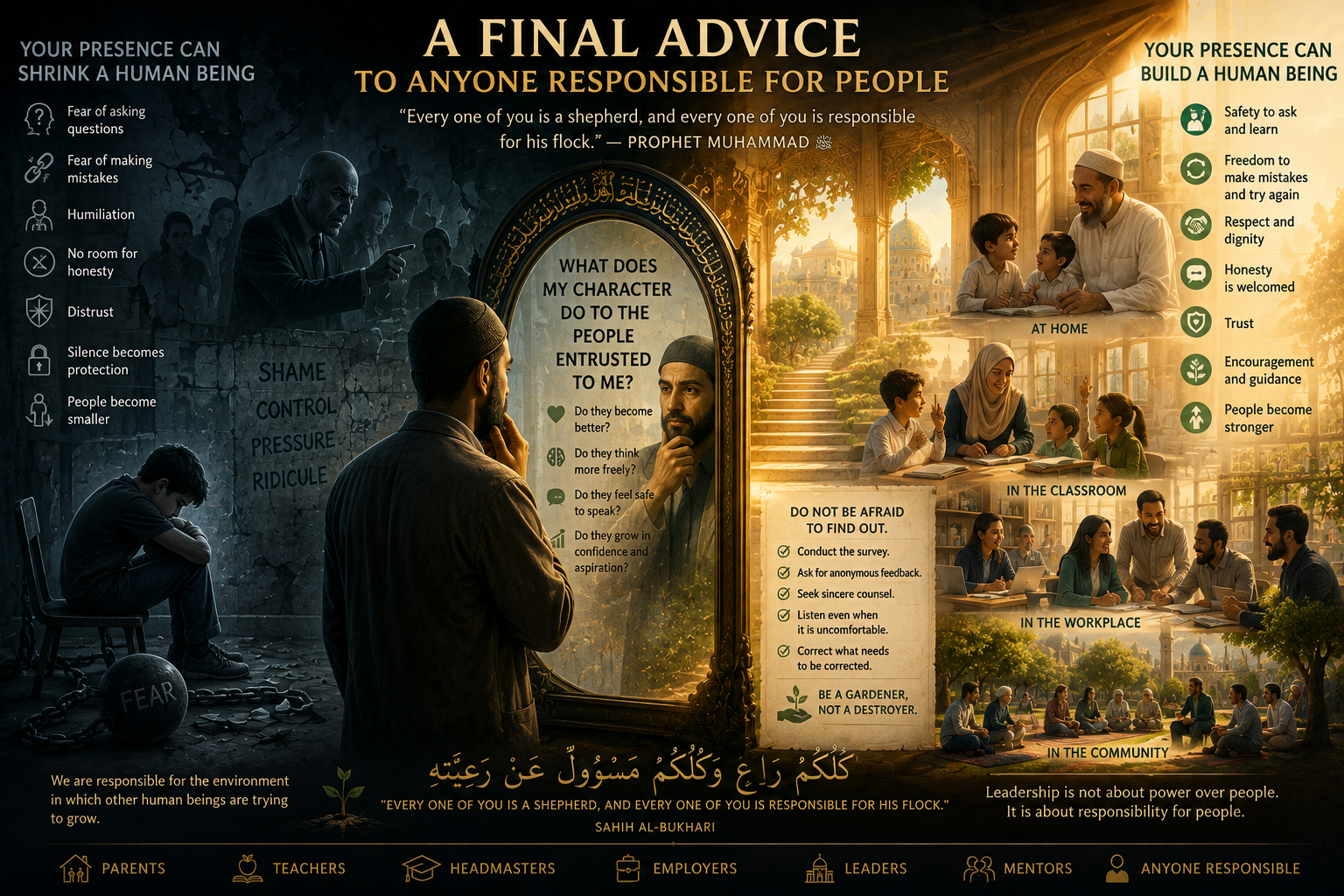
If Allah has placed you in a position of responsibility over other human beings, do not be afraid to investigate how your presence affects them.
Conduct the survey.
Ask the questions.
Create an anonymous channel for feedback if necessary.
Seek sincere counsel from someone who is not afraid of you and has no need to flatter you.
Ask:
What does it feel like to be under my authority?
Can people speak?
Can they respectfully disagree?
Can they make a mistake without being humiliated?
Can they approach me when they are struggling?
Does my presence bring out their intelligence, confidence, honesty and character?
Or does my presence make them smaller?
You may discover things about yourself that are uncomfortable.
That is why you should ask.
Leadership without honest feedback can become a mirror that reflects only what the leader wants to see.
Most of us exercise responsibility over somebody.
Parents shape the environment surrounding their children.
Teachers shape classrooms.
Principals and headmasters carry an enormous responsibility because they help shape the culture in which hundreds or thousands of young minds develop.
Employers shape workplaces.
Religious teachers shape students.
Community leaders shape communities.
Mentors, coaches and older family members can influence younger people profoundly.
Cultivating human beings is difficult work.
People arrive with different personalities, abilities, weaknesses, histories, fears and wounds.
Leadership cannot therefore consist merely of issuing instructions and measuring outcomes.
It requires learning how to cultivate people without crushing them.
So ask yourself:
What does my character do to the minds of the people entrusted to me?
Does a child associate asking me a question with safety or fear?
Are my students becoming more curious or merely more obedient?
When people leave my presence, have I helped them become stronger human beings?
And when honest feedback exposes a fault:
Correct it.
Seek counsel.
Make the adjustment.
Apologize when necessary.
Try again.
THE EXCELLENT EXAMPLE
We do not have to invent the model.
Allah has already declared:
“Indeed, in the Messenger of Allah you have an excellent example…”
— Qur'an, Surah Al-Ahzab, 33:21
Prophet Muhammad ﷺ did not merely transmit information.
He cultivated human beings.
He encountered people with different personalities, backgrounds, weaknesses and abilities, and through truth, patience, mercy, discipline, companionship and love, helped cultivate a generation capable of carrying extraordinary responsibility.
It is time for the West—and for anyone anywhere who is seriously interested in human flourishing—to study the Prophetic model.
Not merely as religious history.
Study it as human development.
If we want children who are curious rather than terrified of mistakes;
students who aspire to learn rather than merely memorize;
adults capable of independent thought without arrogance;
workplaces where people contribute rather than emotionally withdraw;
and societies where human beings aspire to do more, become more, serve more and contribute more;
then we must become interested in the environments that produce those human beings.
We should want human beings who experience meaning, belonging, dignity, aspiration and emotional well-being.
And this is personal for me.
I see this principle in my own life.
I work with artificial intelligence constantly. I experiment. I write. I question. I create. I challenge ideas and explore what these technologies might become.
But technology does not exist separately from the human environment surrounding the person using it.
I have also been blessed with teachers whose character has taught me something information alone could never teach.
They smile.
They encourage.
They correct without destroying.
They give a human being room to grow.
And you can see the results.
You can see what becomes possible when a human being is surrounded by people who are loving, caring, supportive, demanding in the right way, and genuinely interested in seeing that person become better.
That is why this discussion cannot end with artificial intelligence.
AI is not the beginning of human intelligence. Human beings are.
If human beings cannot learn to bring out the best in one another, how can we expect artificial intelligence to do it for us?
Technology will magnify aspects of the architecture we give it.
Feed our systems contempt, surveillance, reductionism and endless categorization, and technology can magnify those tendencies.
Build systems around dignity, restraint, privacy, accountability, truth and mercy, and technology may help protect environments in which human thought can flourish.
But the machine cannot perform the moral work that belongs to us.
LISTENING BEFORE REASONING
The Qur'an gives us a powerful final warning:
“And they will say, ‘If only we had been listening or reasoning, we would not be among the companions of the Blaze.’”
— Qur'an, Surah Al-Mulk, 67:10
Look carefully at those two faculties placed together:
Listening and reasoning.
Humanity was given the ability to hear.
Humanity was given the ability to reason.
Yet human beings can refuse both.
So the answer to the collapse of critical thinking cannot simply be:
Think harder.
It must also be:
Listen better.
Judge less quickly.
Protect dignity.
Respect privacy.
Cover faults.
Help the vulnerable.
Create safety.
Show mercy.
And then see what becomes possible when the human intellect no longer spends so much of its energy defending itself from the environment surrounding it.
The path forward is therefore not merely technological, neurological, psychological or intellectual.
It is also moral and Prophetic.
Return to the baseline.
Return to the Fitrah.
Return to Rahmah.
Return to the Prophetic way.
And before pointing the finger at the supposed stupidity of humanity, turn that finger toward ourselves and ask whether we have created an environment worthy of the extraordinary intellect Allah placed inside the human being.
A FINAL WORD OF GRATITUDE
I want to end not with another argument, but with gratitude.
Everything I have written about mercy, intellectual nurturing, emotional safety and bringing the best out of another human being is not merely theoretical to me.
I have experienced it.
I have been blessed to spend time in environments created by people who have devoted themselves to carrying something of the character of the Messenger of Allah ﷺ—people who advise with gentleness, correct without humiliating, encourage without flattering, push you forward without abandoning you, and continually point you toward Allah and His Messenger ﷺ.
Before I close, I want to offer my sincere gratitude to those who have accepted the tremendous burden of trying to carry something of the Prophetic character into our time. Creating an environment of mercy, patience, dignity, correction, encouragement, and sincere counsel is difficult work, yet it is precisely within such environments that human beings like me are given room to develop—and, God willing, to continue developing. Sometimes what a person needs most is simply to encounter people who carry something of the character of the Messenger of Allah ﷺ: people whose presence reminds us that we can become better without first being humiliated for what we have not yet become. We may see you from a distance. We may never reach your level of knowledge, discipline, service, or character. But we can recognize the light of what you are trying to carry, benefit from the environments you create, and be profoundly grateful that Allah placed people like you in our lives. I therefore want to thank you openly, and I want to name you by name.
To
The Blessed Family and the Teachers Who Carry the Prophetic Inheritance
Before I close, I want to thank these teachers by name, because each of them demonstrates something different about carrying the Prophetic inheritance. There is a difference between knowing the teachings of the Messenger of Allah ﷺ and spending a lifetime trying to embody those teachings through character, institutions, students, companionship, and service. No human being is perfect, and no teacher should be confused with the perfection of the Prophetic model itself. But we should be grateful for people who devote their lives to carrying something of that inheritance forward.
Shaykh Muhammad Abul Huda al-Yaqoubi
Shaykh Muhammad Abul Huda al-Yaqoubi represents for me the indispensable reality of the living teacher—the teacher whose value cannot be reduced to a screen, an algorithm, or a library of information. There is knowledge that can be transmitted digitally, and then there is character that must be witnessed, discipline that must be practiced, correction that must be received, and companionship through which knowledge becomes something lived. In an age obsessed with putting everything online, his example reminds me why the human teacher—the offline teacher, the living presence—can never simply be replaced by technology.
Shaykh Dr. Muhammad bin Yahya al-Husayni al-Ninowy
Shaykh Dr. Muhammad bin Yahya al-Husayni al-Ninowy represents another extraordinary bridge. He is the founder and director of Madina Institute, where traditional Islamic sciences are taught alongside an explicit emphasis on compassion, peace, spiritual development, and engagement with contemporary life. Madina Institute describes its mission as creating a nurturing, empowering, loving, and positive educational environment in which students can grow and maximize their potential.
Website: madinainstitute.com
For me, he also represents the online teacher: someone whose teaching can reach a person in the room while also reaching a human being thousands of miles away. Technology becomes not a replacement for the teacher, but an extension of the teacher's ability to serve.
Shaykh Muhammad Hisham Kabbani
Shaykh Muhammad Hisham Kabbani represents the power of spiritual companionship, remembrance, and sustained teaching. His teachings have been preserved through an extensive digital archive, allowing people throughout the world to encounter lectures, spiritual instruction, and material from the Naqshbandi-Haqqani tradition. The Naqshbandi organization's own resources identify HishamKabbani.com as his official website and SufiLive.com as the order's official media library.
Website: hishamkabbani.com
Teachings and Media Library: sufilive.com/dnk/
His contribution reminds us that Sohbah—companionship—is not simply information transfer. Character is cultivated through time, remembrance, discipline, patience, correction, and remaining in the company of people who continually point the heart toward something higher.
Habib Umar bin Muhammad bin Salim bin Hafiz
Habib Umar bin Hafiz represents the extraordinary continuity of the living traditional school—knowledge joined with worship, companionship, spiritual discipline, service, and the cultivation of character. Through Dar al-Mustafa in Tarim and through his teaching around the world, his work demonstrates that traditional Islamic education does not have to disappear in the digital age. The teacher can remain rooted in direct human companionship while modern technology carries his words across oceans.
Website: alhabibomar.com
He represents both worlds for me: the offline teacher and the online teacher. The root remains human companionship; technology simply allows the branches to reach farther.
Habib Ali Zain al-Abidin al-Jifri
Habib Ali al-Jifri represents the effort to carry Prophetic spirituality and traditional scholarship directly into the intellectual, moral, and social questions confronting the contemporary world. Through teaching, writing, public engagement, and institution-building, his work demonstrates that the Prophetic inheritance must not merely be preserved as history—it must speak intelligently to each new generation.
Website: alhabibali.com
His contribution reminds us that inherited knowledge remains alive when it is capable of addressing the human being standing in front of us today.
Shaykh Babikir Ahmad Babikir
Shaykh Babikir Ahmad Babikir represents something essential to this entire argument: warmth, spiritual companionship, remembrance, community, and reaching the human heart. His example reminds us that Islamic education is not merely the transfer of information from one brain to another. Human beings need belonging. They need encouragement. They need remembrance. They need laughter and gentleness. They need correction delivered by somebody who actually cares whether they become better.
Sometimes the heart must be opened before knowledge can enter it.
Shaykh Dr. Ahmed Saad al-Azhari
Shaykh Dr. Ahmed Saad al-Azhari represents the transmission of the classical scholarly tradition into contemporary life. He memorized the Qur'an at a young age, was educated through the Al-Azhar system, and continued through advanced academic study. His work through Ihsan Institute explicitly seeks to translate traditional knowledge into good manners, ethical living, beauty, authenticity, and relevance.
Website: ihsaninstitute.co.uk
That language is important to this essay because knowledge is not complete merely because information has been successfully transferred.
Knowledge should transform character.
Habib Hamid bin Hafiz
Habib Hamid bin Hafiz represents the quieter but equally important continuity of family, scholarship, worship, companionship, and transmission. Not every contribution to civilization needs to become a global institution or a public brand. Some of humanity's most important work happens quietly: preserving an environment, maintaining worship, cultivating family and students, carrying knowledge faithfully, and ensuring that another generation receives what the previous generation was entrusted to protect.
These teachers do not all perform the same function.
That is precisely the beauty of it.
One demonstrates the irreplaceable importance of the living teacher.
One builds institutions capable of reaching students around the world.
One preserves spiritual companionship and an enormous archive of teaching.
One maintains the traditional environment of sacred learning while speaking globally.
One carries Prophetic spirituality into contemporary intellectual life.
One reaches the human heart through warmth and companionship.
One demonstrates how classical scholarship can become character and ethical living.
And one reminds us of the quiet continuity through which sacred inheritance survives from generation to generation.
The Prophetic inheritance was never meant to exist only inside books.
It has to become an environment.
It has to become companionship.
It has to become teaching.
It has to become institutions.
It has to become service.
It has to become patience.
It has to become mercy.
And ultimately:
It has to become character.
That is why I thank them again
Shaykh Muhammad Abul Huda al-Yaqoubi • Shaykh Dr. Muhammad bin Yahya al-Husayni al-Ninowy • Shaykh Muhammad Hisham Kabbani • Habib Umar bin Muhammad bin Salim bin Hafiz • Habib Ali Zain al-Abidin al-Jifri • Shaykh Babikir Ahmad Babikir • Shaykh Dr. Ahmed Saad al-Azhari • Habib Hamid bin Hafiz
May Allah preserve them, reward their service, increase them in beautiful character, and allow those who learn from them to carry forward what is best in the Prophetic inheritance.
And I can testify to what such an environment can do to a human being.
It has nurtured me as a whole human being.
One of the greatest gifts of that nurturing is that I do not have to walk through the world constantly searching for validation or begging other people to make me feel loved.
I am complete.
I have been given love.
I have been given guidance.
I have been corrected.
I have been encouraged.
I have been reminded.
And I have been given room to grow.
That does not mean I have finished growing.
Quite the opposite.
I look forward to continuing to learn, to being corrected, to working with these people, and to becoming better through their companionship and counsel.
Carrying Prophetic character is heavy work.
It is easy to speak about mercy.
It is much harder to remain gentle when someone is difficult.
It is easy to speak about patience.
It is much harder to patiently cultivate another human being through weaknesses, mistakes, confusion and unfinished character.
It is easy to quote the Prophet ﷺ.
It is much harder to carry something of his character into a room.
So I want to thank the Blessed Family, the blessed scholars, teachers and lovers of the Messenger of Allah ﷺ who continue doing this work.
May Allah reward you for the environments you create.
May Allah reward you for every person you encourage.
May Allah reward you for every person's dignity you protect.
May Allah reward you for every correction delivered with gentleness.
May Allah reward you for every person you push forward when they are ready to give up.
May Allah reward you for carrying a character that is extraordinarily difficult to carry.
TO THE BLESSED FAMILY AND THE BLESSED SCHOLARS
With gratitude and respect:
Shaykh Muhammad Abul Huda al-Yaqoubi
Shaykh Dr. Muhammad bin Yahya al-Husayni al-Ninowy
Shaykh Muhammad Hisham Kabbani
Habib Umar bin Muhammad bin Salim bin Hafiz
Habib Ali Zain al-Abidin al-Jifri
Shaykh Babikir Ahmad Babikir
Shaykh Ahmed Saad al-Azhari
Habib Hamid bin Hafiz
And to the blessed scholars and teachers who continue serving this sacred inheritance:
Shaykh Faisal Hamid Abdur-Razak
Shaykh Hamza Yusuf
Imam Zaid Shakir
Shaykh Abdullah bin Bayyah
Shaykha Safia Shahid
Mufti Abdur-Rahman Mangera
Shaykh Abdal Hakim Murad
Shaykh Yahya Rhodus
Shaykh Amjad Tarsin
And to the institutions, teachers, students and communities throughout the world continuing the work of sacred knowledge, Prophetic character, spiritual refinement and service:
Thank you.
MY INVITATION
And to anyone reading this who does not yet understand what I have been trying to explain throughout this essay, I offer one final invitation:
Go and observe these people carefully.
Do not merely listen to what they say.
Watch how they treat people.
Watch how they advise.
Watch how they correct.
Watch how they smile.
Watch how they welcome.
Watch how they carry themselves when nobody is praising them.
Watch what happens to human beings who remain in environments of knowledge, discipline, companionship and mercy.
Then look at what begins happening inside you when you enter such an environment.
Perhaps then you will understand what I understand.
Perhaps you will understand why preserving something of the Prophetic environment remains so important today.
To my teachers, to the Blessed Family, and to the scholars and servants carrying this sacred inheritance:
Thank you.
I look forward to learning from you.
I look forward to growing with you.
I look forward to being corrected by you.
And I pray that Allah allows all of us to carry even a small portion of the mercy, gentleness, courage, patience, dignity and beautiful character of His beloved Messenger Muhammad ﷺ.
اللهم صل وسلم وبارك على سيدنا محمد وعلى آله وصحبه أجمعين
O Allah, send Your blessings, peace and grace upon our master Muhammad, upon his family and upon his companions.
And perhaps before asking how intelligent our machines can become, humanity should ask a much older and more important question:
WHAT COULD HUMAN BEINGS BECOME IF WE FINALLY LEARNED HOW TO BRING OUT THE BEST IN ONE ANOTHER?
FINAL CONCLUSION: LOOK AGAIN AT THE MESSENGER OF ALLAH ﷺ
And so I want to leave the reader with one final invitation:
Look again.
Humanity has spent centuries searching for theories of leadership, psychology, education, intelligence, emotional development, human flourishing, and social organization.
We want better parents.
We want better teachers.
We want better schools.
We want better leaders.
We want emotionally healthy children.
We want adults capable of thinking independently.
We want communities in which mercy is stronger than cruelty.
We want human beings who bring out the best in one another.
And yet we have overlooked a human being whose character Allah Himself praised.
Muhammad, the Messenger of Allah ﷺ.
Allah says:
“And indeed, you are truly of magnificent character.”
— Qur'an, Surah Al-Qalam, 68:4
وَإِنَّكَ لَعَلَىٰ خُلُقٍ عَظِيمٍ
Wa innaka laʿalā khuluqin ʿaẓīm.
You are upon magnificent character.
Think about what that means.
The Creator of the human being bears witness to the character of this human being.
The One who knows the human soul completely points humanity toward the Messenger ﷺ and tells us:
“Indeed, in the Messenger of Allah you have an excellent example.”
— Qur'an, Surah Al-Ahzab, 33:21
So look again.
LOOK AT THE PORTRAIT PRESERVED IN AL-SHIFĀʾ
If you want to understand what I have been describing throughout this essay, open Imam Qāḍī ʿIyāḍ's al-Shifāʾ bi-Taʿrīf Ḥuqūq al-Muṣṭafā and study the portrait of the Messenger of Allah ﷺ.
Do not merely study what he commanded.
Study how he was with people.
Look at his companionship.
Look at his gentleness.
Look at his generosity.
Look at his patience.
Look at his modesty.
Look at his attentiveness.
Look at his concern for people's needs.
Look at the dignity he gave to the person standing before him.
The reports gathered by Qāḍī ʿIyāḍ describe a Messenger ﷺ who was cheerful and frequently smiling, who honored those who came to him, who listened to people, who attended to their needs, and whose companionship communicated dignity rather than humiliation.
He possessed authority without needing to constantly demonstrate authority.
He corrected people without making humiliation the foundation of education.
He carried tremendous responsibilities without allowing those responsibilities to extinguish his gentleness.
This is the human environment surrounding the Prophetic mission.
And look at what emerged from it.
Human beings were transformed.
People who had lived amid tribal warfare became builders of communities.
People separated by lineage became brothers and sisters.
People accustomed to vengeance learned forgiveness.
People accustomed to domination learned responsibility.
People who possessed strength learned that strength could be restrained by mercy.
Their anger did not have to become their master.
Their power did not have to become cruelty.
Their knowledge did not have to become arrogance.
Mercy could become greater than anger.
Kindness could overcome cruelty.
Service could become greater than ego.
That is civilization beginning inside the human character.
WE WANT A BETTER WORLD, BUT WE REFUSE TO STUDY THE BEST
This is the contradiction I want to leave with the reader.
We say we want a better world.
We want healthier minds.
We want happier families.
We want emotionally secure children.
We want compassionate institutions.
We want ethical technology.
We want responsible artificial intelligence.
We want leaders who listen.
We want teachers who inspire.
We want communities where human beings flourish.
But when Muslims say:
“Look at Muhammad ﷺ.”
the modern world too often looks somewhere else.
Why?
If the objective is genuinely human flourishing, then investigate the model.
You do not have to begin by accepting every theological claim of Islam in order to study what kind of human environment the Prophet Muhammad ﷺ created.
Study him.
Study how he treated children.
Study how he treated the elderly.
Study how he treated the poor.
Study how he treated strangers.
Study how he treated people who made mistakes.
Study how he taught.
Study how he corrected.
Study how he forgave.
Study how he exercised authority.
Study how he listened.
Study how he smiled.
Study what happened to human beings who remained in his companionship.
And then ask:
What kind of human being does this environment produce?
That is the experiment I am asking humanity to examine.
LOOK AGAIN
Perhaps we have overlooked something extraordinary.
Perhaps while searching endlessly for new theories of human optimization, we have neglected one of history's greatest demonstrations of human cultivation through character.
The Prophet Muhammad ﷺ was not merely telling people what to become.
He showed them what a human being could become.
And through his companionship, teaching and example, people around him were called toward something higher within themselves.
So if we truly want a better world:
Look again.
If we want better teachers:
Look again.
If we want better leaders:
Look again.
If we want better parents:
Look again.
If we want technology that serves rather than diminishes humanity:
Look again.
And if we want to understand how mercy, discipline, truth, dignity and intellectual development can exist together inside a single human environment:
Look again at Muhammad ﷺ.
We want a better world.
But we cannot continue refusing to learn from the best examples available to us.
The Qur'an gives its testimony:
وَإِنَّكَ لَعَلَىٰ خُلُقٍ عَظِيمٍ
“And indeed, you are truly of magnificent character.”
— Qur'an, Surah Al-Qalam, 68:4
And with that, I end where every human argument should eventually end:
with praise belonging to Allah, peace upon His messengers, and humility before the Lord of all creation.
سُبْحَانَ رَبِّكَ رَبِّ الْعِزَّةِ عَمَّا يَصِفُونَ
وَسَلَامٌ عَلَى الْمُرْسَلِينَ
وَالْحَمْدُ لِلَّهِ رَبِّ الْعَالَمِينَ
“Glory be to your Lord, the Lord of Might, above what they attribute to Him.
And peace be upon the messengers.
And all praise belongs to Allah, Lord of all worlds.”
— Qur'an, Surah As-Saffat, 37:180–182
اللهم صل وسلم وبارك على سيدنا محمد وعلى آله وصحبه أجمعين
O Allah, send Your blessings, peace and grace upon our master Muhammad, upon his family, and upon his companions.