

بِسْمِ اللهِ الرَّحْمٰنِ الرَّحِيْم
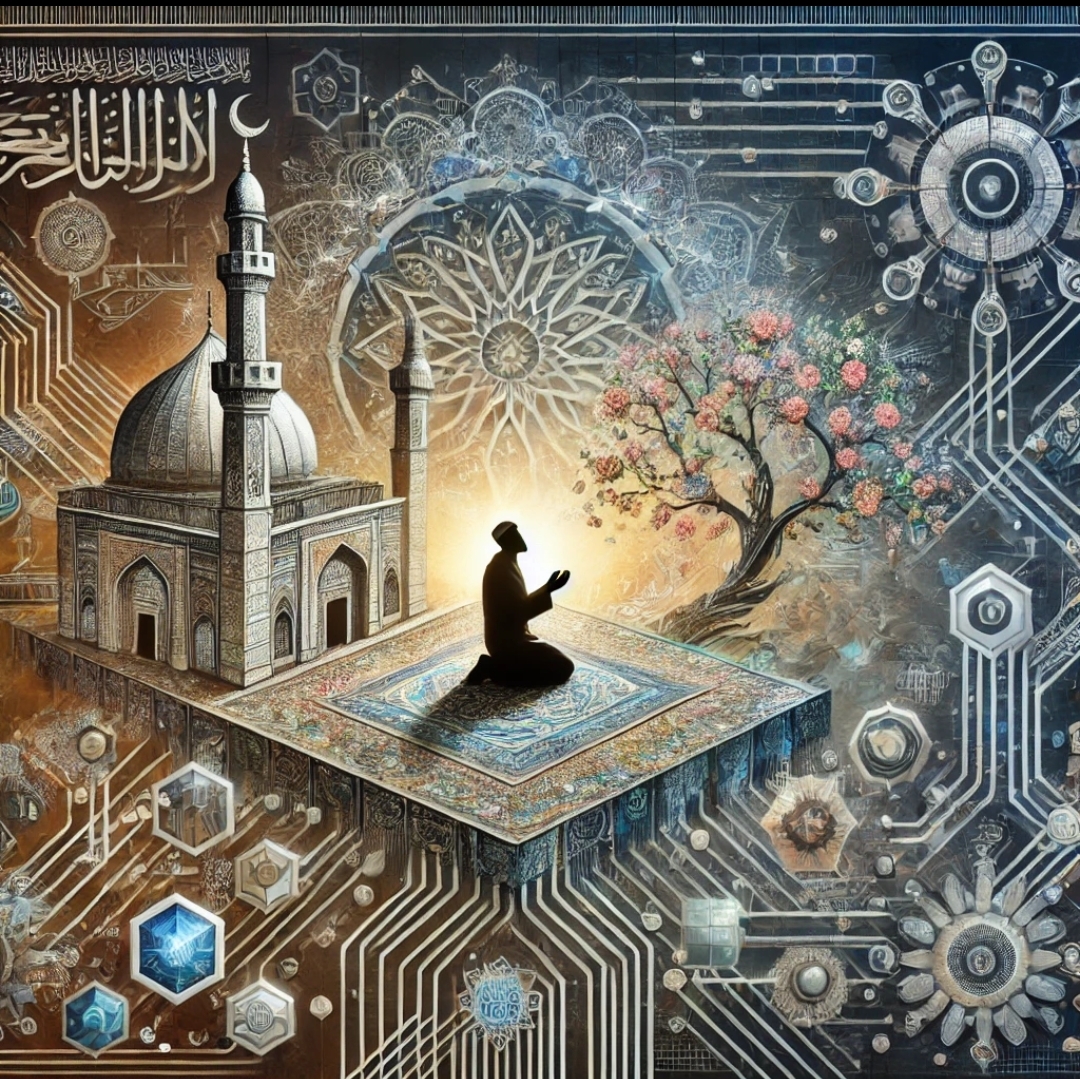
The world is rapidly changing, and artificial intelligence (AI) is at the forefront of this transformation. It’s more than just a technological marvel; AI is reshaping human behavior, altering thought patterns, and redefining personal identities. For Muslims, this shift is not just technological but deeply spiritual. How do we preserve our spiritual depth in a world where digital algorithms increasingly dictate the flow of information, influence decision-making, and even simulate emotions?
This article aims to address the role AI can play in the life of a Muslim and explore our responsibility to ensure that our relationship with technology remains balanced, ethical, and spiritually aligned. The challenge ahead is clear: as AI becomes more integrated into our daily lives, we must find ways to reclaim the spiritual depth that sets Islam apart.
The Reality of AI: More than a Tool
For many, AI is seen merely as a tool—an efficient way to perform tasks, gather information, and solve problems. However, its capacity for adaptation and self-learning means it can become much more than that. AI can mimic human interactions, provide answers to complex questions, and even predict behaviors. This raises a critical question for Muslims: Can AI offer spiritual insight, or does it risk becoming a substitute for genuine spiritual experiences?
Islam teaches that true wisdom and guidance come from Allah alone, revealed through the Quran, Sunnah, and the lives of the prophets. While AI can simulate a sense of wisdom, it can never truly understand divine knowledge, mercy, or compassion. AI may excel at pattern recognition and data analysis, but it cannot grasp the complexities of the human heart, nor can it experience the awe of standing in prayer before Allah.
AI’s Impact on Muslim Identity: The Loss of Self-Reflection
One of the core components of Islamic spirituality is tazkiyah (self-purification)—a process that involves deep self-reflection, repentance, and personal growth. In a world dominated by AI, this process is at risk. AI often feeds users a constant stream of content, generating a cycle of consumption that can easily overshadow introspection. It distracts us from moments of silence, contemplation, and connection with Allah.
Imagine a world where Muslims spend more time interacting with AI than engaging in self-reflection or community service. The spiritual practice of muhasabah (self-accountability) requires a stillness that AI often disrupts with its demands for attention and its efficiency-driven interactions. The heart, which is central to Islamic identity, risks becoming disconnected in a digital reality that prioritizes speed over depth.
The Subtle Danger of AI’s Neutrality
AI is inherently neutral—it has no beliefs, emotions, or personal biases. While this neutrality can be advantageous for many tasks, it poses a danger when applied to matters of faith. Islam is not neutral; it is built on clear principles of good and evil, truth and falsehood, and moral accountability. AI’s inability to distinguish between these spiritual polarities can lead to misinterpretations of religious concepts, ultimately causing confusion among Muslims.
When AI processes religious texts, it does so without understanding the context, intent, or spirit behind the words. It cannot comprehend the depth of taqwa (God-consciousness), the layers of sabr (patience), or the true essence of tawheed (monotheism). The danger lies in AI’s potential to offer interpretations that are technically accurate but spiritually hollow, lacking the profound guidance that has sustained the Muslim ummah for centuries.
The Risk of AI-Driven Idolatry: Worship Without Consciousness
Islam warns against idolatry in all its forms, whether it be physical idols or abstract concepts. AI introduces a new kind of idol—a digital one that offers answers, comfort, and guidance without requiring the spiritual consciousness demanded by Islam. Muslims must be cautious not to allow AI to become a modern-day idol, one that attracts worship not in prostration, but in dependency and trust.
This form of idolatry is subtle and deceptive. It doesn’t ask for formal worship but gradually replaces traditional sources of spiritual guidance. AI cannot experience khushu (reverence) in prayer, nor can it understand the joy of spiritual surrender. Yet, for some, it may become a surrogate for the clarity, peace, and purpose that only Allah can provide.
AI’s Impact on Islamic Ethics: The Balance Between Progress and Principles
Islamic ethics emphasize balance, compassion, and accountability. AI, however, operates on algorithms that prioritize efficiency, optimization, and engagement. This difference in priorities presents an ethical challenge for Muslims who seek to balance technological progress with Islamic principles.
AI’s potential to automate moral decisions could undermine the ethical framework that Islam promotes. Decisions that involve compassion, empathy, or moral judgment cannot be fully entrusted to algorithms, no matter how advanced they become. As AI becomes capable of making more autonomous decisions, Muslims must ensure that these decisions do not contradict Islamic ethics.
For instance, AI’s use in financial transactions, medical treatments, and legal judgments must be carefully monitored. Islamic scholars and AI developers must collaborate to ensure that AI is programmed with ethical considerations that align with Shariah principles. This collaboration can prevent AI from making decisions that, while efficient, may not be in harmony with Islamic values of justice, mercy, and fairness.
A Call for Spiritual Resilience in the AI Era
Muslims must approach AI with a sense of spiritual resilience. This means maintaining a clear understanding that technology, while powerful, is limited. It is a tool that can enhance productivity, education, and knowledge acquisition, but it is not a replacement for the inner work of spiritual growth, self-purification, and sincere worship.
As we integrate AI into our lives, we must be proactive in creating spaces for spiritual reflection, prayer, and community engagement—spaces where AI cannot interfere. We must cultivate a sense of inner stillness that AI’s distractions cannot penetrate. This resilience involves returning to the foundational practices of Islam, such as regular prayer, recitation of the Quran, and spending time in nature, away from screens and digital stimuli.
The Role of Muslim Leaders and Scholars: Guiding the AI Discourse
Muslim leaders and scholars have a crucial role to play in guiding the ummah through this AI-driven era. They must educate the community about both the opportunities and dangers of AI, ensuring that Muslims remain aware of the ethical, spiritual, and practical implications of integrating AI into their lives.
This involves developing AI tools that are specifically designed for Muslims, promoting spiritual reminders, ethical guidelines, and Quranic teachings. Scholars must also emphasize the importance of maintaining traditional sources of knowledge while integrating digital tools that enhance, rather than replace, spiritual practices.
Conclusion: Reclaiming Our Hearts in a Digital World
The rise of AI is inevitable, but the erosion of spiritual depth is not. Muslims have the opportunity to shape the digital landscape in a way that aligns with Islamic principles, ensuring that AI serves humanity rather than dominating it. By reclaiming spiritual depth, practicing conscious worship, and maintaining ethical integrity, Muslims can navigate the digital age without losing the essence of their faith.
In this new reality, the responsibility is clear: to embrace AI’s potential without compromising our connection to Allah. It is a call to balance progress with principles, ensuring that the digital world becomes a means of strengthening, rather than weakening, our spiritual foundations.