

بِسْمِ اللهِ الرَّحْمٰنِ الرَّحِيْم
Introduction: The Echoes of Rabi’a’s Love in Sufi Thought
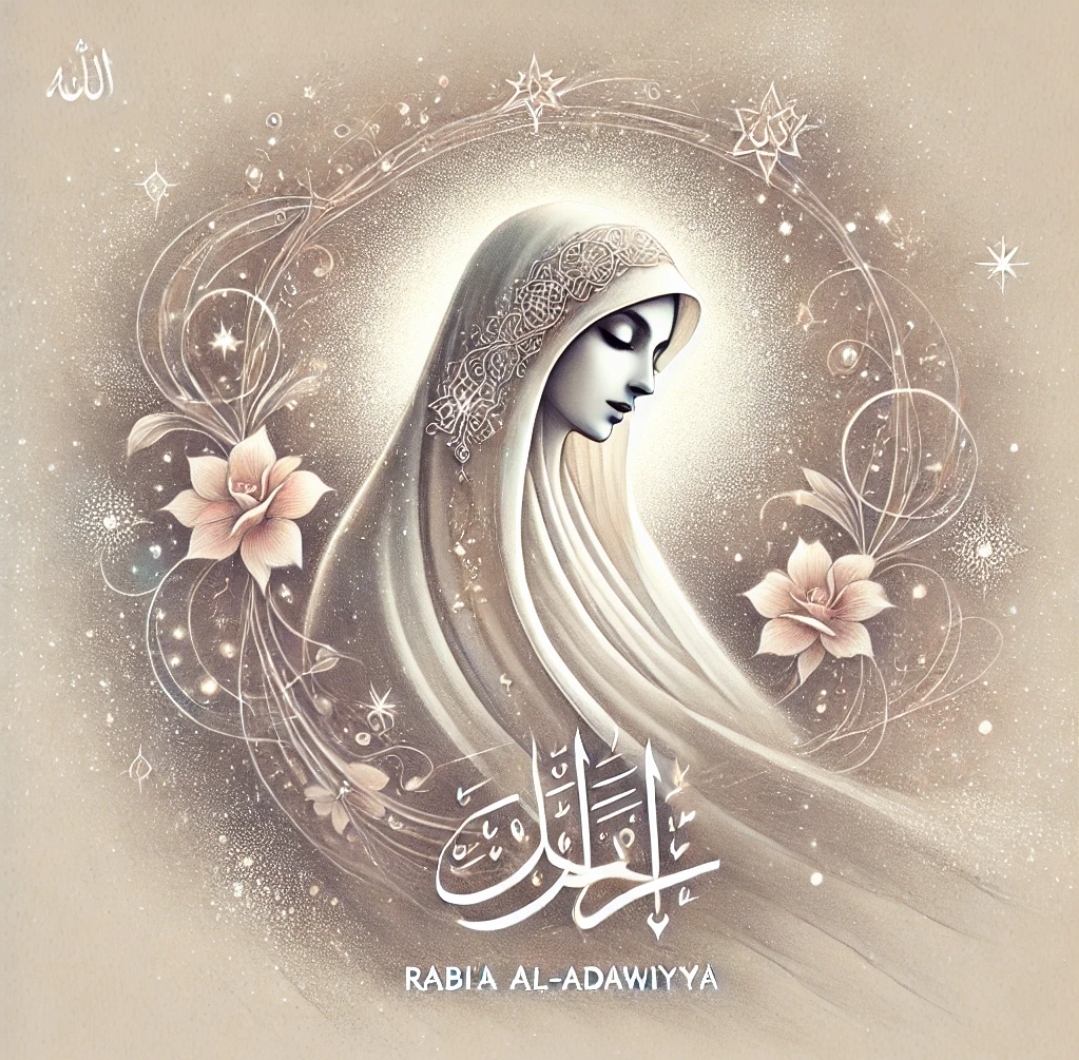
Rabi’a al-Adawiyya’s teachings on divine love not only transformed early Sufism but also laid the foundation for the mystical thought that followed. Her emphasis on pure, unconditional love for Allah inspired later Sufi poets and thinkers, whose works continue to be celebrated today. Among the most prominent of these are Jalaluddin Rumi, Hafez Shirazi, and Ibn Arabi. Each of these mystics carried forward Rabi’a’s ideas in their own unique ways, but the essence of her radical devotion to divine love is at the core of their spiritual teachings.
In this article, we explore how Rabi’a’s concepts of love, annihilation of the self, and spiritual union with Allah influenced these three major figures in Sufi mysticism.
---
1. Rumi: The Poet of Love and Ecstasy
Jalaluddin Rumi, often referred to as the “poet of love,” is perhaps the most famous Sufi mystic in the world. His poetry, filled with ecstatic expressions of longing and devotion, reflects Rabi’a’s influence in its celebration of divine love as the highest form of worship.
Rumi’s concept of ishq (divine love) mirrors Rabi’a’s teachings that love for Allah transcends all material concerns. He often speaks of the annihilation of the self in the Beloved, a theme that Rabi’a introduced through her own experiences of losing herself in divine love. One of Rumi’s famous lines—“I am yours, don’t give myself back to me”—echoes Rabi’a’s surrender to Allah, where she often expressed the idea that her identity dissolved in the presence of divine love.
Rumi: "Love rests on no foundation. It is an endless ocean, with no beginning or end."
Rabi’a: "In these moments, I no longer exist. There is nothing but You, O Allah."
Rumi’s exploration of fana, or the annihilation of the self, draws directly from Rabi’a’s belief that one’s ego and self must be dissolved in the presence of Allah for true union with the Divine to occur. In both mystics’ writings, love becomes the transformative force that enables the soul to experience divine unity.
---
2. Hafez: Love as the Ultimate Path to God
The Persian poet Hafez is another Sufi mystic who was deeply influenced by Rabi’a’s radical devotion to divine love. Hafez’s poetry often centers on the theme of overwhelming love for the Divine, expressing the ecstasy and heartache of longing for union with God. His verses, like Rabi’a’s, emphasize that love for Allah should be free of any expectations of reward.
Where Rabi’a rejected the idea of worshiping Allah for the promise of Paradise, Hafez echoed this sentiment in his poetry, focusing on the idea that love for God is an end in itself, not a means to attain otherworldly rewards. Hafez, like Rabi’a, viewed love as the only path that could lead to God.
Hafez: "I have learned so much from God / That I can no longer call myself / A Christian, a Hindu, a Muslim, a Buddhist, a Jew."
This emphasis on the unity of being through love reflects Rabi’a’s understanding of the soul’s longing for Allah. Both mystics shared the belief that true closeness to Allah comes not through religious identity or strict practice, but through the depth of one’s love for the Divine. Their poetry highlights the transformative nature of this love, capable of lifting the soul beyond the material world.
---
3. Ibn Arabi: The Unity of Being and Divine Love
Ibn Arabi, a 12th-century philosopher and mystic, is best known for his doctrine of wahdat al-wujud (the Unity of Being), which suggests that all existence is a manifestation of Allah. This concept resonates with Rabi’a’s understanding of love as a unifying force that binds the lover and the Beloved in an inseparable union.
Ibn Arabi’s writings on the nature of God and the soul reflect Rabi’a’s teachings on divine love. He often spoke of the heart’s journey to Allah as a process of purification and love, where the self is annihilated, and only Allah remains. Ibn Arabi’s description of the mystical journey, where the lover becomes one with the Beloved, mirrors Rabi’a’s spiritual experience of losing herself in Allah’s presence.
Ibn Arabi: "When my Beloved appears, with what eye do I see Him? / With His own eye, not with mine, for none sees Him except Himself."
This concept of seeing through the Divine’s eyes and losing oneself in the process of love is central to both Rabi’a’s and Ibn Arabi’s teachings. For both, the ultimate goal of the spiritual path is not self-realization, but realization of Allah as the only reality. Through love, the self is dissolved, and all that remains is Allah.
---
Conclusion: The Legacy of Love in Sufi Mysticism
Rabi’a al-Adawiyya’s teachings on divine love continue to resonate through the works of later Sufi poets and philosophers, shaping the direction of Islamic mysticism for centuries. Her influence on figures like Rumi, Hafez, and Ibn Arabi is clear in their writings, where themes of love, surrender, and unity with Allah dominate their spiritual expressions.
Rabi’a’s legacy is not just about her own devotion to Allah—it is about the enduring power of love as the ultimate path to spiritual fulfillment. Her teachings continue to inspire mystics and spiritual seekers today, reminding us that the essence of all worship is not fear or reward, but pure, unselfish love for the Divine.
As we reflect on the lasting impact of Rabi’a’s teachings, we see how her ideas laid the foundation for some of the most celebrated works of Sufi poetry and philosophy. Her radical approach to love transcends time, continuing to inspire new generations of spiritual seekers who long for a deeper connection with Allah.