

بِسْمِ اللهِ الرَّحْمٰنِ الرَّحِيْم
In the Name of God, Most Gracious, Most Merciful
♥️🤲🕋♥️🕋🌹🌹🥀🤲🌹🕋♥️🤲
The Qur’an Over the Centuries — Part One: When the Page Followed the Voice
Opening
In the beginning, the Qur’an was not something to be looked at.
It was something to be heard.
Before it became a book of pages, it was a book of voices — recited aloud, carried in memory, passed from heart to heart. Sound came first. Writing followed.
The earliest Qur’anic manuscripts reflect this reality. They do not strive for visual perfection. They lean, they breathe, they move. The script bends because the people who carried it bent — toward the recitation, toward accuracy, toward trust.
These pages were not made to impress the eye.
They were made to protect the Word.
In this first century after the Prophet Muhammad ﷺ, the Qur’an was already unified, already preserved, already alive in the community. Writing existed not to replace recitation, but to serve it. Ornament was unnecessary. Beauty was not absent — it was simply waiting its turn.
This is the Qur’an at its beginning on the page:
close to the voice,
close to the heart,
and untouched by the ambitions of empire.
I. Before the Page Learned to Be Straight
The Hijazi Qur’an — Written for Reciters, Not for Readers
Before the Qur’an learned how to look,
it already knew how to sound.
Before pages were measured, aligned, and perfected,
the Qur’an lived where no ruler could reach—
in chests, in breath, in memory, in voice.
The earliest Qur’anic manuscripts we possess today do not announce themselves as “art.” They do not stand upright. They do not insist on symmetry. They lean. They wander. They breathe.
The script bends because people bend.
This was not a failure of technique.
It was a reflection of purpose.
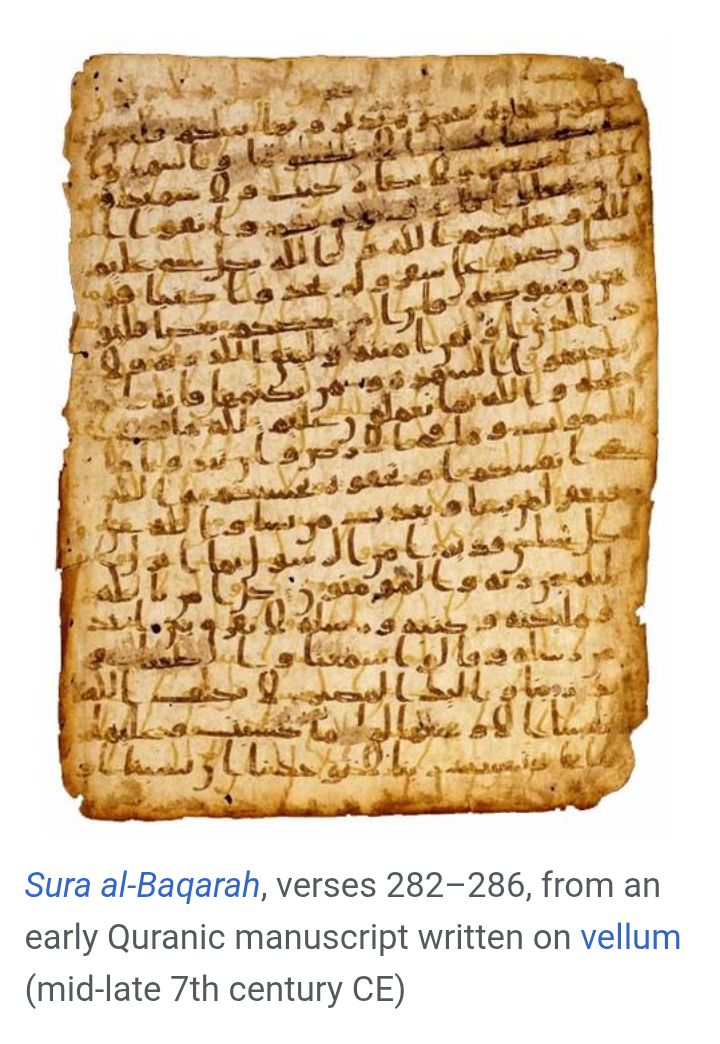
Type: Early Hijazi Qur’an manuscript (parchment, wide margins, uneven lines)
Purpose: First visual contact — intimacy, humility
What the reader should feel: This looks human.
A Script That Listened More Than It Spoke
What scholars later called Hijazi script emerged in a world where the Qur’an was already known. These pages were not written to teach strangers how to read. They were written to support those who already recited—men and women who carried verses in their hearts, who knew the rhythm before they saw the letters.
That is why the letters lean slightly forward, as if in motion.
That is why the baselines are uneven, like footsteps on sand.
That is why dots and vowels are missing or only partially present.
The page assumes a living voice.
The Qur’an, at this stage, does not explain itself to the eye.
It trusts the tongue.
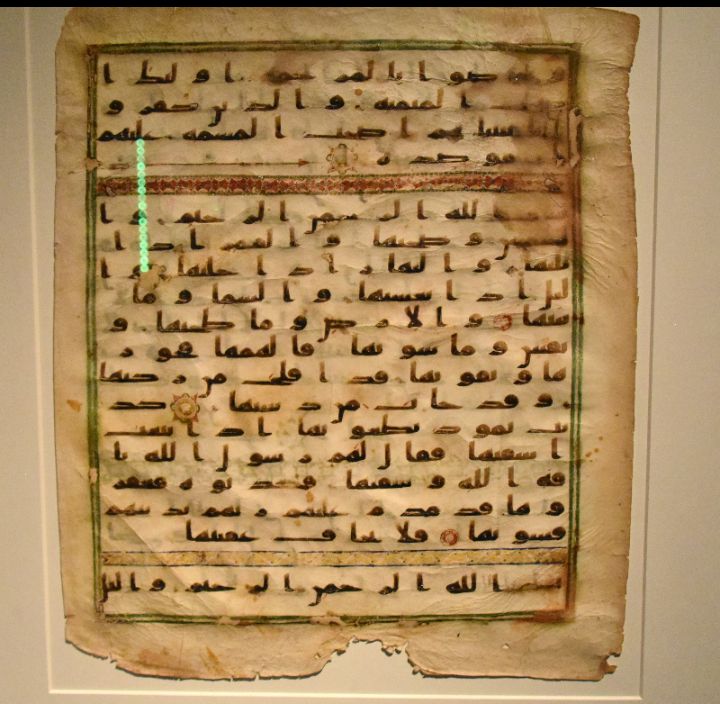
Type: Close-up detail of Hijazi script (show slant, irregular letter heights)
Purpose: Let the reader see the bending letters
What the reader should feel: This was written by someone, not designed by a system.
Skin, Ink, and Seriousness
These early pages were written on animal skin—parchment prepared with care, scraped, stretched, dried, and guarded. Ink was precious. Space was precious. Time was precious.
Nothing here is decorative.
Everything here is intentional.
There is no gold, no geometry, no ambition beyond preservation.
Every stroke says the same quiet thing:
“Carry this carefully.”
And they did.
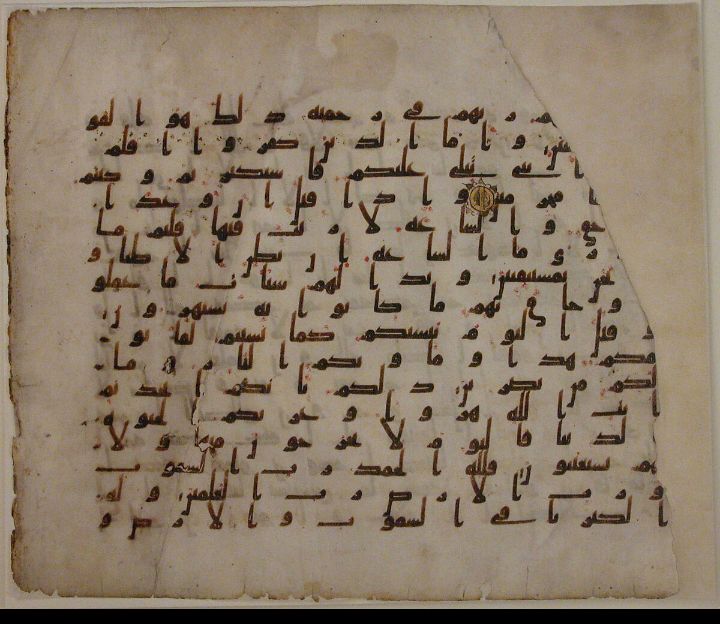
Type: Parchment texture / material close-up OR a full folio showing wide margins
Purpose: Emphasize material sacrifice and scarcity
What the reader should feel: This page cost something.
Sound Before Shape
To encounter a Hijazi Qur’an is to realize something essential:
The Qur’an was never meant to be silent.
Its earliest written form mirrors its earliest life—
recited, not scanned;
heard, not browsed;
remembered, not decoded.
The unevenness of the script preserves the human presence of the one who wrote it. You can feel the pause where a hand hesitated. You can sense where memory guided the pen more than rules.
This is the Qur’an before calligraphy became an art—
when writing was still an act of trust.
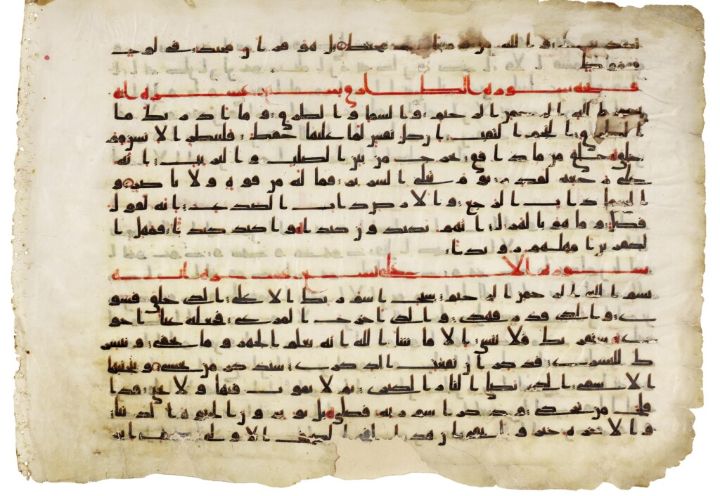
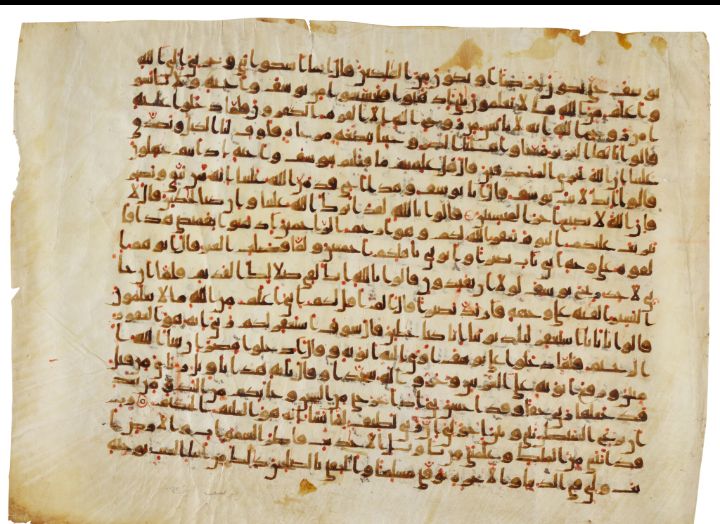
Type: Another Hijazi folio from a different collection (variation matters)
Purpose: Show consistency without uniformity
What the reader should feel: This wasn’t one manuscript — it was a tradition.
Why We Begin Here
Every script that comes later—
Kufic, Maghribi, Naskh, Ottoman—
rests on this moment.
Before the Qur’an was monumental,
it was intimate.
Before it was perfected,
it was protected.
Before it was admired,
it was lived.
A Prayer for the First Hands
**O Allah,
reward the first hands that wrote Your Book
without adornment and without doubt.Reward the reciters whose voices guided the pen,
and the scribes who bent their letters
so Your words would never be lost.Let every uneven line be a witness for them,
and let every recitation today
return light to their graves.
Āmīn.**
Conclusion — Research-grounded, final version
Conclusion: Before Beauty, Certainty
The earliest Qur’anic manuscripts do not speak the language of decoration.
They speak the language of care.
Whether written in early Hijazi, early Kufic, or related regional hands, the guiding principle was the same:
preserve the recitation before perfecting the page.
These manuscripts were written on what was available and trusted — animal skin (parchment, vellum) — durable, costly, and chosen for longevity rather than elegance. Ink was simple. Layout was functional. Letters leaned, stretched, and bent, because the script was still listening to the human voice that carried it.
These were not “unfinished” scripts.
They were deliberately unfinished by design.
There were few or no vowel marks.
Few or no consonantal dots.
Minimal visual hierarchy.
Not because knowledge was lacking —
but because the Qur’an was not yet meant to be read silently.
It was recited. Corrected. Memorized. Heard.
The page served the reciter, not the reader.
The script followed the mouth, not the eye.
This is why early Qur’anic writing appears restrained across regions:
not because artistry was unknown,
but because art had not yet been permitted to lead.
Only once the text was unified, stabilized, and uncontested —
only after the Uthmanic standard had done its work —
could the Qur’an begin a second life on the page.
A life of symmetry.
Illumination.
Empire.
Gold.
But that comes later.
What we see here is the Qur’an before it was adorned —
when trust mattered more than beauty,
and accuracy mattered more than legacy.
This chapter closes not with ornament,
but with certainty.