

بِسْمِ اللهِ الرَّحْمٰنِ الرَّحِيْم
In the Name of God, Most Gracious, Most Merciful 🕋
📡 Protocol 101: The Language of Machines
Before we can talk about APIs, MCP, or even the internet itself, we must start with the most fundamental concept in the digital world: the protocol.
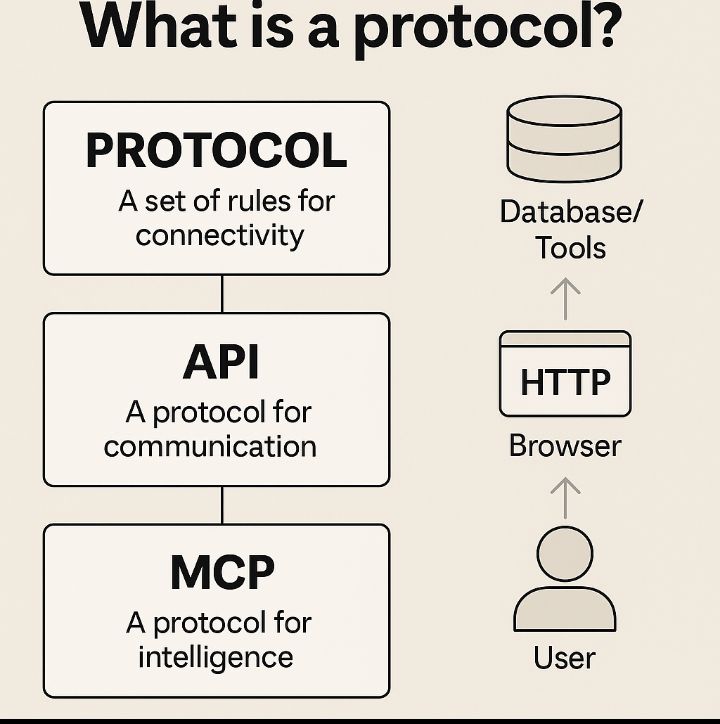
🧠 What Is a Protocol?
A protocol is a set of rules that two machines agree to follow so they can communicate, exchange data, and understand each other.
If humans use languages like English or Arabic to talk, machines use protocols. Without a shared language, humans can’t have a conversation — and without protocols, machines can’t talk either.
Think of a protocol as a digital handshake. It says:
📤 “Here’s how I’ll send you information.”
📥 “Here’s how I expect you to reply.”
📦 “Here’s the format we’ll both use.”
🔁 “Here’s how we’ll keep talking.”
🛜 Everyday Examples of Protocols
You use dozens of protocols every single day — even if you don’t know it:
HTTP (HyperText Transfer Protocol): Lets your browser and a website talk.
SMTP (Simple Mail Transfer Protocol): Sends your emails from one server to another.
TCP/IP: Moves data across the internet.
Bluetooth: Connects your phone to your headphones.
MCP (Model Context Protocol): Allows AI agents to exchange context and coordinate tasks.
Each of these is just a set of rules that says: “Here’s how we talk, and here’s how we make sure we understand each other.”
🧩 The Golden Rule of Protocols: Interoperability
The magic of a protocol is that once it’s agreed upon, anyone can build on top of it.
If you follow the rules of HTTP, your website can be seen by any browser.
If you follow the rules of SMTP, your email can be delivered to any inbox.
If you follow MCP, your AI agent can talk to any other agent.
This is why protocols are often developed and standardized by independent organizations — not private companies. They ensure that the digital world stays interoperable, neutral, and connected.
🪐 Why Protocols Matter
Protocols are the invisible architecture of the digital age. They decide:
What devices can talk to each other.
How data travels across the internet.
Whether your AI systems will be open or closed.
And now, with MCP, they’re about to decide how intelligence itself will flow between machines.
✅ Key Takeaway for Students:
A protocol is not a product or an app. It’s the invisible rulebook that makes all digital communication possible. It is the reason the internet works, the reason your phone syncs with your laptop, and the reason AI agents can talk to each other. Without protocols, nothing in the digital world could connect — and humanity would still be living offline.
Perfect — here’s Part 2: “What Is an API?” — written as a continuation of “Protocol 101,” so students and readers can follow the logic step by step.
🔌 Part 2: What Is an API? — The Bridge Between Humans, Machines, and Data
Now that you understand what a protocol is — a set of rules that lets machines talk — it’s time to meet one of the most powerful inventions built on top of protocols: the API.
🌉 API: The Bridge Between Worlds
API stands for Application Programming Interface, and if a protocol is the language that machines use, then an API is the translator that lets applications speak that language.
Think of it like this:
A protocol is the grammar of communication.
An API is the sentence structure — the specific way you ask for something and receive a response.
If you go to a restaurant, the menu is the API.
You don’t need to know how the kitchen works.
You don’t need to understand the recipe.
You just place an order in the format they expect (“One pizza, please”), and the system takes care of the rest.
The kitchen → database.
The waiter → protocol.
The menu → API.
🧠 What APIs Actually Do
An API is a defined interface — a list of commands, queries, or endpoints — that allows one piece of software to request data or services from another.
For example:
When you use Google Maps inside a food delivery app, that app is using the Google Maps API.
When a website shows you live stock prices, it’s fetching them from a finance API.
When ChatGPT pulls data from a weather service, it’s calling a weather API.
In all these cases, the API defines what you can ask for and how you must ask it — using the language defined by the underlying protocol (often HTTP).
🧰 APIs and Protocols: How They Work Together
Here’s how the layers stack:
Protocol (e.g., HTTP): Defines how messages travel.
API (e.g., REST, GraphQL): Defines what you can ask for and how to structure the request.
Application: Uses the API to get what it needs and show it to the user.
In simple terms:
🌐 Protocol: “We’re speaking English.”
📡 API: “Here’s the sentence structure.”
📱 App: “I want to order pizza.”
🪐 Why APIs Changed Everything
APIs did more than connect apps — they unlocked the modern internet. Without APIs:
No app could share data with another.
No platform could integrate external services.
No AI agent could talk to a database.
APIs turned the internet from a network of pages into a network of functions — and now they are evolving again, powering the age of intelligent agents.
✅ Key Takeaway for Students:
An API is the bridge between machines and applications — a way to request data or actions without needing to understand the underlying code. It’s built on top of protocols like HTTP and acts as the translator that makes the digital world programmable. Without APIs, every piece of software would live in isolation.
🤖 Part 3: What Is MCP — And How Does It Change the Game?
Now that you understand protocols (the language machines speak) and APIs (the interfaces that let apps talk to each other), it’s time to meet the next evolutionary leap — the Model Context Protocol (MCP).
This isn’t just another tool. It’s the bridge between intelligence and information, the missing layer that connects AI agents directly into the digital ecosystem.
🧭 MCP: The Protocol for the Age of Intelligence
If HTTP connected browsers and servers,
and APIs connected applications and data,
👉 MCP connects AI models and agents to the rest of the digital world.
It’s a new standard — created by Anthropic and now submitted for universal adoption — that defines how large language models (LLMs) like GPT, Claude, or Gemini communicate with other systems, request context, and execute tasks in a safe, structured, and predictable way.
Think of MCP as the nervous system of the AI era. It’s the protocol that lets intelligence flow.
🧠 How MCP Works (In Simple Terms)
Here’s the best way to understand MCP — by imagining how a typical “AI question” is handled:
🧑💻 User asks a question: “What were my top 3 product sales in 2025?”
🤖 AI agent interprets the intent: It understands the natural language and passes the request to the MCP Server.
🧩 MCP Server translates the request: It converts the question into an exact action — like generating an SQL query to the right database — using the permissions and rules you defined.
🗄️ Data layer responds: The database sends back the results.
📊 AI formats the answer: The agent turns raw data into a natural-language explanation, a report, or even a dashboard.
The magic is in the middle layer — the MCP — which ensures that everything is done securely, consistently, and without exposing sensitive data.
🛡️ Control Is Everything: The MCP Advantage
What makes MCP revolutionary isn’t just that it works — it’s that it shifts control back to you.
🛑 You decide what’s visible: If the MCP Server doesn’t expose a table or tool, the AI doesn’t even know it exists.
🧑⚖️ You define permissions: You can allow one agent to read customer data but block another from modifying records.
🔐 You enforce policies: All requests are checked against security rules before anything happens — stopping malicious prompts or accidental leaks.
MCP becomes the choke point — the single place where access, trust, and governance converge.
🌐 Why MCP Is to AI What HTTP Was to the Web
In the 1990s, HTTP was the invisible agreement that made the web possible — a simple set of rules that allowed browsers and servers to talk. It wasn’t glamorous, but it changed civilization.
In the 2020s and beyond, MCP will play the same role — but for intelligence itself. It standardizes how LLMs interact with tools, data, APIs, and each other. It’s the missing piece that will allow AI to move beyond “chat” and into the realm of real work — booking flights, running businesses, managing infrastructure, and more.
🧩 The Bigger Picture: Protocol → API → MCP
Let’s recap the journey:
Layer Purpose Era Protocol (e.g., HTTP) Define how systems talk Connectivity Era API Define how apps exchange data Communication Era MCP Define how intelligence acts Intelligence Era
✅ Key Takeaway for Students:
MCP is not just another protocol — it’s the next stage in the internet’s evolution. It transforms LLMs from passive responders into active agents. It introduces a standard for intelligence that ensures security, trust, and control. And most importantly, it gives you the power to decide how, where, and when AI operates in your world.
📍 Where We Go Next
Now that you understand protocols, APIs, and MCP, the next step is to explore how they work together — how HTTP delivers the connection, how APIs deliver the functionality, and how MCP delivers the intelligence.
Because the future isn’t just about tools — it’s about orchestration. And the ones who understand how these layers fit together will be the ones who build the next civilization.