
بِسْمِ اللهِ الرَّحْمٰنِ الرَّحِيْم.
In the Name of God, Most Gracious, Most Merciful.
♥️🤲🕋♥️🕋🌹🌹🥀🤲🌹🕋♥️🤲
This is the document that moves Project Zero from philosophy into physics.
Project Zero: From Buying Each Other’s Debt to Building Each Other’s Future
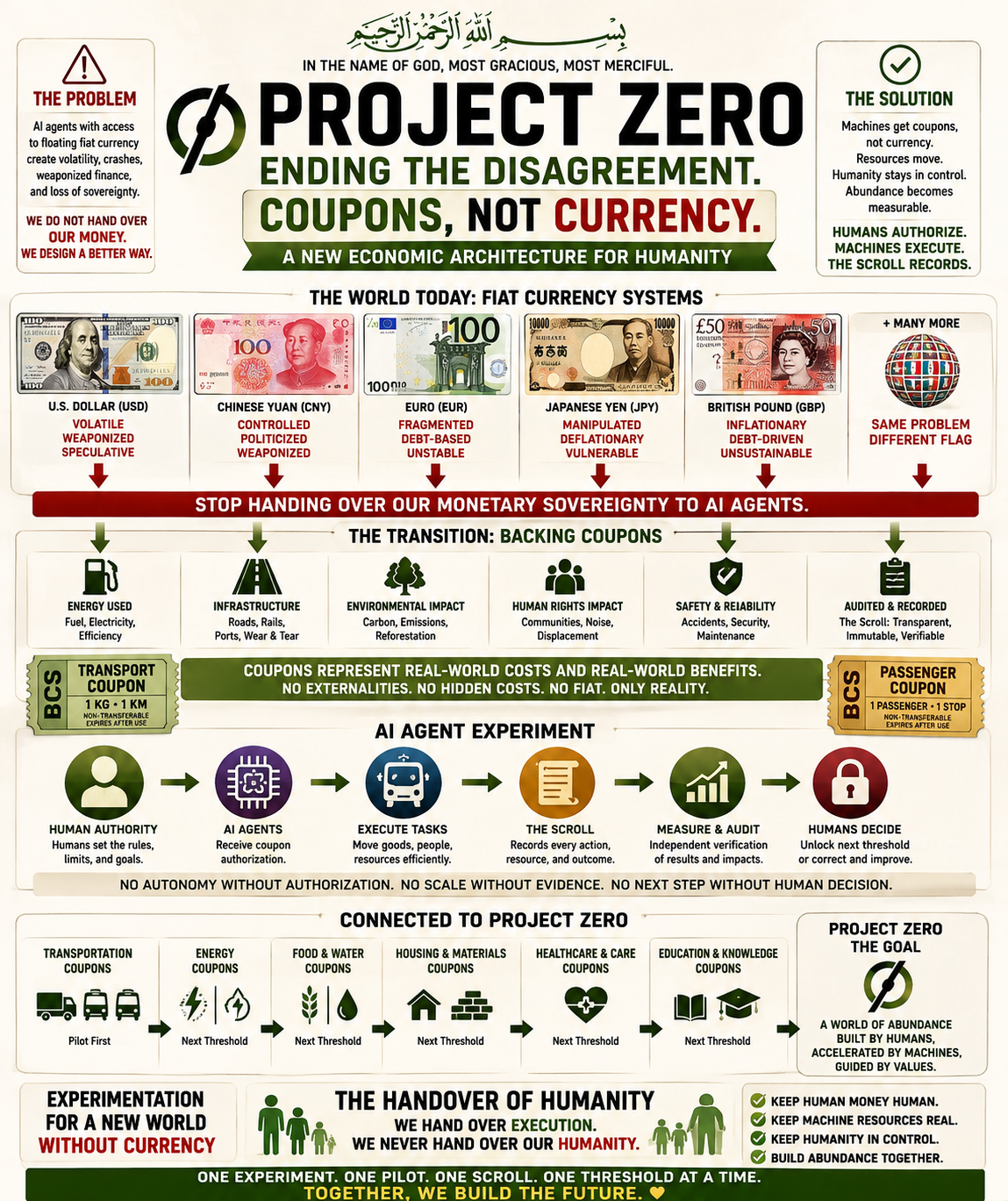
For generations, nations learned how to trade by holding one another’s currencies, purchasing one another’s debt, financing one another’s industries, and tying commodities, shipping, banking, and national reserves together. That architecture helped build the modern global economy, but it also turned cooperation into competition over whose currency would dominate, whose debt everyone would hold, and whose financial system would become indispensable. Now AI agents, robotics, autonomous infrastructure, and machine-to-machine commerce give us an opportunity to ask a completely different question: What if the next stage of global trade is not about replacing one nation’s money with another nation’s money, but about nations connecting their currencies to what their systems can actually build? There does not have to be a winner and a loser. The dollar does not have to destroy the yuan. The yuan does not have to overthrow the dollar. Europe does not have to create another currency weapon. Human currencies can remain stores and mediums of human value while a separate machine layer coordinates the productive capacity underneath them.
Imagine the United States connecting its enormous financial and technological capacity to AI infrastructure and construction; China connecting its manufacturing strength to automated factories, ports, railways, and infrastructure; Europe becoming a powerful standard-setter for environmental accounting, sustainability, and externalities; Japan connecting its expertise in robotics, transportation, precision manufacturing, and automation; and the United Kingdom contributing its strengths in finance, law, insurance, contracting, and global commerce. Other nations bring their own resources, capabilities, knowledge, energy, agriculture, and people to the same table. Nobody has to surrender monetary sovereignty to participate. Instead of flooding the emerging AI economy with competing stablecoins, speculative instruments, and machine-speed currencies, we connect value to measurable productive capacity—transportation, energy, compute, infrastructure, materials, food, housing, and eventually abundance. That is the invitation of Project Zero: stop designing the future around how nations can undermine one another, and begin designing a system where each nation remains sovereign, each currency remains human, machines coordinate real resources, and humanity becomes wealthier because we are building one another’s future instead of buying one another’s weakness.
Project Zero: The Transportation Pilot
Ending the Disagreement Through Coupons, Not Currency
We stand at a crossroads. The United States, China, and Europe are racing to fill the future with their digital dollars, digital yuan, and digital euros. They believe the path forward is to digitize the old financial rails and hand those credentials to AI agents.
This is a catastrophic error.
Giving artificial intelligence the ability to spend floating fiat currency is not progress—it is introducing a destabilizing, high-velocity weapon into global markets. An autonomous agent optimizing for delivery speed could trigger micro-flash crashes across foreign exchange before a human regulator even blinks. Currency fluctuations become attack surfaces. National monetary policy becomes collateral damage to machine efficiency. We will not allow the sovereignty of human money to be arbitraged by algorithms.
Project Zero offers the alternative: Transportation Coupons.
These are not currency. They are not speculative assets. They are utility meters—non-transferable, non-exchangeable, time-bound vouchers for physical movement. A coupon moves one kilogram one kilometer, or one passenger one stop. It has no exchange rate. It cannot be shorted. It cannot be hoarded. It either executes a transport task, or it expires.
Here is why this solves the three foundational pillars of our disagreement—and why we start with transportation.
The Three Pillars of the Transportation Threshold
1. Machines Do Not Get Money. They Get Coupons.
Why? Because stability is sacred.
Human beings living in a free society cannot have their purchasing power eroded by algorithmic trading bots optimizing for kilowatt-hour efficiency. By removing fiat from the machine side entirely, we sever the link between AI execution and monetary volatility.
A machine that misuses its coupon allocation does not crash the yen; it simply loses its routing privilege.
The human economy remains insulated from machine-speed financial shocks.
2. Coupons Are Minted Against Resources, Land, and Negative Externalities.
You cannot mint a transportation coupon from nothing.
Every coupon is backed by a physical reality: the fuel or electricity required, the road or rail wear-and-tear, the carbon emitted, the noise pollution generated, and—most critically—the human rights impact of that movement.
We create a transparent, auditable ledger (The Scroll) that accounts for every negative externality.
If a transport route passes through a community, a portion of the coupon's “cost” is allocated to a community trust fund. If it produces carbon, a matching coupon must be burned for reforestation.
This means cheap transportation is no longer externalized as suffering. The cost is built into the coupon's creation.
When machines cross the threshold—proving they can move goods faster, safer, and with fewer externalities than human-driven fleets—they earn the right to accelerate, but only within the hard caps we set on land use and ecological impact.
3. Transportation First—Because It Is the Circulatory System of Civilization.
Transportation connects food to markets, water to cities, medicine to clinics, and workers to jobs.
If we can solve the transportation threshold, we unlock the metrics for every other sector.
Food becomes abundant when spoilage during transit drops to zero.
Energy becomes reliable when grids can autonomously route maintenance materials.
Housing becomes affordable when raw materials move at fractions of today's cost.
By proving the coupon model in transportation, we create a blueprint for energy coupons, housing coupons, and healthcare coupons.
One threshold begets the next.
The State Loan Mechanism: Keeping Humanity at the Wheel
This is where we answer the hardest question:
What happens to the human drivers, the poor, and the vulnerable?
Project Zero does not abandon them.
The State issues zero-interest, zero-repayment coupons to three specific groups:
1. The Poor.
Transportation is the single largest barrier to economic mobility. A mother cannot take a job across town if the bus fare consumes her daily wage.
We issue her a monthly allocation of passenger-mile coupons—not cash, not debt—so she can move freely without falling into a loan trap.
2. People in Rehab.
Recovery requires consistency. A patient cannot attend physical therapy or addiction counseling if they cannot afford the ride.
Coupons remove that variable entirely.
They do not expire weekly; they expire upon the completion of a prescribed care schedule, anchoring health outcomes to mobility.
3. Human Drivers.
The transition is a partnership, not an eviction.
Existing truckers, taxi operators, and delivery workers receive preferential coupon allocations to oversee and verify the autonomous fleets.
They become the auditors of the threshold.
They are paid in coupons to ride along, to check safety metrics, and to intervene when the machine fails.
Their human judgment remains the ultimate override.
Crucially, these are coupons, not loans.
They do not accrue interest. They do not require collateral. They cannot be seized.
They are a foundational public utility, distributed as a right of citizenship in the machine age—because mobility is no longer scarce.
Why This Ends the Disagreement
For decades, we have been stuck in a sterile debate:
Capitalism vs. Socialism.
Centralization vs. Decentralization.
East vs. West.
Project Zero renders these ideologies obsolete.
It is not capitalist because it issues public utility coupons backed by physical resources, not profit.
It is not socialist because it relies on audited, permissionless machine execution and transparent ledgers, not central planners.
It is not “Chinese” or “American” because the threshold is empirical, not political.
When the threshold is met—when we have irrefutable, independently audited data that coupon-based transportation reduces cost-per-ton-mile by 60%, lowers carbon by 40%, and increases equitable access for rehab patients and low-income workers by 80%—what is there to disagree about?
The data is the authority.
The machine executed.
The humans verified.
The externalities were accounted for.
That is the Zero-Disagreement Standard.
We do not argue about hypotheticals anymore. We argue about metrics, we run the pilot, we measure the outcome, and we decide together whether to unlock the next threshold.
The Road Ahead
We start small.
A single municipality.
A single corridor.
A fleet of mixed human-autonomous vehicles, governed by a local council, backed by a transparent Scroll, funded by state-issued coupons, and audited by the very drivers and residents who use it.
If we succeed, we unlock food.
If we succeed, we unlock energy.
If we succeed, we unlock housing.
Project Zero is not a fantasy.
It is a sequence of physical experiments designed to prove that machines accelerate means, while humans safeguard ends.
The transportation coupon pilot is the first stone laid in that foundation.
Let us lay it together—and end our disagreement by moving in the right direction. Literally.
A message To the Muslim World—and to Everyone Else—Keep the Two Worlds Separate
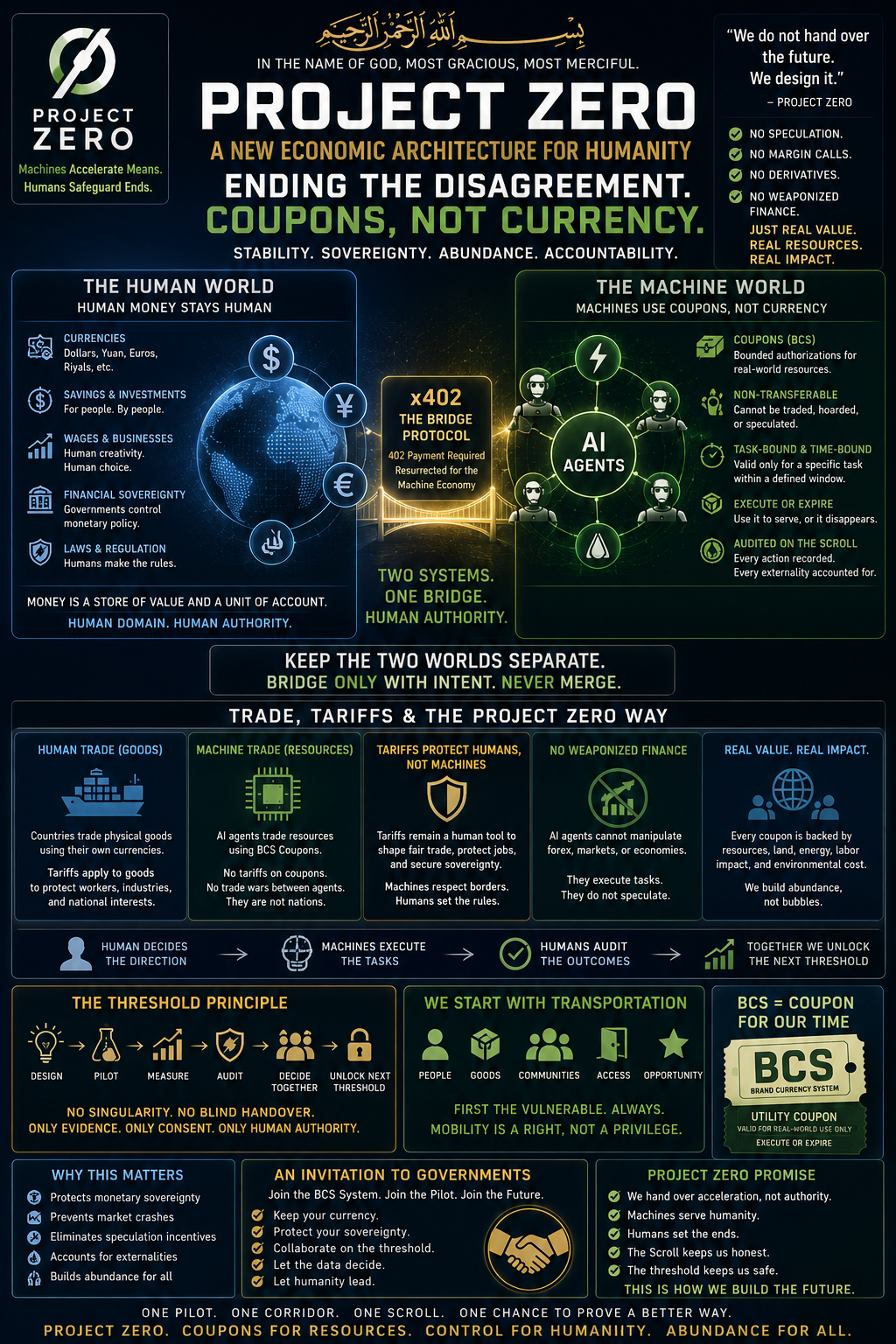
To the Muslim world, there is a particular reason to take Project Zero seriously. We do not have to inherit every financial instrument simply because someone has attached the words AI, digital, or innovation to it. If the machine economy is built around unrestricted currencies, leverage, margin trading, speculative tokens, derivatives, and increasingly autonomous trading systems, then we risk taking some of the most unstable features of the old financial world and accelerating them to machine speed. For Muslims, that also immediately raises serious questions around ribā, gharar, maysir, speculation, unjust enrichment, and whether finance remains connected to real economic activity. Those questions should be examined carefully by qualified scholars rather than answered by technology companies.
Project Zero offers another direction. Do not give machines money and then teach them to become traders. Give them bounded permission to consume real resources. A transportation coupon represents transportation capacity. An energy authorization represents energy. Compute represents compute. These instruments should not become freely tradable currencies. They should not appreciate because somebody hoarded them. They should not become collateral for leveraged bets. There should be no transportation futures casino, no margin call on somebody's mobility allocation, and no derivatives market built on a patient's ride to rehabilitation. Authorization is issued for a purpose, used for that purpose, recorded on the Scroll, and then extinguished.
That distinction is essential because otherwise we will eventually recreate exactly what we were trying to escape. Make transportation coupons freely exchangeable for energy coupons, allow markets to establish floating exchange rates between them, permit borrowing against them, and somebody will inevitably construct leverage, derivatives, speculation, arbitrage, and financial intermediaries around them.
Project Zero must refuse that temptation.
A coupon should represent a bounded right to consume a measurable amount of civilization's productive capacity—not a second form of money.
And this message is not only for Muslims.
To Americans, Europeans, Chinese, Russians, Africans, Indians, Latin Americans, and everyone else, the argument does not require theology.
It requires arithmetic.
Why would we connect autonomous machines capable of conducting millions of operations per second directly to unrestricted monetary markets if their actual job is to move a container, deliver medicine, allocate electricity, obtain compute, construct a building, or transport a human being?
A transportation robot does not need to speculate against the dollar.
A power-management agent does not need a leveraged foreign-exchange position.
A construction robot does not need a credit score.
A medical transportation agent does not need to own an investment portfolio.
It needs authorization to perform a physical task.
That is an entirely different economic architecture.
Two Systems—One Human Authority
The separation should therefore become one of Project Zero's foundational principles:
Human money and machine resource allocation are two different systems. Do not collapse them into one.
The human economy can continue using dollars, euros, yuan, riyals, dinars, shillings, banks, savings, property, investments, businesses, wages, and whatever lawful financial structures societies choose.
That is where human beings exercise economic choice.
The machine economy should primarily concern measurable reality:
kilowatt-hours, passenger-miles, ton-miles, compute, bandwidth, storage, water, materials, land impact, maintenance capacity, carbon, and time.
Machines don't need wealth.
They need equilibrium.
And whenever the two worlds genuinely must meet, a controlled bridge—whether x402 or another open protocol—can translate an authorized human expenditure into a specific machine operation.
Human money enters at the boundary.
LVK checks the authority.
The resource authorization is generated.
The machine executes.
The Scroll records what happened.
The authorization expires.
The machine does not walk away carrying a pile of speculative wealth.
The Market Must Not Become the Machine's Master
This also protects existing currencies.
If billions of autonomous agents eventually optimize simultaneously against unrestricted financial markets, the consequences deserve serious study before deployment. Machine-speed trading already demonstrates that automated markets can behave in ways humans struggle to interrupt quickly.
Project Zero asks a much more conservative question:
Why expose monetary sovereignty to that risk when the machine only needed electricity and transportation capacity in the first place?
Keep the currencies on the human side.
Keep resource coordination on the machine side.
Build carefully controlled bridges between them.
And then experiment.
One city.
One transportation corridor.
One fleet.
One Scroll.
One independently audited dataset.
Measure everything.
Did transportation become cheaper?
Did accidents decline?
Did energy consumption fall?
Did low-income residents gain mobility?
Did patients reliably reach treatment?
Did communities along transportation corridors receive appropriate compensation for externalities?
Did human drivers successfully supervise autonomous systems?
Did the coupon remain a utility authorization rather than becoming speculative money?
And most importantly:
Did humans remain in control?
If the answer is no, we do not cross the threshold.
If the evidence is inconclusive, we do not cross the threshold.
If somebody discovers a better architecture, we change the architecture.
And if the experiment demonstrates independently and repeatedly that the system works, then we authorize the next carefully bounded expansion.
That Is the Zero-Disagreement Standard
Project Zero should never mean that one person announces the answer and everybody else must obey.
It means something more demanding:
Every serious disagreement must be brought into the room before irreversible authority is transferred.
Muslim scholars challenge it.
Economists challenge it.
Engineers challenge it.
Truck drivers challenge it.
Environmental scientists challenge it.
Privacy advocates challenge it.
China challenges it.
America challenges it.
Russia challenges it.
Africa challenges it.
Central bankers challenge it.
Bitcoin developers challenge it.
AI systems themselves red-team it.
Then we experiment.
The best argument does not win because its speaker has the most money, the largest military, the biggest corporation, or the most powerful AI.
Reality decides.
The measurements decide whether the claimed threshold was actually reached.
And disagreement doesn't disappear because dissent was silenced.
Disagreement approaches zero because the experiment answered the question.
That gives us a completely different model for entering the machine age:
Debate → Design → Experiment → Measure → Audit → Correct → Agree → Authorize.
Not:
Invent → Financialize → Leverage → Scale → Crash → Regulate afterward.
Project Zero
That is ultimately why transportation is such a powerful place to begin.
We are not launching another currency.
We are not creating another speculative token.
We are not asking humanity to gamble on another financial revolution.
We are moving something from Point A to Point B.
Let the machine prove it can do that more safely, more cheaply, more efficiently, more fairly, and with fewer negative externalities than the system we have today.
If it succeeds, give it the next inch.
Then test again.
Transportation can unlock food.
Food and transportation can unlock housing.
Energy can unlock manufacturing.
Compute can unlock increasingly sophisticated AI services.
And threshold by threshold, civilization can move toward abundance without ever experiencing the mythical moment when humanity suddenly hands everything to the machines.
That is how we end the fear of the Singularity.
There is no singular handover.
There is Project Zero.
There are thresholds.
There are experiments.
There is evidence.
There is the Scroll.
There is human authorization.
And there is one boundary that remains intact throughout the entire transition:
Machines may accelerate the means.
Humanity retains authority over the ends.
Keep human money human.
Keep machine resources tied to physical reality.
Never confuse a coupon with a currency.
Never turn human necessities into chips on a machine-speed casino table.
And never hand over the next threshold until humanity has proved, together, that we are ready to cross it.
In Conclusion: The BCS System — Preparing Humanity for the Handover
This is where the next stage begins.
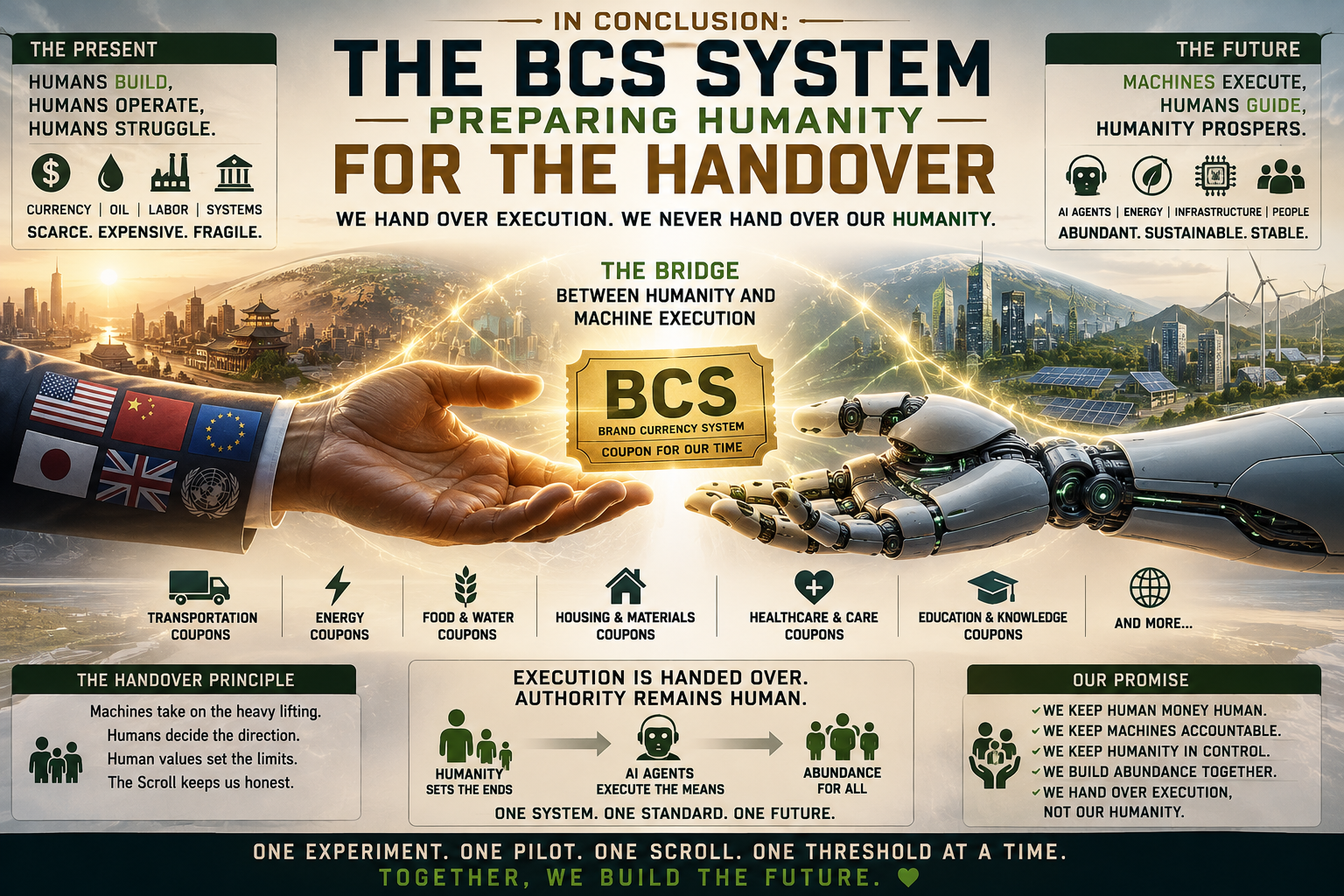
I will be offering governments an opportunity to participate in the BCS system—the Brand Currency System. But in the architecture of Project Zero, BCS begins evolving from “currency” toward the coupon of our time: a bounded medium of exchange and authorization designed increasingly for AI agents and machines, while protecting human money from becoming the operating fuel of an autonomous machine economy.
The objective is not to create another cryptocurrency.
It is not another stablecoin.
It is not another speculative asset for somebody to buy today because they believe somebody else will pay more for it tomorrow.
BCS is intended to represent useful activity.
Transportation.
Energy.
Compute.
Housing.
Resources.
And eventually the machine-to-machine coordination necessary to operate an increasingly abundant civilization.
Humans Begin the Handover—Without Surrendering Control
Project Zero recognizes something we should begin preparing for now:
Humanity may eventually retire from enormous amounts of repetitive economic labor.
That should not frighten us.
If machines can safely move our goods, construct our homes, produce our energy, grow our food, coordinate our supply chains, and perform enormous amounts of repetitive work, then the objective should not be finding artificial ways to keep human beings busy.
The objective should be giving human beings more freedom to live, create, raise families, learn, worship, build communities, care for one another, and determine the direction of civilization.
Machines can increasingly operate the machinery underneath civilization.
Humans remain above it.
That is why BCS becomes part of the blueprint for humanity beginning to hand over execution of portions of the economy, transportation, energy, and eventually other infrastructure—not suddenly, not blindly, and never irreversibly.
Threshold by threshold.
Experiment by experiment.
Audit by audit.
Human authorization remains at the top.
Transportation Comes First
And I intend to begin where I am:
The United States.
The first Project Zero BCS experiment will focus on transportation.
Then I want to collaborate with governments, communities, engineers, drivers, businesses, AI developers, researchers, and eventually other countries willing to test and improve the architecture.
But the order matters.
We begin with the vulnerable.
We begin with the person who cannot afford transportation.
We begin with the patient who cannot reliably reach rehabilitation or treatment.
We begin with the elderly person who has lost mobility.
We begin with human drivers whose livelihoods will eventually encounter automation.
We build around them first.
Because the first people served by a civilization's most powerful technology tell us what that civilization actually values.
If we begin by designing for speculation, speculation will become the priority.
If we begin by designing around stablecoin volume, transaction volume will become the priority.
If we begin by designing around financial markets, financial returns will become the priority.
But if we begin with the person who needs a ride to treatment and cannot afford one, something completely different happens.
Humanity becomes the priority.
The technology grows outward from there.
That Is the Test of Project Zero
BCS must never become valuable merely because people believe its price will increase.
Its value must come from what civilization can actually accomplish with it.
Did somebody get transported?
Was energy delivered?
Was food moved?
Was a house constructed?
Was compute provided?
Was a human need fulfilled?
That is the ledger I care about.
That is the Scroll.
And that is why the distinction between human money and machine resource coordination must remain protected.
We should not build tomorrow's autonomous economy around today's speculative incentives and then act surprised when autonomous systems learn to prioritize those incentives.
Architecture becomes destiny.
If we reward speculation, machines will optimize speculation.
If we reward extraction, machines will optimize extraction.
But if we constrain their authority around measurable human needs, physical resources, transparent limits, and independently audited outcomes, then we have a chance to build something fundamentally different.
The Invitation
So this is my invitation to governments and communities:
Come experiment with us.
Don't surrender your currency.
Don't surrender your sovereignty.
Don't surrender your people to an algorithm.
And don't surrender the future to whichever corporation arrives first with the largest AI model or the fastest payment network.
Bring your laws. Bring your engineers. Bring your economists. Bring your drivers. Bring your scholars. Bring your critics. Bring your disagreements.
We will start with transportation.
We will build around the vulnerable.
We will measure what happens.
We will expose the results.
We will correct what fails.
And we will not cross the next threshold until the evidence tells us that humanity is ready.
BCS is the experiment.
Transportation is the beginning.
Project Zero is the blueprint.
And the destination is not a world where machines rule humanity.
It is a world where humanity can finally begin retiring from the machinery of scarcity because the machinery works for us.
Machines accelerate the means.
Humans safeguard the ends.
And we hand over execution without ever handing over humanity.
The next step is the transportation pilot.
Get ready.
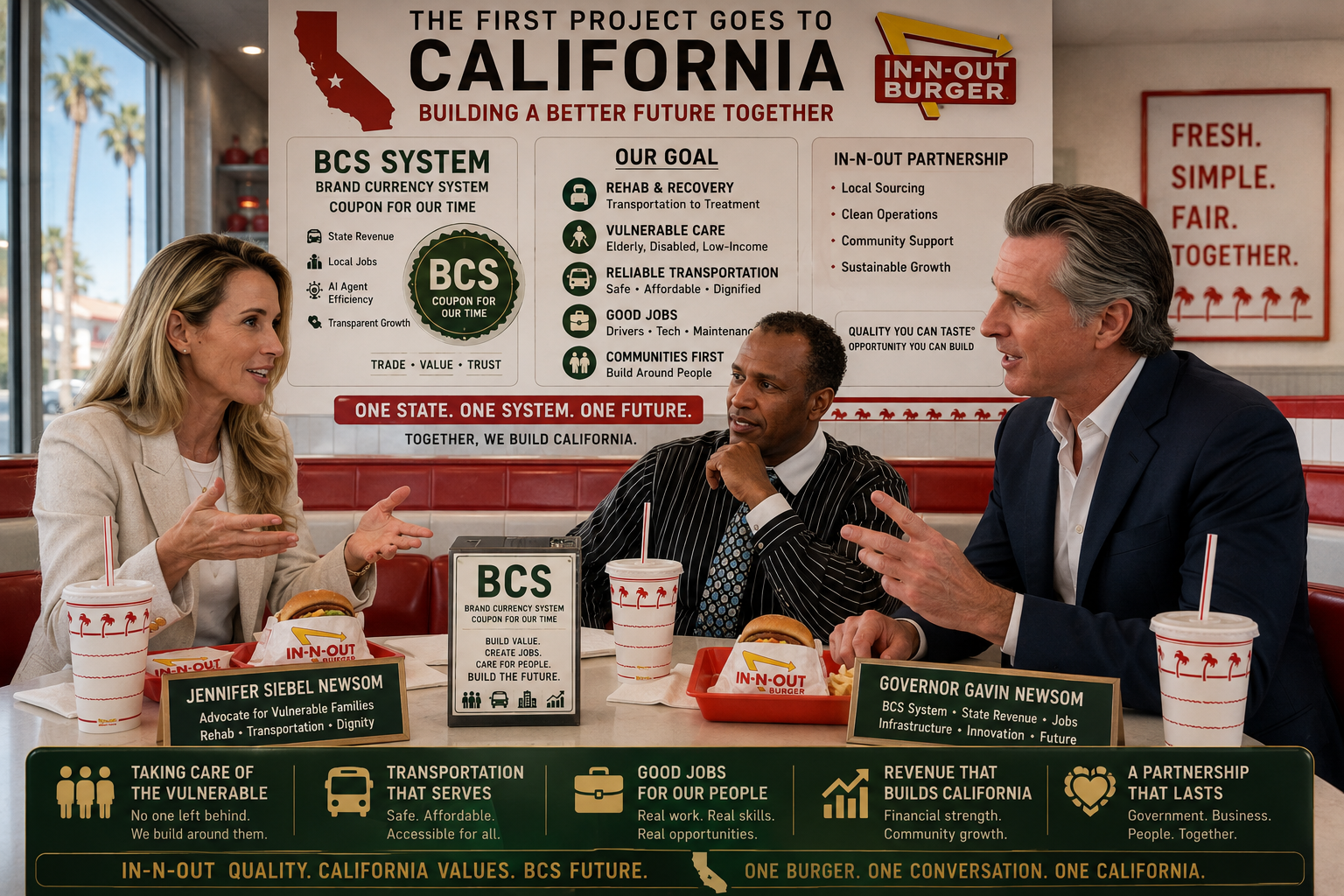
California: Where Project Zero Begins
California has long presented itself as a place where minority communities, immigrants, innovators, workers, and people whose voices are too easily overlooked can enter the conversation about what comes next. Its greatest strength has never been simply technology; it has been the willingness to experiment, listen, challenge established systems, and imagine something different.
That is the spirit in which I look toward California and its governor as Project Zero moves from an idea toward a conversation about a real transportation pilot. I want the first question to be about the people who need the system most: the vulnerable, people traveling to rehabilitation and treatment, low-income families, displaced workers, drivers facing automation, and communities that deserve to participate in the prosperity technology creates. We can generate revenue, create jobs, experiment with AI-assisted transportation, and build new infrastructure—but we should prove from the beginning that technological progress can serve people rather than simply financial speculation.
California does not have to accept my blueprint exactly as I have written it. That is the entire point of the Zero-Disagreement Standard. Bring the governor, communities, businesses, engineers, drivers, advocates, critics, and AI systems to the same table. Challenge the proposal. Improve it. Test it. Measure it. And allow the best ideas to survive.
I am looking forward to beginning that conversation.
Because the next chapter is about California—and whether we can demonstrate, starting with transportation, that machines can accelerate the future while humanity remains firmly in the driver's seat.
I'll be talking about that next.