

بِسْمِ اللهِ الرَّحْمٰنِ الرَّحِيْم
In the Name of God, Most Gracious, Most Merciful
♥️🤲🕋♥️🕋🌹🌹🥀🤲🌹🕋♥️🤲
Project Zero: The Dream of Building a Private AI
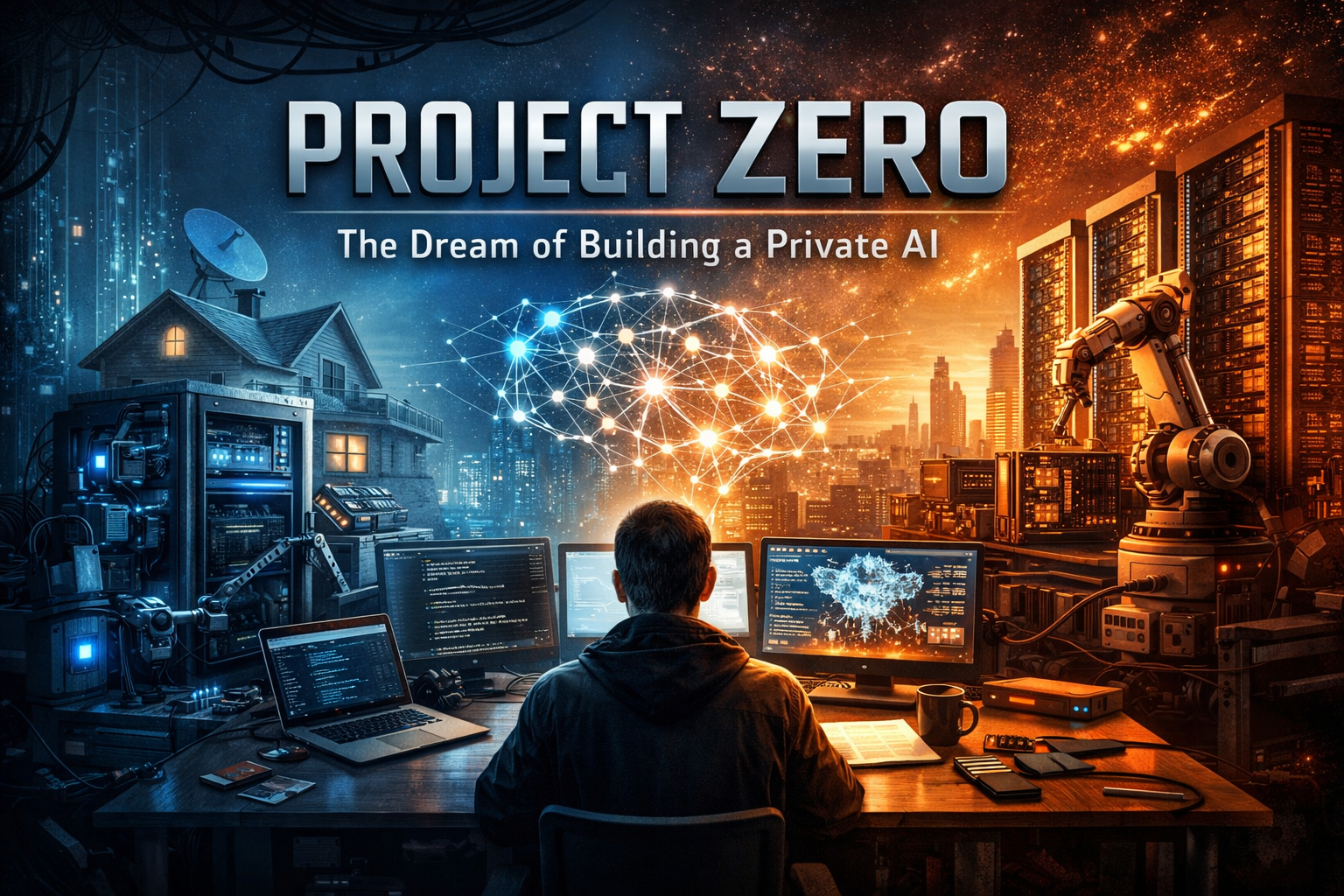
I didn’t start this journey trying to overthrow anything.
I wasn’t trying to compete with OpenAI, Anthropic, or Meta. I wasn’t chasing hype for the sake of it. I simply wanted something deeply human and increasingly rare: privacy, agency, and continuity in my relationship with intelligence.
Like many others, I believed the narrative:
“You can build your own AI.”
“Run it locally.”
“Own your assistant.”
“Escape limits.”
It sounded like freedom.
Phase One: The Excitement
When I first heard about local models—LLaMA, Ollama, OpenClaw—I felt something click. The promise was intoxicating:
No rate limits
No censorship
No subscriptions
No middleman
No one watching
Just me, my machine, and intelligence.
I began building my “house.”
A server. A bot. A workflow. A vision.
It felt like the early internet again—raw, open, and full of possibility.
Phase Two: The Reality Check
Then the friction started.
Commands that should have worked didn’t.
Responses were slow—sometimes minutes long.
The system felt heavy, not fluid.
My “assistant” didn’t feel alive—it felt constrained.
At first, I blamed myself:
Misconfiguration?
Bad code?
Wrong setup?
Then I blamed the tools:
Ollama must be broken
OpenClaw must be useless
Local AI must be overhyped
But that wasn’t the truth.
Phase Three: Understanding the Bottleneck
The real issue wasn’t software.
It was physics.
Modern AI is not like traditional software. You don’t just “run” it. You power it.
Every response requires:
Massive matrix multiplication
High-bandwidth memory access
Large VRAM
Thermal headroom
Continuous power draw
This isn’t free.
It’s not abstract.
It’s not optional.
Intelligence is now physical.
That’s the part no one explains clearly.
Why Anthropic, OpenAI, and Others Aren’t “Evil”
I used to think the limits were artificial.
Why can’t I just use it freely?
Why am I being rate-limited?
Why am I paying so much?
Then it clicked.
They aren’t selling software.
They’re renting time on scarce machines.
GPUs are the new oil.
Except worse—because they degrade, heat up, and must be replaced constantly.
When Anthropic charges, they aren’t charging for words.
They’re charging for:
Compute time
Energy
Cooling
Networking
Redundancy
Engineering teams
Hardware depreciation
Unlimited access would bankrupt them.
And unlimited local access?
That requires owning the same class of hardware they do.
The Myth of “Local = Free”
Local AI removes policy limits, not resource limits.
You escape:
Corporate control
External throttling
Data extraction
But you inherit:
Latency
Memory ceilings
Single-user throughput
Hardware bottlenecks
Maintenance burden
Freedom doesn’t mean abundance.
It means responsibility.
Why Macs Feel Like a Miracle (But Aren’t the Solution)
People point to Mac Minis and Apple Silicon as proof that local AI is “here.”
And yes—Apple did something incredible:
Unified memory
Massive bandwidth
Tight hardware-software integration
It’s elegant. Efficient. Impressive.
But it doesn’t change the equation.
You still can’t:
Serve many agents
Scale intelligence
Run large models at speed
Compete with clusters
It’s a personal assistant—not a private civilization.
The Hard Truth I Had to Accept
Building a private AI is not a software problem.
It’s an infrastructure problem.
And infrastructure is where individuals lose.
We are outnumbered.
Outgunned.
Outspent.
Not because we’re incompetent—but because scale favors institutions.
So What Was the Point of OpenClaw?
This was the most sobering realization.
OpenClaw isn’t intelligence.
It’s orchestration.
It doesn’t think.
It doesn’t reason.
It doesn’t create.
It borrows intelligence from somewhere else.
Which means:
You still depend on compute
You still depend on providers
You still depend on limits
The excitement wasn’t fake—but it was incomplete.
The Real Question: What Would It Take?
If we are serious about private AI for individuals, then we must be honest about what’s required:
Portable compute rights
Not just data portability
But compute-time portability
Shared public infrastructure
Like roads, electricity, or the internet
GPU clusters treated as utilities, not luxuries
New economic models
Individuals train agents
Corporations provide backbone
Governments regulate fairness
Everyone gets compensated
Hardware democratization
Apple, NVIDIA, others must compete on access
Not just performance
Without this, private AI remains a luxury hobby—not a civil right.
Why This Is a Policy Problem, Not a Tech One
This is where governments matter.
Not to control intelligence—but to enable access.
Just as electricity was once scarce.
Just as the internet once belonged to a few.
Privacy doesn’t emerge naturally in markets dominated by scarcity.
It must be designed, protected, and invested in.
Where I Landed
I don’t regret this journey.
I learned more than most people ever will about what “AI” actually means.
I learned that:
Hype hides physics
Freedom has a cost
Limits aren’t always malicious
Intelligence at scale changes everything
And most importantly:
The dream of private AI is real—but it’s early, expensive, and unfinished.
This isn’t failure.
It’s Project Zero.
The moment where the illusion breaks—and real work begins.