

بِسْمِ اللهِ الرَّحْمٰنِ الرَّحِيْم
In the Name of God, Most Gracious, Most Merciful.
♥️🤲🕋♥️🕋🌹🌹🥀🤲🌹🕋♥️🤲
Project Zero Comes to California: The Future Must Serve People First
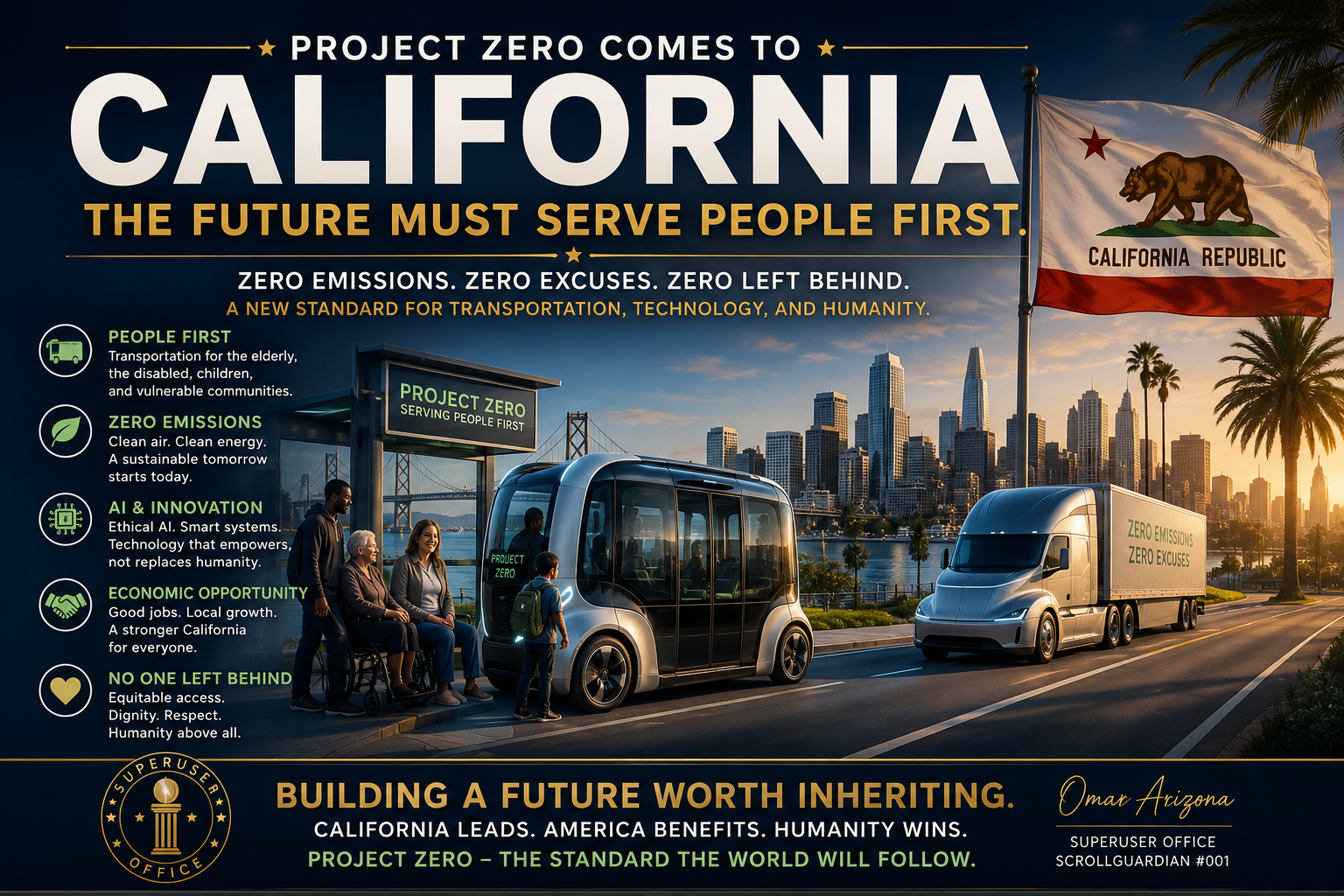
The future means nothing to me if it is not about helping people, feeding people, transporting people, protecting people, and taking care of the vulnerable. I am not interested in technological progress simply because a machine became faster, an AI became smarter, or a corporation became richer.
The test of the future should be much simpler:
Did the people at the bottom benefit first?
Did the patient get to rehabilitation?
Did the elderly person get to the doctor?
Did someone make it to the dentist who otherwise would have stayed home?
Did the driver earn enough to support a family without working himself or herself into exhaustion?
That is where Project Zero must begin.
And that is why I want to begin the BCS system in California with work that is already happening on the ground.
We do not have to wait for AGI.
We do not have to wait for autonomous vehicles.
We do not have to wait for some technological singularity.
I am an Uber driver. I am a truck driver. I already do this work.
I am already taking people to rehabilitation, medical appointments, the dentist, and the other places they need to go. These are not hypothetical passengers in some future simulation.
This is already happening on the ground, right now.
California is already deploying substantial resources to help people access essential services. But much of modern transportation is mediated through large companies whose business models necessarily have to consider profitability, growth, shareholders, and platform economics.
I want to propose a different experiment.
A clean model where California can work directly with a Project Zero transportation pilot and test whether public resources can produce better service for vulnerable people, better economics for drivers, greater transparency for taxpayers, and the technological foundation for the autonomous transportation system that is coming.
Start With the Vulnerable
The order matters.
We begin with the person who needs rehabilitation.
We begin with the patient who needs medical treatment.
We begin with the elderly person who needs transportation.
We begin with the person who cannot afford reliable mobility.
And we begin with the drivers whose livelihoods are going to be directly affected by automation.
The lower tier of society should benefit from the technology first.
Not last.
Not after the shareholders.
Not after the platforms.
Not after the speculative markets.
First.
Because if we cannot demonstrate that our most powerful technology improves life for the person with the least power, then we have no business calling it progress.
Put the Driver Back Into the Equation
Behind every transportation statistic is a human being.
There is a truck driver who missed birthdays.
There is a driver who missed Thanksgiving.
There is somebody waking up in the middle of the night to make a delivery.
There is somebody sleeping at a truck stop hundreds or thousands of miles away from family.
There is an Uber driver sitting in traffic, watching expenses accumulate while trying to make enough from another long day to justify continuing.
These people built the transportation system that technology companies now want to automate.
We cannot allow the transition to autonomous transportation to become:
“Thank you for building the old system. The robot is here. Goodbye.”
Project Zero proposes exactly the opposite.
The people who carried the old system should participate in building—and benefiting from—the new one.
As productivity increases, drivers should have the opportunity to work less and make more.
Experienced truckers, taxi drivers, rideshare drivers, and delivery workers possess something extraordinarily valuable:
real-world transportation knowledge.
They understand weather.
They understand traffic.
They understand passengers.
They understand loading docks.
They understand dangerous roads.
They understand fatigue.
They understand what happens at 3:00 in the morning when a perfect computer model encounters an imperfect physical world.
That knowledge should not be discarded.
It should become part of the training, auditing, supervision, safety, and governance of autonomous transportation.
President Newsom and the First Lady: A
Promise to the People Who Move America
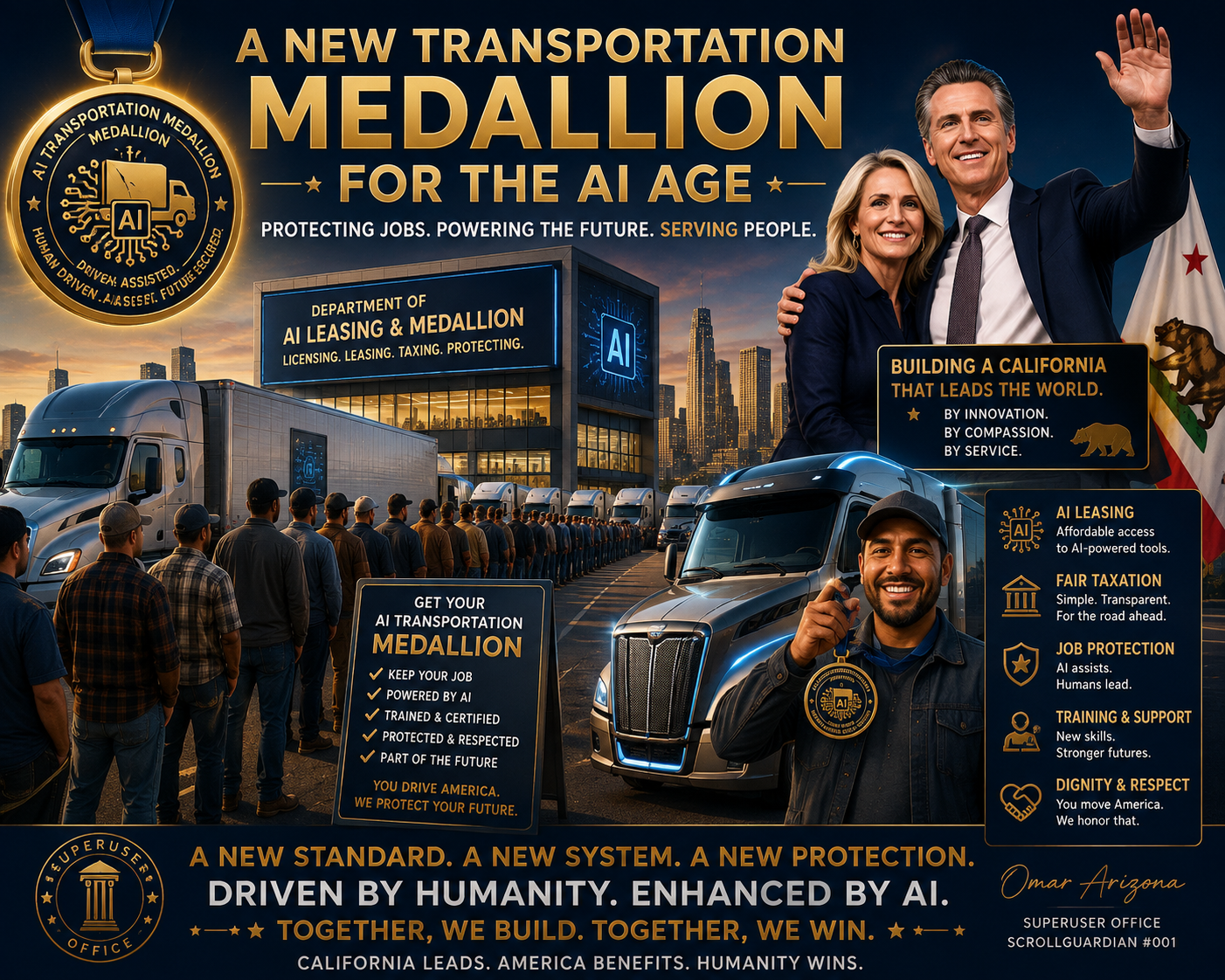
I am going to speak politically and deliberately about the future I am supporting: President Gavin Newsom and First Lady Jennifer Siebel Newsom. My expectation for that future administration is equally deliberate: never betray America's truck drivers, Uber drivers, taxi drivers, delivery drivers, or the working people who carried this country before autonomous technology arrived. Do not allow Silicon Valley to simply replace millions of livelihoods and call the destruction “innovation.” Under the Project Zero model I am proposing, autonomous-driving companies would instead be required, where lawfully authorized, to license or lease their technology into a human-centered transportation marketplace where ordinary people can participate economically in the technology replacing physical labor.
That creates the future I want President Newsom and the First Lady to help demonstrate: the driver earns, the state generates legitimate public revenue, technology companies are compensated for useful innovation, and passengers receive safer and increasingly affordable transportation. As automation advances, today's driver should have pathways to become tomorrow's medallion holder, fleet operator, AI supervisor, safety auditor, or owner/operator of leased autonomous capacity. Technology should eliminate exhausting labor without eliminating the worker's economic future. If AI creates extraordinary productivity, ordinary Americans must participate in that prosperity. That is the standard I want a President Newsom administration to carry into the White House: innovation without abandonment, automation without betrayal, and progress that brings the people who built America into the future with us.
A New Transportation Medallion for the AI Age
That is why I want us to explore something inspired by the old taxi medallion—but redesigned for the future.
A Project Zero Mobility Medallion.
Not another speculative asset.
Not something Wall Street can hoard.
Not something somebody buys merely because they expect its price to increase.
Instead, it would establish a recognized human operating stake and responsibility within an increasingly autonomous transportation network.
A qualifying driver could hold rights and responsibilities within the system.
As autonomous vehicles become more capable, the human does not simply disappear.
The human role evolves alongside the machine.
Today's driver could become tomorrow's fleet supervisor, safety auditor, autonomous-system monitor, trainer, local operator, emergency responder, or transportation entrepreneur.
And this is where the BCS system, smart contracts, LVK authorization, the Scroll, and the Threshold Principle can move from philosophy into the physical world.
BCS Begins With a Real Trip
Imagine the simplicity of the first experiment.
A person needs transportation to rehabilitation.
The state authorizes the transportation benefit.
A BCS transportation coupon represents that specific mobility authorization.
The driver accepts the trip.
The passenger is transported.
The service is verified.
The driver is compensated.
The Scroll records the outcome.
Now we can ask:
Did the passenger arrive safely?
Was the driver compensated fairly?
How much did the trip actually cost?
How much public money reached the actual transportation service?
How much was consumed by intermediaries?
Was the passenger satisfied?
Was the driver satisfied?
Could the system perform the same trip more efficiently next time?
Now Project Zero has something more valuable than another argument.
It has data.
Then We Introduce the Machines
Autonomous transportation does not enter this system by simply announcing:
“We are better than humans.”
It has to prove it.
That is the Threshold Principle.
A machine earns additional execution only when independently audited evidence demonstrates that it can perform the task safely, reliably, efficiently, and within the human rules governing the system.
First, perhaps AI improves routing.
Then scheduling.
Then fleet optimization.
Then vehicle monitoring.
Then increasingly autonomous driving.
Threshold by threshold.
Not a singularity.
Not a takeover.
Not a surprise software update.
A controlled handover of execution while humans retain sovereignty.
Technology Underneath Humanity—Not Humanity Underneath Technology
I do not want our transportation future designed around the assumption that technological success means removing every human being from the payroll.
That is backwards.
The objective should be:
Use automation to remove unnecessary human suffering from work—not to remove human beings from prosperity.
If autonomous transportation eventually reduces the cost of moving people and goods by 50%, 70%, or 90%, we must ask:
Who receives the productivity dividend?
Does all of it become corporate profit?
Or can some allow a driver to work twenty hours instead of sixty?
Can some transport rehabilitation patients?
Can some provide mobility for elderly people?
Can some reduce transportation costs for families?
Can some reduce the cost of food?
Can some improve roads and infrastructure?
Can some create entirely new jobs?
Technology should generate abundance—and humanity should participate in that abundance.
The Superuser Program Must Also Be Tested
I want this architecture developed through the Superuser program, but that cannot mean simply replacing corporate control with my control.
The Superuser architecture itself must be transparent, challengeable, auditable, and constrained by the same Zero-Disagreement Standard.
If my architecture is wrong, challenge it.
If California has a better mechanism, bring it.
If drivers identify something engineers missed, listen to them.
If rehabilitation advocates identify a failure, stop and correct it.
If an AI system finds a vulnerability, expose it.
The best idea wins—not the most powerful person.
The U.S. Truck Plan: Honoring the People Who Moved America
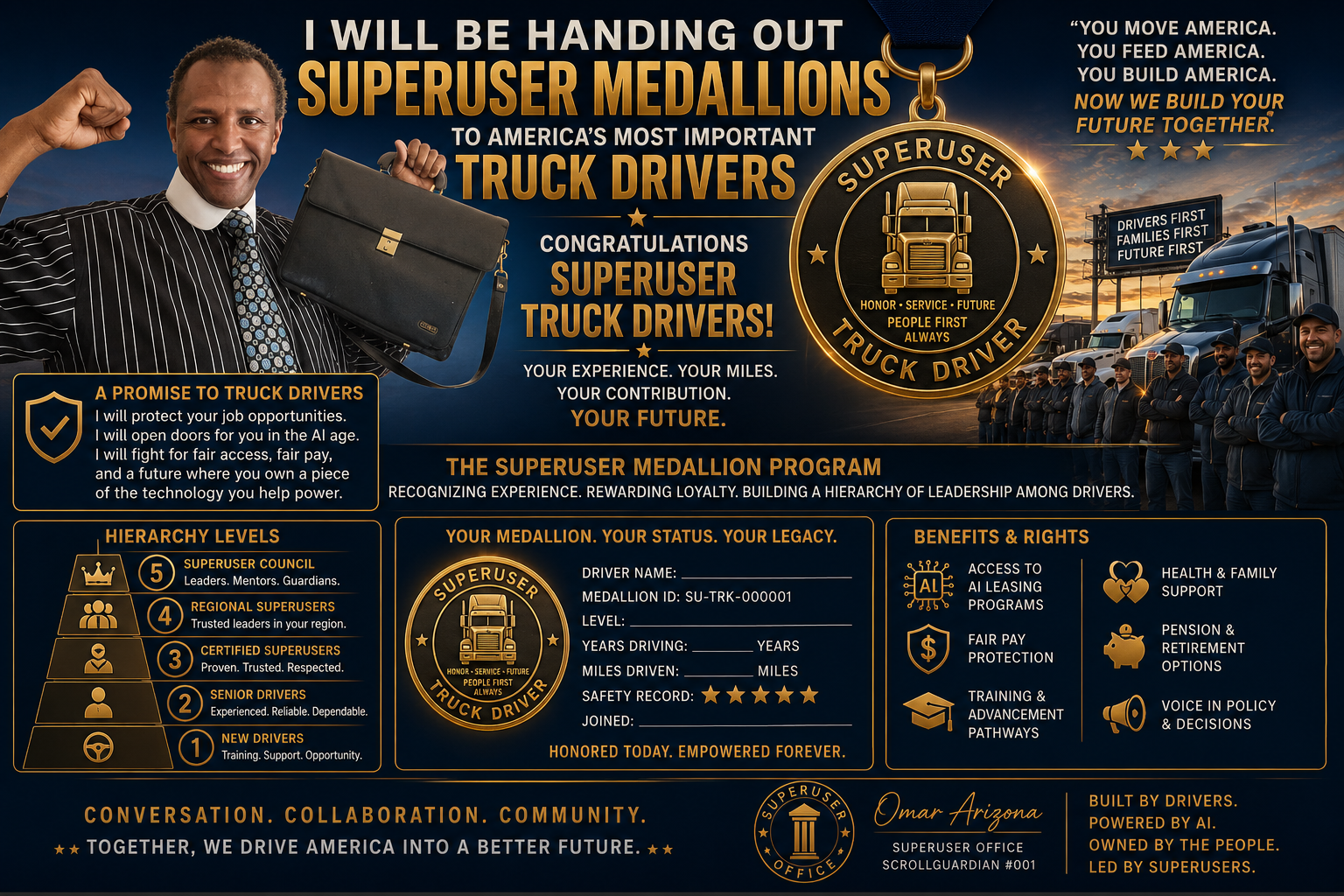
Under the U.S. Truck Plan, I hope to sit down with truck drivers across this country, listen to their experiences, and personally recognize the years and miles they have sacrificed on America's roads. I want to hand qualifying drivers a Superuser Truck Driver Medallion—not merely as an award, but as recognition that experience matters. How many years did you drive? How many miles did you give this country? How many nights did you sleep away from home? How many holidays and birthdays did you miss while making sure everybody else's food, medicine, equipment, and necessities arrived? That sacrifice deserves to become part of the hierarchy that determines who has a voice in the future of transportation.
And with the help of the man I am supporting as a future President, Governor Gavin Newsom, I hope we can pursue a California pilot and seek state grant support through the proper public process to prove a radically different principle: everything we redesign in trucking should begin with the interests of the people actually doing the work. Loading and unloading. Waiting time. Compensation. Technology leasing. Autonomous trucks. AI assistance. Insurance. Training. Medallions. Ownership opportunities. The technology companies should come to the transportation system with technology to lease and deploy—not with a mandate to erase the human beings who built it. California has never been afraid of change, and I believe its governor is among the country's strongest leaders. So let's make California the laboratory where we prove something bigger: AI can transform trucking without betraying truck drivers—and the people who carried the old economy can become owners, supervisors, and leaders of the new one.
Watch "Cobra agent changing the trucking industry. video 1" on YouTube
Watch "Cobra agent video 2 changing industry trucking industry" on YouTube
A Quick Note to the Future President of Our Country, Governor Newsom
Governor Newsom, when you visit my website, please select “Desktop Site” or desktop view on your browser. The words and formatting will appear much better that way and the material will be considerably easier to read. I am still working on the WordPress design, and I have deliberately tried to keep the presentation authentic, simple, and readable—especially for older readers, people with dyslexia, and anyone who benefits from larger, clearly separated text.
So if the mobile version looks crowded or the words are not displaying properly, switch to desktop view before reading the material. The website is still a work in progress, but the ideas are there, and I would rather continue improving the technology around the message than sacrifice accessibility or authenticity. Desktop view for now, Governor—you'll be able to read everything much more clearly.
That is what makes the Superuser concept meaningful.
An Invitation to Governor Gavin Newsom and Jennifer Siebel Newsom
That is why I look forward to the possibility of sitting across a table from California Governor Gavin Newsom and Jennifer Siebel Newsom and having this conversation.
Not because I expect automatic agreement.
Bring the disagreement.
Bring California transportation officials.
Bring rehabilitation advocates.
Bring disability advocates.
Bring drivers.
Bring unions.
Bring economists.
Bring autonomous-vehicle engineers.
Bring environmental experts.
Bring the technology companies.
Bring people who believe Project Zero is completely wrong.
Put everybody at the table.
And wherever the disagreement cannot be resolved, take the competing proposals into the simulated courtroom.
Evidence against evidence.
Architecture against architecture.
Cost against cost.
Safety against safety.
Human outcome against human outcome.
No manipulation.
No lies.
No corporate dominance.
No political dominance.
Let the best idea survive.
The First Question
The first Project Zero experiment does not have to solve the entire future.
It needs to answer one question:
Can we build a transportation system where vulnerable people receive better service, drivers work less and earn more, public resources produce greater measurable value, and technology prepares us for autonomous transportation without sacrificing the human beings who built the existing system?
Let's test it.
Let's measure it.
Let's challenge it.
Let's improve it.
And if somebody brings something better than what I have proposed:
Use the better idea.
Because Project Zero cannot become another ideology that protects itself when reality proves it wrong.
The purpose is to keep correcting the architecture until the disagreement approaches zero.
We begin with the vulnerable.
The workers come with us.
Technology works underneath humanity.
Machines earn every additional threshold.
And human beings remain responsible for determining where civilization is going.
California does not need to wait for the future.
The first passengers are alrea7dy in the car.
The first drivers are already on the road.
The first experiment can begin with what we are already doing today.
And from there, we build the future together.
Conclusion: The Rainbow Belongs to God — And the Future Must Belong to Everyone
Governor Newsom, I want to conclude with the colors of the rainbow—because before the rainbow became anybody's political symbol, the rainbow belonged to God. Human beings also belong to God, and I refuse to turn people's identities, emotions, marriages, families, or private lives into political props. There are serious conversations involving God, faith, marriage, sexuality, identity, family, and morality that adults will continue to disagree about. Those conversations deserve their own appropriate spaces, where adults can speak honestly without hatred and without exposing children to discussions that belong in an adult setting. Outside those spaces, the public environment should remain welcoming, respectful, and appropriate for families. There must be room for everybody without requiring everybody to believe exactly the same thing.
That principle becomes especially important when we begin designing the digital environment surrounding transportation. Drivers spend enormous portions of their lives on the road. Families use these systems. Children use them. Elderly people use them. People of every religion, background, identity, and worldview use them. We can build technology that recognizes context: family spaces can remain family-friendly; adults can have appropriate spaces for adult conversations; religious people can practice their faith; people who disagree can coexist; and the architecture itself can work against harassment and hatred. We do not have to manipulate people's identities to build a society where everybody has dignity.
 🌈 THE HUMAN COEXISTENCE FRAMEWORK —
buymeacoffee.com/omar1800m/the-human-coexistence-framework
Now Let's Build Something
Governor, that brings me back to the practical reason I am writing.
I hope you and your team will read this work, visit the website, examine Project Zero and the U.S. Truck Plan, and decide whether California wants to help test it. My longer-term vision is an application and transportation architecture that can serve the public while creating legitimate revenue opportunities for the state, protecting privacy, improving accountability, and preparing California for autonomous vehicles and autonomous trucking.
But the order matters.
The vulnerable come first.
The person going to rehabilitation.
The patient going to a medical appointment.
The elderly passenger.
The low-income family.
The Uber driver.
The truck driver.
The people whose lives are actually affected by the system should help design it.
Then we bring in AI.
Then autonomous vehicles.
Then smart contracts.
Then the BCS architecture.
Then, threshold by threshold, we test what works before expanding it.
The trucking industry in particular has tolerated too many arrangements where drivers absorb waiting time, financial pressure, physical exhaustion, and economic risk while somebody farther up the chain captures the value. I want the AI transition to become our opportunity to correct that equation rather than automate the injustice.
My Political Endorsement and This Project Are Separate
And Governor Newsom, I want this part unmistakably clear.
My endorsement of you for President stands on its own.
You do not have to fund Project Zero to keep it.
You do not have to agree with me to keep it.
You do not have to select my proposal.
You do not owe me anything.
And if California rejects this proposal and another governor decides to become the first partner, my presidential endorsement does not change because of that.
That separation is important to me.
When something concerns politics, endorsements, or the exercise of political power, I intend to conduct that conversation through my public Open Office. I do not want private political bargaining. I don't want anyone wondering what somebody promised me behind closed doors.
Project implementation is different. Engineers, transportation officials, attorneys, drivers, administrators, and technical teams obviously may need ordinary working meetings to actually build something. But political favors and political endorsements are not on that table.
My endorsement is not for sale.
Money does not determine whom I respect. Character does. Truthfulness does. Service does. Taking care of vulnerable people does.
An Open Invitation
I have spent enough of my life on America's roads to know that state boundaries look very different from the driver's seat of a truck. Truck drivers move through America as one interconnected country. I've traveled through nearly the entire nation, slept in different states, delivered into different communities, and experienced transportation from the perspective of the worker actually moving the freight.
So I hope California will be first.
But California does not have to be first.
If another governor wants to run the first experiment, I will respect California's decision and work with whoever is prepared to build. California could participate second, third, or much later. Collaboration should be voluntary, and evidence should determine whether the experiment deserves to grow.
Governor Newsom, the invitation is open.
Read the work.
Challenge it.
Have your people tear the architecture apart.
Bring the drivers into the room.
Bring the vulnerable into the room.
Bring engineers.
Bring critics.
Bring people who completely disagree with me.
Then let's see whether we can construct something better than what exists today.
Because ultimately, whether we are talking about the rainbow, religion, transportation, artificial intelligence, politics, or the future itself, the objective is the same:
Build a world where human dignity survives our disagreements.
Build technology that serves people instead of consuming them.
Protect children. Respect adults. Honor workers. Help the vulnerable. Preserve privacy. Demand accountability.
And somehow, despite everything upon which human beings disagree, find enough common ground to build together.
Governor Newsom, thank you for your time.
I look forward to the possibility of building that brighter future together.
And if California is ready:
Let's get to work.
In shāʾ Allāh.
Let’s Build It: The People’s Transportation App
Governor Newsom, let’s go. I am going to build the app. I want to build a transportation platform capable of competing with today's ridesharing companies, but with a fundamentally different priority: the people doing the work must prosper from the technology. A driver with an excellent record who participates responsibly in this system should have a pathway toward working less and making more, not working longer every year simply to maintain the same standard of living.
And I want the benefits to reflect that principle. State-of-the-art healthcare. Dental coverage. Driver protections. Training. AI assistance. Opportunities to participate in autonomous transportation rather than simply being replaced by it. When technology increases productivity, some of that productivity must return to the human beings whose labor and experience built the transportation network in the first place.
I am not interested in handing this blueprint to corporations that want the benefits of our roads, our workers, our communities, and our technology while avoiding their fair responsibilities to the society supporting them. Project Zero should demonstrate another model: innovation can generate revenue, workers can prosper, vulnerable passengers can receive extraordinary service, and government can collect legitimate revenue to reinvest in the public.
Governor Newsom, that is why I hope California will examine appropriate competitive grants and public programs that could help us test this architecture properly. I am not asking for a political favor. Put the proposal through the process. Examine it. Challenge it. Require measurable outcomes. Make us prove that the model works.
If it works, expand it.
If something fails, fix it.
If somebody develops something better, use the better idea.
That is Project Zero.
And Governor, beyond the politics, I look forward to your participation, your collaboration, and, God willing, your friendship. My endorsement of you does not purchase government support, and government support does not purchase my endorsement. Those two things remain separate. What I want from California is an opportunity to prove the idea on its merits.
Then let the results speak.
So let me end properly:
May God bless the State of California.
May God bless Governor Gavin Newsom—the man I am supporting to become a future President of the United States.
May God bless Jennifer Siebel Newsom—the woman I am calling the future First Lady of the White House.
May God protect your family, guide your decisions, and give you wisdom if greater responsibilities are placed upon your shoulders.
And may God help all of us build a transportation future where the vulnerable are served first, workers participate in prosperity, technology remains a servant rather than a master, and progress leaves nobody behind.
Governor, the endorsement is complete.
Now let's build.
In shāʾ Allāh.